
The 5 Love Languages: The Secret to Love That Lasts study guide · Lesson 4 of 7
Lesson 4: Love Language #3 — Receiving Gifts
4.1 Visual Symbols of Love & Thoughtfulness · 4.2 The Gift of Self & The Investment Mindset
Unofficial study guide for The 5 Love Languages: The Secret to Love That Lasts by Gary Chapman. FlashFeed is not affiliated with the author or publisher.
This is the lesson's study guide from the FlashFeed app, plus its key facts and a self-test.
What you'll be able to do
- Identify gifts as tangible visual symbols of love and understand why thoughtfulness supersedes monetary cost.
- Apply the Gift of Self in times of crisis and reframe gift-giving as a high-yield relational investment.
Monograph Section: Lesson 4 of The 5 Love Languages: The Secret to Love That Lasts by Dr. Gary Chapman.
Executive Overview
Analyzes gifts as tangible visual representations of love and affection, establishes why monetary cost is secondary to thoughtful intentionality, introduces the profound concept of the 'Gift of Self' through physical presence in times of crisis, and explores how shifting from a strict saver mindset to an emotional investment framework unlocks genuine generosity.
Visual Symbols of Love & Thoughtfulness
Conceptual Foundations: Receiving Gifts, Visual Symbols of Love, Tangible Anchors of Affection, Anthropological Universality of Gift-Giving
Core Insight: A gift is something you can hold in your hand and say, 'Look, he was thinking of me,' serving as a tangible visual symbol of love.
For a gift-oriented individual, physical objects serve as enduring visual evidence that they were held in their partner's thoughts and heart.
Core Insight: Gift-giving is an anthropological universal found across virtually every culture throughout human history.
From indigenous tribal ceremonies to modern societies, the presentation of physical gifts is a universal ritual signifying honor, affection, and alliance.
Core Insight: The monetary cost of a gift is completely irrelevant; what matters is the thought, effort, and affection it represents.
A wild flower picked on a morning walk, a folded paper bird, or a homemade card carries equal or greater emotional value than a costly luxury item.
Core Insight: Visual symbols of love, such as wedding rings, provide daily physical reminders of enduring relational commitment.
A wedding ring or cherished token worn on the body acts as an ongoing visual anchor, continuously affirming connection and belonging.
Core Insight: Found gifts—such as an unusual sea shell, an interesting smooth stone, or an autumn leaf—serve as zero-cost visual expressions of love.
Found objects demonstrate that even in the middle of routine daily activities, the thought of the partner was vividly present in your mind.
Core Insight: Handmade gifts represent a personal investment of creative energy and time, communicating profound emotional devotion.
Crafting something with one's own hands requires focused intentionality, making the resulting artifact a unique expression of devotion.
Core Insight: For someone whose primary love language is Receiving Gifts, a forgotten birthday, anniversary, or special occasion feels like an emotional betrayal.
Because gifts are their primary emotional meter, the absence of a token on meaningful dates is interpreted as a total absence of love and care.
Core Insight: Maintaining a dedicated 'Gift Idea Notebook' to record items your spouse mentions admiring ensures you are always prepared with thoughtful presents.
Proactively logging spousal preferences removes guesswork and shows that you listen attentively to their casual everyday remarks.
Core Insight: Gifts need not be reserved only for formal holidays; spontaneous, unexpected gifts often carry the greatest romantic surprise.
An unexpected gift delivered on a random Tuesday carries zero social obligation, highlighting pure, spontaneous affection.
Core Insight: Receiving a gift that is poorly chosen or obviously self-serving can communicate that the giver does not truly know or understand their spouse.
Gifts must reflect the recipient's tastes and desires; self-interested purchases reveal a lack of empathy and care.
Core Insight: Presenting a gift with beautiful wrapping and a handwritten card amplifies the emotional impact of the gesture.
Careful packaging signals that the gift was prepared with unhurried devotion, heightening anticipation and emotional appreciation.
Core Insight: Children often express their natural love language by giving parents drawings, small rocks, or wild dandelions they gathered.
Children intuitively grasp that offering a physical object is a tangible way to transfer affection from their heart to their parent's hands.
Core Insight: Learning to receive a gift with enthusiastic gratitude and delight is just as vital as learning to give one.
A dismissive response ('Why did you spend money on this?') penalizes the giver's attempt to speak love and discourages future efforts.
Core Insight: Gifts are among the easiest love languages to learn because concrete objects can be bought, found, or crafted regardless of innate personality.
Unlike emotional conversational styles which require deep psychological shifting, gift-giving simply requires organizational habits and execution.
Core Insight: A house filled with meaningful visual symbols of love becomes a living physical gallery of a couple's shared journey and devotion.
Surrounding oneself with physical tokens of shared history constantly reinforces feelings of emotional security and mutual belonging.
The Gift of Self & The Investment Mindset
Conceptual Foundations: The Gift of Self, Physical Presence in Times of Crisis, Intangible Gifts, The Saver Mindset vs. Emotional Investment
Core Insight: The 'Gift of Self'—being physically present with your spouse in times of crisis, grief, or major life milestones—is an intangible gift of supreme value.
In moments of severe grief, surgery, childbirth, or tragedy, physical presence communicates unwavering solidarity and profound emotional commitment.
Core Insight: Physical presence in a moment of crisis speaks far louder to a spouse than any words, cards, or material compensation ever could.
When catastrophe strikes, abandoning routine duties to stand beside your partner embodies absolute loyalty and sacrificial devotion.
Core Insight: If your physical presence is requested during a significant personal event, failing to attend leaves an indelible emotional scar.
Refusing a direct plea for presence in a vulnerable moment is viewed as an abandonment of the foundational marital covenant.
Core Insight: Individuals with a natural 'saver' financial personality often struggle with gift-giving because spending money triggers acute emotional anxiety.
Savers derive security from accumulated reserves; spending on non-essential items feels dangerous unless their mindset is consciously reframed.
Core Insight: A natural saver must reframe spending money on gifts not as an expense, but as a high-yield investment in their spouse's emotional security.
Purchasing a gift is an investment in marital harmony and stability, which pays far higher life dividends than idle cash sitting in a bank account.
Core Insight: Money is simply a tool for living and loving; hoarding it at the expense of a spouse's emotional well-being is a tragic misuse of resources.
Financial prudence becomes destructive when it degenerates into stinginess that suffocates spousal joy and relational warmth.
Core Insight: The Gift of Self requires clearing your schedule and setting aside personal hobbies when your partner faces an emotional emergency.
Authentic love holds schedules loosely, ready to pivot instantly when a partner requires emotional rescue or companionship.
Core Insight: Giving a gift to a spouse should never be accompanied by complaints about the price or lectures on financial austerity.
Complaining about cost transforms a loving gesture into a guilt-laden burden, leaving the recipient feeling ashamed rather than cherished.
Core Insight: Experiential gifts—such as tickets to a concert, a weekend trip, or a cooking class—combine Receiving Gifts with Quality Time.
Gifting shared experiences satisfies the desire for a thoughtful presentation while generating long-term relational bonding.
Core Insight: Establishing a dedicated monthly 'Gift Budget' allows natural savers to spend freely without feeling financial guilt.
Budgeting legitimizes gift expenditures for disciplined spenders, transforming gift-buying into an authorized, guilt-free mission.
Core Insight: Giving a small gift of favorite food, coffee, or a sweet treat during a stressful workday provides a tangible midday emotional boost.
Midday surprise deliveries interrupt daily workplace stress with a warm injection of love and reassurance.
Core Insight: A gift given as an attempt to 'buy forgiveness' after an unrepentant betrayal is perceived as bribery, not love.
Material items cannot substitute for moral ownership, authentic apology, and behavioral change following relational harm.
Core Insight: Children who receive thoughtful, unselfish gifts learn the joy of generosity and develop a healthy, non-materialistic perspective on possessions.
Framing gifts as vehicles of love rather than consumer entitlements cultivates gratitude and generosity in developing children.
Core Insight: The Gift of Self includes being emotionally accessible and engaged, not merely sitting as a silent physical presence.
True presence requires active emotional attunement, eye contact, and empathetic responsiveness to the partner's distress.
Core Insight: Consistently speaking the language of Receiving Gifts transforms material objects into sacred milestones of an enduring love story.
Over a lifetime, these visual symbols stand as enduring physical witnesses to decades of mutual faithfulness and devotion.
Key terms
- Visual Symbol of Love
- A tangible physical object that serves as enduring visual evidence that you were held in your partner's thoughts and affection.
- The Gift of Self
- The supreme intangible gift of being physically present with your spouse during moments of crisis, grief, or major milestones.
Key facts
Visual Anchors of Commitment
Physical objects worn on the body—such as wedding rings—that provide daily tangible reminders of mutual covenant vows.
Spontaneous, Everyday Gifts
Gifts need not be reserved only for formal holidays; spontaneous, unexpected gifts often carry the greatest romantic surprise.
Childhood Dandelion Gifts
The intuitive childhood practice of picking wild dandelions to present parents with tangible symbols of affection.
A Living Gallery of Love
A house filled with meaningful visual symbols of love becomes a living physical gallery of a couple's shared journey and devotion.
The Saver Financial Personality
Individuals who derive emotional security from accumulating savings and experience anxiety when spending on discretionary gifts.
Money as a Tool for Loving
Money is simply a tool for living and loving; hoarding it at the expense of a spouse's emotional well-being is a tragic misuse of resources.
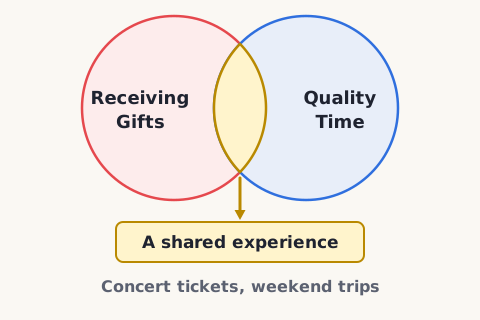
Experiential Gifting
Gifting shared experiences—such as concert tickets or weekend trips—that bridge Receiving Gifts with Quality Time.
Gifts as Sacred Milestones
Consistently speaking the language of Receiving Gifts transforms material objects into sacred milestones of an enduring love story.
Matched pairs
Each item on the left goes with the one on the right.
- Handmade Crafted Gift
- Embodies a direct investment of personal time, creativity, and energy
- Enthusiastic Gratitude and Delight
- Validates the giver's love and encourages future joyful generosity
- Attending a Business Meeting Instead of a Spouse's Crisis
- Communicates that business career is more valuable than your partner's soul
- Midday Specialty Coffee Delivery at Work
- Communicates that your partner is on your mind even during busy work hours
Step by step
How to maintain a Gift Idea Notebook for your spouse
- Keep a small pocket notebook or digital notes file dedicated to your partner.
- Listen attentively during everyday conversations and shopping outings.
- Immediately record specific items, books, foods, or colors they admire.
- Consult the notebook before anniversaries, birthdays, or spontaneous gift days.
How a natural saver can establish a guilt-free monthly Gift Budget
- Review monthly discretionary income during domestic budget planning.
- Allocate a dedicated line item specifically labeled for spousal gifts and love expressions.
- Designate the allocated funds as completely spent upon budget authorization.
- Purchase thoughtful items from your gift notebook with total joy and financial peace.
Self-test
Answer each question from memory, then check your work against the answer key.
1. What does a gift represent for someone whose love language is Receiving Gifts?
- AA record of favors owed
- BA financial safety net for the future
- CA tangible symbol of being thought of
- DA public display of social status
2. Which is NOT an example of a zero-cost 'found' gift?
- AAn autumn leaf
- BA gift card
- CA smooth stone
- DA wild flower
3. Compared to a costly luxury item, what does the lesson say about a wildflower picked on a walk?
- AIt carries measurably less emotional value
- BIt cannot be considered a real gift
- CIt only counts as a gift from children
- DIt can carry equal or greater emotional value
4. A partner wears their wedding ring every day. What function does the lesson say this serves?
- AA visual anchor for commitment
- BA superstition against bad luck
- CA workplace dress requirement
- DA display of financial status
5. What matters more than a gift's monetary cost?
- AThe brand reputation of the item
- BHow recently it was purchased
- CThe thought and effort behind it
- DThe physical size of the item
6. What does the lesson call being physically present with your spouse during a crisis or milestone?
- AThe Saver Financial Personality
- BThe Gift of Self
- CA Visual Symbol of Love
- DExperiential Gifting
7. Which choice sends the message that career matters more than your partner?
- AA meeting over a spouse's crisis
- BWorking late during a normal week
- CAnswering a work email on vacation
- DTaking a scheduled business trip
8. What does giving the Gift of Self require you to be willing to do?
- AWait for a more convenient time to respond
- BDelegate emotional support to someone else
- CKeep your schedule fixed no matter what
- DDrop non-essential routines during an emergency
9. How does the lesson describe someone with a 'Saver' financial personality?
- AAnxious about spending on discretionary gifts
- BProne to impulsive luxury purchases
- CUninterested in receiving any gifts
- DAnxious about having too much in savings
10. What kind of gift does the lesson say bridges Receiving Gifts with Quality Time?
- AA handwritten card with a gift
- BA found object like a smooth stone
- CExperiential gifts like trips
- DA midday coffee delivered to work
Go deeper
- ReadThe 5 Love Languages by Gary Chapman · on Amazon ↗
- StudyThe 5 Love Languages: The Secret to Love That Lasts in the FlashFeed app
These are affiliate links: if you buy a book through one, FlashFeed may earn a small commission at no extra cost to you. The commission helps pay for FlashFeed's servers.
As an Amazon Associate we earn from qualifying purchases.
Answer key
- 1. C A tangible symbol of being thought ofGifts are visual symbols of love and of being held in a partner's thoughts, not financial or status markers.
- 2. B A gift cardWild flowers, stones, and leaves are free found gifts; a store gift card is purchased, not found.
- 3. D It can carry equal or greater emotional valueA wild flower or handmade card can carry equal or greater emotional value than a costly item.
- 4. A A visual anchor for commitmentWorn items like wedding rings are visual anchors that provide daily reminders of relational commitment.
- 5. C The thought and effort behind itThe monetary cost of a gift is irrelevant compared to the thought and effort it represents.
- 6. B The Gift of SelfPhysical presence during crisis or milestones is called 'The Gift of Self.'
- 7. A A meeting over a spouse's crisisThe lesson specifically states choosing a business meeting over a spouse's crisis communicates career is valued more than the partner.
- 8. D Drop non-essential routines during an emergencyThe Gift of Self requires schedule flexibility to drop non-essential routines when an emotional emergency strikes.
- 9. A Anxious about spending on discretionary giftsSavers derive security from accumulated savings and feel anxiety when spending on discretionary gifts.
- 10. C Experiential gifts like tripsExperiential gifts, such as concert tickets or weekend trips, bridge Receiving Gifts with Quality Time.
Sources
- The 5 Love Languages: The Secret to Love That Lasts — Gary Chapman
- The 5 Love Languages - Chapter 6
Image credits
- Experiential Gifting: FlashFeed original diagram · CC-BY-4.0