
Getting to yes study guide · Lesson 1 of 6
Beyond Positional Bargaining & The Principled Method
The Pitfalls of Positional Bargaining · The Four Pillars of Principled Negotiation
Unofficial study guide for Getting to Yes: Negotiating Agreement Without Giving In (3rd ed.) by Roger Fisher, William Ury, Bruce Patton. FlashFeed is not affiliated with the author or publisher.
This is the lesson's study guide from the FlashFeed app, plus its key facts and a self-test.
What you'll be able to do
- Explain why positional bargaining yields unwise agreements, how a soft bargainer loses to a hard one, and why coalition positions resist revision.
- Name principled negotiation's four pillars (people, interests, options, criteria) and the three universal benchmarks: wise agreement, efficiency, relationship.
The Pitfalls of Positional Bargaining
In everyday life, corporate commerce, legal conflicts, labor disputes, and international diplomacy, negotiation is most frequently conducted through positional bargaining. In this traditional method, each participant stakes out an explicit, concrete position (such as a specific dollar demand, a rigid contract term, or a fixed territorial boundary), defends that position with aggressive argumentation, and makes reluctant, incremental concessions to achieve an eventual compromise. Whether observing consumers haggling with merchants over antique rugs, corporate attorneys negotiating an acquisition, or diplomats debating treaties at the United Nations, the mechanics of positional bargaining remain pervasive across human institutions.
However, decades of negotiation practice and case work at the Harvard Negotiation Project demonstrate that positional bargaining suffers from severe structural flaws. The foremost problem is that arguing over positions produces unwise agreements. When negotiators take positions, their personal egos become inextricably intertwined with their stances. As Roger Fisher and William Ury observed, the more you clarify your position and defend it against attack, the more committed you become to it. Your psychological desire to save face, defend turf, and avoid the appearance of surrender makes backing down increasingly painful. The substantive merits of the dispute recede into the background, eclipsed by an exhausting, personal contest of wills.
Furthermore, positional bargaining is profoundly inefficient. The standard strategy requires opening with an extreme, unrealistic anchor, concealing one's true bottom line, and yielding only in grudging, microscopic increments. Because each concession requires careful tactical calculations to avoid projecting weakness, negotiations drag on with posturing, stalling, artificial deadlines, and walkout threats. The time, energy, and transaction costs consumed by positional haggling frequently exceed the value of the marginal gains achieved. Negotiators become so focused on the optical mechanics of concessions that they miss the larger economic and strategic opportunities available to both sides.
When bargainers attempt to navigate these pitfalls, they typically gravitate toward one of two standard styles: soft bargaining or hard bargaining.
- The soft bargainer treats the other party as a friend, emphasizes the importance of building and preserving the relationship above all else, makes early offers, discloses their bottom line, concedes readily to maintain harmony, trusts the other party implicitly, changes positions easily to avoid confrontation, and yields to pressure.
- The hard bargainer, in contrast, views the other side as an adversary, treats the negotiation as a battle of wills, demands unilateral concessions as the price of a relationship, digs into an extreme opening anchor, distrusts the counterpart, applies relentless pressure, issues threats, hides information, and insists on total victory.
The fatal danger of this dichotomy occurs when a soft bargainer meets a hard bargainer. In such encounters, the result is asymmetric exploitation: if you play a soft version of positional bargaining while the other party plays a hard version, you will almost certainly lose your shirt. The hard bargainer captures all substantive gains while the soft bargainer concedes real value in pursuit of an illusion of friendship. Conversely, when two hard bargainers collide, talks frequently collapse into costly strikes, litigation, or diplomatic rupture.
These failures multiply exponentially in multi-party negotiations. When multiple nations, creditors, or departmental factions negotiate, positional bargaining forces the creation of rigid coalitions. Once a coalition negotiates an internal compromise position among its members, modifying that position to accommodate outside parties becomes nearly impossible, paralyzing the assembly in institutional gridlock. Historical failures—such as the Cold War Comprehensive Test Ban Treaty talks where the US and USSR deadlocked over ten versus three inspections without analyzing inspection team procedures—illustrate how positional rigidity destroys viable agreements.
To overcome these structural defects, Principled Negotiation replaces positional gamesmanship with a method that is hard on the problem and soft on the people, focusing on underlying merits, objective standards, and mutual interests.
Strategic Checkpoints for Diagnosing Positional Bargaining
Negotiators seeking to avoid positional traps should watch for three early warning signs during opening exchanges:
- Premature Public Anchoring: Stating an inflexible public number before understanding the other party's operational constraints.
- Concession Haggling Over Underlying Merits: Spending time debating whether to split a numerical difference rather than examining the underlying cost structures or value drivers.
- Escalating Emotional Hostility: Treating counter-proposals as personal insults or bad-faith provocations rather than data points reflecting different internal realities.
By recognizing these symptoms early, principled negotiators can actively pause the exchange, reframe the conversation around underlying objectives, and prevent the negotiation from deteriorating into an adversarial battle of wills.
The Four Pillars of Principled Negotiation
Developed at Harvard Law School by Roger Fisher, William Ury, and Bruce Patton, the method of Principled Negotiation (also known as interest-based negotiation or negotiation on the merits) provides an analytical, repeatable framework for resolving conflicts without sacrificing relationships or capitulating on substance. Rather than viewing negotiation as a contest of willpower or haggling over arbitrary figures, principled negotiation approaches conflict as joint problem-solving on the merits.
The entire framework of principled negotiation rests upon four foundational pillars, each corresponding to a fundamental component of any negotiation:
People: Separate the people from the problem. Negotiators are human beings first, carrying distinct emotions, values, perceptual biases, and communication barriers. Positional bargaining entangles substantive issues with interpersonal relationships. Principled negotiation treats human dynamics and substantive problems separately, addressing emotions and perceptions directly with psychological tools rather than substantive concessions. Negotiators attack the problem together, side-by-side, rather than attacking each other across the table.
Interests: Focus on interests, not positions. A position is what a negotiator decides upon; an interest is the underlying motivation, need, desire, concern, or fear that led to that decision. By identifying and reconciling the underlying interests of both sides, negotiators uncover shared and compatible motivations that unlock creative solutions hidden by rigid positional demands. For every interest, there usually exist multiple positions that can satisfy it.
Options: Invent options for mutual gain. Under the pressure of conflict, negotiators tend to narrow their perspective to a single zero-sum axis (such as purchase price). Principled negotiation mandates establishing a dedicated generative phase to brainstorm an abundance of creative options that expand the pie before evaluating or selecting a final agreement. By separating the act of inventing options from the act of judging them, negotiators create value that neither party could achieve alone.
Criteria: Insist on using objective criteria. Rather than allowing outcomes to be decided by who is more stubborn, aggressive, or irrational, principled negotiators insist that agreements be anchored on fair, legitimate, and independent standards—such as market value, professional benchmarks, scientific data, replacement cost, or legal precedent. Decisions are reached through principled reasoning rather than coercive pressure.
Every method of negotiation should be evaluated against three universal benchmarks:
- Wise Agreement: A wise agreement satisfies the legitimate interests of each side to the extent possible, resolves conflicting interests fairly, proves durable over time, and accounts for broader community and third-party interests.
- Efficiency: The process must resolve disputes quickly and smoothly without the wasted time, posturing, and frictional transaction costs of positional bargaining.
- Amicable Relationship: The process must improve, or at the very least not damage, the working relationship between the parties, fostering mutual trust and enabling long-term cooperation.
Principled negotiation progresses across three operational stages:
- The Analysis Stage: Gathering information, identifying emotional and human barriers, mapping both sides' interests, listing existing options, and researching objective criteria.
- The Planning Stage: Designing strategies to address human dynamics, prioritizing interests, inventing additional options, selecting relevant benchmarks, and formulating a strong BATNA (Best Alternative to a Negotiated Agreement).
- The Discussion Stage: Communicating collaboratively, articulating interests, generating shared options, and evaluating proposals against objective standards without yielding to arbitrary pressure.
This interdisciplinary synthesis created by Roger Fisher (international law and dispute resolution), William Ury (social anthropology and conflict de-escalation), and Bruce Patton (a Harvard Law School lecturer and co-founder of the Harvard Negotiation Project) established the modern standard for interest-based negotiation worldwide, providing a practical methodology applicable across commercial contracts, legal mediation, community disputes, and international diplomacy.
The Operational Harmony of the Four Pillars
The four pillars of principled negotiation operate as an integrated ecosystem rather than disconnected techniques:
- Separating the people from the problem creates the psychological safety necessary to explore sensitive underlying motivations.
- Focusing on interests provides the substantive raw material needed to generate win-win possibilities.
- Inventing options expands the frontier of potential agreement, converting zero-sum trade-offs into positive-sum synergies.
- Insisting on objective criteria provides the legitimate, fair benchmark needed to select final terms without forcing either side to surrender pride or concede to arbitrary power.
When all four pillars are applied concurrently, negotiators build durable, high-trust agreements that withstand future volatility and strengthen institutional partnerships.
Key terms
- Soft Bargaining Relationship Priority
- In soft bargaining, the participant treats the other party as a friend and prioritizes the relationship above all else.
- Coalition Modification Obstacle
- The internal political cost of modifying a coalition position freezes the entire assembly into institutional gridlock.
- Pillar 2 - Interests
- Focus on interests, not positions.
- Discussion Stage Communication
- When the parties meet face-to-face, they communicate to resolve differences. They address perceptions and feelings directly, articulate interests, brainstorm options together, and use objective standards to evaluate proposals without yielding to arbitrary pressure.
Key facts
Standard Positional Bargaining
In positional bargaining, each participant stakes out a concrete position, defends it against attack, and makes reluctant concessions to reach an eventual compromise.
Ego Identification Makes Positional Bargaining Produce Unwise Deals
The foremost problem with positional bargaining is that arguing over positions produces unwise agreements. When negotiators take positions, their egos become entangled with those positions, so the more they defend a stance, the more committed to it they become — and the standard script of opening with an extreme anchor and yielding only in grudging increments wastes the time and energy that could go toward the substance of the deal.
The Hard Bargainer's Playbook
The hard bargainer views the other side as an adversary and treats the negotiation as a battle of wills. They dig into an extreme opening position, distrust the counterpart, apply relentless pressure, issue threats, hide information, and demand unilateral concessions as the price of any relationship — insisting on total victory rather than a workable agreement.
Principled Negotiation: Hard on the Problem, Soft on the People
To escape the pitfalls of positional bargaining, principled negotiation resolves disputes on their merits — focusing on interests and objective criteria rather than positional gamesmanship. Its guiding motto is to be hard on the problem and soft on the people, pursuing mutual interests and fair standards instead of a contest of wills.
The Soft Bargainer's Playbook
The soft bargainer treats the other party as a friend and prioritizes the relationship above all else. They make early offers, disclose their bottom line, concede readily to maintain harmony, trust the other side implicitly, and yield to pressure rather than risk confrontation.
Comparing approaches regarding Hard Bargainer Pressure Tactics:
Positional Bargaining — Negotiation Focus: Rigid stances, defense of ego, and grudging concessions; Standard of Outcome: Conceding to pressure, stubbornness, or artificial deadlines
Principled Negotiation — Negotiation Focus: Underlying interests, shared needs, and creative value creation; Standard
Soft Meets Hard: Asymmetric Exploitation
The fatal danger of the soft-versus-hard dichotomy occurs when a soft bargainer meets a hard bargainer. The hard bargainer captures the substantive gains while the soft bargainer, chasing an illusion of friendship, concedes real value and comes away having lost their shirt.
Hard-on-Hard Bargaining Deadlock
Conversely, when two hard bargainers meet, negotiations frequently collapse into costly strikes, litigation, or diplomatic rupture.
Positional Bargaining Paralyzes Multi-Party Talks
In negotiations among many nations, creditors, or factions, positional bargaining forces the formation of rigid coalitions. Once a coalition has hammered out an internal compromise position, the internal political cost of modifying it for outsiders becomes so high that the whole assembly freezes into institutional gridlock.
The Comprehensive Test Ban Treaty Deadlock
Getting to Yes cites the Cold War Comprehensive Test Ban Treaty talks as a case study in positional rigidity: the United States insisted on a minimum of ten on-site inspections while the Soviet Union offered only three, and because both sides treated their numbers as fixed, non-negotiable positions, neither side ever analyzed the underlying inspection-team procedures that might have resolved the dispute.
Comparing approaches regarding Commercial Lease Value Trap:
Positional Bargaining — Negotiation Focus: Rigid stances, defense of ego, and grudging concessions; Standard of Outcome: Conceding to pressure, stubbornness, or artificial deadlines
Principled Negotiation — Negotiation Focus: Underlying interests, shared needs, and creative value creation; Standard

Harvard Negotiation Project Origin
Developed systematically by Roger Fisher, William Ury, and Bruce Patton at the Harvard Negotiation Project, principled negotiation was created to provide a scientific, replicable methodology for conflict resolution.
Principled Negotiation as Joint Problem-Solving
Rather than treating negotiation as a contest of willpower or a game of deceptive haggling, principled negotiation approaches conflict as joint problem-solving on the merits. Both sides work the same problem from the same side of the table instead of trying to outmaneuver each other.
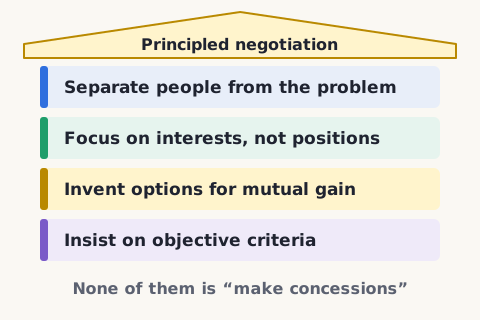
The Four Pillars of Principled Negotiation
Principled negotiation rests on four pillars: separate the people from the problem, focus on interests rather than positions, invent options for mutual gain before deciding among them, and insist on objective criteria. Each pillar addresses one fundamental component of any negotiation, and none of them is "make concessions."
Comparing approaches regarding Wise Agreement Standard:
Positional Bargaining — Negotiation Focus: Rigid stances, defense of ego, and grudging concessions; Standard of Outcome: Conceding to pressure, stubbornness, or artificial deadlines
Principled Negotiation — Negotiation Focus: Underlying interests, shared needs, and creative value creation; Standard

Efficiency: One of the Three Benchmarks for a Good Method
Any method of negotiation should be judged against three benchmarks: a wise agreement, an amicable relationship, and efficiency. Efficiency asks whether the process resolves the dispute quickly and smoothly, without the wasted time, posturing, and transaction costs that plague positional bargaining.
Amicable Relationship Preservation
The process must improve, or at the very least not damage, the working relationship between the parties, ensuring that agreements are implemented cooperatively and future disputes can be resolved productively.
The Three Operational Stages: Analysis, Planning, Discussion
Principled negotiation progresses through three stages. In the Analysis stage, negotiators gather information and diagnose emotional barriers, interests, options, and criteria. In the Planning stage, they design strategy and formulate a BATNA. In the Discussion stage, they meet face to face, address perceptions and feelings, articulate interests, brainstorm options, and apply objective standards without yielding to pressure.
The Harvard Negotiation Project's Interdisciplinary Breakthrough
Founded within Harvard Law School, the Harvard Negotiation Project set out to turn negotiation into a systematic, teachable methodology rather than an assortment of ad hoc tactics — one that could be applied consistently across commercial, legal, and diplomatic disputes alike.
Comparing approaches regarding Three Founding Perspectives:
Positional Bargaining — Negotiation Focus: Rigid stances, defense of ego, and grudging concessions; Standard of Outcome: Conceding to pressure, stubbornness, or artificial deadlines
Principled Negotiation — Negotiation Focus: Underlying interests, shared needs, and creative value creation; Standard
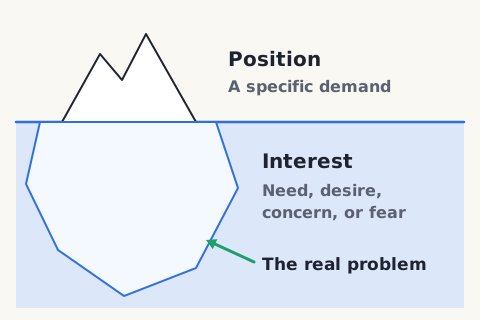
Position vs. Interest: The Core Distinction
A position is what a negotiator decides upon — a specific demand or stance. An interest is the underlying motivation, need, desire, concern, or fear that led the negotiator to take that position in the first place. Principled negotiation targets interests, because that is where the real problem lives.
Matched pairs
Each item on the left goes with the one on the right.
- Inefficiency of Incremental Concessions
- Extreme openings and grudging concessions waste time and energy.
- Hard Bargaining Adversarial Stance
- Hard bargainers view rivals as adversaries in a battle of wills.
- Principled Negotiation
- Resolving disputes based on merits, interests, and objective criteria
- Rigid Coalitions in Multi-Party Talks
- A coalition's internal deal becomes too costly to change.
- Inspection Nuances Overlooked
- The US wanted 10 site checks, the USSR only 3, and talks froze.
- Pillar 1 - People
- Separate the people from the problem.
- Pillar 4 - Criteria
- Insist that agreements rest on objective criteria.
- Planning Stage Strategy
- Negotiators map out tactics and build a strong BATNA here.
- HNP's Interdisciplinary Breakthrough
- It combined law, anthropology, and legal teaching expertise.
Step by step
Applying the Principled Negotiation method to counter a Hard Bargaining Adversarial Stance
- Identify underlying interests and separate personal dynamics from substantive issues
- Generate multiple creative options and dovetail differing preferences for mutual gain
- Anchor the final agreement on legitimate, independent objective criteria
Applying the principled-negotiation method to avoid the Test Ban Treaty's 'Inspection Nuances Overlooked' mistake
- Identify underlying interests and separate personal dynamics from substantive issues
- Generate multiple creative options and dovetail differing preferences for mutual gain
- Anchor the final agreement on legitimate, independent objective criteria
Applying the Pillar 4 - Criteria method in principled negotiation
- Identify underlying interests and separate personal dynamics from substantive issues
- Generate multiple creative options and dovetail differing preferences for mutual gain
- Anchor the final agreement on legitimate, independent objective criteria
Applying the Normative Behavioral Framework method in principled negotiation
- Identify underlying interests and separate personal dynamics from substantive issues
- Generate multiple creative options and dovetail differing preferences for mutual gain
- Anchor the final agreement on legitimate, independent objective criteria
Self-test
Answer each question from memory, then check your work against the answer key.
1. What is the result, per Getting to Yes, when a soft bargainer faces a hard bargainer?
- ABoth sides build lasting mutual trust
- BThe hard bargainer captures the gains
- CTalks collapse into strikes or rupture
- DBoth parties compromise equally
2. In multi-party positional bargaining, what happens after a coalition agrees on an internal compromise position?
- AOutside parties can join the coalition much more easily
- BThe coalition gains new flexibility
- CModifying it for outsiders becomes nearly impossible
- DThe position becomes irrelevant
3. Which historical negotiation stalemate does Getting to Yes cite to show how positional rigidity destroys agreements?
- AComprehensive Test Ban Treaty talks
- BThe 1919 Treaty of Versailles peace talks
- CCuban Missile Crisis
- DCamp David Accords
4. Which trait belongs to a HARD bargainer rather than a soft bargainer, per Getting to Yes?
- ATrusts the other party implicitly
- BMakes early offers, discloses bottom line
- CYields to pressure to keep peace
- DDistrusts the counterpart, applies pressure
5. What did Fisher and Ury identify as the foremost problem with positional bargaining?
- AIt moves to agreement too quickly
- BIt produces unwise agreements
- CIt removes emotion from the dispute
- DIt relies only on legal precedent
6. Who developed the method of Principled Negotiation at Harvard Law School?
- ARobert Cialdini, Adam Grant, and Daniel Kahneman
- BHerb Cohen, Chester Karrass, and Gerard Nierenberg
- CRoger Fisher, William Ury, and Bruce Patton
- DHoward Raiffa, David Lax, and James Sebenius
7. Which of the four pillars focuses on brainstorming creative solutions before evaluating them?
- APeople: separate the people from the problem
- BCriteria: insist on objective criteria
- CInterests: focus on interests, not positions
- DOptions: invent options for mutual gain
8. Under the Interests pillar, a position is most accurately defined as what?
- AWhat a negotiator decides upon
- BThe underlying motivation for a decision
- CA brainstormed alternative, unevaluated
- DAn objective standard for evaluation
9. Which of the following is NOT one of the four pillars of Principled Negotiation?
- AInterests behind positions
- BConcessions
- CCriteria
- DPeople
10. Which of the three benchmarks for judging a negotiation method asks whether it reaches resolution quickly, without wasted time and posturing?
- AWise Agreement
- BObjective Criteria
- CAmicable Relationship
- DEfficiency
Go deeper
- ReadGetting to Yes by Roger Fisher, William Ury, Bruce Patton · on Amazon ↗
- StudyGetting to yes in the FlashFeed app
These are affiliate links: if you buy a book through one, FlashFeed may earn a small commission at no extra cost to you. The commission helps pay for FlashFeed's servers.
As an Amazon Associate we earn from qualifying purchases.
Answer key
- 1. B The hard bargainer captures the gainsThe hard bargainer captures the substantive gains while the soft bargainer concedes real value chasing an illusion of friendship; two HARD bargainers colliding is what causes rupture instead.
- 2. C Modifying it for outsiders becomes nearly impossibleThe internal political cost of changing a coalition's agreed position freezes the whole assembly into institutional gridlock.
- 3. A Comprehensive Test Ban Treaty talksThe US and USSR deadlocked over ten versus three inspections without ever discussing inspection procedures, illustrating positional rigidity.
- 4. D Distrusts the counterpart, applies pressureThe hard bargainer distrusts the other side and applies relentless pressure; the other three traits describe the soft bargainer instead.
- 5. B It produces unwise agreementsArguing over positions entangles egos with stances, producing unwise agreements as the substantive merits recede behind a contest of wills.
- 6. C Roger Fisher, William Ury, and Bruce PattonPrincipled Negotiation was developed at the Harvard Negotiation Project by Roger Fisher, William Ury, and Bruce Patton.
- 7. D Options: invent options for mutual gainThe Options pillar mandates a dedicated generative brainstorming phase, separated from judging, to expand the pie before choosing an agreement.
- 8. A What a negotiator decides uponA position is what a negotiator decides upon; an interest is the underlying motivation, need, or fear that led to that decision.
- 9. B ConcessionsThe four pillars are People, Interests, Options, and Criteria; concessions are a hallmark of positional bargaining, not one of the four pillars.
- 10. D EfficiencyEfficiency judges whether the process avoids the time and posturing costs of positional bargaining; Objective Criteria is a pillar, not one of the three benchmarks.
Sources
- Getting to yes — Roger Fisher, William Ury, and Bruce Patton
- Getting to Yes — Roger Fisher, William Ury, and Bruce Patton
Image credits
- Harvard Negotiation Project Origin: Wikimedia Commons · Daderot · Public domain — commons.wikimedia.org/wiki/File:Langdell_Hall,_Harvard_Law_School,_Cambridge,_MA_-_IMG_5626.JPG
- The Four Pillars of Principled Negotiation: FlashFeed original diagram · CC-BY-4.0
- Efficiency: One of the Three Benchmarks for a Good Method: AI-generated (gpt-image-1.5)
- Position vs. Interest: The Core Distinction: FlashFeed original diagram · CC-BY-4.0
