
Getting to yes study guide · Lesson 2 of 6
Separate the People from the Problem
Perception, Framing, and Cognitive Empathy · Managing Emotion, Active Listening, and Clear Communication
Unofficial study guide for Getting to Yes: Negotiating Agreement Without Giving In (3rd ed.) by Roger Fisher, William Ury, Bruce Patton. FlashFeed is not affiliated with the author or publisher.
This is the lesson's study guide from the FlashFeed app, plus its key facts and a self-test.
What you'll be able to do
- Explain why conflict lives in perception, and use cognitive empathy to understand the other side's view without deducing their intentions from your fears.
- Manage emotion by letting the other side vent and feel heard, speaking about yourself rather than blaming them, and using symbolic gestures.
Perception, Framing, and Cognitive Empathy
A central premise of Principled Negotiation is recognizing that negotiators are not abstract institutional entities, corporate representatives, or mathematical algorithms; they are human beings. They possess deep-seated emotions, distinct values, personal backgrounds, and unpredictable psychological vulnerabilities. Every negotiator operates with two distinct types of interests: substantive interests (such as price, contract terms, delivery deadlines, and technical specifications) and relationship interests (such as respect, trust, reputation, and long-term partnership).
A major failure in conventional positional bargaining is that relationship interests become inextricably entangled with substantive problems. When a buyer says "Your price is too high," the seller often hears a personal insult or an attack on their professional competence. The conversation degenerates into defensive posturing. To maintain rational problem-solving, negotiators must separate the substantive problem from the personal relationship. Negotiators must see themselves as working side-by-side, attacking the shared problem rather than attacking each other across an adversarial divide.
Conflict does not exist in objective physical reality; it exists in human perception. The dispute between two parties is almost always a dispute between two differing interpretations of reality. Principled negotiators systematically master cognitive empathy:
- Put yourself in their shoes: Understanding the counterpart's perspective is not an act of capitulation or agreement. As Roger Fisher, William Ury, and Bruce Patton emphasize, understanding their point of view is not the same thing as agreeing with it. A better understanding of their thinking allows you to appreciate their constraints and design proposals that appeal to their legitimate needs.
- Do not deduce their intentions from your fears: A common cognitive distortion in conflict is assuming that whatever you fear is exactly what the other side plans to do. If a supplier experiences an operational delay, a buyer often assumes bad faith rather than supply chain disruption. Decoupling your fears from their actual intent prevents premature paranoia.
- Do not blame them for your problem: Blaming attacks the other person's self-esteem and triggers defensive resistance. Even when blame is justified, voicing it causes the counterpart to dig in and resist constructive solutions. Distinguish the symptoms of the problem from the individuals involved.
- Discuss perceptions openly and explicitly: Bringing differing perceptions into the open without judgment allows both sides to acknowledge discrepancies and address them objectively. Making perceptions an explicit topic of dialogue defuses hidden tension.
- Act inconsistently with their negative perceptions: If the counterpart expects you to be arrogant, aggressive, or dismissive, demonstrating humility, patience, and active listening shatters their negative preconceptions and reframes the dynamic.
- Involve the other side in the process to give them ownership: If you want someone to accept a solution, you must involve them directly in creating it. People routinely reject proposals crafted in isolation because they feel excluded from the process. Ownership of the process generates commitment to the outcome.
- Protect face-saving: Face-saving is essential to principled negotiation. Face-saving does not mean catering to vanity; it means helping the other person reconcile the proposed agreement with their personal integrity, values, and past public commitments.
In commercial conflicts—such as a tenant furious over building maintenance disruptions—applying cognitive empathy allows a landlord to recognize that the tenant's real fear is client embarrassment and lost productivity during investor visits. By acknowledging the tenant's perception and involving the startup founder in designing maintenance schedules and service-level agreements (SLAs), the landlord resolves the substantive issue through dedicated technician access while preserving the long-term lease revenue and upholding the tenant's professional dignity.
Cognitive Empathy vs. Substantive Agreement
It is critical to distinguish cognitive empathy from emotional sympathy or substantive agreement:
- Cognitive empathy is an intellectual discipline: accurately mapping how the world looks through your counterpart's eyes, understanding the pressures they face from their stakeholders, and diagnosing the constraints that dictate their behavior.
- Substantive agreement is a strategic decision: accepting or declining specific contract terms.
Developing profound cognitive empathy does not mean conceding to unreasonable demands; rather, it provides the precise behavioral intelligence needed to structure proposals that solve the other party's real problems while protecting your own vital interests.
Managing Emotion, Active Listening, and Clear Communication
High-stakes negotiations often generate intense fear, anger, resentment, wounded pride, and anxiety. If left unmanaged, emotions can hijack rational judgment, transforming minor misunderstandings into destructive conflict. Principled negotiators handle emotional turbulence with disciplined techniques:
Recognize and understand emotions (theirs and yours): Monitor physical tension, voice modulation, breathing, and emotional shifts in both yourself and your counterpart. Understand the underlying fears, pride, or frustrations driving emotional reactions.
Make emotions explicit and acknowledge them as legitimate: Explicitly validating emotions ("We recognize that the recent operational delays caused immense frustration for your team") neutralizes defensiveness without conceding substantive points. When feelings are acknowledged as real and valid, negotiators feel respected and ready to engage in constructive dialogue.
Allow the other side to let off steam (catharsis): When a negotiator is furious, attempting to silence them or argue back escalates the confrontation. Giving the other party uninterrupted space to vent their anger releases psychological pressure and restores cognitive equilibrium. As the authors write, one effective way to deal with people's anger, frustration, and other negative emotions is to help them release those feelings.
Do not react to emotional outbursts: Maintain calm composure when attacked. Meeting anger with anger guarantees escalation; maintaining a calm posture breaks the destructive feedback loop. Refuse to be provoked into personal retaliation or defensive justification.
Utilize symbolic gestures: Simple, low-cost symbolic acts—such as a sincere apology, a warm handshake, an expression of sympathy, or sharing a quiet meal—can dramatically dismantle interpersonal barriers and reset the emotional tone.
Communication is the lifeblood of negotiation, yet it is fraught with three primary breakdowns:
- Negotiators may not be talking to each other: Negotiators frequently speak to the "gallery"—their board of directors, constituents, political base, or media observers—rather than attempting to influence the person across the table.
- Negotiators may not be hearing each other: While one person speaks, the other is typically busy formulating their next counter-argument, completely missing the nuances of what is being expressed.
- Misunderstanding and misinterpretation: Differing cultural norms, vocabulary, or emotional filters cause messages to be received in ways never intended by the sender.
To overcome communication failures, principled negotiators apply specific communication disciplines:
- Listen actively and acknowledge what is being said: Active listening involves focused attention, clarifying questions, and summarizing the other party's position accurately. The cheapest concession you can make to the other side is to let them know they have been heard. When a counterpart knows they have been fully understood, their urge to repeat demands evaporates.
- Speak to be understood: Direct your message directly to the counterpart as a collaborative problem-solver rather than an adversary in an arena.
- Speak about yourself, not about them: Frame statements around your own experiences and feelings using "I" statements ("I feel concerned about project continuity") rather than accusatory "You" statements ("You are unreliable"). "I" statements convey critical information without provoking defensiveness.
- Speak for a purpose: Recognize that indiscriminate speech can derail delicate agreements. Before sharing information or raising a topic, ask yourself what constructive purpose it serves in advancing the negotiation.
In labor disputes, such as automotive factory wildcat slowdowns, structured listening sessions where plant managers accurately transcribe worker grievances onto shared screens defuse hostility. By letting off steam and confirming accurate transcription, workers feel heard, allowing the meeting to transition to collaborative drafting of ergonomic and safety improvements within 48 hours.
Practical Communication Checklist for High-Stakes Talks
Before entering a critical negotiation session, verify your communication readiness against four core standards:
- Active Listening Primacy: Plan to spend the first third of the meeting asking clarifying open-ended questions and summarizing the counterpart's answers without offering rebuttals.
- Constructive "I" Framing: Prepare your key points using first-person experiential language ("From our operational data, we observe...") rather than second-person accusatory claims ("Your team failed to...").
- Purposeful Speech Filter: Verify that every piece of information shared serves a constructive problem-solving purpose rather than simply venting frustration.
- De-escalation Posture: Establish a clear internal commitment to maintain calm composure in the face of emotional outbursts, using silence and validation to restore rational dialogue.
Key terms
- Where Conflict Actually Lives
- Conflict does not exist in objective physical reality; it exists in human perception.
- Commercial Tenant Maintenance Case
- Consider a conflict between a commercial building landlord and a tech startup tenant. The tenant is furious over recurring elevator outages and demands a 30% rent reduction.
- Catharsis of Letting Off Steam
- One effective way to deal with people's anger, frustration, and other negative emotions is to help them release those feelings.
- Own-Experience Constructive Framing
- Frame statements around your own experiences and feelings ("I feel concerned about project continuity") rather than accusing the other party ("You are unreliable"). "I" statements convey critical information without provoking defensiveness.
Key facts
Human Dimension Reality
A fundamental premise of Getting to Yes is that negotiators are not abstract institutional entities or computer algorithms; they are human beings with emotions, deeply held values, personal backgrounds, and unpredictable psychological responses.
Substantive Interests, Relationship Interests, and Their Entanglement
Every negotiator carries two kinds of interests: substantive interests, such as price and delivery terms, and relationship interests, such as respect, trust, and reputation. A major failure of positional bargaining is that these get entangled — when a buyer says "your price is too high," the seller often hears a personal insult, and the conversation degenerates into defensive posturing instead of problem-solving.
Do Not Deduce Their Intentions From Your Own Fears
A common cognitive distortion in conflict is assuming that whatever you fear is exactly what the other side intends. If a supplier misses a deadline, a buyer often assumes bad faith rather than a genuine supply-chain disruption — decoupling your fears from their actual intent prevents this premature paranoia.
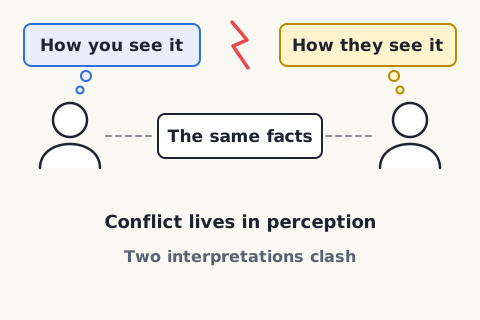
Conflict Lives in Perception, Not in Objective Reality
Conflict does not exist in objective physical reality; it exists in human perception. A dispute between two parties is almost always a clash between two differing interpretations of the same facts, which is why understanding how the other side sees the situation is central to resolving it.
Understanding Their View Is Not the Same as Agreeing With It
Cognitive empathy means putting yourself in the other side's shoes to understand how the world looks to them — it is not an act of capitulation. Understanding their point of view lets you appreciate their real constraints and design proposals that appeal to their legitimate needs, without requiring you to agree with their position.
Discuss Perceptions Openly, and Give Them Ownership
Bringing differing perceptions into the open without judgment lets both sides acknowledge discrepancies and address them directly, defusing hidden tension. And because people routinely reject proposals crafted in isolation, involving the other side directly in creating a solution gives them ownership of it — and ownership generates commitment to the outcome.
Inconsistent Action Reframing
If the counterpart expects you to be arrogant, aggressive, or dismissive, demonstrating humility, patience, and active listening shatters their negative preconceptions and reframes the dynamic.
Face-Saving Means Protecting Their Integrity, Not Their Vanity
Face-saving is essential to principled negotiation, but it does not mean catering to vanity. It means helping the other person reconcile the proposed agreement with their personal integrity, their values, and any public commitments they have already made.

The Elevator Outage: Cognitive Empathy in a Lease Dispute
A commercial tenant furious over recurring elevator outages demands a 30% rent reduction. Applying cognitive empathy, the landlord recognizes the tenant's real fear is client embarrassment and lost productivity during investor visits — and by involving the tenant in designing a maintenance schedule with dedicated technician access, the landlord resolves the substantive issue while preserving lease revenue and the tenant's professional dignity.
Emotional Hijacking Risk
Emotions can hijack rational judgment in an instant, transforming minor misunderstandings into destructive conflict.
Recognize Emotion, Validate It, and Don't React to Outbursts
Principled negotiators monitor physical tension, voice modulation, and emotional shifts in themselves and their counterpart. Explicitly validating an emotion ("we recognize the delays caused real frustration") neutralizes defensiveness without conceding substance — and when the other side lashes out, meeting anger with calm rather than anger breaks the escalation loop instead of feeding it.
Symbolic Gestures Reset the Emotional Tone
Simple, low-cost symbolic acts — a sincere apology, a warm handshake, an expression of sympathy, or sharing a quiet meal — can dramatically dismantle interpersonal barriers. Exchanging formal business cards is not one of these gestures; it is these small human acts, not procedural ones, that reset the emotional climate of a negotiation.
Catharsis: Let the Other Side Vent
One effective way to deal with anger, frustration, and other negative emotions is simply to help the other side release them. When a counterpart vents during a heated negotiation, Getting to Yes recommends letting them let off steam without interruption, because silencing or arguing back only escalates the confrontation.

The Three Communication Breakdowns
Negotiators may speak to the "gallery" — their board, constituents, or the media — rather than to the person across the table. They may also fail to hear each other, since while one side speaks the other is often busy rehearsing its next counter-argument instead of listening. A shared deadline is not one of these breakdowns; differing cultural norms and vocabulary causing outright misunderstanding is the third.
Message Distortion and Misunderstanding
Differing cultural norms, vocabulary, or emotional filters cause messages to be received in ways never intended by the sender.
Active Listening Is the Cheapest Concession You Can Make
The cheapest concession you can make to the other side is simply letting them know they have been heard. When a counterpart knows their point has been fully understood, their urge to keep repeating the demand evaporates, freeing the conversation to move forward.

Speak to Be Understood, and With Purpose
Principled negotiators direct their message to the counterpart as a collaborative problem-solver, and before raising a topic they ask what constructive purpose it serves. A tense union-management dispute over wildcat slowdowns at an automotive plant was defused when managers structured listening sessions, transcribing worker grievances onto shared screens so the workers felt heard.
"I" Statements Instead of "You" Statements
Frame statements around your own experience and feelings — "I feel concerned about project continuity" — rather than accusing the other party with a "you" statement like "you are unreliable." "I" statements convey the same critical information without provoking the defensiveness that accusatory language triggers.
Matched pairs
Each item on the left goes with the one on the right.
- Entanglement of People and Substance
- A price complaint can feel like a personal insult to the other side.
- Fear vs Intent Distortion
- Their intentions aren't defined by what worries you.
- Psychological Function of Face-Saving
- It means helping them reconcile a deal with their own integrity.
- Elevator Outage: Empathy in Action
- The landlord involved the tenant in designing a new upkeep plan.
- Legitimizing Emotional Experience
- Validating an emotion defuses defensiveness.
- Power of Symbolic Gestures
- A sincere apology or warm handshake can dismantle barriers.
- Direct Collaborative Address
- Treat your counterpart as a fellow problem-solver, not the gallery.
- Automotive Wildcat Labor Dispute
- Plant managers transcribed grievances live to defuse a slowdown.
Step by step
Applying the core principled-negotiation method (interests, options, objective criteria)
- Identify underlying interests and separate personal dynamics from substantive issues
- Generate multiple creative options and dovetail differing preferences for mutual gain
- Anchor the final agreement on legitimate, independent objective criteria
Self-test
Answer each question from memory, then check your work against the answer key.
1. According to Getting to Yes, where does conflict actually exist?
- AIn factual data alone
- BIn human perception
- CIn objective physical reality
- DIn the written contract terms
2. According to Getting to Yes, what does cognitive empathy fundamentally require?
- ASympathizing emotionally with their situation
- BConceding to their proposed terms
- CUnderstanding the counterpart's point of view
- DAgreeing with their demands
3. A buyer assumes a supplier's delay signals bad faith because of their own worries. Which guideline does this violate?
- ADiscuss perceptions openly and explicitly
- BDo not blame them for your problem
- CProtect face-saving
- DDo not deduce their intentions from your fears
4. Which of these is NOT one of the cognitive empathy techniques described in Getting to Yes?
- AConfirm their negative expectations of you
- BProtect face-saving
- CInvolve the other side in the process
- DAct inconsistently with their negative perceptions
5. In principled negotiation, what does 'protecting face-saving' actually mean?
- AHelping them reconcile it with their values
- BAvoiding public statements about the agreement
- CCatering to the other side's vanity
- DPublicly praising the counterpart's skills
6. According to Getting to Yes, what is the cheapest concession you can make to the other side?
- AAgreeing to meet again
- BLetting them know they have been heard
- CReducing your price by a small percentage
- DOffering a future favor
7. A negotiator says 'I feel concerned about project continuity' instead of 'You are unreliable.' Which discipline is this?
- AListen actively and acknowledge
- BSpeak for a purpose
- CSpeak about yourself, not them
- DSpeak to be understood
8. Which of the following is NOT one of the three primary communication breakdowns in Getting to Yes?
- ANegotiators may not be hearing each other
- BMisunderstanding and misinterpretation
- CNegotiators may not be talking to each other
- DNegotiators may not share a common deadline
9. When a counterpart vents anger during a heated negotiation, what does Getting to Yes recommend?
- AAllow them to let off steam without interruption
- BReact immediately to correct factual errors
- CChange the subject to defuse tension
- DMatch their tone to demonstrate strength
10. Which of the following is NOT one of the symbolic gestures Getting to Yes cites for resetting emotional tone?
- ASharing a quiet meal together
- BA warm handshake
- CA sincere apology
- DExchanging formal business cards
Go deeper
- ReadGetting to Yes by Roger Fisher, William Ury, Bruce Patton · on Amazon ↗
- StudyGetting to yes in the FlashFeed app
These are affiliate links: if you buy a book through one, FlashFeed may earn a small commission at no extra cost to you. The commission helps pay for FlashFeed's servers.
As an Amazon Associate we earn from qualifying purchases.
Answer key
- 1. B In human perceptionConflict does not exist in objective reality; it exists in human perception, since disputes are between differing interpretations of reality, not the contract text or raw facts.
- 2. C Understanding the counterpart's point of viewFisher, Ury, and Patton stress that understanding the other side's thinking is an intellectual discipline, distinct from emotional sympathy, agreement, or concession.
- 3. D Do not deduce their intentions from your fearsAssuming the other side's intent matches your own fears is the exact distortion this guideline warns against, as with the supply-chain delay example.
- 4. A Confirm their negative expectations of youGetting to Yes recommends acting inconsistently with negative expectations to reframe the dynamic, the opposite of confirming them.
- 5. A Helping them reconcile it with their valuesFace-saving is not about vanity; it means helping someone reconcile an agreement with their integrity and past commitments.
- 6. B Letting them know they have been heardLetting the other side know they have been heard costs nothing yet dissolves their urge to keep repeating demands.
- 7. C Speak about yourself, not themThis is an 'I' statement, framed around one's own experience rather than an accusatory 'you' statement, exactly the discipline described.
- 8. D Negotiators may not share a common deadlineThe three breakdowns cited are not talking to each other, not hearing each other, and misunderstanding or misinterpretation; a shared deadline is not one of them.
- 9. A Allow them to let off steam without interruptionGetting to Yes advises giving the other party uninterrupted space to vent, which releases psychological pressure and restores cognitive equilibrium.
- 10. D Exchanging formal business cardsThe text lists a sincere apology, a warm handshake, an expression of sympathy, and sharing a meal as symbolic gestures; exchanging business cards is not among them.
Sources
- Getting to yes — Roger Fisher, William Ury, and Bruce Patton
- Getting to Yes — Roger Fisher, William Ury, and Bruce Patton
Image credits
- Conflict Lives in Perception, Not in Objective Reality: FlashFeed original diagram · CC-BY-4.0
- The Elevator Outage: Cognitive Empathy in a Lease Dispute: AI-generated (gpt-image-1.5)
- The Three Communication Breakdowns: AI-generated (gpt-image-1.5)
- Speak to Be Understood, and With Purpose: AI-generated (gpt-image-1.5)