
Getting to yes study guide · Lesson 3 of 6
Focus on Interests, Not Positions
Uncovering Underlying Interests & The Hierarchy of Human Needs · Communicating Interests and Anchoring on the Problem
Unofficial study guide for Getting to Yes: Negotiating Agreement Without Giving In (3rd ed.) by Roger Fisher, William Ury, Bruce Patton. FlashFeed is not affiliated with the author or publisher.
This is the lesson's study guide from the FlashFeed app, plus its key facts and a self-test.
What you'll be able to do
- Explain why reconciling interests works better than compromising positions, uncover interests by asking 'Why?', and name the five basic human needs.
- Explain the problem and your interests before proposing a solution, look forward rather than back, and stay hard on the problem and soft on the people.
Uncovering Underlying Interests & The Hierarchy of Human Needs
The central breakthrough of Principled Negotiation is recognizing that the true problem in any dispute lies not in conflicting positions, but in conflicting interests. A position is a tangible demand or decision that a negotiator has settled on (such as demanding a salary of $150,000, setting a boundary line at a specific ridge, or insisting on a 60-day delivery window). Interests are the underlying motivations, needs, concerns, desires, and fears that led the negotiator to take that position.
As Roger Fisher, William Ury, and Bruce Patton formulate this foundational principle: interests define the problem. The basic problem in a negotiation lies not in conflicting positions, but in the conflict between each side's needs, desires, concerns, and fears.
Reconciling interests is far more effective than compromising positions for two fundamental reasons:
- For every interest, there usually exist multiple positions that can satisfy it. Negotiators frequently discover that their underlying interests can be met through alternative positions they had not previously considered.
- Behind opposed positions lie shared and compatible interests, alongside conflicting ones. For instance, in a commercial lease dispute between a shopkeeper and a property owner, both share a deep interest in building maintenance, tenant stability, and a thriving commercial district, even while disagreeing over base rent.
To uncover the interests hidden behind rigid positions, negotiators use deliberate analytical techniques:
- Ask 'Why?': Examine the other party's position and respectfully ask why they want what they are asking for. Seek to understand the functional need behind the demand.
- Ask 'Why not?': Analyze why the counterpart has not accepted your proposal. Put yourself in their shoes and evaluate the specific negative consequences, organizational risks, or reputational hazards they foresee if they were to say yes.
- Recognize multiple interests: Every party carries a complex web of internal interests, balancing immediate financial targets with long-term strategic positioning, employee morale, and regulatory compliance.
The classic parable of the library window illustrates this dynamic clearly: two patrons quarrel over whether a window should be open or shut. One wants fresh air (Position A); the other wants to avoid a draft (Position B). A compromise of leaving the window halfway open satisfies neither. The librarian asks why each wants their position, and opens a window in an adjacent room—providing fresh air without any draft and satisfying 100% of both parties' interests.
At the deepest level of interest analysis, the most powerful and non-negotiable drivers of human behavior are basic human needs. If a negotiation threatens a party's core human needs, they will fight fiercely regardless of financial incentives. The five fundamental human needs identified in Getting to Yes are:
- Security: Physical protection, financial stability, and operational predictability.
- Economic well-being: Sustained livelihood, profit margins, career growth, and asset growth.
- A sense of belonging: Social inclusion, peer acceptance, community standing, and organizational alignment.
- Recognition: Respect from peers, validation of contribution, professional prestige, and status.
- Autonomy / Control over one's life: Self-determination, freedom from micromanagement, and authority over key decisions.
Agreements that explicitly satisfy these basic human needs achieve enduring stability, whereas agreements that ignore them face constant sabotage, resistance, or breach.
The Multi-Tiered Matrix of Organizational Interests
In business and public policy negotiations, parties rarely possess a single monolithic interest. A comprehensive interest audit maps motivations across three distinct levels:
- Institutional / Commercial Interests: Profitability, cost containment, cash flow stability, brand equity, market share, and legal compliance.
- Team / Operational Interests: Resource allocation, workload distribution, project delivery timelines, technical standards, and cross-functional autonomy.
- Personal / Career Interests: Professional reputation, peer recognition, job security, advancement opportunities, and alignment with personal ethics.
By systematically identifying interests across all three tiers, negotiators uncover unexpected alignment opportunities where minor non-monetary adjustments satisfy vital personal or team needs.
Communicating Interests and Anchoring on the Problem
Understanding interests is ineffective if you cannot communicate them with persuasive clarity to the other party. Abstract requests are easily dismissed, but concrete explanations of operational impact demand attention. As the authors write, if you want the other side to take your interests into account, you must explain to them what those interests are. If you have an ulcer, you do not expect a doctor to help you unless you describe the symptoms.
Key principles for communicating interests effectively include:
- Make your interests come alive: Be specific and descriptive. Concrete details make the legitimacy of your needs undeniable. Provide vivid examples, operational timelines, and real cost data to substantiate why your interests matter.
- Acknowledge their interests as part of the overall problem: Demonstrating that you understand and care about their constraints builds psychological reciprocity. When you state their interests clearly, they feel heard and become substantially more willing to listen to your needs.
- Put the problem before your answer: In traditional bargaining, negotiators announce their conclusion first ("I demand a 20% discount") and then justify it. The counterpart immediately stops listening and prepares a counter-attack. In principled negotiation, explain the problem, the operational data, and your interests first, and present your proposed solution only after the counterpart understands the problem.
- Look forward, not backward: Arguments about past grievances ("You failed to meet the deadline in June") lead to defensive finger-pointing. Principled negotiators redirect attention to the future: "How can we structure our workflow so that upcoming milestones are met reliably?"
- Be concrete but flexible: Maintain total clarity regarding your substantive goals while remaining completely open to creative, flexible ways of achieving them.
A cornerstone principle of the Harvard framework is the disciplined practice of being hard on the problem and soft on the people. Combining relentless advocacy for your substantive interests with genuine personal warmth and respect creates productive cognitive dissonance in the counterpart's mind: being hard on the problem increases pressure for a real solution; being soft on the people builds the relationship and makes agreement more likely. Negotiators vigorously pursue fair outcomes while protecting the dignity of their counterparts.
The power of reconciling underlying interests was demonstrated at the historic 1978 Camp David Peace Accords negotiated between Egypt and Israel:
- Israel had occupied the Egyptian Sinai Peninsula during the 1967 Six-Day War.
- When peace negotiations opened, both nations asserted mutually exclusive positions: Egypt insisted on the complete return of every inch of sovereign Egyptian territory, while Israel insisted on retaining military control over strategic portions of the Sinai to protect against surprise invasion.
- Compromise along a positional axis (e.g., drawing a border through the middle of the desert) was rejected by both sides.
- Examining the underlying interests reveals that Egypt's core interest was sovereignty (having been ruled by foreign powers for thousands of years, national pride and territorial sovereignty were paramount), while Israel's core interest was security (Israel did not desire Egyptian land for agriculture or settlement; it feared Egyptian tanks stationing within striking distance of Israeli cities).
- The interest-based solution was elegant: return complete sovereign ownership of the entire Sinai Peninsula to Egypt, while fully demilitarizing the territory under international monitoring. Egypt achieved 100% of its sovereignty interests, and Israel achieved 100% of its security interests.
Strategic Guidelines for Forward-Looking Alignment
To maintain momentum when discussing sensitive interests, apply three communication disciplines:
- Make the Problem Shared: Frame challenges collaboratively ("How might we structure delivery milestones so that our supply chain remains resilient while your inventory costs are minimized?").
- Anchor on Future Value: When past disputes arise, acknowledge the historical difficulty briefly and redirect focus immediately to future safeguards ("We recognize past scheduling friction; let us focus on what mechanisms will ensure 100% on-time delivery next quarter").
- Firm Substance, Warm Interpersonal Tone: Pair rigorous, uncompromising advocacy for your legitimate substantive goals with unwavering warmth, courtesy, and respect for your counterpart's personal dignity.
Key terms
- Diagnostic Power of Asking Why
- Examine the other party's position and respectfully probe the reasoning behind it. Seek to understand the functional need behind the demand.
- Economic Well-Being Need
- Sustained livelihood, profit margins, career growth, and asset growth.
- Forward-Looking vs Backward-Looking Focus
- Principled negotiators redirect attention to the future: "How can we structure our workflow so that upcoming milestones are met reliably?"
- Israel Military Security Interest
- Israel did not desire Egyptian land for agriculture or settlement; it feared Egyptian tanks stationing within striking distance of Israeli cities.
Key facts
Interests Define the Problem
Interests define the problem. The basic problem in a negotiation lies not in conflicting positions, but in the conflict between each side's needs, desires, concerns, and fears.
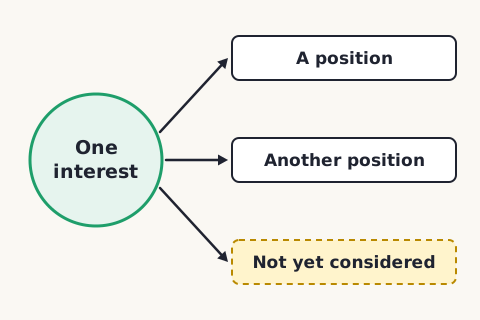
One Interest, Many Possible Positions
For every interest there usually exist multiple positions that could satisfy it. Reconciling interests works better than compromising positions partly because negotiators frequently discover their underlying interest can be met through an alternative position they had not previously considered.
Interests Are Plural — and Often Shared
Behind opposed positions lie both conflicting and compatible interests: a shopkeeper and a property owner may disagree on rent but share a deep interest in building maintenance and a thriving commercial district. Every party also carries a complex web of internal interests at once, balancing financial targets against morale, reputation, and regulatory compliance.
Ask "Why" and "Why Not" to Surface Interests
To uncover the interest behind a rigid position, respectfully ask the other party why they want what they're asking for — seeking the functional need behind the demand. Just as usefully, analyze why they have not accepted your proposal, putting yourself in their shoes to see the risks or costs they fear.
Comparing approaches regarding The Library Window Problem:
Positional Bargaining — Negotiation Focus: Rigid stances, defense of ego, and grudging concessions; Standard of Outcome: Conceding to pressure, stubbornness, or artificial deadlines
Principled Negotiation — Negotiation Focus: Underlying interests, shared needs, and creative value creation; Standard of Outcome: Agreements measured against fair, independent, objective criteria that both sides accept.
The Library Window: A Compromise That Pleases No One
Two patrons quarrel over whether a library window should be open or shut — one wants fresh air, the other wants to avoid a draft. A simple compromise of leaving the window halfway open pleases neither, since it still lets in some draft while providing only some fresh air.
Librarian Adjacent Window Solution
The librarian enters and asks each person why they want what they want (their interests). Recognizing that one person wants fresh air and the other wants to avoid a draft blowing directly onto them, the librarian opens a window in the adjacent room.
Basic Human Needs Are the Deepest, Most Powerful Interests
At the deepest level of interest analysis lie basic human needs — the most powerful and non-negotiable drivers of behavior. If a negotiation threatens a party's core human needs, they will fight fiercely regardless of financial incentives, so agreements that ignore these needs face constant sabotage or breach.
The Five Basic Human Needs
Getting to Yes names five basic human needs: security (physical and financial stability), economic well-being (livelihood and career growth), a sense of belonging (social inclusion and acceptance), recognition (respect and validation), and autonomy (self-determination and freedom from micromanagement). Personal happiness is not one of the five — these are structural needs, not a mood.
Comparing approaches regarding Autonomy and Self-Determination Need:
Positional Bargaining — Negotiation Focus: Rigid stances, defense of ego, and grudging concessions; Standard of Outcome: Conceding to pressure, stubbornness, or artificial deadlines
Principled Negotiation — Negotiation Focus: Underlying interests, shared needs, and creative value creation; Standard of Outcome: Agreements measured against fair, independent, objective criteria that both sides accept.
Vividness in Interest Articulation
If you want the other side to take your interests into account, you must explain to them what those interests are. If you have an ulcer, you do not expect a doctor to help you unless you describe the symptoms.
Acknowledge Their Interests, Stay Concrete but Flexible
Demonstrating that you understand and care about the other side's constraints builds psychological reciprocity, making them more willing to listen to your needs in turn. At the same time, maintain total clarity about your own substantive goals while staying completely open to creative, flexible ways of achieving them.
Put the Problem Before Your Answer
In traditional bargaining, negotiators announce their conclusion first ("I demand a 20% discount") and the counterpart immediately stops listening to prepare a counter-attack. In principled negotiation, explain the problem, the operational data, and your interests first, and offer your proposed solution only after the counterpart understands the problem.
Hard on the Problem, Soft on the People
Combining relentless advocacy for your substantive interests with genuine personal warmth creates productive cognitive dissonance: being hard on the problem increases pressure for a real solution, while being soft on the people builds the relationship and makes agreement more likely. Negotiators pursue fair outcomes vigorously while protecting the counterpart's dignity.
Look Forward, Not Backward
Arguments about past grievances — "you failed to meet the deadline in June" — lead only to defensive finger-pointing. Principled negotiators redirect attention to the future, such as asking how the team can structure its workflow so upcoming milestones are met reliably.
Comparing approaches regarding Dignity Protection While Advocating Interests:
Positional Bargaining — Negotiation Focus: Rigid stances, defense of ego, and grudging concessions; Standard of Outcome: Conceding to pressure, stubbornness, or artificial deadlines
Principled Negotiation — Negotiation Focus: Underlying interests, shared needs, and creative value creation; Standard of Outcome: Agreements measured against fair, independent, objective criteria that both sides accept.

Background to the Camp David Impasse
Israel had occupied the Egyptian Sinai Peninsula during the 1967 Six-Day War, and when peace talks opened, Egypt demanded the complete return of every inch of sovereign territory while Israel insisted on retaining military control of strategic portions. A positional compromise — drawing a border through the middle of the desert — was rejected by both sides as satisfying neither.
Positional Mutually Exclusive Deadlock
When peace negotiations opened, both nations asserted mutually exclusive positions: Egypt insisted on the complete return of every inch of sovereign Egyptian territory, while Israel insisted on retaining military control over strategic portions of the Sinai to protect against surprise invasion.
Egypt's Sovereignty Interest vs. Israel's Security Interest
Analysis of the underlying interests showed that Egypt's core interest was sovereignty — after millennia of foreign rule, national pride and territorial control over the Sinai were paramount — while Israel's core interest was security, since it feared Egyptian tanks massing within striking distance of Israeli cities, not the land itself for settlement.
The Interest-Based Sinai Solution: Full Sovereignty, Full Demilitarization
The interest-based solution returned complete sovereign ownership of the entire Sinai Peninsula to Egypt while fully demilitarizing the territory under international monitoring. Egypt achieved 100% of its sovereignty interest, and Israel achieved 100% of its security interest — a result the positional compromise of splitting the desert could never have reached.
Comparing approaches regarding Power of Uncovering Latent Interests:
Positional Bargaining — Negotiation Focus: Rigid stances, defense of ego, and grudging concessions; Standard of Outcome: Conceding to pressure, stubbornness, or artificial deadlines
Principled Negotiation — Negotiation Focus: Underlying interests, shared needs, and creative value creation; Standard of Outcome: Agreements measured against fair, independent, objective criteria that both sides accept.
Matched pairs
Each item on the left goes with the one on the right.
- Compatible Interests Behind Opposed Positions
- Rival demands can still hide shared goals both sides want.
- Plurality of Negotiator Interests
- Each side juggles many competing goals, not just one.
- Security as Fundamental Need
- Physical protection, financial stability, and stable operations.
- Recognition and Contribution Need
- Peer respect, validation of your work, and professional status.
- Explaining Problem Before Solution
- Lay out the issue and your reasoning ahead of proposing a fix.
- Hard on the Problem, Soft on the People
- Push hard on substance while treating counterparts with warmth.
- Egypt Sovereign Territorial Interest
- Centuries of foreign rule made pride, not land, the true goal.
- 100% Core Interest Satisfaction
- At Camp David, both nations got everything they truly needed.
Step by step
Applying the Plurality of Negotiator Interests method in principled negotiation
- Identify underlying interests and separate personal dynamics from substantive issues
- Generate multiple creative options and dovetail differing preferences for mutual gain
- Anchor the final agreement on legitimate, independent objective criteria
Applying the Recognition and Contribution Need method in principled negotiation
- Identify underlying interests and separate personal dynamics from substantive issues
- Generate multiple creative options and dovetail differing preferences for mutual gain
- Anchor the final agreement on legitimate, independent objective criteria
Applying the Hard on Problem Soft on People Synergy method in principled negotiation
- Identify underlying interests and separate personal dynamics from substantive issues
- Generate multiple creative options and dovetail differing preferences for mutual gain
- Anchor the final agreement on legitimate, independent objective criteria
Applying the 100% Core Interest Satisfaction method in principled negotiation
- Identify underlying interests and separate personal dynamics from substantive issues
- Generate multiple creative options and dovetail differing preferences for mutual gain
- Anchor the final agreement on legitimate, independent objective criteria
Self-test
Answer each question from memory, then check your work against the answer key.
1. According to Getting to Yes, where does the true problem in a negotiation lie?
- AConflicting needs, desires, and fears
- BConflicting opening positions
- CThe number of issues on the table
- DDifferences in negotiating skill
2. Which is one of the two reasons interests are easier to reconcile than positions?
- AInterests never change during negotiation
- BPositions are easier to measure than interests
- CMultiple positions can satisfy one interest
- DCompromising positions saves more time
3. In the library window parable, what solution satisfied both patrons' interests?
- ALeaving the window halfway open
- BInstalling a fan for airflow
- CTaking turns opening the window
- DOpening a window in the next room
4. Which is NOT one of the five basic human needs named in Getting to Yes?
- ARecognition from peers and superiors
- BPersonal happiness
- CSecurity
- DAutonomy
5. What question helps uncover the interest behind a rigid position?
- AWho has final authority?
- BWhat is your final number?
- CWhen do you need an answer?
- DWhy do you want that?
6. What should a negotiator do before presenting a proposed solution?
- AList prior concessions made
- BState the final number immediately
- CExplain the problem and interests first
- DHighlight the other side's mistakes
7. Which approach demonstrates 'looking forward, not backward' in negotiation?
- ACriticizing habitual lateness
- BPlanning future milestones
- CBlaming a missed deadline
- DFaulting lack of advance notice
8. What does being 'hard on the problem, soft on the people' mean?
- AAdvocate firmly while respecting the person
- BYield on interests to keep the relationship
- CCompromise on substance, stay distant
- DCriticize the proposal and ignore feelings
9. At Camp David, what was Israel's core underlying interest regarding the Sinai?
- AAgricultural land
- BReligious significance
- CSecurity
- DEconomic development
10. What was the interest-based solution reached for the Sinai Peninsula?
- AFull sovereignty to Egypt, demilitarized zone
- BSplit the peninsula along a new border
- C99-year lease to Egypt
- DJoint Egyptian-Israeli military control
Go deeper
- ReadGetting to Yes by Roger Fisher, William Ury, Bruce Patton · on Amazon ↗
- StudyGetting to yes in the FlashFeed app
These are affiliate links: if you buy a book through one, FlashFeed may earn a small commission at no extra cost to you. The commission helps pay for FlashFeed's servers.
As an Amazon Associate we earn from qualifying purchases.
Answer key
- 1. A Conflicting needs, desires, and fearsThe book states the basic problem lies in conflicting needs, desires, concerns, and fears — not in the positions themselves.
- 2. C Multiple positions can satisfy one interestBecause most interests can be satisfied by several different positions, focusing on interests opens more paths to agreement.
- 3. D Opening a window in the next roomThe librarian opened a window in the adjacent room, giving fresh air without a draft — satisfying both interests fully, unlike the halfway compromise.
- 4. B Personal happinessThe five basic human needs are security, economic well-being, belonging, recognition, and autonomy. Personal happiness isn't one of the five named needs.
- 5. D Why do you want that?Asking 'why' helps uncover the functional need behind a stated position, revealing the real interest at stake.
- 6. C Explain the problem and interests firstPrincipled negotiators explain the problem and their interests before proposing a solution, so the other side understands the reasoning first.
- 7. B Planning future milestonesForward-looking negotiators redirect attention to planning future workflow rather than blaming, criticizing, or faulting past behavior.
- 8. A Advocate firmly while respecting the personIt means vigorously advocating for your substantive interests while treating the other person with genuine respect and warmth.
- 9. C SecurityIsrael's core interest was security against invasion, not land for farming, religion, or economic development.
- 10. A Full sovereignty to Egypt, demilitarized zoneEgypt regained full sovereignty over the Sinai while it was demilitarized under international monitoring, satisfying both sides' core interests.
Sources
- Getting to yes — Roger Fisher, William Ury, and Bruce Patton
- Getting to Yes — Roger Fisher, William Ury, and Bruce Patton
Image credits
- One Interest, Many Possible Positions: FlashFeed original diagram · CC-BY-4.0
- Background to the Camp David Impasse: Wikimedia Commons · Daniel Fafard · Public domain — commons.wikimedia.org/wiki/File:Mont_sinai2.jpg
