
Getting to yes study guide · Lesson 4 of 6
Invent Options for Mutual Gain
Diagnosing Obstacles & The Circle Chart Framework · Brainstorming, Dovetailing Differences & Drafting Yesable Propositions
Unofficial study guide for Getting to Yes: Negotiating Agreement Without Giving In (3rd ed.) by Roger Fisher, William Ury, Bruce Patton. FlashFeed is not affiliated with the author or publisher.
This is the lesson's study guide from the FlashFeed app, plus its key facts and a self-test.
What you'll be able to do
- Identify the four obstacles to inventing options, such as premature judgment and the fixed pie, and use the four-quadrant Circle Chart.
- Run a brainstorm of 5 to 8 people with zero criticism, dovetail differences such as risk tolerance, and draft a yesable proposition.
Diagnosing Obstacles & The Circle Chart Framework
In high-stakes disputes, negotiators often fail to discover win-win solutions because of four pervasive cognitive obstacles:
Premature judgment: The critical faculty suffocates the creative faculty. The moment a new idea is suggested, participants immediately analyze its flaws, identify potential downsides, and shoot it down before it can be explored, refined, or adapted. Fear of appearing foolish or revealing vulnerabilities prevents participants from voicing innovative proposals.
Searching for the single answer: Negotiators assume that their task is to find the one "right" solution immediately, causing them to prematurely converge on narrow, unimaginative compromises instead of exploring a wide horizon of possibilities. They treat negotiation as a linear reduction of differences rather than a creative expansion of value.
The assumption of a fixed pie: Negotiators view the negotiation through a zero-sum lens, assuming that every dollar, benefit, or concession gained by one side must come directly out of the pocket of the other side ("The more for you, the less for me"). This cognitive trap blinds parties to opportunities for joint gains and complementary trade-offs.
Thinking that 'solving their problem is their problem': Negotiators focus exclusively on their own immediate demands, failing to recognize that a sustainable agreement requires designing a solution that solves the counterpart's internal problems and constituency pressures as well. If the proposal does not address the counterpart's needs, they will simply reject it.
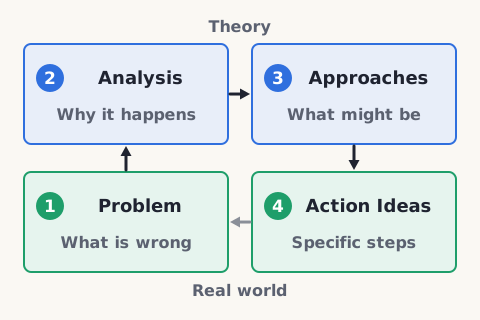
To guide negotiators through a systematic process of creative problem-solving, Roger Fisher, William Ury, and Bruce Patton designed The Circle Chart. The Circle Chart organizes strategic thinking across four quadrants, bridging concrete real-world symptoms with conceptual theory and actionable solutions:
Step 1: Problem (Real World / What Is): Identify what is currently wrong in the concrete situation. List the specific symptoms, observable breakdowns, and pain points experienced by both parties in the real world.
Step 2: Analysis (Theory / What Is): Diagnose the underlying systemic causes behind the symptoms. Classify problems into categories, identify missing incentives or structural bottlenecks, and analyze what mechanisms are failing in theory.
Step 3: Approaches (Theory / What Might Be): Brainstorm broad conceptual remedies and theoretical strategies. What principles, economic models, or policy frameworks could address the diagnosed causes in theory?
Step 4: Action Ideas (Real World / What Might Be): Translate theoretical approaches into specific, tangible, and actionable steps that negotiators can implement tomorrow in the real world.
By cycling between the concrete world and theoretical analysis across the four quadrants of the Circle Chart, negotiators unlock dozens of novel options that traditional bargaining ignores. For example, in a dispute over Northern Ireland's school curriculum, cycling through the Circle Chart turned the symptom that Catholic and Protestant students used entirely different history textbooks into concrete action ideas: producing a shared history textbook for both systems and creating a teacher exchange program between them — ideas neither side had proposed while arguing only about whose curriculum should prevail.
Systematic Implementation of the Circle Chart
To maximize the practical yield of The Circle Chart, teams should structure joint strategy sessions to move systematically through the four quadrants:
- Map Current Symptoms (Quadrant I - Real World / What Is): Document every observable breakdown, missed deadline, quality defect, or financial shortfall without assigning blame.
- Diagnose Systemic Causes (Quadrant II - Theory / What Is): Group symptoms into root-cause categories (e.g., misaligned incentive structures, information asymmetry, ambiguous authority, or mismatched operational cadences).
- Formulate Conceptual Strategies (Quadrant III - Theory / What Might Be): Develop high-level theoretical remedies (such as risk-sharing formulas, contingent bonuses, third-party monitoring, or joint steering committees).
- Author Concrete Action Items (Quadrant IV - Real World / What Might Be): Convert high-level remedies into specific, measurable contractual clauses and operational commitments that both sides can execute immediately.
Brainstorming, Dovetailing Differences & Drafting Yesable Propositions
To generate an abundance of creative options, negotiators must strictly separate the creative act of inventing options from the analytical act of judging options. When inventing and deciding occur simultaneously, creative ideation is strangled by immediate critique and risk aversion.
Structured joint brainstorming sessions should follow three distinct phases:
- Before the Session: Clarify the specific purpose, select a small group of 5 to 8 participants, arrange an informal and neutral environment, and appoint a facilitator to maintain focus and enforce ground rules.
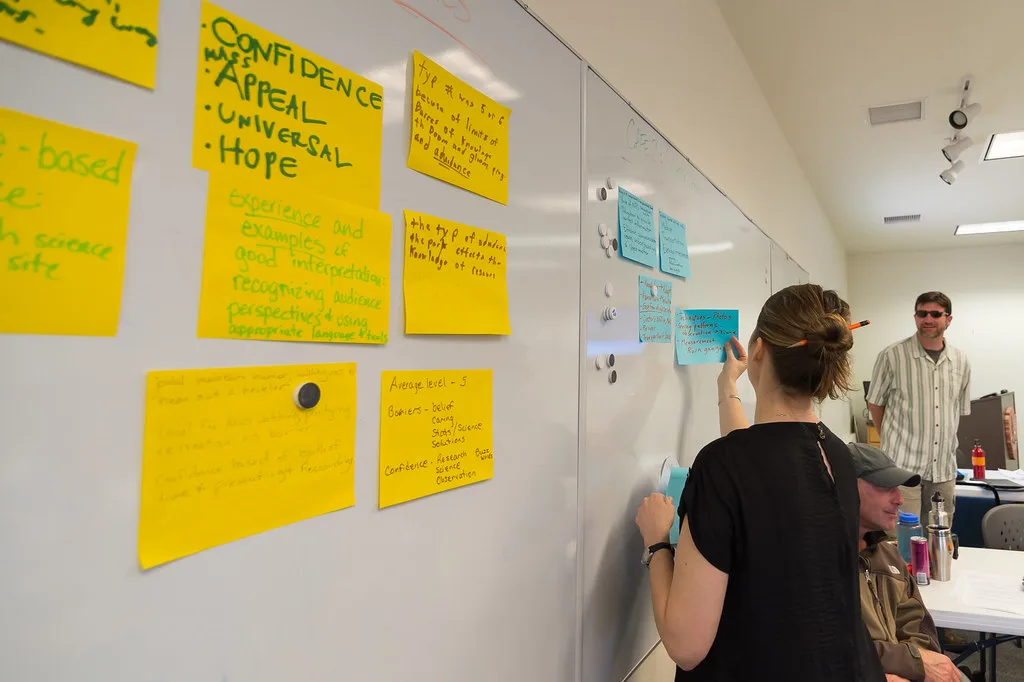
- During the Session: Seat participants side-by-side facing the problem (such as a whiteboard), establish an absolute rule of zero criticism, encourage wild or unconventional ideas, and record all contributions visibly so all participants share ownership of the generated list.
- After the Session: Review the recorded list, star the most promising options, invent improvements to make unorthodox ideas feasible, and set a separate subsequent meeting to evaluate and select finalists.
To multiply options, negotiators should examine issues through the lenses of different professions (such as an engineer, an economist, a psychologist, or an attorney) and invent agreements of differing strengths (such as provisional vs. permanent, partial vs. comprehensive, or substantive vs. procedural).
Negotiators mistakenly believe that agreement is easiest when parties share identical preferences. In reality, value creation in negotiation is driven primarily by differences in interests, valuations, and tolerances. By dovetailing differing interests, negotiators trade items of low cost to themselves but high value to the other side:
- Differences in risk tolerance: A risk-averse party can trade potential upside for guaranteed fixed payments, while a risk-tolerant party absorbs variability for greater long-term return.
- Differences in time preferences: A party facing an immediate cash crunch can accept lower total compensation in exchange for upfront payment, while a well-capitalized counterpart benefits from deferred terms.
- Differences in future forecasts: Differing expectations about future market conditions can be harmonized through contingent agreements, earn-outs, or performance incentives.
- Differences in valuations: A buyer may place immense value on immediate technical support, which the seller can provide at near-zero marginal cost.
Finally, principled negotiators focus on making the counterpart's decision as simple and painless as possible:
- Identify the decision-maker: Focus precisely on the individual whose choice you need to influence ("Whose shoes are you trying to put yourself in?").
- Address their internal constraints: Consider the political, organizational, and personal pressures they face from superiors, colleagues, and constituents.
- Draft a 'yesable proposition': Structure your proposal as a complete, self-contained, and ready-to-execute document. Rather than asking the counterpart to solve complex drafting ambiguities, present an offer that requires only a simple "Yes" to close the agreement.
This approach was demonstrated at the United Nations Conference on the Law of the Sea (UNCLOS), where deep-sea mining deadlocks between developing and industrialized nations were resolved by dovetailing differing economic tolerances into a two-tier structure: low front-end exploration fees combined with progressive profit-sharing taxes once commercial mining commenced.
Engineering High-Value Yesable Propositions
A truly effective yesable proposition satisfies three rigorous criteria:
- Decision-Maker Specificity: It is drafted directly for the specific executive or representative with authority to approve it, directly addressing their mandate and political constraints.
- Operational Completeness: It contains all necessary legal, financial, and procedural details, requiring zero additional negotiation rounds to execute.
- Effortless Closure: It is framed as an offer that can be accepted with a simple signature or a single word ("Yes"), eliminating friction and ambiguity.
By combining structured brainstorming, multi-factor dovetailing, and polished yesable propositions, negotiators dramatically compress deal timelines while maximizing total value created.
The Psychological Power of Joint Inventing
When negotiators co-create options side-by-side, the psychology of ownership fundamentally changes the bargaining climate. In traditional bargaining, an offer presented by one side is viewed with suspicion (reactive devaluation). In contrast, options developed during structured joint brainstorming are perceived as shared intellectual property. Both parties feel invested in defending and refining the solutions they created together, converting potential adversaries into cooperative problem-solving partners.
Key terms
- Fixed Pie Zero-Sum Assumption
- The assumption of a fixed pie: Negotiators view the negotiation through a zero-sum lens, assuming that every dollar, benefit, or concession gained by one side must come directly out of the pocket of the other side.
- Post-Brainstorming Review Protocol
- After the Session: Review the recorded list, star the most promising options, invent improvements to make unorthodox ideas feasible, and set a separate subsequent meeting to evaluate and select finalists.
- Targeting the Decision-Maker
- Identify the decision-maker: Focus precisely on the individual whose choice you need to influence ("Whose shoes are you trying to put yourself in?").
Key facts
Four Obstacles to Creative Options
In most negotiations there are four major obstacles that inhibit the inventing of an abundance of options: (1) premature judgment; (2) searching for the single answer; (3) the assumption of a fixed pie; and (4) thinking that 'solving their problem is their problem.'
Premature Judgment Suffocates New Ideas
The moment a new idea is suggested, the critical faculty tends to suffocate the creative faculty: participants immediately analyze its flaws and shoot it down before it can be explored or refined. Fear of appearing foolish or revealing vulnerability keeps people from voicing innovative proposals in the first place.
Two More Obstacles: One Right Answer, and "Their Problem Is Their Problem"
Negotiators often assume their task is to find the one "right" solution immediately, prematurely converging on a narrow compromise instead of exploring a wide range of possibilities. They also tend to focus exclusively on their own demands, forgetting that a sustainable agreement must solve the counterpart's internal problems too — a proposal that ignores the other side's constraints will simply be rejected.
The Circle Chart's Four Quadrants
Roger Fisher, William Ury, and Bruce Patton designed the Circle Chart to guide negotiators through a systematic process of creative problem-solving. It organizes thinking across four quadrants, cycling between the concrete real world and conceptual theory to bridge symptoms with actionable solutions.
The Fixed-Pie Assumption
Negotiators often view a negotiation through a zero-sum lens, assuming every dollar or benefit one side gains must come directly out of the other side's pocket. This cognitive trap blinds parties to opportunities for joint gains — such as when a negotiator wrongly assumes any gain for one side must be a loss for the other.
Comparing approaches regarding Circle Chart Quadrant 1 - Problem:
Positional Bargaining — Negotiation Focus: Rigid stances, defense of ego, and grudging concessions; Standard of Outcome: Conceding to pressure, stubbornness, or artificial deadlines
Principled Negotiation — Negotiation Focus: Underlying interests, shared needs, and creative value creation; Standard of Outcome: Agreements tested against fair, objective criteria rather than raw pressure or willpower.
Circle Chart Quadrant 2: Analysis
The Circle Chart's second quadrant, Analysis, diagnoses the underlying systemic causes behind the symptoms identified in Quadrant 1. It classifies problems into categories and identifies missing incentives or structural bottlenecks — moving from what is observably wrong to why it is happening.
Circle Chart Quadrant 3 - Approaches
Step 3: Approaches (Theory / What Might Be): Brainstorm broad conceptual remedies and theoretical strategies. What principles, economic models, or policy frameworks could address the diagnosed causes?
Circle Chart Quadrant 4, and Cycling Through the Chart
The fourth quadrant, Action Ideas, translates theoretical approaches into specific, tangible steps negotiators can implement tomorrow. By cycling repeatedly between the concrete world and theoretical analysis across all four quadrants, negotiators unlock dozens of novel options that traditional bargaining never surfaces.

The Circle Chart in Action: Northern Ireland's History Textbooks
In a dispute over Northern Ireland's school curriculum, cycling through the Circle Chart turned the symptom that Catholic and Protestant students used entirely different history textbooks into concrete action ideas: producing a shared history textbook for both systems and creating a teacher exchange program between them — ideas neither side had proposed while arguing only about whose curriculum should prevail.
Separation of Inventing from Deciding
To generate an abundance of options, negotiators must strictly separate the creative act of inventing options from the analytical act of judging options.
Brainstorming Sessions: Preparing Before, Reviewing After
Before a brainstorming session, clarify its purpose, select a small group of 5 to 8 participants, arrange an informal setting, and appoint a facilitator. After the session, review the recorded list, star the most promising options, invent improvements to make unorthodox ideas feasible, and set a separate follow-up meeting to evaluate and select finalists.
Zero Criticism During the Brainstorming Session
During the session itself, participants sit side-by-side facing the problem — such as a shared whiteboard — rather than facing each other, and an absolute rule of zero criticism is enforced. Wild or unconventional ideas are encouraged and recorded visibly so every participant shares ownership of the list.
Dovetailing: Trade What's Cheap for You for What They Value
Negotiators mistakenly believe agreement is easiest when parties share identical preferences, but value creation is actually driven by differences. By dovetailing differing interests, negotiators trade items that cost them little but are worth a great deal to the other side.
Comparing approaches regarding Value Creation Through Differences:
Positional Bargaining — Negotiation Focus: Rigid stances, defense of ego, and grudging concessions; Standard of Outcome: Conceding to pressure, stubbornness, or artificial deadlines
Principled Negotiation — Negotiation Focus: Underlying interests, shared needs, and creative value creation; Standard of Outcome: Agreements tested against fair, objective criteria rather than raw pressure or willpower.
Dovetailing Differences in Risk Tolerance
A risk-averse party can trade potential upside for guaranteed fixed payments, while a risk-tolerant counterpart absorbs the variability in exchange for a shot at greater long-term return. This is dovetailing a difference in risk tolerance into a deal that suits both parties' temperaments.
Dovetailing Time Preferences
Differences in time preferences: A party facing an immediate cash crunch can accept lower total compensation in exchange for upfront payment, while a well-capitalized counterpart benefits from deferred terms.
Dovetailing Differing Forecasts and Valuations
Differing expectations about future market conditions can be harmonized through contingent agreements, earn-outs, or performance incentives. Likewise, a buyer may place immense value on something the seller can provide at near-zero marginal cost, such as immediate technical support — a difference in valuation that both sides can exploit.

The UNCLOS Deep-Sea Mining Deadlock
At the United Nations Conference on the Law of the Sea, deep-sea mining deadlocks between developing and industrialized nations were resolved by dovetailing differing economic tolerances into a two-tier structure: low front-end exploration fees paired with progressive profit-sharing taxes once commercial mining commenced.
The Yesable Proposition: Target the Decision-Maker
Effective proposals identify the specific decision-maker and address their internal constraints, then draft a 'yesable proposition' — a complete, self-contained, ready-to-execute document requiring only a simple "yes." A strong yesable proposition is decision-maker-specific, operationally complete, and effortless to close; competitive pricing on its own is not one of its three defining criteria.
Comparing approaches regarding Two-Tier Risk-Profit Mining Tax:
Positional Bargaining — Negotiation Focus: Rigid stances, defense of ego, and grudging concessions; Standard of Outcome: Conceding to pressure, stubbornness, or artificial deadlines
Principled Negotiation — Negotiation Focus: Underlying interests, shared needs, and creative value creation; Standard of Outcome: Agreements tested against fair, objective criteria rather than raw pressure or willpower.
Matched pairs
Each item on the left goes with the one on the right.
- Search for the Single Answer Trap
- Assuming there's one right fix cuts off other options too soon.
- Circle Chart Theoretical Grounding
- A four-quadrant tool linking real symptoms to theory and action.
- Iterative Cycling Across Quadrants
- Cycling between concrete facts and theory reveals fresh options.
- Zero Criticism Rule During Ideation
- In brainstorming, no idea may be judged until the session ends.
- Trading Differences for Mutual Value
- Give up what costs you little but the other side prizes highly.
- Asymmetric Valuation Trade-Offs
- One party may prize something the other can supply almost free.
- UNCLOS Deep Seabed Deadlock
- Low fees and profit sharing broke a seabed-mining standoff.
Step by step
Applying the core principled-negotiation framework (interests, options, objective criteria)
- Identify underlying interests and separate personal dynamics from substantive issues
- Generate multiple creative options and dovetail differing preferences for mutual gain
- Anchor the final agreement on legitimate, independent objective criteria
Self-test
Answer each question from memory, then check your work against the answer key.
1. Which obstacle occurs when the critical faculty suffocates the creative faculty during idea generation?
- ASearching for the single answer
- BAssumption of a fixed pie
- CSolving their problem is their problem
- DPremature judgment
2. Which of these is NOT one of the four obstacles to inventing options in negotiation?
- AAnchoring bias
- BPremature judgment
- CSearching for the single answer
- DAssumption of a fixed pie
3. Along with Roger Fisher and William Ury, which author co-designed the Circle Chart?
- AThomas Schelling
- BBruce Patton
- CHerb Cohen
- DHoward Raiffa
4. In the Circle Chart, which quadrant focuses on diagnosing the underlying systemic causes of a problem?
- AAction Ideas
- BProblem
- CAnalysis
- DApproaches
5. A negotiator assumes any gain for one side must be a loss for the other. Which obstacle is this?
- ASearching for the single answer
- BPremature judgment
- CAssumption of a fixed pie
- DSolving their problem is their problem
6. According to the brainstorming guidelines, how many participants should an ideal session include?
- A2 to 4
- B10 to 15
- C20 to 25
- D5 to 8
7. Which of these is NOT one of the three criteria for a strong 'yesable proposition'?
- ADecision-maker specificity
- BCompetitive pricing
- CEffortless closure
- DOperational completeness
8. One party accepts guaranteed fixed payments instead of an uncertain payout, while the other absorbs the fluctuation for a shot at greater return. This dovetails which difference?
- ARisk tolerance
- BTime preferences
- CFuture forecasts
- DValuations
9. What ground rule must be strictly enforced during a brainstorming session?
- AImmediate ranking of ideas
- BZero criticism
- CMajority voting on each idea
- DAssigning a devil's advocate
10. The UNCLOS deep-sea mining deadlock was resolved by pairing low front-end exploration fees with what?
- AFixed annual licensing fees
- BEqual revenue splitting
- CProgressive profit-sharing taxes
- DMandatory technology transfers
Go deeper
- ReadGetting to Yes by Roger Fisher, William Ury, Bruce Patton · on Amazon ↗
- StudyGetting to yes in the FlashFeed app
These are affiliate links: if you buy a book through one, FlashFeed may earn a small commission at no extra cost to you. The commission helps pay for FlashFeed's servers.
As an Amazon Associate we earn from qualifying purchases.
Answer key
- 1. D Premature judgmentPremature judgment happens when new ideas are immediately criticized, silencing creativity before they can be explored.
- 2. A Anchoring biasThe four obstacles are premature judgment, searching for the single answer, the fixed-pie assumption, and treating the other side's problem as solely theirs.
- 3. B Bruce PattonFisher, Ury, and Bruce Patton together designed the Circle Chart framework for creative problem-solving.
- 4. C AnalysisQuadrant 2, Analysis, diagnoses systemic causes; Problem lists symptoms, Approaches brainstorms remedies, Action Ideas builds steps.
- 5. C Assumption of a fixed pieThis zero-sum view, 'the more for you, the less for me', defines the fixed-pie assumption obstacle.
- 6. D 5 to 8A small group of 5 to 8 participants keeps a brainstorming session focused and manageable.
- 7. B Competitive pricingA yesable proposition needs decision-maker specificity, operational completeness, and effortless closure, not competitive pricing.
- 8. A Risk toleranceTrading guaranteed payments for potential upside dovetails the parties' differing risk tolerances.
- 9. B Zero criticismAn absolute rule of zero criticism keeps participants generating ideas freely without fear of judgment.
- 10. C Progressive profit-sharing taxesThe two-tier UNCLOS deal combined low upfront exploration fees with progressive profit-sharing taxes once mining began.
Sources
- Getting to yes — Roger Fisher, William Ury, and Bruce Patton
- Getting to Yes — Roger Fisher, William Ury, and Bruce Patton
Image credits
- The Circle Chart's Four Quadrants: FlashFeed original diagram · CC-BY-4.0
- Circle Chart Quadrant 4, and Cycling Through the Chart: Joshua Tree National Park (Openverse) · pdm 1.0 — www.flickr.com/photos/115357548@N08/16520442071
- The Circle Chart in Action: Northern Ireland's History Textbooks: Wikimedia Commons · Eric Jones · CC BY-SA 2.0 — commons.wikimedia.org/wiki/File:Kilbroney_Integrated_School,_Rostrevor_-_geograph.org.uk_-_2977526.jpg
- The UNCLOS Deep-Sea Mining Deadlock: Wikimedia Commons · Kidfly182 · CC BY-SA 4.0 — commons.wikimedia.org/wiki/File:Midtown_Manhattan_Skyline_004_(cropped).jpg

