
Getting to yes study guide · Lesson 5 of 6
Insist on Objective Criteria
Developing Fair Standards and Independent Procedures · Negotiating with Objective Principles & Resisting Coercion
Unofficial study guide for Getting to Yes: Negotiating Agreement Without Giving In (3rd ed.) by Roger Fisher, William Ury, Bruce Patton. FlashFeed is not affiliated with the author or publisher.
This is the lesson's study guide from the FlashFeed app, plus its key facts and a self-test.
What you'll be able to do
- Identify objective criteria (market value, precedent, professional standards) and fair procedures such as taking turns or one cuts, the other chooses.
- State the three guidelines for negotiating with objective criteria (joint search, reason and openness to reason, never yield to pressure).
Developing Fair Standards and Independent Procedures
When negotiating parties face directly conflicting interests—such as a buyer seeking a lower price and a seller demanding a higher price—resolving the dispute through positional bargaining degenerates into an exhausting battle of wills. The party willing to be more stubborn, belligerent, or irrational forces concessions from the more reasonable party, leaving a legacy of resentment, damaged relationships, and unstable agreements.
Principled Negotiation resolves conflicts on their merits by insisting on objective criteria. As Roger Fisher, William Ury, and Bruce Patton assert: negotiate on some basis independent of the will of either side—that is, on the basis of objective criteria. Objective criteria ensure that agreements reflect fair, legitimate, and workable standards rather than raw willpower, stubbornness, or coercion.
To establish objective criteria, negotiators identify external benchmarks recognized by law, industry, science, or commerce:
- Market value: Prevailing commercial sales data, real estate comps, or market transaction records.
- Precedent: Past organizational practices, previous contract terms, or historical settlement benchmarks.
- Scientific judgment: Environmental impact studies, engineering load calculations, or clinical lab findings.
- Professional standards: Standard accounting principles (GAAP), medical ethics codes, or architectural safety guidelines.
- Efficiency and cost data: Time-motion studies, fuel economy data, or audited production costs.
- Replacement cost / Depreciated book value: Standardized valuation formulas accepted by insurers and appraisers.
- Court rulings: How an independent judge, arbitrator, or administrative panel would decide the case based on established statute.
A valid objective criterion must be independent of both parties' subjective desires and legitimate in the eyes of all stakeholders. Grounding proposals in legitimate standards shields negotiators from accusations of arbitrary greed and provides the other party with a principled basis for agreeing that they can defend to their peers.
When parties cannot agree on substantive criteria, they can turn to fair procedures to resolve differences amicably:
- 'One cuts, the other chooses': The classic procedural mechanism for dividing a resource (such as cake cutting or estate division). One party divides the assets into two equal packages, and the other party chooses which package to take. This gives the divider an absolute incentive to make both packages perfectly equitable.
- Taking turns: Rotating priority in scheduling, assignment of choice territories, or operational leadership.
- Drawing lots or coin toss: Utilizing pure mathematical randomness for allocating minor or equally valued items.
- Binding third-party arbitration: Agreeing in advance to submit unresolved disputes to an impartial expert whose ruling is final.
By establishing fair procedures or objective standards, negotiators transform an adversarial clash of personalities into a cooperative intellectual search for the right standard.
The Multi-Dimensional Spectrum of Substantive Standards
When identifying objective criteria for complex commercial or legal negotiations, practitioners should explore multiple standard categories:
- Financial & Economic Standards: Verified replacement cost, depreciated book value, competitive price bids, discounted cash flow valuations, and inflation indices.
- Technical & Scientific Standards: Independent engineering stress tests, environmental impact metrics, ISO quality certifications, and clinical safety data.
- Legal & Ethical Standards: Prevailing statutory law, judicial precedents, established trade customs, and industry-standard codes of ethics.
- Procedural Benchmarks: Standardized commercial arbitration rules, equal allocation mechanisms ("one cuts, the other chooses"), and rotating leadership schedules.
Grounding proposals in well-established, independent standards transforms negotiations from subjective power struggles into collaborative, principled problem-solving.
Establishing Multi-Tiered Independent Criteria
In high-stakes corporate and international negotiations, the credibility of an objective standard depends directly on its perceived independence. If a standard appears biased toward one party, it will be rejected as veiled positional pressure. Principled negotiators should seek standards that have been established by neutral third parties prior to the current dispute—such as published commercial indices, standardized industry contracts, independent scientific research, or statutory guidelines—ensuring that neither party can manipulate the benchmark for unilateral gain.
Negotiating with Objective Principles & Resisting Coercion
To execute principled negotiation using objective criteria in live discussions, follow three operational guidelines:
Frame each issue as a joint search for objective criteria: Open discussions by proposing a collaborative search for fair standards: "You want a high settlement and I want a low settlement. Let's look at what a fair figure is based on industry precedent. What objective standards should we use?" Framing the issue as a joint search invites the other party into a shared inquiry rather than putting them on the defensive.
Reason and be open to reason as to which standards are most appropriate: When the other party suggests an objective standard, do not dismiss it. Analyze why they consider it fair, propose alternative standards, and engage in open reasoning about which standard best fits the facts. A principled negotiator is willing to be persuaded by facts and reason, but refuses to be moved by mere assertions of will.
Never yield to pressure—only to principle: Refuse to capitulate to pressure in any guise, whether it takes the form of a bribe, a threat, an emotional plea to trust, or a stubborn refusal to negotiate. As the authors state, never yield to pressure, only to principle. In response to power, principled negotiators ask the other side to state the reasoning behind their position, suggest objective criteria of their own, and refuse to budge except on this basis.
In Getting to Yes, the authors illustrate the application of objective criteria through the classic negotiation between a car owner whose vehicle was totaled in an accident and an insurance adjuster:
- When the adjuster offers an arbitrary low settlement ($13,600) based on company policy, the owner does not become emotional or counter with an arbitrary demand.
- Instead, the owner inquires into the standard: "How did you arrive at that figure? What objective standard did you use?"
- When the adjuster cites depreciated book value, the owner presents comparisons to similar used cars selling for a much higher price, and offers to visit local automobile dealers together to obtain written replacement estimates.
- By persistently anchoring the discussion on objective market data and refusing to yield to arbitrary policy pressure, the owner secures a fair replacement settlement of $18,024 while maintaining a completely professional and constructive relationship with the adjuster.
In real-world treaty negotiations, the same principle guided the Law of the Sea Conference: when nations disagreed over what fee mining companies should pay to extract seabed manganese nodules, negotiators turned to an economic model — developed with input from MIT — that projected a mine's likely costs and profits under different fee formulas, replacing a raw contest of positions with a shared analysis of the numbers.
Responding to Coercive Pressure in Practice
When counterparts resort to coercive pressure—such as take-it-or-leave-it ultimatums, artificial deadlines, or veiled threats—principled negotiators refuse to react emotionally or counter with an ultimatum of their own. Instead, per Fisher and Ury's guidance, they ask the other side to state the reasoning behind their position, probing calmly for the objective standard behind the demand ("What is the basis for that number or deadline?"), and refuse to budge except on that basis.
By consistently rewarding reason and ignoring pressure, you train the counterpart that the only way to reach an agreement is through principled negotiation on the merits.
Transforming Arbitrary Demands into Principled Inquiries
When a counterpart states an inflexible opening demand, the most effective response is not to argue, but to ask: "What is the theory behind that number?" By inviting the counterpart to explain the objective principles supporting their position, you shift the dialogue from an assertion of will to an examination of merits. If the counterpart possesses a legitimate basis, you can evaluate it rationally; if the demand is arbitrary, their inability to justify it with objective criteria creates natural momentum toward a fair, principled benchmark.
Key terms
- Precedent as Objective Benchmark
- Past organizational practices, previous contract terms, or historical settlement benchmarks used as an objective yardstick neither party invented for the dispute.
- Divider Incentive for Equity
- This gives the divider an absolute incentive to make both packages perfectly equitable.
- Refusal to Capitulate to Coercion
- Refuse to capitulate to pressure in any guise, whether it takes the form of a bribe, a threat, an emotional plea to trust, or a stubborn refusal to negotiate.
- Contrasting Competing Standards
- Analyze why they consider it fair, propose alternative standards, and engage in open reasoning about which standard best fits the facts.
Key facts
Replacing Battles of Will with Merit
Principled negotiation resolves conflicts on their merits by insisting on objective criteria.
Objective Criteria: Market Value and Professional Standards
Market value draws on prevailing commercial sales data, real estate comps, or transaction records to justify a figure. Professional standards — such as GAAP accounting principles or medical ethics codes — provide another independent benchmark that neither party invented for the occasion.
Objective Criteria: Precedent and Scientific Judgment
Precedent draws on past organizational practices, previous contract terms, or historical settlement benchmarks. Scientific judgment draws on environmental impact studies, engineering load calculations, or clinical lab findings — both are external standards no one party controls.
Comparing approaches regarding Efficiency and Audited Costs:
Efficiency and cost data — such as time-motion studies, fuel economy data, or audited production costs — is another objective criterion negotiators can anchor a proposal on, rather than an arbitrary company figure.
Replacement Cost and Depreciated Book Value
Replacement cost and depreciated book value are standardized valuation formulas accepted by insurers and appraisers alike. Anchoring a settlement on such formulas — rather than an arbitrary company policy figure — grounds the number in a method neither side invented for the dispute.
Judicial Rulings and Statutes
Court rulings: How an independent judge, arbitrator, or administrative panel would decide the case based on established statute.
An Objective Criterion Must Be Independent and Legitimate
A valid objective criterion must be independent of both parties' subjective desires and legitimate in the eyes of all stakeholders. Grounding a proposal in a legitimate standard shields a negotiator from accusations of arbitrary greed and gives the other side a principled basis for agreeing that they can defend to their own peers.
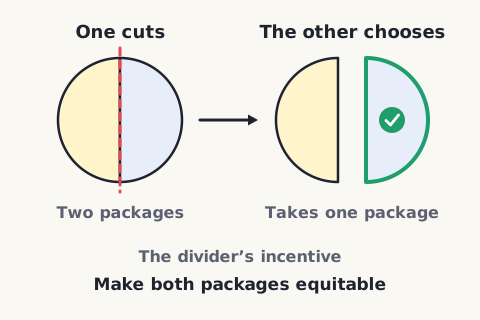
"One Cuts, the Other Chooses"
The classic procedure for dividing a resource — such as cutting a cake or dividing an estate — has one party split the assets into two packages while the other party chooses which package to take. This gives the divider an absolute incentive to make both packages as equitable as possible.
Fair Procedures: Taking Turns, Drawing Lots, and Arbitration
When parties cannot agree on substantive criteria, they can turn to fair procedures instead: taking turns rotating priority, drawing lots or a coin toss for equally valued items, or binding third-party arbitration where an impartial expert's ruling is final. A majority vote is not one of these classic fair procedures for two-party disputes.
Comparing approaches regarding Binding Impartial Arbitration:
Binding third-party arbitration means agreeing in advance to submit an unresolved dispute to an impartial expert whose ruling both sides accept as final.
Framing Joint Search for Standards
Frame each issue as a joint search for objective criteria: Open discussions by proposing a collaborative search for fair standards: "You want a high settlement and I want a low settlement. Let's look at what a fair figure is based on industry precedent. What objective standards should we use?"
Reason and Be Open to Reason About Standards
When the other party suggests an objective standard, do not dismiss it outright. Analyze why they consider it fair, propose alternative standards, and engage in open reasoning about which one best fits the facts — a principled negotiator is willing to be persuaded by facts and reason, but not by mere assertions of will.
Never Yield to Pressure, Only to Principle
Refuse to capitulate to pressure in any guise, whether a bribe, a threat, an emotional plea, or a stubborn refusal to negotiate. In response to power, principled negotiators ask the other side to state the reasoning behind their position, suggest objective criteria of their own, and refuse to budge except on that basis.
Probing for the Standard Behind an Offer
Rather than reacting emotionally or countering with an arbitrary demand, an effective negotiator inquires directly into the standard behind a low offer: "How did you arrive at that figure? What objective standard did you use?" This question shifts the conversation from a clash of numbers to an examination of the reasoning.
The Totaled Car: A $13,600 Offer Based on Depreciated Book Value
When an insurance adjuster offers an arbitrary low settlement of $13,600 for a totaled car based on company policy, the owner does not get emotional or counter with an arbitrary demand. Instead the owner learns the adjuster cited depreciated book value as the basis, giving the owner a concrete standard to challenge with better data.
Comparing approaches regarding Introducing Local Market Data:
Introducing local market data — such as recent classified ads for comparable vehicles or a written dealer estimate — gives a negotiator concrete, independent numbers to counter an arbitrary company figure.

Securing an $18,024 Replacement Settlement
The car owner presented comparisons to similar used cars selling for a much higher price than the adjuster's offer and offered to visit dealers together for written replacement estimates. By persistently anchoring on objective market data and refusing to yield to arbitrary policy pressure, the owner secured a fair $18,024 settlement while keeping the relationship with the adjuster professional.
Preserving Professional Adjuster Relationship
The owner secures a fair replacement settlement of $18,024 while maintaining a completely professional and constructive relationship with the adjuster.
Comparing approaches regarding Legitimacy Across Multi-Stakeholders:
A criterion is only useful if every stakeholder can see it as legitimate rather than skewed toward one side — a standard only one party would accept invites suspicion instead of agreement.
Matched pairs
Each item on the left goes with the one on the right.
- Market Value Benchmark
- Prevailing sales, real estate comps, or transaction records.
- Professional Standards Benchmark
- GAAP rules, medical ethics codes, or safety guidelines.
- One Cuts Other Chooses Rule
- A resource is split in two; the other side picks a share.
- Randomness Via Coin Toss
- Drawing lots settles minor, equally valued items fairly.
- Never Yield to Pressure Mandate
- Give ground only to sound reasoning, never to threats or bribes.
- Probing for Adjuster Standard
- Ask how they arrived at that number and on what basis.
- Standardizing Commercial Appraisals
- Replacement cost or depreciated value, the formula insurers use.
Step by step
Applying the general principled-negotiation process
- Identify underlying interests and separate personal dynamics from substantive issues
- Generate multiple creative options and dovetail differing preferences for mutual gain
- Anchor the final agreement on legitimate, independent objective criteria
Self-test
Answer each question from memory, then check your work against the answer key.
1. Which objective-criteria category includes GAAP and medical ethics codes?
- AProfessional standards
- BScientific judgment and studies
- CPrecedent
- DMarket value
2. A negotiator cites recent real estate comps and sales records to justify a price. Which criterion is this?
- AEfficiency and cost data
- BPrecedent
- CMarket value
- DCourt rulings
3. Which of these is NOT one of the fair procedures for resolving disputes without agreed criteria?
- ATaking turns
- BMajority vote
- CDrawing lots or coin toss
- DOne cuts, the other chooses
4. In the 'one cuts, the other chooses' procedure, what incentive does the divider have?
- ADelay the division indefinitely
- BInvolve a third-party arbitrator
- CKeep the larger share personally
- DMake both packages equitable
5. According to Getting to Yes, what must a valid objective criterion be?
- AChosen solely by legal counsel
- BIndependent and legitimate to both parties
- CBased on one side's initial offer or opening demand
- DFavorable to the stronger party
6. What is the first of the three operational guidelines for negotiating with objective principles?
- AFrame issue as joint search for standards
- BNever yield to pressure, only to principle
- CAcknowledge and pause first
- DReason and be open to reason
7. In the classic car-accident example, what was the insurance adjuster's initial settlement offer?
- A$4,000
- B$15,000
- C$13,600
- D$4,025
8. What standard did the insurance adjuster cite to justify the low offer?
- AKelly Blue Book valuation
- BReplacement cost estimates
- CMarket value comps
- DDepreciated book value
9. What does 'insist on objective criteria' mean in principled negotiation?
- ANegotiate on a basis independent of either side's will
- BWhichever side has more power decides the outcome
- CWhoever is more stubborn should set the terms
- DSplitting the difference in half satisfies fairness
10. When a counterpart uses raw power and refuses to budge, what does a principled negotiator do?
- AMatch their refusal with an ultimatum of their own
- BAsk for their reasoning, propose criteria, hold firm
- CAccept the position to avoid conflict
- DOffer a one-time bribe to end the impasse
Go deeper
- ReadGetting to Yes by Roger Fisher, William Ury, Bruce Patton · on Amazon ↗
- StudyGetting to yes in the FlashFeed app
These are affiliate links: if you buy a book through one, FlashFeed may earn a small commission at no extra cost to you. The commission helps pay for FlashFeed's servers.
As an Amazon Associate we earn from qualifying purchases.
Answer key
- 1. A Professional standardsGAAP and medical ethics codes are professional standards. Market value uses sales data; precedent uses past practice; scientific judgment uses studies and lab findings.
- 2. C Market valueMarket value relies on prevailing commercial sales data and comps. Precedent uses past agreements; efficiency data uses time-motion/cost studies; court rulings use judicial decisions.
- 3. B Majority voteGetting to Yes lists one-cuts-other-chooses, taking turns, drawing lots, and binding arbitration as fair procedures; majority vote is not among them.
- 4. D Make both packages equitableSince the other party picks first, the divider is incentivized to split the resource into two perfectly equal packages.
- 5. B Independent and legitimate to both partiesA valid objective criterion is independent of both parties' subjective desires and legitimate in the eyes of all stakeholders, not skewed toward either side.
- 6. A Frame issue as joint search for standardsThe first guideline is to frame each issue as a joint search for objective criteria, inviting shared inquiry rather than defensiveness.
- 7. C $13,600The adjuster's arbitrary opening offer was $13,600 based on company policy, well below the $18,024 the owner ultimately secured.
- 8. D Depreciated book valueThe adjuster justified the low figure using depreciated book value, while the owner countered with market comps, dealer estimates, and Kelly Blue Book.
- 9. A Negotiate on a basis independent of either side's willInsisting on objective criteria means grounding the outcome in a standard independent of either side's will, rather than in who is more stubborn or powerful.
- 10. B Ask for their reasoning, propose criteria, hold firmFacing coercion, principled negotiators ask the other side to justify its position, propose their own objective criteria, and refuse to move except on that basis.
Sources
- Getting to yes — Roger Fisher, William Ury, and Bruce Patton
- Getting to Yes — Roger Fisher, William Ury, and Bruce Patton
Image credits
- "One Cuts, the Other Chooses": FlashFeed original diagram · CC-BY-4.0
- Securing an $18,024 Replacement Settlement: AI-generated (gpt-image-1.5)