
How to Talk to Anyone: 92 Little Tricks for Big Success study guide · Lesson 1 of 6
Nonverbal Mastery & The First Ten Seconds
First Impressions, Posture & Eye Contact · Body Language, Attunement & Nonverbal Decoding
Unofficial study guide for How to Talk to Anyone: 92 Little Tricks for Big Success in Relationships by Leil Lowndes. FlashFeed is not affiliated with the author or publisher.
This is the lesson's study guide from the FlashFeed app, plus its key facts and a self-test.
What you'll be able to do
- Master the Flooding Smile, Sticky Eyes, and Hang by Your Teeth posture to project immediate authenticity in the first ten seconds.
- Apply the Big-Baby Pivot for ventral openness and decouple nervous pacifiers to project poise and attentiveness.
FlashFeed Study Guide | How to Talk to Anyone Knowledge Pack (Lesson 1)
First Impressions, Posture & Eye Contact
Human social cognition operates on ancient evolutionary mechanisms that evaluate strangers for threat, hierarchy, and collaborative potential in the opening moments of contact. Long before verbal language is processed, the subconscious mind scans for authentic indicators of status, emotional stability, and psychological openness. In How to Talk to Anyone, Leil Lowndes establishes that master communicators do not leave first impressions to chance; they cultivate deliberate nonverbal habits that project formidable competence alongside deep personal warmth.
The Flooding Smile & Neurological Authenticity
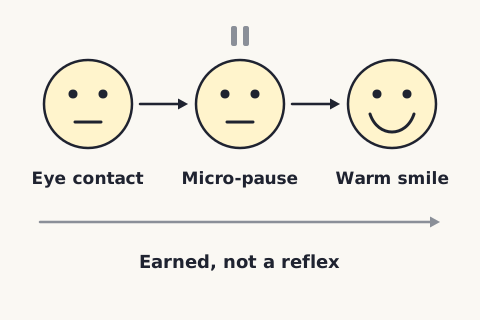
A ubiquitous pitfall in social interactions is flashing an immediate, indiscriminate smile upon making visual contact. When a smile is deployed instantly to anyone who walks into view, it registers subconsciously as an automatic greeting reflex or an anxious attempt to please. High-status communicators deploy The Flooding Smile. When meeting someone, maintain composure, gaze directly into their eyes for a split second, absorb their unique presence, and only then allow a warm, responsive smile to flood across your face and engulf your eyes.
This deliberate delay signals that the smile is a genuine emotional response crafted specifically for that individual. Neurophysiologically, it engages the orbicularis oculi muscle surrounding the eyes, which produces the characteristic crow's-feet wrinkles of a true Duchenne Smile. This stands in stark contrast to voluntary social grins that only activate the zygomaticus major muscle to pull back the lips. The Flooding Smile masterfully resolves the classic interpersonal tension between Warmth vs. Competence, establishing high executive presence without appearing aloof.
Gaze Dynamics: Sticky Eyes & Epoxy Eyes
Visual gaze is the most potent somatosensory channel of charisma. Sticky Eyes mandates maintaining continuous, warm eye contact even after your conversation partner has finished speaking. Rather than abruptly darting your eyes away the moment speech concludes, imagine your gaze connected by warm, gooey taffy. If you must look away, stretch the taffy slowly and reluctantly.
In multi-person settings, deploy Epoxy Eyes. Instead of looking at whoever is currently speaking, keep your visual focus glued to your target individual, carefully observing their reactions to the speaker's remarks. Some communication coaches suggest that maintaining direct eye contact for roughly 60% to 70% of an interaction optimizes perceived intimacy without tipping into a stare, though the precise figure isn't drawn from a single cited study, and produces genuine Pupillary Dilation that a partner reads unconsciously as fascination.
When disengaging visual focus, always break gaze laterally (to the side) rather than downward. Dropping your eyes downward signals shame, subservience, or deceit, whereas lateral gaze disengagement conveys thoughtful reflection and intellectual gravitas.
Somatic Architecture: Hang by Your Teeth
Physical posture communicates social rank instantly. Hang by Your Teeth utilizes a powerful somatosensory visualization: imagine biting down on a leather circus trapeze bit suspended from the top of every door frame. As you walk through, picture the trapeze pulling your cheekbones upward, stretching your spine, rolling your shoulders back, and lifting your ribcage.
This alignment optimizes Diaphragmatic Respiration and projects an aura of immovable social poise. By turning every architectural Doorway into a conditioning stimulus, you train your neuromuscular system to snap into an upright, elegant posture dozens of times a day. Ground your presence by planting Both Feet shoulder-width apart with equal weight distribution, execute a deliberate Micro-Pause upon initial eye contact, and maintain a wide, relaxed Peripheral Gaze to monitor room dynamics without darting your eyes erratically.
Cognitive Heuristics & The Ten-Second Appraisal Window
Leil Lowndes argues that within the first ten seconds of an encounter, human observers already form snap judgments regarding your trustworthiness, social power, and competence. Because these heuristics form before verbal conversation begins, nonverbal excellence is the foundational prerequisite for all subsequent communication.
Body Language, Attunement & Nonverbal Decoding
Beyond initial posture and gaze, ongoing physical orientation and the suppression of anxiety cues determine whether rapport flourishes or disintegrates.
The Big-Baby Pivot & Ventral Openness
When introduced to someone new, average conversationalists merely turn their neck, leaving their body oriented elsewhere. The Big-Baby Pivot requires rotating 100% of your body—including your torso, hips, and toes—directly toward the newcomer, mirroring how adults instinctively turn their entire physical self toward an adorable infant. This complete bodily orientation communicates undivided devotion, making the other person feel like the most significant individual in the room.
Pair this with Ventral Openness. The ventral front (chest and abdomen) houses the body's most vulnerable organs. Crossing your arms, clutching a drink like a protective shield, or holding bags across your chest creates a subconscious barricade that signals defensiveness. Keeping your front unobstructed signals fearless psychological availability and trust.
Hello Old Friend: Autonomic Affection
Because the autonomic nervous system governs hundreds of microscopic muscular twitches across the facial complex, genuine affection cannot be simulated through conscious willpower. Hello Old Friend provides an internal cognitive reframing technique: whenever you encounter a stranger, mentally treat them as a cherished lifelong friend whom you haven't seen in years. This mental shift effortlessly triggers natural eye softening, facial relaxation, and warm vocal timbre.
Limit the Fidget & Decoupling Pacifiers
Under social stress, humans instinctively perform Adapter Gestures—touching the face, scratching the nose, rubbing the neck, or twiddling rings. In nonverbal-communication research, these self-touching motions — often called adaptors — serve as neurological pacifiers that soothe the limbic system. However, in social and professional environments, fidgeting destroys credibility by signaling deceit, anxiety, and low status. Limit the Fidget mandates disciplined physical stillness; high-status communicators hold their limbs with calm composure.
Hans's Horse Sense & Micro-Behavioral Decoding
Named after the famous 20th-century horse Clever Hans who appeared to solve arithmetic by decoding human muscle twitches, Hans's Horse Sense cultivates acute sensitivity to human micro-cues. Master communicators observe Micro-Expressions lasting between 1/25th and 1/5th of a second to discern true emotions before conscious filters intervene.
Beyond that specific technique, a few general nonverbal reading skills are worth layering in:
- Head Tilts: Tilting the head slightly during active listening exposes the vulnerable neck, signaling non-threatening curiosity.
- Proxemic Boundaries: Respect the 1.5 to 4-foot social zone to prevent triggering claustrophobic recoil.
- Nonverbal Pacing: Synchronize your breathing cadence and physical tempo with your partner.
- Foot Orientation: Track the direction of a partner's feet; feet angled toward an exit reveal a subconscious urge to depart.
Core Takeaways & Practical Action Checklist
- Delay your smile by one second; let genuine warmth flood your eyes.
- Maintain unbroken eye contact across conversational transitions; break gaze sideways.
- Use doorway visualization to snap into tall, open, diaphragmatic posture.
- Rotate your entire torso and feet directly toward new arrivals.
- Eliminate all face-touching and fidgeting during high-stakes exchanges.
Real-World Case Study: The Executive Boardroom Introduction
Consider two executives entering an international summit. Executive A walks in quickly, flashing an instant grin at everyone in general, holding a coffee cup directly across his chest, and nervously scratching his collar while speaking. Subconsciously, the board registers anxiety and low status.
In contrast, Executive B enters calmly, shoulders rolled back and spine aligned (Hang by Your Teeth), and makes eye contact with the lead negotiator. She pauses for a full second before letting a warm smile flood her face (The Flooding Smile). When addressed, she pivots her entire body toward the speaker (The Big-Baby Pivot), keeps her hands resting still on the conference table (Limit the Fidget), and holds steady, warm eye contact (Sticky Eyes). Within sixty seconds, Executive B has commanded the room without uttering a controversial word.
Comparative Nonverbal Analysis Table
| Behavioral Dimension | Amateur Communicator | Elite High-Status Communicator |
|---|---|---|
| Smile Latency | Instant, reflexive grin upon sight | Deliberate 1-second pause; Duchenne Flooding Smile |
| Gaze Maintenance | Breaks gaze instantly; drops eyes down | Unbroken Sticky Eyes; slow lateral gaze break |
| Bodily Pivot | Turns neck only; torso angled away | 100% Big-Baby Pivot of torso, hips, and feet |
| Ventral Posture | Crossed arms; clutching drink over chest | Open ventral torso; relaxed hands at sides |
| Stress Gestures | Rubs nose, neck, or ears (pacifiers) | Disciplined physical stillness; grounded presence |
Actionable Behavioral Drills & Muscle Memory Exercises
- The Trapeze Threshold Drill: For the next 48 hours, treat every single door frame in your home and workplace as a physical trigger. Imagine biting down on the trapeze bit, feeling your cheekbones lift and spine stretch as you walk through.
- The Delayed Smile Practice: Practice in the mirror pausing for a full one-second count before letting a warm smile flood your eyes. Notice the engagement of your orbicularis oculi muscles.
- Lateral Gaze Calibration: In your next five conversational interactions, consciously practice breaking eye contact slowly to the left or right rather than glancing down at the floor.
Key terms
- Duchenne Smile
- A genuine facial expression that engages the muscle around the eyes, producing crow's-feet wrinkles.
- Epoxy Eyes
- Keeping your focus fixed on one listener in a group instead of whoever is speaking.
- Adapter Gestures
- Self-touching motions, like touching the face or scratching the nose, that soothe anxiety under stress.
Key facts
The Flooding Smile
The Flooding Smile technique holds off on smiling: look directly into someone's eyes for a beat, execute a deliberate micro-pause, and only then let a warm smile spread across your face. Flashing an instant, reflexive grin the moment someone comes into view reads as an automatic greeting reflex rather than a response to them specifically. The brief delay is what signals the smile was earned by their unique presence.
The Duchenne Smile
An authentic Duchenne smile engages the orbicularis oculi — the ring of muscle around the eyes — producing real crow's-feet crinkles. A posed social grin activates only the zygomaticus major, the muscle that pulls back the lips, leaving the eyes flat. Because the eye muscle is involuntary and hard to fake, it separates felt warmth from a polite reflex.
Sticky Eyes
Sticky Eyes means holding warm eye contact even after your partner finishes speaking, rather than darting away the instant they stop. Some communication coaches suggest direct eye contact for roughly 60% to 70% of an interaction optimizes intimacy without tipping into a stare, though the figure isn't from one cited study, and sustained, interested gaze produces genuine pupil dilation the other person reads unconsciously as fascination. When you do disengage, break gaze laterally — sideways reads as thoughtful, while dropping your eyes down reads as shame or evasion.
Epoxy Eyes
In a group conversation, Epoxy Eyes means keeping your gaze locked on your target listener rather than shifting to whoever is currently speaking, so you catch their reaction through the punchline. Softening your focus to a wide, relaxed peripheral gaze lets you monitor the room's movement without the tight, scanning look that broadcasts you're hunting for someone more important.
Hang by Your Teeth
Hang by Your Teeth is a posture visualization: imagine biting down on a circus trapeze bit hanging in every doorway, pulling your cheekbones up and your spine, shoulders, and ribcage into alignment as you walk through. An upright spine opens the ribcage for deeper breathing, so the poised presence is a physical by-product, not a pose. Doorways work as the trigger because you pass through dozens a day, resetting your posture for free, and planting both feet with even weight adds a stance that can't be shifted off balance.
The Ten-Second Window
Within the first ten seconds of meeting someone, observers form lasting snap judgments about trustworthiness, social power, and competence — well before a single word of conversation is exchanged. Because these impressions form on nonverbal cues alone, mastering posture, gaze, and expression is the foundation everything else builds on.
The Big-Baby Pivot
The Big-Baby Pivot means rotating your whole body — torso, hips, and toes, not just your neck — toward someone you've just been introduced to, the same total-body attention adults instinctively give an adorable infant. Pair it with ventral openness: keeping your chest and torso clear of crossed arms, a clutched drink, or a bag held like a shield, since anything held across the front reads as a subconscious barricade.
Hello Old Friend
Hello Old Friend is a mental reframe: when meeting a stranger, mentally treat them as a cherished old friend you haven't seen in years. Because the autonomic nervous system governs facial muscles, pupil size, and vocal cadence, this belief shift triggers genuine softening and warmth on its own — effects that can't be convincingly faked through conscious muscle control alone.
Limit the Fidget
Under social stress, people instinctively perform adapter gestures — touching the face, scratching the nose, rubbing the neck, twiddling a ring — which function as neurological pacifiers that soothe the nervous system. Limit the Fidget calls for disciplined stillness instead, because these self-touching motions read as anxiety, deceit, or low status to an observer regardless of what's being said. Fewer fidgets and more calm, contained stillness is what registers as higher social standing.
Hans's Horse Sense
Hans's Horse Sense is named after Clever Hans, a horse who appeared to solve arithmetic but was actually reading his trainer's involuntary muscle twitches. Lowndes builds the technique on that story: get on a dual track while you talk — say what you mean to say, but keep a keen eye on how your listener is reacting, catching the micro-expressions that flicker across a face in 1/25th to 1/5th of a second, faster than conscious filters can suppress them — and adjust your next move by what you just saw.
Reading the Room's Small Signals
Respecting the 1.5-to-4-foot social zone prevents triggering a claustrophobic recoil in conversation. Before trying to lift someone's energy, first match their breathing cadence and physical tempo — you can't lead someone from a pace they aren't in. And feet are more honest than faces: a partner's feet angled toward the exit reveal a subconscious urge to leave, whatever the conversation is saying.
Matched pairs
Each item on the left goes with the one on the right.
- Leil Lowndes
- Establishes that master communicators don't leave first impressions to chance
- Sticky Eyes
- Holding warm eye contact even after the other person stops talking
- Clever Hans
- Horse that seemed to solve arithmetic by reading human muscle twitches
- Ventral Openness
- Keeping chest and torso unobstructed instead of crossing your arms
Self-test
Answer each question from memory, then check your work against the answer key.
1. What does the Flooding Smile technique call for the moment you make eye contact?
- AKeep a flat, neutral expression
- BFlash an instant, reflexive grin
- CPause, then let the smile flood in
- DSmile first, then make eye contact
2. Which muscle produces the genuine crow's-feet crinkles of a Duchenne smile?
- AZygomaticus major
- BFrontalis
- CRisorius
- DOrbicularis oculi
3. Sticky Eyes means holding warm eye contact through which moment?
- AAfter your partner stops speaking
- BOnly while you are speaking
- COnly during the initial greeting
- DWhile scanning the room's exits
4. Priya meets a stranger, holds eye contact for a beat, then lets warmth spread across her face. Which technique is this?
- ASticky Eyes
- BThe Flooding Smile
- CEpoxy Eyes
- DHang by Your Teeth
5. Which body part is NOT part of the Hang by Your Teeth doorway visualization?
- ACheekbones
- BEyebrows
- CSpine
- DRibcage
6. The Big-Baby Pivot calls for rotating which parts of your body toward someone new?
- AOnly the feet and knees
- BOnly the neck and head
- CJust the shoulders and arms
- DTorso, hips, and toes
7. Ventral openness means keeping which part of your body unobstructed?
- AChest and torso
- BHips and legs
- CNeck and throat
- DBack and shoulders
8. Which of these counts as an adapter gesture — a nervous pacifier signaling anxiety?
- APlanting both feet shoulder-width apart
- BRotating the torso toward someone
- CScratching the nose
- DTilting the head while listening
9. Marcus keeps twisting his ring and rubbing his neck during a tense meeting. What is he displaying?
- AAdapter gestures
- BHans's Horse Sense
- CThe Big-Baby Pivot
- DVentral openness
10. Limit the Fidget calls for which response to social stress, instead of fidgeting?
- AVigorous nodding
- BRapid foot tapping
- CDisciplined physical stillness
- DNoticeably increased hand gesturing and movement
11. What does the Big-Baby Pivot require rotating toward a new acquaintance?
- AOnly the shoulders and forearms
- BOnly the head and eyes
- COnly the feet, torso held still
- DThe torso, hips, and toes
12. The Big-Baby Pivot models full-body orientation on which instinctive behavior?
- AA crowd turning toward a loud noise
- BAdults turning wholly toward an adorable infant
- CA speaker gesturing while telling a story
- DA listener nodding along to music
Go deeper
- ReadHow to Talk to Anyone by Leil Lowndes · on Amazon ↗
- StudyHow to Talk to Anyone: 92 Little Tricks for Big Success in the FlashFeed app
These are affiliate links: if you buy a book through one, FlashFeed may earn a small commission at no extra cost to you. The commission helps pay for FlashFeed's servers.
As an Amazon Associate we earn from qualifying purchases.
Answer key
- 1. C Pause, then let the smile flood inThe Flooding Smile holds off smiling for a beat so the warmth reads as genuine, not an automatic greeting reflex like an instant grin.
- 2. D Orbicularis oculiThe orbicularis oculi rings the eyes and is hard to fake; a posed grin uses only the zygomaticus major, leaving the eyes flat.
- 3. A After your partner stops speakingSticky Eyes means not darting your gaze away the instant your partner finishes speaking, rather than only holding contact while you talk.
- 4. B The Flooding SmileDelaying the smile after initial eye contact is the defining move of the Flooding Smile, not the gaze-holding or posture techniques.
- 5. B EyebrowsThe visualization lifts the cheekbones and ribcage and aligns the spine as you pass through a doorway; eyebrows are never mentioned.
- 6. D Torso, hips, and toesAverage conversationalists just turn their neck; the Big-Baby Pivot rotates the whole body — torso, hips, and toes — toward the newcomer.
- 7. A Chest and torsoThe ventral front houses vulnerable organs; keeping the chest and torso clear of crossed arms or a held drink signals psychological availability.
- 8. C Scratching the noseAdapter gestures are self-touching motions like scratching the nose; head tilts, torso rotation, and stable footing are poised, not anxious, cues.
- 9. A Adapter gesturesTwiddling a ring and rubbing the neck are classic adapter gestures — self-soothing pacifiers that leak anxiety under stress.
- 10. C Disciplined physical stillnessLimit the Fidget replaces self-touching adapter gestures with calm, disciplined stillness, since fidgeting undermines perceived credibility.
- 11. D The torso, hips, and toesBig-Baby Pivot means turning your whole body—torso, hips, toes—toward someone new, not just your head.
- 12. B Adults turning wholly toward an adorable infantLowndes compares full-body reorientation toward a new acquaintance to how adults instinctively turn wholly toward a baby.
Sources
- How to Talk to Anyone: 92 Little Tricks for Big Success — Leil Lowndes
- How to Talk to Anyone — Part One: How to Intrigue Everyone Without Saying a Word
Image credits
- The Flooding Smile: FlashFeed original diagram · CC-BY-4.0