
How to Talk to Anyone: 92 Little Tricks for Big Success study guide · Lesson 2 of 6
Conversational Catalyst & Small Talk Architecture
Hooks, Introductions & Icebreakers · Conversational Elasticity & Active Listening
Unofficial study guide for How to Talk to Anyone: 92 Little Tricks for Big Success in Relationships by Leil Lowndes. FlashFeed is not affiliated with the author or publisher.
This is the lesson's study guide from the FlashFeed app, plus its key facts and a self-test.
What you'll be able to do
- Deploy the Whatzit technique, Make a Mood Match, and the 'Never Naked' introduction rule to spark effortless conversation.
- Apply active listening techniques including Word Detective, Parroting, and the Swiveling Spotlight rule.
FlashFeed Study Guide | How to Talk to Anyone Knowledge Pack (Lesson 2)
Hooks, Introductions & Icebreakers
Small talk is frequently dismissed as superficial chatter, yet it serves as the indispensable social runway that establishes mutual safety, emotional alignment, and relational trust before substantive exchange can occur. Mastering small-talk architecture requires combining emotional attunement, conversational props, and descriptive narrative enrichment.
Make a Mood Match & Prosaic with Passion
Before uttering a single word, take an emotional 'mood snapshot' of your intended counterpart. Make a Mood Match dictates tuning your vocal energy, speed, and volume to match the other person's internal state. Approaching someone who is somber, exhausted, or deeply focused with explosive cheerfulness triggers immediate defensive alienation. You must meet them at their current emotional tempo first, establishing emotional attunement before gradually guiding the mood toward higher energy.
Simultaneously, apply Prosaic with Passion. In the opening moments of conversation, literal semantic content matters far less than emotional delivery. Deliver mundane pleasantries ('Good morning', 'Delighted to make your acquaintance') with genuine vocal musicality, rich resonance, and sincere warmth, communicating that you are fully engaged.
Always Wear a Whatzit & Pre-Event Reconnaissance
To lower the friction of initiating conversation, Always Wear a Whatzit. A Whatzit is an unusual, distinctive accessory—such as an antique brooch, an exotic pocket square, an artisanal watch, or an intriguing pin—that naturally sparks curiosity. A Whatzit transfers the psychological burden of opening a conversation from the stranger to the object, providing an effortless, friendly script.
Complement this with Whoozat reconnaissance: ask the host or organizer in advance for background details on key guests to craft bespoke, personalized openers. When entering ongoing conversations, use Eavesdrop In with the polite formula: 'Excuse me, I couldn't help overhearing your fascinating point about...' to join seamlessly without appearing intrusive.
The 'Never Naked' Rule of Conversation
Never allow conversational elements to stand bare and unadorned:
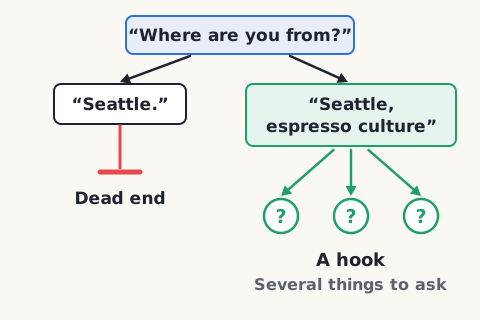
- Never the Naked City: When asked where you are from, never give a bare one-word answer. Always attach an engaging historical, geographical, or culinary detail (e.g., 'I'm from Seattle, where the maritime mist created the world's highest density of espresso roasters'). This geographical storytelling provides multiple thematic hooks for your partner.
- Never the Naked Job: Avoid sterile corporate job titles. Paint a colorful picture of the real-world human impact and problem-solving drama behind your work, transforming an actuary into 'someone who protects families from financial ruin.'
- Never the Naked Introduction: When introducing two strangers, never drop bare names and abandon them. Give both people a shared thread along with their names — the specific mutual passion or project connecting them — providing an instant springboard for dialogue.
Conversational Elasticity & Active Listening
True conversational mastery is measured not by personal eloquence, but by the ability to draw out the eloquence, passion, and brilliance of your partner.
Be a Word Detective
Like an investigator hunting for clues, Be a Word Detective. Listen intently for the passing, offhand keywords dropped by your speaker—an offhand mention of a garden, a marathon, a rescue dog, or an obscure travel destination. These offhand keywords reveal the speaker's true emotional passions. Seize upon these keywords immediately to steer the conversation into their zone of greatest enthusiasm.
The Swiveling Spotlight
Amateurs constantly interrupt stories with their own related anecdotes ('Oh, that reminds me of when I went to Italy!'), effectively hijacking the narrative. In contrast, The Swiveling Spotlight enforces disciplined ego restraint. When the conversational spotlight lands on you, answer briefly and then immediately swivel it back onto your partner.
Let your counterpart hold the majority of the airtime, and they will leave the interaction convinced that you are an extraordinarily insightful conversationalist.
Parroting & The Conversational Pump
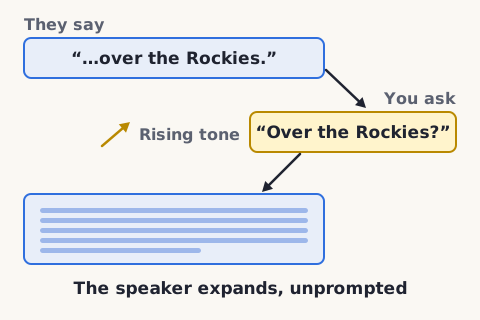
When a dialogue begins to stall, deploy Parroting. Simply repeat the last two to three words of your partner's sentence with an inquisitive, rising inflection. For instance, if they state, 'We encountered unexpected turbulence over the Rockies,' you respond curiously: 'Over the Rockies?' Parroting acts as an effortless psychological pump, prompting the speaker to expand without requiring you to formulate new questions.
Encore!, Positive Priming & Current News
Elevate your friends in group settings using Encore!: publicly prompt an acquaintance to retell their finest story ('Sarah, tell everyone about how you landed that historic museum exhibit!'). This elevates their social stature without forcing them to boast.
Practice Ac-CEN-tuate the Positive by quarantining personal complaints and leading with upbeat valence. Scan The Latest News before events to maintain universal social currency.
Core Takeaways & Practical Action Checklist
- Match your vocal energy to your partner's mood before attempting to lead.
- Wear a distinctive Whatzit prop to invite natural conversational openers.
- Never state a bare city or job title; attach vivid, human-centered story hooks.
- Listen for offhand keywords and swivel the conversational spotlight onto your partner.
- Deploy Parroting (repeating the last 2-3 words) to effortlessly pump stalled dialogue.
Real-World Case Study: Transforming Small Talk at a Gala Reception
Imagine arriving at a charity gala where you know no one. An amateur approaches a stranger and asks, 'Cold weather, isn't it?' followed by 'Where are you from?' and 'I'm an accountant.' The dialogue stalls in under two minutes.
An elite practitioner arrives wearing an antique navigational compass pin (Always Wear a Whatzit). A fellow guest notices and asks about it. The practitioner delivers Prosaic with Passion, matching the guest's energetic mood (Make a Mood Match). When asked where he is from, he replies, 'I'm from Boston, where the historical cobblestones keep shoe cobblers in business' (Never the Naked City). When asked about his work, he explains, 'I help independent filmmakers navigate financing so their cultural stories reach global audiences' (Never the Naked Job).
Listening to the guest, he hears an offhand mention of a rescue dog in Montana (Be a Word Detective). He immediately deploys Parroting: 'A rescue dog in Montana?' prompting a ten-minute passionate story while he lets his new acquaintance hold most of the airtime. When joining another circle, he uses Eavesdrop In with precision, and introduces his new acquaintance using Never the Naked Introduction.
Conversational Framework Comparison Table
| Interaction Stage | Low-Value Approach | High-Value FlashFeed Strategy |
|---|---|---|
| Initial Hook | Waiting awkwardly for someone to speak | Wearing a distinctive Whatzit prop |
| Hometown Inquiry | Naked city name ('Denver') | Descriptive hook ('Denver, where high altitude...') |
| Job Description | Sterile title ('Senior Auditor') | Human-centered impact narrative |
| Stalled Dialogue | Awkward silence or topic change | Parroting the last 2-3 words with curious pitch |
| Introductions | Bare name exchange ('Bob, meet Alice') | 3-Point bridge: Name A, Name B, shared passion |
Actionable Behavioral Drills & Muscle Memory Exercises
- The Whatzit Wardrobe Audit: Select three distinctive accessories from your wardrobe (a unique watch, a vintage pin, an artisanal scarf) and wear one to your next three social or professional gatherings.
- Hometown & Job Story Crafting: Write out two colorful, human-centered sentences for your hometown (Never the Naked City) and your occupation (Never the Naked Job). Memorize them until they roll off the tongue naturally.
- The Parroting Challenge: In your next telephone or coffee conversation, identify two moments where dialogue begins to stall and deploy Parroting on the last two or three words to effortlessly pump the conversation.
Key terms
- Word Detective Clues
- Offhand keywords a speaker drops that reveal what they're truly passionate about.
Key facts
Make a Mood Match
Make a Mood Match means tuning your vocal energy, speed, and volume to a person's emotional state before you try to shift it anywhere. Approaching someone who is somber, exhausted, or deeply focused with explosive cheerfulness doesn't lift them — it triggers immediate defensive alienation, because forced cheer aimed at a subdued person lands as a dismissal of what they're actually feeling.
Prosaic with Passion
Prosaic with Passion holds that in the opening moments of small talk, the literal words barely matter — the emotional delivery is the whole signal. Saying something as ordinary as "Good morning" with genuine vocal warmth and musicality communicates full engagement, even though the content itself is mundane.
Always Wear a Whatzit
A Whatzit is a deliberately unusual, distinctive accessory — an antique brooch, an exotic pin, an artisanal watch — chosen specifically to spark curiosity. Wearing one transfers the burden of starting a conversation from the stranger to the object itself: curiosity about the item, not nerve, is what moves a stranger to approach you.
Whoozat
Whoozat means asking a host or organizer in advance for background details on key guests, so you arrive with bespoke, personalized openers instead of improvising cold. Lowndes argues against the ordinary habit of showing up without any of this groundwork and having to invent an opener on the spot.
Eavesdrop In
Eavesdrop In lets you join an existing conversation circle politely: name the topic you overheard and add a disarming line, such as "Excuse me, I couldn't help overhearing your fascinating point about..." Naming the topic shows you were listening rather than intruding, and the compliment travels with the apology so the interruption lands as flattery instead of an intrusion.
Never the Naked City
Never the Naked City means never answering "where are you from?" with a bare one-word place name. Attaching an engaging historical, geographical, or culinary detail — like naming Seattle for its espresso culture — turns a dead-end answer into a hook, handing your partner several things to ask about instead of stopping the exchange after one line.
Never the Naked Job
Never the Naked Job replaces a sterile job title with a colorful picture of the real-world impact and problem-solving behind the work — turning "actuary" into "someone who protects families from financial ruin." Framing a profession by who it helps gives a listener something to feel and ask about, while a dry title or abstract corporate jargon gives them nothing to hold onto and stifles connection.
Never the Naked Introduction
Never the Naked Introduction means never dropping two names on each other and walking away. Give both people a shared thread along with their names — the specific mutual passion or project connecting them — a bridge that prevents the awkward silence a bare introduction leaves behind, and marks whoever supplies it as the connector.
Be a Word Detective
Be a Word Detective means listening for the offhand keywords a speaker drops in passing — a garden, a marathon, a rescue dog — since these small, specific clues reveal what they actually care about. Following that thread beats a string of generic "uh-huhs": swapping in varied, specific replies shows you're processing what's said, not just holding your place in line to speak.
Parroting
When dialogue stalls, Parroting repeats the last two or three words of your partner's sentence with a curious, rising inflection — if they say "we hit unexpected turbulence over the Rockies," you simply ask, "over the Rockies?" It works as an effortless psychological pump: the speaker expands unprompted, and you never have to invent a new topic or a new question.
The Swiveling Spotlight
The Swiveling Spotlight means resisting the urge to answer a story with your own matching anecdote — doing so quietly hijacks the narrative away from the teller. Let your counterpart hold the majority of the airtime, and they'll walk away convinced you're an unusually insightful conversationalist.
Encore!
Encore! means publicly prompting an acquaintance to retell their best story in front of a new group — "Sarah, tell everyone how you landed that exhibit!" Being asked to retell it lets someone shine without having to boast themselves, which is why the gratitude that follows runs so deep.
Ac-CEN-tuate the Positive
Ac-CEN-tuate the Positive means leading conversations with upbeat, optimistic topics and quarantining minor gripes and complaints out of the opening minutes. An early grievance primes negativity and marks you as a complainer, setting the emotional key for everything that follows — while opening with what's going well sets a far better tone.
The Latest News
Scanning the day's headlines before attending a gathering gives you material that works on nearly anyone in the room, before you know anything else about them. Current events are one of the few things strangers reliably share, so they bridge a gap that personal commonalities can't yet fill.
Matched pairs
Each item on the left goes with the one on the right.
- Whatzit
- A distinctive prop, like an antique pin, that shifts the burden of starting a chat to the object.
- Never the Naked Job
- Reframes a job title as its human impact, e.g. an actuary becomes someone who protects families from ruin.
- Eavesdrop In
- Joins an existing conversation with: 'I couldn't help overhearing your fascinating point about...'
- Encore!
- Publicly prompts an acquaintance to retell their best story, boosting their status without them having to boast.
Self-test
Answer each question from memory, then check your work against the answer key.
1. In the Whatzit technique, what is a Whatzit?
- AA folder of guest details gathered in advance
- BA warmly delivered greeting phrase
- CA rehearsed apology for joining a conversation
- DAn accessory chosen to spark curiosity
2. Before trying to lift someone's energy, what does Make a Mood Match say you should do first?
- AWait for them to speak first
- BAsk them to explain their mood
- CMatch their current emotional tempo
- DOverwhelm them with cheerfulness
3. Someone asks 'Where are you from?' Which reply best follows the Never the Naked City rule?
- ABoston, where cobblestones keep cobblers busy
- BWhy do you ask?
- CChicago.
- DSomewhere over on the East Coast, not sure exactly.
4. How does Never the Naked Job suggest describing your profession?
- ABy your years of experience
- BThrough its real-world human impact
- CBy your exact corporate title and department
- DBy your company's name
5. Which is NOT something Never the Naked Introduction says to hand two strangers?
- APerson B's name
- BTheir shared passion or project
- CEach person's job title
- DPerson A's name
6. What does 'Never the Naked City' warn against when asked where you're from?
- AAnswering with a bare, one-word place name
- BMentioning more than one city you've lived in
- CAsking where the other person grew up
- DNaming your neighborhood instead of city
7. Which reply best follows the 'Never the Naked City' technique?
- APortland
- BSomewhere out on the coast, can't recall exactly
- CI'd rather not say
- DSeattle, home of great espresso roasters
8. What does Be a Word Detective mean in conversation?
- AAsking rapid-fire personal questions
- BListening for offhand keywords that reveal passions
- CInterrupting immediately to correct every factual error
- DRepeating your own related stories
9. A partner says, 'We hit unexpected turbulence over the Rockies.' What is the correct Parroting response?
- AOver the Rockies?
- BHave you flown much before?
- CThat happened to me once too!
- DThat sounds terrifying!
10. Which behavior violates the Swiveling Spotlight technique?
- AAsking a follow-up question about their story
- BTopping their story with a longer one of your own
- CRepeating their last few words with curiosity
- DLetting them hold most of the airtime
11. A colleague offhandedly mentions training for a marathon. What should Be a Word Detective prompt you to do?
- ARedirect to your own fitness routine
- BContinue your original topic
- CFollow up on the marathon detail
- DChange the subject entirely
12. What does 'Be a Word Detective' mean during a conversation?
- AWaiting silently until the speaker finishes
- BCorrecting factual errors as soon as you hear them
- CAsking a scripted list of questions in order
- DListening for keywords that reveal true passions
13. An offhand mention of a rescue dog in small talk exemplifies what, per Word Detective?
- AA rehearsed conversation opener
- BA safety valve to avoid conflict
- CA verbal nod merely signaling passive agreement
- DAn offhand keyword revealing genuine passion
14. How does 'Parroting' keep a stalled conversation moving?
- ABy summarizing the whole conversation so far
- BBy repeating the last two or three words, rising
- CBy offering your own matching story instead
- DBy asking a completely unrelated question
15. Partner says 'We hit turbulence over the Rockies.' What is the Parroting reply?
- AOver the Rockies?
- BThat sounds terrifying
- CI once flew through a storm too
- DTurbulence happens a lot in winter
Go deeper
- ReadHow to Talk to Anyone by Leil Lowndes · on Amazon ↗
- StudyHow to Talk to Anyone: 92 Little Tricks for Big Success in the FlashFeed app
These are affiliate links: if you buy a book through one, FlashFeed may earn a small commission at no extra cost to you. The commission helps pay for FlashFeed's servers.
As an Amazon Associate we earn from qualifying purchases.
Answer key
- 1. D An accessory chosen to spark curiosityA Whatzit is an unusual accessory that shifts the burden of starting conversation from the stranger to the object itself, unlike guest research, entry lines, or greeting delivery.
- 2. C Match their current emotional tempoMeeting someone at their current energy avoids the defensive alienation caused by forced cheer aimed at a somber or exhausted person.
- 3. A Boston, where cobblestones keep cobblers busyNever the Naked City pairs the place name with a vivid detail, turning a dead-end answer into a hook, unlike a bare city name, a vague region, or a deflection.
- 4. B Through its real-world human impactNever the Naked Job reframes a sterile title as human impact, like turning 'actuary' into 'someone who protects families from financial ruin.'
- 5. C Each person's job titleNever the Naked Introduction pairs both names with their shared passion or project; job titles aren't part of the bridge it creates between two strangers.
- 6. A Answering with a bare, one-word place nameA bare place name is a dead end; attaching a detail turns it into a conversational hook.
- 7. D Seattle, home of great espresso roastersAttaching a colorful detail, like Seattle's espresso culture, gives a partner something to ask about.
- 8. B Listening for offhand keywords that reveal passionsWord Detective means catching stray keywords, like an offhand mention of a garden or rescue dog, that reveal what someone truly cares about.
- 9. A Over the Rockies?Parroting repeats the last two or three words with a curious, rising inflection, prompting the speaker to expand without a new question.
- 10. B Topping their story with a longer one of your ownThe Swiveling Spotlight means resisting the urge to hijack a story with your own matching anecdote and instead keeping focus on your partner.
- 11. C Follow up on the marathon detailThat offhand mention is an offhand keyword revealing genuine enthusiasm; Word Detective means following such threads instead of past them.
- 12. D Listening for keywords that reveal true passionsWord Detective means catching small, offhand keywords that reveal a speaker's real passions.
- 13. D An offhand keyword revealing genuine passionSmall, offhand details like a rescue dog point to what a speaker cares about.
- 14. B By repeating the last two or three words, risingParroting repeats the speaker's last two or three words with rising inflection, prompting them to expand.
- 15. A Over the Rockies?Parroting repeats the last two or three words with rising inflection, here 'Over the Rockies?'
Sources
- How to Talk to Anyone: 92 Little Tricks for Big Success — Leil Lowndes
- How to Talk to Anyone — Part Two: How to Know What to Say After You Say 'Hi'
Image credits
- Never the Naked City: FlashFeed original diagram · CC-BY-4.0
- Parroting: FlashFeed original diagram · CC-BY-4.0