
How to Talk to Anyone: 92 Little Tricks for Big Success study guide · Lesson 3 of 6
VIP Presence & High-Status Communication
Elite Vocabulary & Conversational Brevity · Subliminal Bonding & Relational Grammar
Unofficial study guide for How to Talk to Anyone: 92 Little Tricks for Big Success in Relationships by Leil Lowndes. FlashFeed is not affiliated with the author or publisher.
This is the lesson's study guide from the FlashFeed app, plus its key facts and a self-test.
What you'll be able to do
- Avoid the 'What Do You Do?' trap, ask how someone spends their time instead, and match their visual, auditory, or kinesthetic language.
- Utilize Instant History, the Premature We, and Never the Naked Thank You to build subliminal peer bonding.
FlashFeed Study Guide | How to Talk to Anyone Knowledge Pack (Lesson 3)
Elite Vocabulary & Conversational Brevity
High-status communication is defined by intentional restraint, linguistic precision, and sensory attunement. VIPs never project transactional intent or hide behind jargon.
What Do You Do? — NOT!
Opening a social dialogue with 'What do you do?' immediately frames the speaker as a calculating social climber attempting to size up net worth and professional utility. Banish this question from your repertoire. Instead, ask: 'How do you spend most of your time?'
This status-blind phrasing is democratic and gracious. It allows your counterpart to speak about their professional career, artistic pursuits, family life, or charitable endeavors as they see fit, conferring dignity on homemakers, retirees, artists, and executives alike.
Anatomically Correct Empathizers
People often signal a favored way of describing experience in their word choice:
- Visual: ('I see what you mean', 'Let's look at the big picture', 'That looks clear to me')
- Auditory: ('That rings a bell', 'I hear where you're coming from', 'That sounds harmonious')
- Kinesthetic: ('I have a feeling about this', 'Let's get a handle on the situation', 'That feels solid')
With Anatomically Correct Empathizers, notice which channel your listener is speaking through and echo it back in your own reply. If someone says a plan has 'a good ring to it,' respond with 'it does sound great' rather than 'I see what you mean' — matching their channel removes a small translation step and the point lands more naturally.
Your Personal Thesaurus
Elevate your language with Your Personal Thesaurus. Look up a tired, overused word you reach for daily — 'smart,' 'nice,' 'good' — and substitute a more precise synonym (e.g., 'astute' for 'smart,' 'exemplary' for 'great,' 'arduous' for 'hard'). One new word a day, kept up for a couple of months, is enough to move your everyday vocabulary from average to distinctly rich.
Subliminal Bonding & Relational Grammar
Subliminal bonding leverages relational grammar and in-group linguistic priming to transform casual acquaintances into dedicated allies.
Instant History
Cement social bonds using Instant History. Cite a shared observation, inside joke, or humorous incident that occurred earlier in the conversation. Re-referencing that shared moment creates an immediate psychological feeling of long-standing camaraderie and establishes an exclusive club of two.
The Premature We & Gratitude Amplification
Shift the grammatical baseline of your interactions using The Premature We. Subtly incorporate first-person plural pronouns ('we', 'us', 'our') into dialogue with new acquaintances, even ones you've just met. This linguistic shift primes the subconscious mind to view the interaction as a collaborative in-group alliance facing the world together.
Refine expressions of gratitude with Never the Naked Thank You: always append the specific reason for your gratitude ('Thank you for staying late to help me finish this analysis'), rather than letting a bare 'thank you' stand alone. Specificity proves that their unique effort was noticed and valued.
Core Takeaways & Practical Action Checklist
- Ask 'How do you spend most of your time?' instead of 'What do you do?'.
- Identify whether your partner is visual, auditory, or kinesthetic, and match their language.
- Use 'we' and 'us' early in dialogue to prime collaborative in-group bonding.
- Never state a naked 'thank you'; always append the specific reason for your gratitude.
Real-World Case Study: High-Stakes Stakeholder Alignment
During an executive strategy session, an inexperienced director opens by asking a new board member, 'So, what is your title at the holding company?' The board member gives a terse reply, feeling screened. When presenting a proposal, the director rambles with filler ('I'm not the world's biggest expert on this, but maybe we should kind of look into this...'), finishing with rising vocal uptalk.
A seasoned VP demonstrates VIP mastery. She approaches the board member and asks, 'How do you spend most of your time these days?' (What Do You Do—NOT!). The board member lights up, talking about his renewable energy foundation. Listening closely, the VP notices the board member repeatedly says 'I want to see the architectural blueprint' and 'That looks promising' — a visual sensory preference. She responds in kind (Anatomically Correct Empathizers).
When the VP presents, she frames the strategy in vivid visual terms ('Let's look at the horizon map and visualize our market footprint') and uses The Premature We ('How we will capture this sector'). When thanking the board, she avoids naked gratitude: 'Thank you for your decisive feedback on our timeline' (Never the Naked Thank You).
VIP Communication Standards Matrix
| Communication Element | Low-Status Habit | High-Status VIP Protocol |
|---|---|---|
| Opening Inquiry | 'What do you do?' | 'How do you spend most of your time?' |
| Sensory Matching | Random, mismatched metaphors | Echoing their own visual, auditory or kinesthetic language |
| Vocabulary | Generic filler words ('nice', 'good') | Precise vocabulary, one new word a day |
| Gratitude Phrasing | A bare 'Thanks' | Specific 'Thank you for [X]' |
| Linguistic Framing | Individualistic 'I' and 'You' | Collaborative in-group 'We' and 'Us' |
Actionable Behavioral Drills & Muscle Memory Exercises
- Sensory Predicate Tracking: In your next meeting, write down whether your counterpart uses predominantly visual ('see'), auditory ('hear'), or kinesthetic ('feel') language. Respond using two matching sensory metaphors.
- Gratitude Contextualization: Replace every single bare 'thank you' today with a contextualized 'Thank you for [specific action]', observing the enhanced emotional resonance of the recipient.
Key terms
- Anatomically Correct Empathizers
- Matching your reply's sensory language — visual, auditory, or kinesthetic — to the words your listener just used.
- The Premature We
- Using 'we,' 'us,' and 'our' early with a new acquaintance to create an instant sense of being on the same team.
- Never the Naked Thank You
- Never letting 'thank you' stand alone — always naming the specific thing you're grateful for.
Key facts
What Do You Do—NOT!
Opening with "What do you do?" frames you as a social climber calculating someone's net worth, and it strands anyone whose answer is complicated. What Do You Do—NOT! swaps in "How do you spend most of your time?" instead — a status-blind question that lets a person talk about career, art, family, or charity as they choose, fitting the retired, the between-jobs, and the executive equally comfortably.
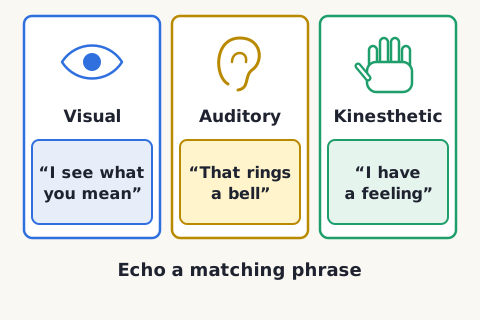
Anatomically Correct Empathizers
People often lean toward a favored way of describing experience — visual ("I see what you mean"), auditory ("that rings a bell"), or kinesthetic ("I have a feeling about this") — and hint at it in their word choice. Anatomically Correct Empathizers means spotting that leaning and echoing it back in a matching empathizer phrase, so your response lands with less friction.
Your Personal Thesaurus
Your Personal Thesaurus trades generic adjectives like "nice," "good," or "bad" for precise, rich synonyms that carry a specific picture — "astute" instead of "smart," "exemplary" instead of "great." The build is deliberately slow: one new precise word substituted per day compounds quietly over time, rather than a sudden vocabulary shift that reads as trying to impress.
Instant History
Instant History cites a shared observation, inside joke, or funny moment from earlier in the same conversation, giving the exchange an instant sense of a shared past. A private joke only the two of you have creates a small exclusive world, and referring back to it is what turns a single encounter into something that feels like a relationship — years of real shared history compressed into minutes.
The Premature We
The Premature We subtly swaps first-person-plural pronouns — "we," "us," "our" — into dialogue with new acquaintances, quietly assigning both people to the same side before anything has actually been agreed. Framing a difficulty as "ours" rather than "yours" converts a request into a joint problem, priming the subconscious to feel collaboration rather than a transaction.
Never the Naked Thank You
Never the Naked Thank You requires always naming the specific reason for your gratitude — "thank you for staying late to finish this" — because that specificity is proof the effort was actually noticed.
Matched pairs
Each item on the left goes with the one on the right.
- What Do You Do—NOT!
- Swaps 'What do you do?' for 'How do you spend most of your time?'
- Your Personal Thesaurus
- Swaps one tired adjective for a more precise synonym each day.
- Instant History
- Re-references an earlier shared joke or moment to build instant camaraderie.
- Never the Naked Thank You
- Always names the specific reason for a 'thank you' instead of leaving it bare.
Self-test
Answer each question from memory, then check your work against the answer key.
1. What Do You Do—NOT! replaces 'What do you do?' with which question?
- AWhat's your title?
- BWhere do you work?
- CWhat's your exact line of business?
- DHow do you spend most of your time?
2. What's the main problem with opening a conversation with 'What do you do?'
- AFrames the asker as a social climber
- BSignals disinterest in the answer
- CMakes the question sound rehearsed
- DSounds too casual for a business setting
3. A colleague says 'that rings a bell' and 'I hear where you're coming from.' Which sensory modality is this?
- AVisual
- BAuditory
- COlfactory
- DKinesthetic
4. Which phrase signals a Visual sensory preference, per Anatomically Correct Empathizers?
- ALet's get a handle on the situation
- BI have a feeling about this
- CLet's look at the big picture
- DThat rings a bell
5. Which of these is NOT one of the three VAK sensory modalities?
- AVisual
- BAuditory
- CKinesthetic
- DOlfactory
6. What does 'Anatomically Correct Empathizers' require detecting in a conversation partner?
- ATheir vocabulary's syllable count
- BTheir primary sensory mode: visual, auditory, kinesthetic
- CTheir vocal pitch and pause length
- DTheir preferred topic of complaint, small talk, or gossip
7. Which phrase signals a kinesthetic sensory mode, per Anatomically Correct Empathizers?
- AI see what you mean
- BThat sounds harmonious to my ear
- CI have a feeling about this
- DThat rings a bell
8. What does 'Instant History' do in a conversation?
- ACites a shared joke or moment from earlier in the talk
- BRecounts a person's entire professional biography in detail
- CRecalls a previous meeting from months ago
- DReferences a mutual friend's introduction
9. Using The Premature We, how would you phrase a request to a new acquaintance?
- AI need you to fix this problem
- BHow will you handle this issue?
- CWhat's your plan for solving this?
- DHow can we tackle this together?
10. Which of these is NOT one of the three bonding techniques?
- AThe Premature We
- BNever the Naked Thank You
- CYour Personal Thesaurus
- DInstant History
11. What does 'Instant History' involve doing during a conversation?
- AReferencing a shared joke from earlier
- BAsking about their family background
- CRepeating their last words, rising inflection
- DReciting a person's professional biography
12. Why does referencing an earlier inside joke build rapport, per Instant History?
- AIt proves you remember facts accurately
- BIt creates an exclusive sense of shared past
- CIt signals mild disagreement with them
- DIt tests whether they were paying attention
13. What does 'The Premature We' involve with a new acquaintance?
- ARepeating the listener's own pronouns back
- BUsing formal titles instead of first names
- CIncorporating pronouns like 'we' and 'us'
- DAvoiding personal pronouns entirely
14. What effect does framing a challenge as 'our problem' produce, per The Premature We?
- AImmediate defensive alienation
- BA feeling of collaborative in-group alliance
- CFormal detachment from the issue
- DReduced sense of listener responsibility
Go deeper
- ReadHow to Talk to Anyone by Leil Lowndes · on Amazon ↗
- StudyHow to Talk to Anyone: 92 Little Tricks for Big Success in the FlashFeed app
These are affiliate links: if you buy a book through one, FlashFeed may earn a small commission at no extra cost to you. The commission helps pay for FlashFeed's servers.
As an Amazon Associate we earn from qualifying purchases.
Answer key
- 1. D How do you spend most of your time?What Do You Do—NOT! swaps the status-loaded 'What do you do?' for the status-blind 'How do you spend most of your time?', letting anyone answer with dignity.
- 2. A Frames the asker as a social climber'What do you do?' frames the asker as calculating someone's net worth and utility, making the question feel transactional. The other options aren't the main problem with it.
- 3. B Auditory'Rings a bell' and 'I hear where you're coming from' are auditory predicates, language tied to sound and hearing.
- 4. C Let's look at the big picture'Let's look at the big picture' is a visual predicate. The other options are auditory or kinesthetic phrases.
- 5. D OlfactoryThe three VAK modes are Visual, Auditory, and Kinesthetic. Olfactory (smell) is a real sensory mode, but it isn't one of them.
- 6. B Their primary sensory mode: visual, auditory, kinestheticAnatomically Correct Empathizers means spotting whether someone processes reality visually, auditorily, or kinesthetically, then answering in the same channel.
- 7. C I have a feeling about this'I have a feeling about this' is a kinesthetic predicate, one of the three sensory modes matched.
- 8. A Cites a shared joke or moment from earlier in the talkInstant History re-references a shared observation or inside joke from earlier in the same conversation to create instant camaraderie.
- 9. D How can we tackle this together?The Premature We swaps in first-person-plural pronouns ('we', 'us') to frame a problem as shared rather than the other person's alone.
- 10. C Your Personal ThesaurusInstant History, The Premature We, and Never the Naked Thank You build subliminal bonding. Your Personal Thesaurus is a vocabulary-upgrade technique instead.
- 11. A Referencing a shared joke from earlierInstant History cites a shared moment from earlier in the same conversation to build a sense of shared past.
- 12. B It creates an exclusive sense of shared pastRe-referencing a shared moment creates an exclusive 'club of two' feeling, per Instant History.
- 13. C Incorporating pronouns like 'we' and 'us'The Premature We subtly swaps in first-person-plural pronouns to prime a collaborative feeling.
- 14. B A feeling of collaborative in-group allianceFraming a difficulty as shared ('ours') primes the subconscious to see it as a joint, in-group effort.
Sources
- How to Talk to Anyone: 92 Little Tricks for Big Success — Leil Lowndes
- How to Talk to Anyone — Part Three: How to Talk Like a VIP
Image credits
- Anatomically Correct Empathizers: FlashFeed original diagram · CC-BY-4.0