
The Infinity Machine (book) study guide · Lesson 10 of 12
Step by Step — Gemini and the comeback
Gemini ships · Mallaby's closing register
Unofficial study guide for The Infinity Machine: Demis Hassabis, DeepMind, and the Quest for Superintelligence by Sebastian Mallaby. FlashFeed is not affiliated with the author or publisher.
This is the lesson's study guide from the FlashFeed app, plus its key facts and a self-test.
What you'll be able to do
- Define Gemini as Google DeepMind's flagship multimodal model family (launched 2023) and identify Gemini Ultra
- Explain the MMLU benchmark (57 subjects) and Gemini Ultra's announced 90% score
- Recall Gemini 1.5 Pro (2024) with its million-token context window and sparse mixture-of-experts design, and why RL couldn't crack post-training
- Identify the two triggers Mallaby gives for the November 2023 Altman firing — undisclosed Gulf fundraising and pushing out critical board members
- Explain Mallaby's closing register — Hassabis as both Nobel laureate and CEO, preferring the label 'realist'
Gemini ships
The merger between Google Brain and DeepMind was sold as a synergy story. Gemini was the first test of whether it was actually true — and getting there required resolving a culture war as much as a research programme.
Gemini, December 2023
On 6 December 2023 Google DeepMind launched Gemini, its first frontier model built jointly by the merged London and Mountain View teams. Two smaller variants shipped immediately; the headline Gemini Ultra was previewed against GPT-4 on MMLU (Massive Multitask Language Understanding) — a benchmark of 57 subjects spanning maths, humanities, ethics, and law. Gemini Ultra's announced MMLU score was 90%, edging past GPT-4's published number. The launch arrived roughly fourteen months after ChatGPT; late by Silicon Valley standards, but the first proof that the merger could ship at frontier scale.
Cultures collide
Building Gemini exposed a deep friction between the two halves of the merged organisation. Mountain View's culture was "crash projects out quickly"; London's was "measure each tweak". Mallaby describes 80-hour weeks, two-time-zone Slack channels, and Sergey Brin re-engaging after years away from day-to-day work to personally clear roadblocks. Speed eventually won the internal debates — Mountain View's instinct to ship and iterate beat London's instinct to wait until the science was settled. It was a preview of a tension that would not disappear with the launch.
David Silver and the RL wall
David Silver — the AlphaGo architect and one of DeepMind's most celebrated researchers — agreed after ChatGPT to lead Gemini's post-training. His instinct was to apply sophisticated reinforcement learning techniques to language model alignment, the approach that had conquered Go. After roughly six months of frustration he quit the post-training team. The core problem: RL requires a clear reward signal, and language quality resists easy scoring. "It wasn't clear how machine RL could distinguish a good haiku from a great one," Mallaby explains. A Bard veterans team that concentrated on data cleaning and RLHF widgets shipped the upgrade instead.
Mechanistic interpretability
Geoffrey Irving's safety group at DeepMind extended a line of research that had earlier taken shape at Anthropic: identifying the specific circuits inside a network responsible for specific behaviours. Mallaby calls mechanistic interpretability "chinks of light in the black box" — a rare alignment programme that produced findings with credible commercial uptake, not just academic citations. Irving later left DeepMind to become chief scientist at the UK's AI Safety Institute, carrying the field's credibility with him into government-backed safety work.
Mallaby's closing register
Gemini 1.5 Pro shifted the internal power balance at Google DeepMind, the Altman episode rattled Silicon Valley's governance pretensions, and Mallaby closes his book on a paradox that the AI race has yet to resolve.
Gemini 1.5 Pro, February 2024
On 15 February 2024 Google DeepMind released Gemini 1.5 Pro, whose headline capability at launch was a million-token context window paired with a sparse mixture-of-experts architecture — meaning only a fraction of the model's parameters activate for any given input, keeping inference costs manageable. The model was built by a London-led "strike team" of the kind that had produced AlphaFold: small, scientifically minded, given unusual autonomy. Among the team were Sebastian Borgeaud and Jack Rae, who had returned to DeepMind after a period at OpenAI. It was the first Gemini release where London set the research agenda.
"First innings of the game"
Mallaby catches Hassabis on Christmas vacation in late 2023, still calibrating his position relative to OpenAI. "OpenAI had the scaling and engineering and product focus that we didn't have. But now with Gemini we are matching that. And I think we still have the better ideas." His view was that ChatGPT represented "just the start" — the AI race was in its first innings, not its ninth. It is the kind of framing that reads differently depending on whether you find it energising or alarming, and Mallaby declines to adjudicate.
Why the OpenAI board fired Altman
Mallaby identifies two distinct triggers for the November 2023 firing. First, undisclosed fundraising overtures to investors in the Persian Gulf — conversations Altman had not disclosed to the board. Second, a pattern of attempting to push out independent board members who criticised him. The board, whose charter charged it with pursuing "safe AI for the benefit of the world", concluded Altman could not be trusted with that mission. What the board underestimated was how thoroughly Silicon Valley and OpenAI's workforce would close ranks behind him within days.
Mallaby's closing register
Mallaby ends the book with Hassabis simultaneously a Nobel laureate and the chief executive of one of the most powerful AI labs in the world — a dual status that captures the book's central tension. By the epilogue, Hassabis says he prefers the word "realist" to either "doomer" or "accelerationist" to describe his own position on AI. Mallaby does not pretend to resolve the paradox he closes on: that the most morally serious major figure in the race is also racing as hard as anybody to build the technology he has spent his career warning the world about.
Key terms
- MMLU (Massive Multitask Language Understanding)
- A benchmark of 57 subjects spanning maths, humanities, ethics and law. In 2020, GPT-3 scored 44%; in 2023 GPT-4 reached 86%; Gemini Ultra hit 90%, the first AI system to exceed top human experts. Each generational bump on MMLU is roughly a year of student-level cognition gained.
- Gemini
- Gemini is Google DeepMind's flagship family of multimodal AI models, launched in 2023. Gemini was the lab's answer to OpenAI's GPT-4 and marked its return to the research frontier.
Key concepts
Gemini Ultra
- The headline variant of Google DeepMind's first frontier model built jointly by its London and Mountain View teams.
- Launched 6 December 2023, it was previewed head-to-head against GPT-4.
- Its announced score of 90% on a 57-subject benchmark edged past GPT-4's published number.
MMLU
- A benchmark used to preview Google DeepMind's flagship model against GPT-4.
- It spans 57 subjects, from maths and humanities to ethics and law.
- The London-Mountain View model's announced 90% on it edged past GPT-4's published number.
Gemini 1.5 Pro
- A February 2024 model release built by a London-led 'strike team' of the kind that had produced AlphaFold.
- Its headline capability was a million-token context window.
- It was the first release of Google DeepMind's flagship line where London, not Mountain View, set the research agenda.
sparse mixture-of-experts
- An efficiency-minded architecture paired with a million-token context window in a February 2024 model.
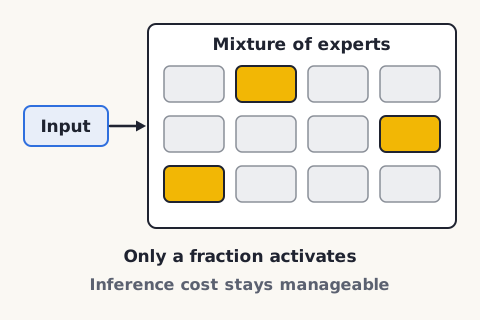
- Only a fraction of the model's parameters activate for any given input, keeping inference costs manageable.
Key facts
Gemini, December 2023
On 6 December 2023 Google DeepMind launched Gemini, its first frontier model designed jointly by the merged London and Mountain View teams. Two smaller versions shipped immediately; the headline Gemini Ultra was previewed against GPT-4 on MMLU. The launch was Hassabis's response to ChatGPT — late, but the first proof that the merger could ship at all.
Cultures collide
Building Gemini was as much a management challenge as a research one. Mountain View's culture was "crash projects out quickly"; London's was "measure each tweak". Mallaby describes 80-hour weeks, two-time-zone Slack channels, and Sergey Brin re-engaging "after years of playboy life" to clear roadblocks. Speed eventually won the internal debates.
David Silver and the RL wall
After ChatGPT, David Silver — the AlphaGo veteran — agreed to lead Gemini's post-training. He hoped to apply sophisticated machine RL to language models. After six months of frustration, he quit the post-training team. "It wasn't clear how machine RL could distinguish a good haiku from a great one," Mallaby explains. A Bard veterans team that focused on cleaning data and RLHF widgets shipped the upgrade instead.
Mechanistic interpretability
Geoffrey Irving's safety group at DeepMind extended a line of research started at Anthropic: identifying the specific circuits inside a network responsible for specific behaviours. Mallaby calls the field — mechanistic interpretability — "chinks of light in the black box". By 2024 it was one of the few alignment programmes with credible commercial uptake.
Gemini Ultra's preview-only debut
At Gemini's launch, two smaller variants shipped immediately, but the headline Gemini Ultra was only previewed — benchmarked against GPT-4 rather than released to the public right away.
Gemini 1.5 Pro, February 2024
On 15 February 2024 Google DeepMind released Gemini 1.5 Pro — a million-token context window, sparse mixture-of-experts architecture, and the first model from a London-led, scientifically minded "strike team" of the kind that had built AlphaFold. Among the team were Sebastian Borgeaud and Jack Rae, who had returned from a stint at OpenAI.
"First innings of the game"
Mallaby's Hassabis, on Christmas vacation in late 2023: "OpenAI had the scaling and engineering and product focus that we didn't have. But now with Gemini we are matching that. And I think we still have the better ideas." He insisted ChatGPT was "just the start" — the AI race was in its first innings, not its ninth.
Why the OpenAI board fired Altman
Mallaby identifies two triggers. First, undisclosed fundraising overtures to investors in the Persian Gulf. Second, a pattern of trying to push out independent board members who criticised him. The board, charged with "safe AI for the benefit of the world", concluded Altman could not be trusted with the mission. They underestimated how thoroughly Silicon Valley would close ranks behind him.
Mallaby's closing register
Mallaby ends the book in 2025–26, with Hassabis simultaneously a Nobel laureate and the chief executive of one of the most powerful AI labs in the world. The book closes on a paradox he does not pretend to resolve: that the most morally serious major figure in AI is also racing as hard as anybody to build the technology he has spent his life warning the world about.
Only a fraction fires
Gemini's sparse mixture-of-experts architecture means only a fraction of the model's parameters activate for any given input, which keeps inference costs manageable despite its overall size.
By the numbers
- Gemini Ultra's announced MMLU score (percentage)
- 90 %
- Year Google DeepMind released Gemini 1.5 Pro
- 2024 year
Matched pairs
Each item on the left goes with the one on the right.
- Gemini 1.5 Pro's headline capability at launch
- A million-token context window with a mixture-of-experts design
- Two triggers Mallaby gives for the Altman firing
- Undisclosed Gulf fundraising and pushing out critical board members
- Hassabis's dual status as the book closes in 2025-26
- A Nobel laureate and chief executive of a leading AI lab
Self-test
Answer each question from memory, then check your work against the answer key.
1. What is Gemini?
- AMeta's open-weights model family released alongside Llama
- BOpenAI's successor to GPT-4, launched in 2023
- CGoogle DeepMind's flagship family of multimodal AI models, launched in 2023
- DAnthropic's mechanistic-interpretability research programme
2. On what date did Google DeepMind launch Gemini?
- A6 December 2023
- B15 February 2024
- C30 November 2022
- D6 December 2022
3. At the launch, which Gemini variant was the headline model previewed against GPT-4 rather than shipped immediately?
- AGemini Flash
- BGemini Nano
- CGemini 1.5 Pro
- DGemini Ultra
4. Which statement about Gemini's December 2023 launch is NOT true?
- AGemini Ultra was previewed against GPT-4 on the MMLU benchmark
- BEvery variant, including the headline model, shipped to users immediately
- CIt was the first frontier model built jointly by the merged London and Mountain View teams
- DThe launch arrived roughly fourteen months after ChatGPT
5. In Mallaby's account, why did the Gemini launch matter for Google DeepMind beyond the model itself?
- AIt was the first model trained entirely in London without Mountain View
- BIt was the first time Google published its full training data
- CIt was the first proof the Brain–DeepMind merger could ship at frontier scale
- DIt was the first commercial product DeepMind had ever sold
6. What does the acronym MMLU stand for?
- AMassive Multitask Language Understanding
- BMulti-Metric Language Uniformity
- CMultimodal Machine Learning Utility
- DMassive Model Learning Universe
7. How many subjects does the MMLU benchmark cover?
- A100
- B57
- C40
- D24
8. What was Gemini Ultra's announced MMLU score?
- A44%
- B86%
- C95%
- D90%
9. Which of these is NOT one of the areas MMLU's 57 subjects are described as spanning?
- AHumanities
- BMaths
- CComputer vision
- DLaw
10. Which sequence correctly ranks the MMLU scores for GPT-3 (2020), GPT-4 (2023) and Gemini Ultra?
- A44% → 86% → 90%
- B44% → 90% → 86%
- C56% → 80% → 90%
- D60% → 86% → 95%
11. According to Mallaby, why did David Silver's reinforcement-learning approach fail to crack Gemini's post-training?
- AReinforcement learning could not scale to a million-token context
- BHuman raters generated too much data to process
- CThe pretrained base model was never shared with his team
- DLanguage quality offers no clear reward signal for RL to optimize
12. What was Gemini 1.5 Pro's headline capability at launch?
- AA 32,000-token context window
- BA million-token context window
- CNative real-time voice conversation
- DA 90% score on the MMLU benchmark
13. When did Google DeepMind release Gemini 1.5 Pro?
- A6 December 2023
- B15 February 2024
- C30 November 2023
- D15 February 2025
14. What does a sparse mixture-of-experts architecture mean for how the model runs?
- AThe model is retrained from scratch for each specialist domain
- BHuman expert raters score every output before it is returned
- CSeveral separate models vote and the majority answer wins
- DOnly a fraction of the model's parameters activate for any given input
15. After David Silver quit the post-training team, which approach actually shipped Gemini's post-training upgrade?
- AA London strike team using sparse mixture-of-experts
- BSilver's machine-RL pipeline, scaled up by a larger team
- CA Bard veterans team focused on data cleaning and RLHF widgets
- DGeoffrey Irving's mechanistic-interpretability circuits
16. In what year did Google DeepMind release Gemini 1.5 Pro?
- A2024
- B2025
- C2022
- D2023
17. On what date did Google DeepMind release Gemini 1.5 Pro?
- A17 November 2023
- B15 February 2024
- C22 January 2024
- D6 December 2023
18. Which pair does Mallaby identify as the two triggers for the OpenAI board's November 2023 firing of Altman?
- AA failed safety evaluation, and misreporting compute spending
- BThe 100x profit cap, and an undisclosed deal with Microsoft
- CUndisclosed Gulf fundraising, and a pattern of pushing out critical board members
- DA leaked model, and refusing to sign the White House safety commitments
19. Undisclosed fundraising overtures to investors in which region formed one of the two triggers?
- ALatin America
- BScandinavia
- CSoutheast Asia
- DThe Persian Gulf
20. A news report says Altman was fired over a failed safety evaluation. On Mallaby's account, what is wrong with that claim?
- ANeither trigger concerned model testing; both were about undisclosed conduct and board control
- BEvaluations only began after the firing, so none could have failed
- CThe evaluation did fail, but the board judged the lapse too minor to act on
- DRunning safety evaluations was the board's own job, not Altman's
21. The OpenAI board's charter charged it with pursuing what mission — the standard against which it judged Altman?
- A"Compute at any cost"
- B"Open research, openly published"
- C"Safe AI for the benefit of the world"
- D"Artificial general intelligence for shareholders"
22. What does Mallaby say the board underestimated when it fired Altman?
- AHow much regulators would intervene in the dispute
- BHow quickly Microsoft would withdraw its funding
- CHow far ahead Google DeepMind's Gemini already was
- DHow thoroughly Silicon Valley and OpenAI's workforce would close ranks behind him
23. In the book's epilogue, which label does Hassabis say he prefers for his own stance on AI?
- ARealist
- BAccelerationist
- COptimist
- DDoomer
24. As Mallaby closes the book, what is Hassabis's dual status?
- AA Nobel laureate and chief scientist of the AI Safety Institute
- BA Nobel laureate and chief executive of one of the most powerful AI labs
- CA chess grandmaster and OpenAI board member
- DA Turing Award winner and a UK government minister
25. What paradox does Mallaby close the book on, and decline to resolve?
- AThat the most morally serious figure in the race is also racing hardest to build the technology he warns about
- BThat larger models became cheaper to run than smaller ones
- CThat AI safety research is funded mostly by the labs it scrutinises
- DThat the UK produced the science while the US captured the profits
26. Which of these is NOT part of how Mallaby closes the book on Hassabis?
- AHis standing as a Nobel laureate
- BHis job running one of the most powerful AI labs in the world
- CHis preference for "realist" over "doomer" or "accelerationist"
- DHis decision to step back from the lab to work full-time on safety
27. A reader says Mallaby ends by judging Hassabis a hypocrite. Why does that misread the closing register?
- AMallaby argues the tension dissolved once Gemini 1.5 Pro shipped
- BMallaby settles the question by crediting the Nobel Prize
- CMallaby explicitly declines to resolve the paradox he closes on
- DMallaby concludes Hassabis is at heart a doomer
Go deeper
- ReadThe Infinity Machine by Sebastian Mallaby · on Amazon ↗
- StudyThe Infinity Machine (book) in the FlashFeed app
These are affiliate links: if you buy a book through one, FlashFeed may earn a small commission at no extra cost to you. The commission helps pay for FlashFeed's servers.
As an Amazon Associate we earn from qualifying purchases.
Answer key
- 1. C Google DeepMind's flagship family of multimodal AI models, launched in 2023Gemini is Google DeepMind's flagship multimodal model family, launched in 2023 as the lab's answer to OpenAI's GPT-4 and its return to the research frontier. It is a Google DeepMind product, not an OpenAI one.
- 2. A 6 December 2023Gemini launched on 6 December 2023, roughly fourteen months after ChatGPT (30 November 2022). 15 February 2024 is the later Gemini 1.5 Pro release.
- 3. D Gemini UltraTwo smaller variants shipped immediately; the headline Gemini Ultra was only previewed, benchmarked against GPT-4 on MMLU. Gemini 1.5 Pro was a separate release in February 2024.
- 4. B Every variant, including the headline model, shipped to users immediatelyOnly two smaller variants shipped immediately — Gemini Ultra was previewed, not released. The other three statements match Mallaby's account of the launch.
- 5. C It was the first proof the Brain–DeepMind merger could ship at frontier scaleGemini was the first test of whether the merger's synergy story was real — late by Silicon Valley standards, but proof the merged organisation could ship at frontier scale. London only set the research agenda later, with Gemini 1.5 Pro.
- 6. A Massive Multitask Language UnderstandingMMLU is Massive Multitask Language Understanding — the benchmark on which Gemini Ultra was previewed against GPT-4.
- 7. B 57MMLU spans 57 subjects, covering maths, humanities, ethics and law — its breadth is the point, testing general knowledge rather than one narrow skill.
- 8. D 90%Gemini Ultra's announced MMLU score was 90%, edging past GPT-4's published 86%. 44% was GPT-3's 2020 score.
- 9. C Computer visionMMLU spans maths, humanities, ethics and law. Computer vision is not part of the benchmark — MMLU tests language-based multitask knowledge.
- 10. A 44% → 86% → 90%GPT-3 scored 44% in 2020, GPT-4 reached 86% in 2023, and Gemini Ultra hit 90% — the first system announced above top human experts. Each bump is roughly a year of student-level progress.
- 11. D Language quality offers no clear reward signal for RL to optimizeRL needs a clear reward signal, but language quality resists scoring — as Mallaby puts it, RL couldn't tell a good haiku from a great one. Silver quit after ~6 months; a Bard team using data cleaning and RLHF shipped the upgrade instead.
- 12. B A million-token context windowGemini 1.5 Pro's headline capability was a million-token context window, paired with a sparse mixture-of-experts architecture. The 90% MMLU score belonged to Gemini Ultra at the earlier December 2023 launch.
- 13. B 15 February 2024Gemini 1.5 Pro was released on 15 February 2024. 6 December 2023 was the original Gemini launch.
- 14. D Only a fraction of the model's parameters activate for any given inputIn a sparse mixture-of-experts design only a fraction of parameters activate per input, which keeps inference costs manageable despite the model's size. It is not an ensemble vote or a human-review step.
- 15. C A Bard veterans team focused on data cleaning and RLHF widgetsSilver quit after ~6 months because language quality gives RL no clear reward signal. A Bard veterans team concentrating on data cleaning and RLHF widgets shipped the upgrade instead — not sophisticated machine RL.
- 16. A 2024Google DeepMind released Gemini 1.5 Pro on 15 February 2024, about two months after the original Gemini launch.
- 17. B 15 February 2024Gemini 1.5 Pro shipped on 15 February 2024, built by a London-led strike team of the kind that produced AlphaFold.
- 18. C Undisclosed Gulf fundraising, and a pattern of pushing out critical board membersMallaby gives exactly two triggers: fundraising overtures to Gulf investors that Altman had not disclosed to the board, and a pattern of attempting to push out independent board members who criticised him.
- 19. D The Persian GulfMallaby cites undisclosed fundraising overtures to investors in the Persian Gulf — conversations Altman had not disclosed to the board.
- 20. A Neither trigger concerned model testing; both were about undisclosed conduct and board controlMallaby's two triggers were the undisclosed Gulf fundraising and the pattern of pushing out critical board members — questions of trust and governance, not of any safety evaluation result.
- 21. C "Safe AI for the benefit of the world"The board's charter charged it with pursuing "safe AI for the benefit of the world"; measured against that mission, it concluded Altman could not be trusted.
- 22. D How thoroughly Silicon Valley and OpenAI's workforce would close ranks behind himThe board underestimated how completely Silicon Valley and OpenAI's own workforce would rally behind Altman within days — the reaction that undid the firing.
- 23. A RealistMallaby closes with Hassabis rejecting both "doomer" and "accelerationist," preferring "realist" — fitting for a man who is at once a Nobel laureate warning about AI and a CEO racing to build it.
- 24. B A Nobel laureate and chief executive of one of the most powerful AI labsMallaby ends with Hassabis as simultaneously a Nobel laureate and the CEO of one of the most powerful AI labs in the world. It was Geoffrey Irving who became chief scientist at the UK's AI Safety Institute.
- 25. A That the most morally serious figure in the race is also racing hardest to build the technology he warns aboutMallaby's closing paradox is that the most morally serious major figure in the race is also racing as hard as anybody to build the technology he has spent his career warning the world about — and he does not pretend to resolve it.
- 26. D His decision to step back from the lab to work full-time on safetyMallaby's closing register holds the two roles together — Nobel laureate and sitting CEO — alongside the "realist" label. Hassabis never steps back from the lab; that tension is the point of the ending.
- 27. C Mallaby explicitly declines to resolve the paradox he closes onMallaby does not pretend to resolve the paradox — he leaves the two Hassabises standing side by side. He offers no verdict, and the "realist" label is Hassabis's own, not Mallaby's judgement.
Image credits
- Gemini, December 2023: Wikimedia Commons · Google · Public domain — commons.wikimedia.org/wiki/File:Google_Gemini_Screenshot_(2026).png
- Only a fraction fires: FlashFeed original diagram · CC-BY-4.0
