
Investing 201 study guide · Lesson 14 of 17
Building Your Investment Foundation
Portfolio and tax-advantaged accounts · Compound math and discipline
This is the lesson's study guide from the FlashFeed app, plus its key facts and a self-test.
What you'll be able to do
- Structure a portfolio into a base layer and a speculative top layer.
- Distinguish 401(k), Traditional IRA, Roth IRA, and HSA by tax treatment.
- Demonstrate the power of compounding over decades and the market's long-run return.
All the history, theory, and vocabulary in this pack converge on a single practical question: how should you actually put money to work? This lesson assembles the pieces into a foundation — a sensible portfolio structure, the tax-advantaged accounts that supercharge it, and the compounding math that makes the whole thing worth doing.
Portfolio and tax-advantaged accounts
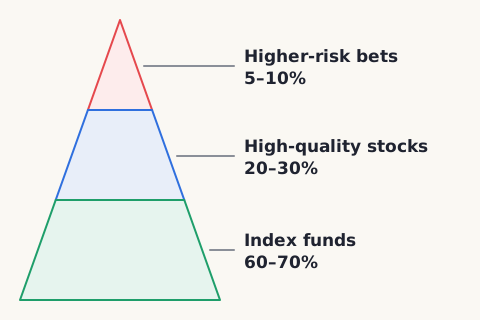
A useful mental model is the portfolio pyramid, built in three layers. The base (60–70%) is index funds — total-market, S&P 500, and international exposure — the bedrock of wealth creation. The middle (20–30%) is individual high-quality stocks with identifiable moats, strong free cash flow, and reasonable valuations. The top (5–10%) is higher-risk positions — growth stocks, crypto, sector bets, speculation — and should be limited to what you can afford to lose entirely. The shape matters: a broad, stable base carries the portfolio, while the narrow speculative top adds upside without threatening the whole.
Where you hold these investments matters as much as what you hold, because the tax structure compounds alongside the returns. A 401(k) is an employer-sponsored, pre-tax retirement account; contributions reduce your taxable income today, and withdrawals are taxed in retirement. A Traditional individual retirement account (IRA) is the individual equivalent. A Roth IRA flips the timing: contributions are post-tax, but all growth and qualified withdrawals are completely tax-free — which makes it a very powerful long-term wealth vehicle for many investors, because decades of compounding accrue entirely to you. An HSA (Health Savings Account) offers a rare triple advantage — pre-tax contributions, tax-free growth, and tax-free withdrawals for medical expenses — and can quietly double as a stealth retirement account. Never invest in a vacuum: filling these accounts before a taxable brokerage account is often the highest-return decision a saver can make.
Compound math and discipline
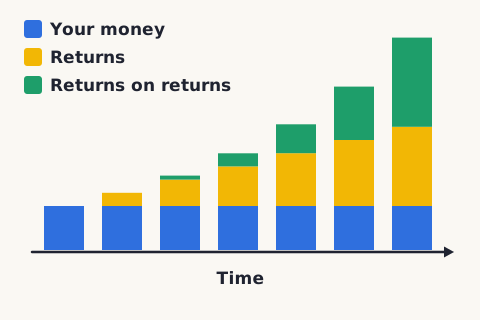
The reason to do any of this is compound growth — the single most powerful force in personal finance, where your money earns returns and those returns earn returns of their own. The numbers are almost hard to believe. A 25-year-old who invests 10,000 in an S&P 500 index fund at 10% and never adds another dollar has roughly 453,000 by age 65. Add 500 a month throughout, and the ending value is roughly 3.2 million. Time, not timing, is the decisive variable, and waiting is the costliest mistake a young investor can make.
History backs the math. The S&P 500 has returned roughly 10% annualized since 1928 (about 9.9–10.0% depending on the end year), including dividends — though a sobering footnote applies: a 100 investment made at the start of 1957 would have grown to about 100,000 by the end of 2025 with dividends reinvested, but adjusted for inflation that's only around $8,500 in 1957 purchasing power. Nominal gains flatter; inflation quietly erodes. That's why even long-term investors must keep their money working rather than idle.
Finally, the math only pays off for those who stay disciplined. A handful of rules recur across great investors: do your homework before buying; own your mistakes and sell when a thesis breaks, regardless of profit or loss; don't panic sell, because U.S. markets have historically recovered from their busts; and diversify — but don't over-diversify, since knowing ten companies well beats knowing fifty superficially. Benjamin Graham and his student Warren Buffett built their records on the core of these ideas: no secret algorithms, no insider information, just decades of disciplined application of principles Graham wrote down in the 1930s and 1940s.
Key terms
- 401(k)
- An employer-sponsored, pre-tax retirement account. Contributions reduce your taxable income now; withdrawals are taxed in retirement.
- Traditional IRA
- An individual pre-tax retirement account. Contributions may be deductible now, and withdrawals are taxed in retirement.
- Roth IRA
- An individual retirement account funded with post-tax dollars, but all growth and qualified withdrawals are completely tax-free, making it a very powerful long-term wealth vehicle for many investors.
- HSA
- A triple-tax-advantaged account: pre-tax contributions, tax-free growth, and tax-free withdrawals for medical expenses. It can double as a stealth retirement account.
Key concepts
401(k)
- An employer-sponsored retirement account funded with pre-tax dollars.
- Contributions lower your taxable income today, and withdrawals are taxed later, in retirement.
Traditional IRA
- A pre-tax retirement account you open on your own, not through an employer.
- It's the individual equivalent of the employer-sponsored plan — contributions may be deductible up front, with taxes deferred until you withdraw.
Roth individual retirement account (IRA)
- This retirement account flips the usual tax timing — you fund it with post-tax dollars instead of pre-tax.
- In return, all growth and qualified withdrawals come out completely tax-free, making it a very powerful long-term wealth vehicle for many investors.
Health savings account (HSA)
- This account offers a rare triple tax advantage: pre-tax contributions, tax-free growth, and tax-free withdrawals for qualifying medical expenses.
- Tied to covering medical costs, it can quietly double as a stealth retirement account.
Key facts
The portfolio pyramid
A useful model for building a portfolio in three layers. The base (60–70%) is index funds — the bedrock of wealth creation. The middle (20–30%) is individual high-quality stocks with moats and strong cash flow. The top (5–10%) is higher-risk bets — growth stocks, crypto, speculation — only what you can afford to lose entirely.

Why the Roth is special
For many investors the Roth IRA (Individual Retirement Account) is a very powerful long-term wealth vehicle. Because growth and qualified withdrawals are tax-free, decades of compounding accrue entirely to you: the longer the time horizon, the more valuable that tax-free status becomes.

The 401(k) Tax Trade
A 401(k) is funded with pre-tax dollars that reduce taxable income today, but withdrawals are taxed once the money comes out in retirement.
A Stealth Retirement Account
The health savings account (HSA) offers a unique triple tax advantage — pre-tax contributions, tax-free growth, and tax-free withdrawals for medical expenses — letting it double as a stealth retirement account.
The most powerful force
The single most powerful force in personal finance is compound growth — your money earns returns, and those returns earn returns of their own. Left alone over time, even modest sums grow dramatically. Time, not timing, is the investor's greatest ally.
The discipline rules
A few discipline rules recur across great investors: do your homework before buying; own your mistakes and sell when a thesis breaks, regardless of profit or loss; don't panic sell, because U.S. markets have historically recovered from their busts; and diversify — but knowing ten companies well beats knowing fifty superficially.
A century of returns
The S&P 500 has returned roughly 9.92% annualized since 1928, including dividends. A 100 investment made at the start of 1957 would have grown to about 100,000 by the end of 2025 with dividends reinvested — though adjusted for inflation, that's roughly $8,500 in 1957 purchasing power, a reminder that inflation quietly erodes nominal gains.
The Inflation Illusion
A 100 investment in the S&P 500 at the start of 1957 grew to about 100,000 by the end of 2025 in nominal terms (dividends reinvested) — but adjusted for inflation, that's only about $8,500 in real purchasing power.
By the numbers
- $10,000 invested at age 25 at 10% grows to roughly how much by age 65 (no further contributions)?
- 453000 USD
- What is the S&P 500's approximate annualized return since 1928 (percent, with dividends)?
- 9.92 %
Matched pairs
Each item on the left goes with the one on the right.
- Base layer (60–70%)
- Index funds — the bedrock of long-term wealth
- Result of adding $500 a month to the $10,000 example
- An ending value of about $3.2 million by age 65
- Value by 2025 of $100 invested in the S&P 500 in 1957
- About $100,000 in nominal terms (dividends reinvested)
Step by step
Open a taxable brokerage account
- Pick a major broker (Fidelity, Schwab, Vanguard) and start the application online.
- Provide your Social Security number (SSN), address, and employment info so the broker can complete its legally required identity verification (KYC/AML).
- Link an external bank account for automated clearing house (ACH) funding using routing and account numbers.
- Set up two-factor authentication and recovery options.
- Initiate a first ACH transfer — settlement usually takes 1–3 business days.
- Once funded, place your first buy order using a market or limit order.
Execute a year-end tax-loss harvest
- Pull your year-to-date realized gains and unrealized losses from the broker.
- Identify positions with losses you can sell without disrupting your asset mix.
- Sell the losing position to realize the capital loss.
- Immediately buy a similar-but-not-identical replacement to avoid the 30-day wash-sale rule.
- After 31 days you can swap back into the original holding if you prefer.
- Use the realized losses to offset realized gains plus up to $3,000 of ordinary income.
Set up an automated dollar-cost averaging plan
- Decide on a fixed dollar amount per month (e.g. $500).
- Pick the target asset — usually a broad-market exchange-traded fund (ETF).
- Schedule an automatic transfer from your bank to the brokerage on payday.
- Enable an auto-investment rule on the brokerage to buy the target ETF on settlement.
- Set a quarterly calendar reminder to verify executions and rebalance if needed.
Self-test
Answer each question from memory, then check your work against the answer key.
1. In the portfolio pyramid, what belongs at the top layer — just 5–10% of the portfolio?
- AHigher-risk bets like growth stocks, crypto, and speculation
- BHigh-quality individual stocks with durable moats
- CTotal-market and S&P 500 index funds
- DInvestment-grade government and corporate bonds
2. The base of the portfolio pyramid makes up 60–70% of holdings. What belongs at that base?
- AGrowth stocks and crypto speculation
- BLong-dated Treasury bonds
- CTotal-market and S&P 500 index funds
- DHigh-quality individual stocks with moats
3. The middle layer of the pyramid (20–30%) consists of what?
- ATotal-market index funds
- BIndividual high-quality stocks with moats and strong cash flow
- CCrypto and sector bets
- DCash and money-market funds
4. Roughly what share of the portfolio does the pyramid reserve for the speculative top layer?
- A60–70%
- B20–30%
- C40–50%
- D5–10%
5. Which of these does NOT belong in the pyramid's speculative top layer?
- AGrowth stocks
- BTotal-market index funds
- CSector bets
- DCrypto
6. Which account is funded with post-tax dollars but offers completely tax-free growth and qualified withdrawals?
- ATaxable brokerage account
- BTraditional IRA
- C401(k)
- DRoth IRA
7. How are 401(k) contributions and withdrawals taxed?
- AContributions are post-tax; withdrawals are tax-free
- BBoth are taxed at the moment of contribution
- CContributions are pre-tax; withdrawals are taxed in retirement
- DBoth contributions and withdrawals are tax-free
8. Which account offers a triple tax advantage — pre-tax contributions, tax-free growth, and tax-free withdrawals for medical expenses?
- AHSA
- BTraditional IRA
- C401(k)
- DRoth IRA
9. How does a Roth individual retirement account's (IRA) tax timing differ from a Traditional IRA's?
- ABoth are post-tax now and tax-free later
- BBoth are pre-tax now and taxed in retirement
- CRoth is pre-tax now; Traditional is post-tax now
- DRoth is post-tax now and tax-free later; Traditional is pre-tax now and taxed later
10. Which statement about these accounts' tax treatment is FALSE?
- AA Roth IRA's qualified withdrawals are taxed in retirement
- BA Traditional IRA's withdrawals are taxed in retirement
- CAn HSA allows tax-free withdrawals for medical expenses
- DA 401(k) lowers your taxable income the year you contribute
11. Of these four tax-advantaged accounts, which one is an employer-sponsored retirement plan?
- AA Traditional IRA
- BA 401(k)
- CAn HSA
- DA Roth IRA
12. Which account is called 'the individual equivalent' of the employer-sponsored 401(k)?
- AHealth savings account (HSA)
- BTaxable brokerage account
- CTraditional IRA
- DRoth individual retirement account (IRA)
13. Which account has post-tax contributions, but tax-free growth and tax-free qualified withdrawals?
- ATraditional 401(k)
- BRoth IRA
- CHSA
- DTraditional IRA
14. Which account is meant for medical expenses and can quietly double as a 'stealth retirement account'?
- ARoth IRA
- B401(k)
- CHSA
- DTraditional IRA
15. Priya's retirement account is set up and sponsored through her workplace. Which type of account does she have?
- AA Roth IRA
- BAn HSA
- CA Traditional IRA
- DA 401(k)
16. A $100 investment in the S&P 500 at the start of 1957 grew to about $100,000 by the end of 2025 in nominal terms (dividends reinvested). Adjusted for inflation, what is that worth in real purchasing power?
- AAbout $8,500
- BAbout $453,000
- CAbout $100,000
- DAbout $30,000
17. $10,000 invested at age 25 at a 10% return, with no further contributions, grows to roughly what by age 65?
- AAbout $100,000
- BAbout $45,300
- CAbout $453,000
- DAbout $3,500,000
18. In the same $10,000 example, adding $500 a month throughout raises the age-65 value to roughly what?
- A$453,000
- B$3.2 million
- C$1.8 million
- D$5.6 million
19. What is the S&P 500's approximate annualized return since 1928, including dividends?
- AAbout 12.4%
- BAbout 14.8%
- CAbout 6.5%
- DAbout 9.9%
20. Which statement best captures the core principle of compounding?
- ATime, not timing, is the decisive variable
- BStarting late matters less than adding more money
- CFrequent trading maximizes compound growth
- DTiming the market beats time in the market
Go deeper
- WatchBuild a Pyramid Think of a portfolio as a pyramid. The base, 60–70%, is index funds.
- WatchStart at Twenty-Five $10,000 at 10%, from age 25 to 65, grows to roughly $453,000.
- StudyInvesting 201 in the FlashFeed app
Answer key
- 1. A Higher-risk bets like growth stocks, crypto, and speculationThe pyramid's narrow top (5–10%) is speculation you can afford to lose entirely. Index funds form the 60–70% base and quality individual stocks the 20–30% middle, so the base carries the portfolio while the top adds upside.
- 2. C Total-market and S&P 500 index fundsThe 60–70% base is index funds — total-market, S&P 500, and international — the bedrock of wealth creation. Individual quality stocks are the middle; speculation is the narrow top.
- 3. B Individual high-quality stocks with moats and strong cash flowThe 20–30% middle is individual high-quality stocks with identifiable moats, strong free cash flow, and reasonable valuations. Index funds are the base; crypto and sector bets are the speculative top.
- 4. D 5–10%The narrow top is just 5–10% — growth stocks, crypto, and speculation limited to what you can afford to lose entirely. 20–30% is the middle and 60–70% is the base.
- 5. B Total-market index fundsIndex funds form the stable 60–70% base, not the top. The 5–10% top is higher-risk positions — growth stocks, crypto, and sector bets you can afford to lose.
- 6. D Roth IRAThe Roth IRA flips the timing: contributions are post-tax, but all growth and qualified withdrawals are tax-free. The 401(k) and Traditional IRA are pre-tax with taxable withdrawals.
- 7. C Contributions are pre-tax; withdrawals are taxed in retirementA 401(k) is pre-tax: contributions reduce taxable income now, and withdrawals are taxed in retirement. Post-tax contributions with tax-free withdrawals describe the Roth, not the 401(k).
- 8. A HSAThe HSA is uniquely triple-tax-advantaged and can double as a stealth retirement account. The Roth has only two of those (post-tax in, tax-free out); the 401(k) and Traditional IRA are taxed on withdrawal.
- 9. D Roth is post-tax now and tax-free later; Traditional is pre-tax now and taxed laterThe Roth uses post-tax dollars but grows and pays out tax-free; the Traditional IRA is pre-tax now with taxable withdrawals in retirement. The two accounts invert each other's timing.
- 10. A A Roth IRA's qualified withdrawals are taxed in retirementFalse: Roth withdrawals are tax-free, not taxed. The other three are accurate — the 401(k) reduces taxable income now, the HSA covers medical costs tax-free, and Traditional IRA withdrawals are taxed later.
- 11. B A 401(k)The 401(k) is the employer-sponsored retirement plan. The Traditional and Roth IRAs are individual retirement accounts. An HSA is a health account, not a retirement plan, though some employers offer one.
- 12. C Traditional IRAThe Traditional IRA is the individual equivalent of the 401(k). The Roth IRA flips the timing, the HSA is for medical expenses, and a brokerage account carries no tax advantage.
- 13. B Roth IRAThe Roth IRA flips the timing: contributions are post-tax, but growth and qualified withdrawals are tax-free, so decades of compounding accrue entirely to the saver.
- 14. C HSAThe Health Savings Account is tied to medical expenses and can double as a stealth retirement account. The 401(k) and IRAs are retirement accounts with no medical-spending purpose.
- 15. D A 401(k)An account sponsored through a workplace is a 401(k), which is employer-sponsored by definition. The IRAs are individual accounts, and the HSA is a health savings account, not a workplace retirement plan.
- 16. A About $8,500Adjusted for inflation, the roughly $100,000 nominal figure is only about $8,500 in 1957 purchasing power. Nominal gains flatter; inflation quietly erodes them — which is why money must stay invested and working.
- 17. C About $453,000Left alone at 10% for 40 years, $10,000 compounds to roughly $453,000. Adding $500/month would lift it to about $3.2 million; $100,000 is the unrelated 1957 S&P example.
- 18. B $3.2 millionContributing $500 a month on top of the initial $10,000 lifts the ending value to roughly $3.2 million by age 65 — $453,000 is the no-contribution result.
- 19. D About 9.9%The S&P 500 has returned roughly 10% annualized since 1928 with dividends included (about 9.9–10.0%, depending on the end year) — the historical basis for compounding examples.
- 20. A Time, not timing, is the decisive variableTime in the market — not trying to time it — drives compounding, and waiting is a young investor's costliest mistake.
Image credits
- The portfolio pyramid: FlashFeed original diagram · CC-BY-4.0
- Why the Roth is special: Wikimedia Commons · Prosperosity · CC BY 4.0 — commons.wikimedia.org/wiki/File:The_Sapling_20231119_140207_01.jpg
- The 401(k) Tax Trade: AI-generated (gpt-image-1.5)
- The most powerful force: FlashFeed original diagram · CC-BY-4.0
- The discipline rules: Wikimedia Commons · Chainwit. · CC BY 4.0 — commons.wikimedia.org/wiki/File:Bangkok_NatMu_-_Siamese_ceramics_(2022)_-_Thai_chess_pieces_%E0%B8%AB%E0%B8%A1%E0%B8%B2%E0%B8%81%E0%B8%A3%E0%B8%B8%E0%B8%81%E0%B9%84%E0%B8%97%E0%B8%A2.jpg
- The Inflation Illusion: Wikimedia Commons · SpeakingArch · CC BY-SA 4.0 — commons.wikimedia.org/wiki/File:One_Hundred_Rupee_Note,_George_V.jpg


