
Investing 201 study guide · Lesson 6 of 17
Projecting Cash Flows: The DCF Model
DCF concepts · DCF steps and pitfalls
This is the lesson's study guide from the FlashFeed app, plus its key facts and a self-test.
What you'll be able to do
- Explain the time value of money as the foundation of a DCF.
- Define WACC and recall its typical range for established firms.
- Define terminal value and name the Gordon Growth model that estimates it.
- Define enterprise value as the true cost to acquire a company.
If financial statements tell you what a company has done, the discounted cash flow model is an attempt to price what it will do. The discounted cash flow (DCF) is widely considered the gold standard of equity valuation — and also the most easily abused. Understanding both its logic and its limits is essential.
DCF concepts
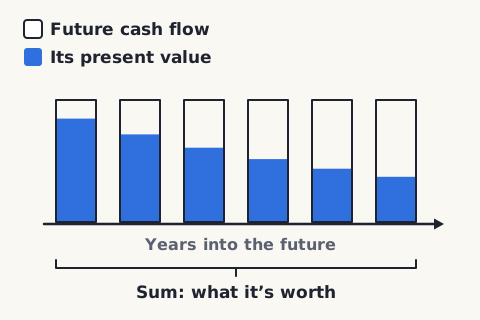
A Discounted Cash Flow analysis rests on one elegant principle: an investment today is worth the sum of all the future cash flows it will produce, with each cash flow discounted back to its present value. Why discount? Because of the time value of money — a dollar today is worth more than a dollar tomorrow, since today's dollar can be invested to earn returns in the meantime. The further into the future a cash flow lies, the less it is worth right now.
The formula sums each year's free cash flow divided by (1 + r) raised to that year's power, then adds the discounted terminal value. Two variables do the heavy lifting. The discount rate r is typically the company's WACC — its Weighted Average Cost of Capital, the blended cost of equity and debt used to fund the business. A higher WACC shrinks the present value of future cash flows; a lower one inflates it. For established U.S. companies, WACC typically lands around 8–12%. The terminal value captures all cash flows beyond the explicit projection window — and because it represents the company's entire indefinite future, it usually accounts for the majority of the model's output.
DCF steps and pitfalls
Building a DCF follows a clear sequence. Step one: project free cash flows, starting from the most recent trailing-twelve-months figure and extending 5–10 years using assumptions for revenue growth, margins, and capital expenditure. Be conservative — small changes in growth assumptions swing the answer dramatically. Step two: choose a discount rate, the WACC. Step three: calculate terminal value, using one of two methods. The Gordon Growth model sets it as the final year's free cash flow (FCF) grown by a modest perpetual rate g, divided by (r − g), with g usually near long-run GDP growth of 2–3%. The exit multiple method instead multiplies the final year's earnings before interest, taxes, depreciation, and amortization (EBITDA) by an appropriate industry EV/EBITDA multiple, grounding the estimate in what comparable companies actually sell for.
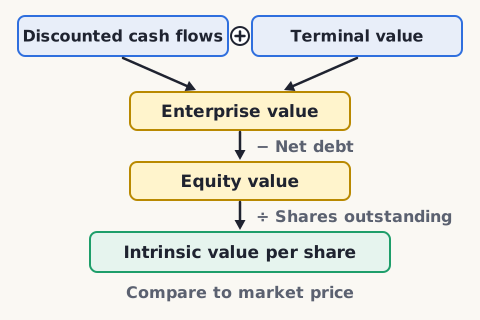
Step four: add the present values of the projected cash flows and the terminal value to get enterprise value — market cap plus debt minus cash, the total cost to acquire the business. Subtract net debt to reach equity value, then divide by shares outstanding for intrinsic value per share. That per-share number is what you compare to the market price: trade far below it and you may have a buy with a wide margin of safety; trade above it and you're likely overpaying.
The model's great weakness is captured in three words: garbage in, garbage out. Slightly optimistic inputs compound across ten years and can justify almost any valuation — which is why "a DCF can justify anything" is a fair critique. The defense is humility and stress-testing: run bear, base, and bull scenarios, and treat the output as a range of plausible values rather than a single precise answer. A DCF is most useful not as an oracle but as a disciplined way to make your assumptions explicit.
Key terms
- Time value of money
- The principle that a dollar today is worth more than a dollar in the future, because today's dollar can be invested to earn returns in the meantime. It's the reason future cash flows must be discounted.
- WACC
- Weighted Average Cost of Capital — the blended cost of all capital, equity and debt, used to fund a business. It's the discount rate in a discounted cash flow (DCF): a higher WACC lowers the present value of future cash flows.
- Terminal value
- The value of all a company's cash flows beyond the explicit projection period, capturing the bulk of a discounted cash flow's (DCF) output. It's estimated with the Gordon Growth model or an exit multiple.
- Enterprise value (EV)
- Market capitalization plus debt minus cash — the total cost to acquire a company outright. It captures the whole business, regardless of how it's financed.
Key concepts
WACC (Weighted Average Cost of Capital)
- In a discounted cash flow model, this is the variable most often used as the discount rate r.
- It blends what a company pays to fund itself through equity and debt into a single rate.
- For established U.S. companies it lands around 8-12%; raise it and the present value of future cash flows shrinks.
Terminal Value
- In a discounted cash flow (DCF), this figure captures every cash flow lying beyond the explicit 5-10 year projection window.
- Because it stands in for the company's entire indefinite future, it usually makes up the majority of the model's output.
- It's computed in step three, using either the Gordon Growth method or an exit-multiple approach on the final projected year.
Gordon Growth Model
- One of two standard ways to calculate a discounted cash flow's (DCF) terminal value.
- It takes the final projected year's free cash flow, applies a modest perpetual rate g, and divides by (r - g).
- Its perpetual rate g is usually set near long-run GDP expansion of about 2-3%.
Exit Multiple Method
- The alternative to a perpetual-growth formula for pinning down a discounted cash flow's (DCF) terminal value.
- It grounds the terminal estimate in what comparable companies actually sell for.
- It takes the final year's earnings before interest, taxes, depreciation, and amortization (EBITDA) and applies an appropriate industry EV/EBITDA figure.
Enterprise Value
- In a discounted cash flow (DCF), you reach this by adding up the discounted projected cash flows and the discounted terminal figure.
- It equals market cap plus debt minus cash - the total price to acquire the whole business.
- Subtract net debt from it to reach equity worth, then divide by shares outstanding for intrinsic worth per share.
Key facts
The discounted cash flow (DCF): gold standard of valuation
A Discounted Cash Flow analysis is considered the gold standard of equity valuation. Its principle is simple: an investment is worth the sum of all the future cash flows it will produce, with each cash flow discounted back to its present value — because a dollar today is worth more than a dollar tomorrow.
The discounted cash flow (DCF) formula
The DCF sums each year's free cash flow divided by (1 + r) raised to that year's power, plus the discounted terminal value. Here r is the discount rate (typically weighted average cost of capital (WACC)), and n is the number of years projected. The further out a cash flow, the more the discounting shrinks it.

A Dollar's Shrinking Worth
The time value of money is the principle that a dollar today is worth more than a dollar in the future, because today's dollar can be invested to earn returns in the meantime.
Same Dollar, Different Value
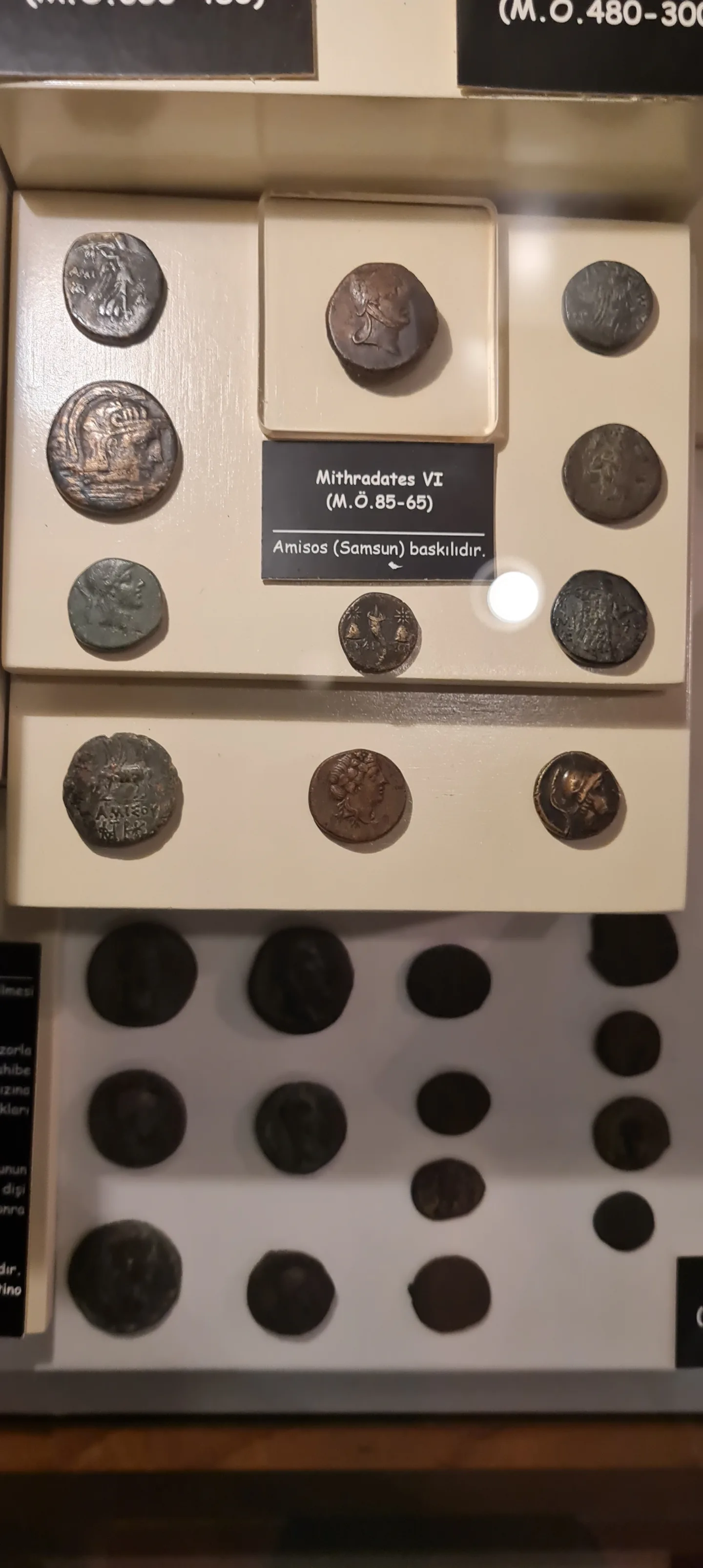
The same $1,000 is worth less today when it arrives in year 10 than in year 1 — the more distant a cash flow, the more discounting shrinks its present value.
Step 1: project free cash flows
Start with the most recent trailing-twelve-months free cash flow (FCF) and project forward 5–10 years using estimates for revenue growth, margins, and capex. Be conservative — even small changes in growth assumptions dramatically swing the output.
Step 2: choose a discount rate
Discount the projected cash flows using weighted average cost of capital (WACC), the blended cost of equity and debt. A higher WACC reduces the present value of future cash flows; a lower one increases it. WACC typically ranges from 8–12% for established U.S. companies.
Terminal value: Gordon Growth
The Gordon Growth model sets terminal value as the final year's free cash flow (FCF) grown by a long-term rate g, divided by (r − g). It assumes the company grows at a modest, perpetual rate forever — usually near long-run GDP growth, around 2–3%.
Terminal value: exit multiple
The exit-multiple method estimates terminal value by multiplying the final year's earnings before interest, taxes, depreciation, and amortization (EBITDA) by an appropriate industry EV/EBITDA multiple. It grounds the terminal value in what comparable businesses actually sell for, rather than a perpetual growth assumption.
From enterprise value to per-share value
Sum the present values of the projected cash flows plus the terminal value to get enterprise value. Subtract net debt (total debt minus cash) to reach equity value, then divide by shares outstanding for intrinsic value per share — the number you compare to the market price.
By the numbers
- WACC for established U.S. companies typically falls around what percent?
- 10 %
Self-test
Answer each question from memory, then check your work against the answer key.
1. Which statement best defines the time value of money?
- AA dollar today is worth more than a dollar in the future
- BA dollar today is worth exactly the same as a dollar in the future
- CA dollar's worth depends only on inflation, not returns
- DA dollar in the future is worth more than a dollar today
2. Why must a discounted cash flow (DCF) discount future cash flows back to present value?
- ABecause future cash flows are guaranteed to shrink
- BBecause inflation always exceeds investment returns
- CBecause today's dollar can be invested to earn returns meanwhile
- DBecause companies pay dividends only in the present
3. Which statement about the time value of money is NOT true?
- AIt is the reason future cash flows must be discounted
- BA dollar today can be invested to earn returns
- CA dollar today is worth more than a dollar tomorrow
- DThe further into the future a cash flow lies, the more it is worth today
4. A firm will receive $1,000 in year 1 and $1,000 in year 10. Discounted to today, how do their present values compare?
- AThe year-10 cash flow is worth more today
- BThe year-10 cash flow is worth less today
- CThe year-1 cash flow is worth less today
- DThey are worth the same today
5. The time value of money is the underlying reason a discounted cash flow (DCF) does what to projected cash flows?
- AAdds them together without adjustment
- BMultiplies them by the terminal value
- CConverts them into shares outstanding
- DDiscounts them to present value
6. What does the acronym WACC stand for?
- AWeighted Annual Cost of Capital
- BWeighted Average Cost of Credit
- CWeighted Average Cost of Capital
- DWorking Average Capital Cost
7. For established U.S. companies, weighted average cost of capital (WACC) typically falls in which range?
- A15–20%
- B8–12%
- C4–6%
- D2–3%
8. How does a higher weighted average cost of capital (WACC) affect the present value of a discounted cash flow's (DCF) future cash flows?
- AIt lowers their present value
- BIt has no effect on present value
- CIt raises their present value
- DIt converts them into terminal value
9. Which best describes weighted average cost of capital's (WACC) role in a discounted cash flow (DCF) model?
- AIt is the perpetual growth rate g
- BIt is the discount rate r applied to the cash flows
- CIt is the terminal value exit multiple
- DIt is the number of shares outstanding
10. WACC represents the blended cost of which two sources of capital?
- ADividends and buybacks
- BRevenue and margins
- CCash and inventory
- DEquity and debt
11. The ___ model sets terminal value as the final year's FCF grown by a long-term rate g, divided by (r − g). It assumes the company grows at a modest, perpetual rate forever — usually near long-run GDP growth, around 2–3%.
- AGordon Growth
- BTime value of money
- CTerminal value
- DWeighted average cost of capital (WACC)
12. What does terminal value represent in a discounted cash flow (DCF)?
- AThe company's total debt minus cash
- BThe company's free cash flow in the first projected year
- CAll the company's cash flows beyond the explicit projection period
- DThe market price of the stock today
13. In the Gordon Growth model, terminal value equals the final year's free cash flow (FCF) grown by g, divided by what?
- Ar plus g
- Bg minus r
- Cr minus g
- D1 plus r
14. Why does terminal value usually account for the majority of a discounted cash flow's (DCF) output?
- AIt is discounted at a lower rate than the other cash flows
- BIt captures the company's entire indefinite future beyond the projection window
- CIt ignores the time value of money entirely
- DIt equals market cap plus debt minus cash
15. A discounted cash flow (DCF) projects free cash flows explicitly for 8 years. Where is the company's year-12 cash flow captured?
- AIn the terminal value
- BIn the net debt subtraction
- CIt is excluded from the model entirely
- DIn the year-8 free cash flow figure
16. How is enterprise value calculated?
- AMarket capitalization minus debt plus cash
- BFree cash flow divided by (r − g)
- CShares outstanding times terminal value
- DMarket capitalization plus debt minus cash
17. Enterprise value best represents which of the following?
- AThe total cost to acquire a company outright
- BThe company's stock price per share
- CThe company's annual free cash flow
- DThe discount rate used in a discounted cash flow (DCF)
18. To move from enterprise value to equity value in a discounted cash flow (DCF), you do what?
- ADivide by weighted average cost of capital (WACC)
- BAdd net debt
- CSubtract net debt
- DMultiply by shares outstanding
19. Which statement about enterprise value is NOT correct?
- AIt represents the total cost to acquire a company
- BIt excludes a company's debt from the acquisition cost
- CIt equals market cap plus debt minus cash
- DIt captures the whole business regardless of financing
20. In a discounted cash flow (DCF), enterprise value is obtained by summing which two things?
- AMarket cap and shares outstanding
- BRevenue growth and profit margins
- CWACC and the terminal growth rate
- DThe present values of the projected cash flows and the terminal value
Go deeper
- WatchA Dollar Today A dollar today is worth more than a dollar tomorrow. Today's dollar can be invested and earn returns.
- WatchGarbage In, Garbage Out A DCF has 4 steps. Forecast free cash flow for 5–10 years. Choose a discount rate. Estimate a terminal value.
- StudyInvesting 201 in the FlashFeed app
Answer key
- 1. A A dollar today is worth more than a dollar in the futureThe time value of money is the principle that a dollar today is worth more than one in the future, because today's dollar can be invested to earn returns in the meantime.
- 2. C Because today's dollar can be invested to earn returns meanwhileFuture cash flows are discounted because of the time value of money: a dollar received later is worth less now, since today's dollar could be invested to earn returns in the interim.
- 3. D The further into the future a cash flow lies, the more it is worth todayThe opposite is true: the further out a cash flow lies, the LESS it is worth today. Distance in time increases discounting, shrinking present value.
- 4. B The year-10 cash flow is worth less todayThe more distant a cash flow, the more discounting shrinks it. The year-10 dollar is discounted over more periods, so its present value is lower than the identical year-1 cash flow.
- 5. D Discounts them to present valueBecause a dollar tomorrow is worth less than a dollar today, a DCF discounts each projected cash flow back to present value before summing them.
- 6. C Weighted Average Cost of CapitalWACC is the Weighted Average Cost of Capital — the blended cost of equity and debt used to fund a business, and the discount rate in a DCF.
- 7. B 8–12%WACC typically lands around 8–12% for established U.S. firms. The 2–3% figure is the perpetual growth rate g in the Gordon Growth model, not the discount rate.
- 8. A It lowers their present valueWACC is the discount rate: a higher WACC shrinks the present value of future cash flows, while a lower one inflates it.
- 9. B It is the discount rate r applied to the cash flowsWACC serves as the discount rate r in the DCF. The growth rate g, the exit multiple, and shares outstanding are all distinct inputs.
- 10. D Equity and debtWACC is the Weighted Average Cost of Capital — the blended cost of equity and debt used to fund the business.
- 11. A Gordon GrowthThe Gordon Growth model is the perpetual-growth approach to terminal value: it takes the final year's FCF, grows it by a modest long-term rate g, and divides by (r − g). Time value of money, WACC, and Terminal value are related but distinct discounted cash flow (DCF) concepts.
- 12. C All the company's cash flows beyond the explicit projection periodTerminal value captures all cash flows beyond the explicit projection window — the company's indefinite future — and usually accounts for the majority of the model's output.
- 13. C r minus gThe Gordon Growth model sets terminal value as the final year's FCF grown by perpetual rate g, divided by (r − g), where r is the discount rate.
- 14. B It captures the company's entire indefinite future beyond the projection windowTerminal value represents all cash flows beyond the explicit 5–10 year window — the company's whole indefinite future — so it typically dominates the model's total.
- 15. A In the terminal valueTerminal value covers everything beyond the explicit projection window, so a year-12 cash flow sits inside it — not dropped, and not folded into the final projected year.
- 16. D Market capitalization plus debt minus cashEnterprise value = market cap + debt − cash, the total cost to acquire a company outright regardless of how it's financed.
- 17. A The total cost to acquire a company outrightEnterprise value is the total cost to acquire a company outright — it captures the whole business, regardless of financing.
- 18. C Subtract net debtSubtract net debt (total debt minus cash) from enterprise value to reach equity value, then divide by shares outstanding for intrinsic value per share.
- 19. B It excludes a company's debt from the acquisition costEnterprise value explicitly ADDS debt (market cap + debt − cash); it does not exclude it. Debt is part of the true cost to acquire the business.
- 20. D The present values of the projected cash flows and the terminal valueEnterprise value is the sum of the discounted projected cash flows plus the discounted terminal value; net debt is then subtracted to reach equity value.
Image credits
- The discounted cash flow (DCF): gold standard of valuation: FlashFeed original diagram · CC-BY-4.0
- A Dollar's Shrinking Worth: Wikimedia Commons · Safyrr · CC BY-SA 4.0 — commons.wikimedia.org/wiki/File:Canadian_1999_Coin_Collection_-_Sarsfield,_ON_-_February_2026.jpg
- Same Dollar, Different Value: Wikimedia Commons · Muhsin Kadıoğlu · CC BY-SA 4.0 — commons.wikimedia.org/wiki/File:20230903_144856_Sikkeler_R%C3%BCze_M%C3%BCzesi.jpg
- From enterprise value to per-share value: FlashFeed original diagram · CC-BY-4.0

