
Investing 201 study guide · Lesson 3 of 17
The Foundations: Asset Classes
Equities · Bonds and fixed income · Commodities, crypto, and real estate
This is the lesson's study guide from the FlashFeed app, plus its key facts and a self-test.
What you'll be able to do
- Define stock ownership and recall the S&P 500's long-run average return.
- Distinguish growth, value, cyclical, and defensive stocks.
- Explain bonds and classify Treasury, municipal, and junk bonds.
- Define blockchain and cryptocurrency, and recall when Bitcoin launched and when Ethereum moved to Proof-of-Stake.
- Define real estate investment trusts (REITs), name the safe-haven assets investors favor in a crisis, and recognize Bitcoin's fixed supply.
Investing begins with knowing what you're actually buying. Every investment belongs to an asset class — a category of instruments that share risk profiles and behave in characteristic ways. Master the handful of major classes and you have the vocabulary to build any portfolio.
Equities
A stock is an ownership stake in a company. Buy a share of Apple and you own a tiny fraction of its assets, earnings, and future. Stocks are issued through an initial public offering (IPO) and then trade on exchanges. They pay you in two ways: capital appreciation, when the price rises and you sell for a profit, and dividends, when the company distributes part of its earnings on a schedule. Over long horizons, stocks are the highest-returning asset class — the S&P 500 has averaged a little over 10% a year since 1957 in nominal terms, with dividends reinvested (the exact figure shifts as each year's return is added).
Stocks come in flavors worth knowing. Growth stocks reinvest earnings aggressively and are expected to grow faster than average (think Nvidia). Value stocks trade below their estimated intrinsic worth — classic Graham and Buffett territory. Cyclical stocks rise and fall with the economy (automakers, airlines), while defensive stocks stay stable regardless of the cycle (utilities, healthcare, consumer staples). A portfolio's tilt toward growth or value, cyclical or defensive, shapes how it behaves through booms and busts.
Bonds and fixed income
A bond is a loan you make to a corporation or government. The issuer often pays a fixed interest rate, the coupon, over the bond's life and returns your principal at maturity. Bonds are safer than stocks but return less over time. The types form a risk ladder: U.S. Treasury bonds, backed by the full faith and credit of the government, are nearly risk-free; municipal bonds issued by cities and states are often tax-advantaged; corporate bonds are rated by agencies like Moody's and S&P; and junk (high-yield) bonds carry below-investment-grade ratings, paying more to compensate for higher default risk.
Bonds also send a famous macro signal. Normally long-term bonds yield more than short-term ones. When that relationship flips — short-term yields exceeding long-term, an inverted yield curve — it has historically been one of the most reliable warnings of an approaching recession. It isn't infallible, and disciplined investors confirm it against unemployment, consumer confidence, and purchasing manager indexes rather than trusting it alone.
Commodities, crypto, and real estate
Commodities are physical raw goods — gold, silver, oil, copper, wheat, livestock. Investors access them by owning the physical asset, trading futures contracts (regulated by the Commodity Futures Trading Commission (CFTC)), or buying exchange-traded funds (ETFs) like GLD for gold. Gold in particular is widely held as a store of value and often treated as an inflation hedge, though its record as a hedge over short and medium horizons is mixed, and in crises investors stage a "flight to safety" into gold and Treasuries.
Cryptocurrency is a digital asset transferred peer-to-peer over a blockchain — a decentralized public ledger maintained by a global network of computers. Bitcoin, launched in 2009, was the first widely adopted crypto, with a fixed supply capped at 21 million coins; its 2008 whitepaper described online payments sent directly from one party to another without going through a financial institution. Ethereum was the first major blockchain to implement smart contracts — a concept defined by computer scientist Nick Szabo in the 1990s — as self-executing code that powers DeFi and non-fungible tokens (NFTs). On September 15, 2022, an upgrade called "The Merge" moved Ethereum from Proof-of-Work, in which miners secure the network, to Proof-of-Stake, in which validators who have staked coins process transactions.
But the risks are real. Crypto is not insured by the Federal Deposit Insurance Corporation (FDIC) or any government agency, and SIPC (the Securities Investor Protection Corporation), which restores customers' cash and securities when a member brokerage firm fails, does not protect crypto assets that are not registered securities, such as Bitcoin (as of 2026). Exchanges can be hacked, and transactions are irreversible. A private key is the passcode that authorizes a crypto transaction and cannot be replaced — lose your keys and you lose your coins. Holding through the swings instead of selling is called HODL in crypto slang, from a misspelling of "hold" in a 2013 Bitcoin forum post.
Finally, real estate can be owned directly or through REITs — Real Estate Investment Trusts, companies (many of them publicly traded) that own income-producing property and are required by law to distribute at least 90% of taxable income as dividends. That mandate makes REITs a favorite of income-focused investors who want real-estate exposure without managing a building.
Key terms
- Stock
- An ownership stake in a company. Buying a share of Apple makes you a fractional owner of its assets, earnings, and future prospects. Stocks are issued via an initial public offering (IPO) and traded on exchanges.
- Bond
- A loan made by an investor to a corporation or government. The issuer often pays a fixed rate of interest (the coupon) over the bond's life and returns the principal at maturity. Bonds are safer than stocks but offer lower long-term returns.
- Blockchain
- A decentralized, public ledger maintained by a global network of computers, enabling peer-to-peer transfer of value without a central intermediary.
- REIT
- Real Estate Investment Trust: a company (many are publicly traded, though non-traded REITs also exist) that owns income-producing real estate and is required by law to distribute at least 90% of taxable income as dividends.
Key concepts
U.S. Treasury Bonds
- On the fixed-income risk ladder, this instrument sits at the very bottom for risk.
- Backed by the full faith and credit of the federal government, it is considered nearly risk-free.
- In a crisis, investors stage a flight to safety into gold and this government debt.
Corporate Bonds
- This debt is a loan you make to a business rather than to a government.
- Its risk is graded by ratings agencies like Moody's and S&P.
- Sitting between government-backed and below-investment-grade debt, its safety hinges on the issuing firm's credit rating.
Municipal Bonds
- This debt is issued by local governments, not by companies or the federal treasury.
- Cities and states issue it to finance their public needs.
- Its interest is often tax-advantaged, making it a favorite of investors in higher tax brackets.
Junk Bonds
- This category sits at the very top of the fixed-income risk ladder.
- It carries below-investment-grade ratings from the agencies.
- It pays a higher return precisely to compensate investors for a greater chance of default — hence its unflattering nickname.
Key facts
Two ways stocks pay you
Stock returns come in two forms. Capital appreciation is when the price rises and you sell for a profit. Dividends are when the company distributes a portion of its earnings to shareholders on a regular schedule. Stocks are historically the highest-returning asset class over long periods.
A Fractional Claim
Buying a share of stock means purchasing an ownership stake in the company: a fractional claim on its assets, earnings, and future — not a loan to be repaid like a bond.
Stocks' Long-Run Average
Since 1957 the S&P 500 has averaged a little over 10% a year in nominal terms, with dividends reinvested, historically making stocks the highest-returning major asset class over long time horizons.
A Stock's Public Debut
A company's stock first reaches public investors through an IPO (initial public offering); after that debut, shares change hands on exchanges rather than being reissued by the company.
Riding The Economic Cycle
Automakers and airlines are classic cyclical stocks: their fortunes track the broader economy, booming in expansions and slumping in downturns, unlike defensive stocks that stay stable regardless.
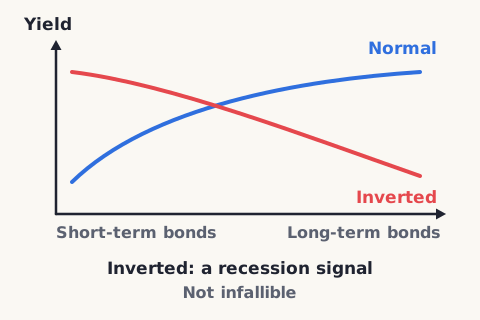
The inverted yield curve
Normally long-term bonds yield more than short-term ones. When that flips — short-term bonds yielding more than long-term, an inverted yield curve — it has historically been one of the most reliable signals of an approaching recession. But it isn't infallible, and savvy investors cross-check it against other indicators.

Lending, Not Owning
Buying a bond means making a loan to a corporation or government: the issuer pays interest along the way and returns the principal at maturity, unlike a stock's ownership stake.
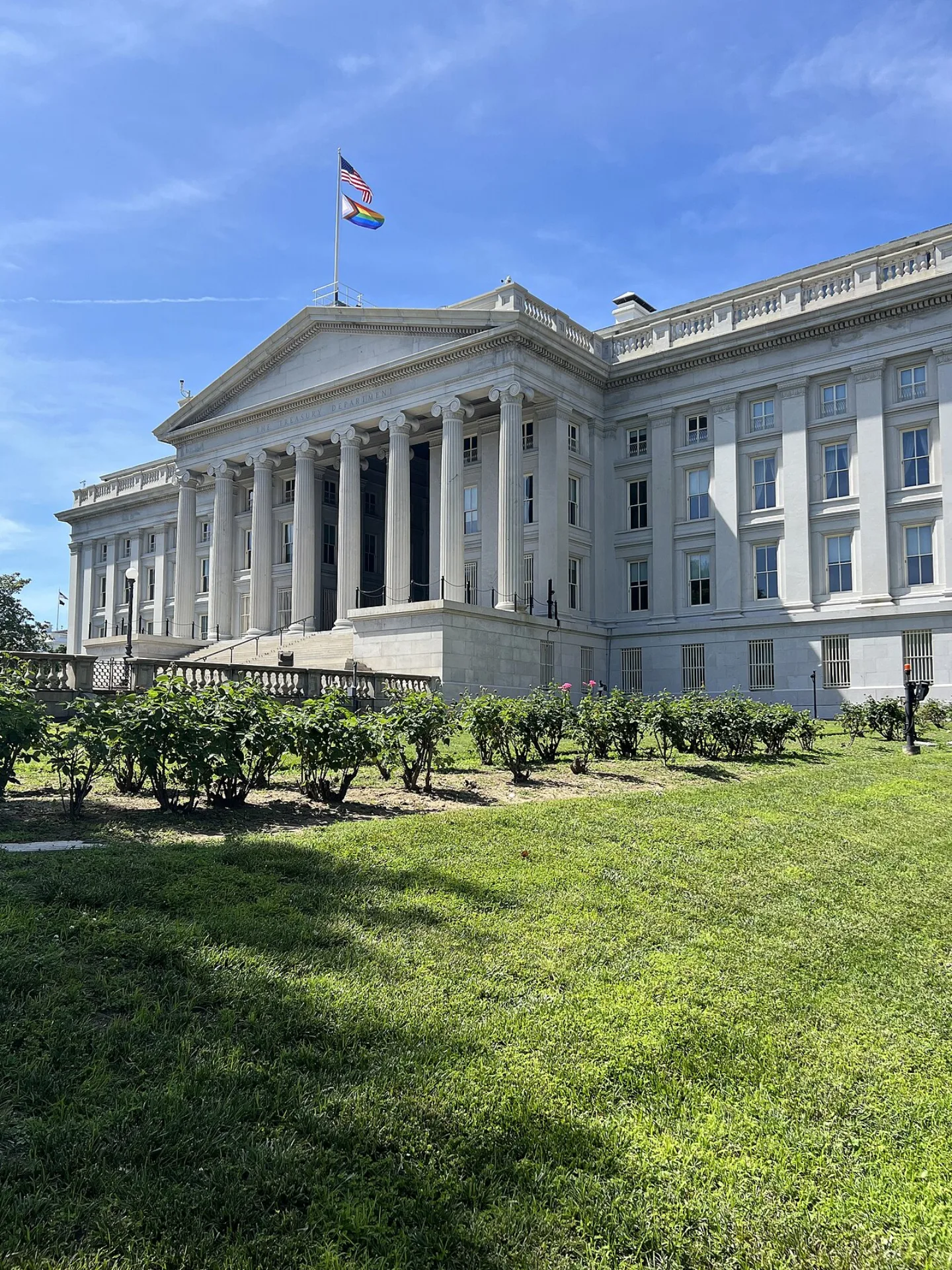
The Safest Rung
U.S. Treasury bonds are backed by the full faith and credit of the U.S. government, making them the safest rung of the bond risk ladder and considered nearly risk-free.
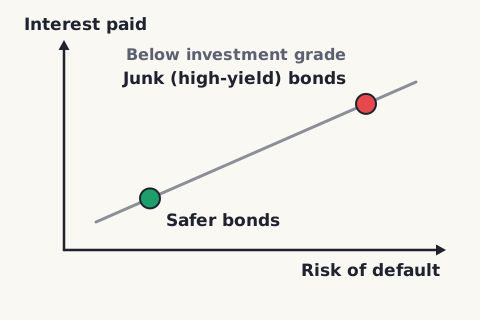
Higher Risk, Higher Yield
Junk, or high-yield, bonds carry below-investment-grade ratings and pay higher interest than safer bonds to compensate investors for the added risk of default.
Cities And States Borrow
Municipal bonds are issued by cities and states and often come with tax advantages, distinguishing them from federally issued Treasuries and company-issued corporate bonds.
Commodities
Commodities are physical raw goods: gold, silver, oil, natural gas, copper, wheat, and livestock. Investors access them through direct ownership (physical gold), futures contracts regulated by the Commodity Futures Trading Commission (CFTC), or exchange-traded funds (ETFs) that track commodity prices, such as GLD for gold and USO for oil.
Ethereum and smart contracts
Ethereum was the first major blockchain to implement smart contracts: self-executing code that powers DeFi and non-fungible tokens (NFTs). After 'The Merge' in 2022, Ethereum switched to Proof-of-Stake.
By the numbers
- What nominal yearly S&P 500 return, dividends reinvested, is commonly cited since 1957?
- 10.5 %
Matched pairs
Each item on the left goes with the one on the right.
- Growth stock
- Reinvests earnings aggressively; expected to grow faster than average (e.g., Nvidia)
- Value stock
- Trades below estimated intrinsic value; classic Graham/Buffett territory
- Cyclical stock
- Performance tied to the economic cycle (e.g., automakers, airlines)
- Defensive stock
- Stable regardless of the cycle (e.g., utilities, healthcare, staples)
- Coupon
- The interest rate a bond pays its holder
- U.S. Treasury bonds
- Backed by the full faith and credit of the U.S. government — nearly risk-free
- Municipal bonds
- Issued by cities and states; often tax-advantaged
- Junk (high-yield) bonds
- Below investment-grade ratings; higher risk and higher return
- Cryptocurrency
- A digital asset transferred peer-to-peer over a blockchain
Self-test
Answer each question from memory, then check your work against the answer key.
1. When you buy a share of stock, what have you actually purchased?
- AInsurance against the company's default
- BAn ownership stake in the company
- CA fixed claim on the company's interest payments
- DA loan to the company repaid at maturity
2. Roughly what nominal average annual return (before inflation, dividends reinvested) has the S&P 500 delivered since 1957?
- A21.0%
- B4.5%
- C10.3%
- D7.0%
3. When a stock's price rises and you sell your shares for a profit, that gain is called:
- APrincipal repayment
- BA dividend
- CA coupon
- DCapital appreciation
4. A company distributing a portion of its earnings to shareholders on a regular schedule is paying a:
- ADividend
- BCoupon
- CPrincipal repayment
- DInterest
5. How is a company's stock first made available to public investors?
- AThrough an IPO, then traded on exchanges
- BBy direct issuance from the Treasury
- COnly via private peer-to-peer transfer
- DThrough a coupon auction at maturity
6. Automakers and airlines, whose fortunes rise and fall with the broader economy, are classic examples of which kind of stock?
- ADefensive stocks
- BValue stocks
- CCyclical stocks
- DGrowth stocks
7. A company like Nvidia that reinvests earnings aggressively and is expected to grow faster than average is a classic example of a:
- ADefensive stock
- BGrowth stock
- CValue stock
- DCyclical stock
8. A stock trading below its estimated intrinsic worth — classic Graham and Buffett territory — is called a:
- ACyclical stock
- BDefensive stock
- CGrowth stock
- DValue stock
9. Utilities, healthcare, and consumer staples that stay stable regardless of the economic cycle are examples of which stock type?
- AValue stocks
- BGrowth stocks
- CDefensive stocks
- DCyclical stocks
10. Which pairing of stock type to example is INCORRECT?
- ADefensive stock — utilities and consumer staples
- BDefensive stock — automakers and airlines
- CGrowth stock — Nvidia
- DCyclical stock — automakers and airlines
11. Which stock type reinvests earnings aggressively and is expected to grow faster than average, like Nvidia?
- ADefensive stock
- BCyclical stock
- CValue stock
- DGrowth stock
12. Which feature describes growth stocks rather than value stocks?
- AReinvests earnings for faster-than-average growth
- BPays higher dividends than value stocks
- CTrades below its estimated intrinsic value
- DIncludes only utility companies
13. Which stock type trades below its estimated intrinsic value — classic Graham/Buffett territory?
- ADefensive stock
- BGrowth stock
- CValue stock
- DCyclical stock
14. Which trait defines a value stock?
- ATrades below its estimated intrinsic value
- BReinvests earnings for faster-than-average growth
- CStays stable regardless of the cycle
- DRises and falls with the economy
15. What does an investor actually do when they buy a bond?
- APurchase a physical commodity like gold
- BMake a loan to a corporation or government
- CBuy an ownership stake in a company
- DAcquire a share of future dividend payments
16. On a bond, the interest rate the issuer pays the holder over the bond's life is called the:
- AMaturity
- BDividend
- CPrincipal
- DCoupon
17. Which type of bond is described as nearly risk-free, backed by the full faith and credit of the U.S. government?
- AJunk (high-yield) bonds
- BMunicipal bonds
- CU.S. Treasury bonds
- DCorporate bonds
18. Which bonds carry below-investment-grade ratings and pay more to compensate for higher default risk?
- AJunk (high-yield) bonds
- BU.S. Treasury bonds
- CInvestment-grade corporate bonds
- DMunicipal bonds
19. Bonds issued by cities and states, often carrying tax advantages, are known as:
- AInvestment-grade corporate bonds
- BMunicipal bonds
- CU.S. Treasury bonds
- DJunk (high-yield) bonds
20. What is a blockchain?
- AA private database controlled by a single central bank
- BA wallet app that stores a user's private keys
- CA trading platform where investors buy and sell coins
- DA decentralized public ledger maintained by a global network of computers
21. Bitcoin, the first widely adopted cryptocurrency, was launched in what year and has what supply cap?
- ALaunched in 2009, capped at 21 million coins
- BLaunched in 2022, capped at 21 million coins
- CLaunched in 2009, with unlimited supply
- DLaunched in 2015, capped at 100 million coins
22. Which major blockchain was the first to implement smart contracts — self-executing code that powers DeFi and non-fungible tokens (NFTs)?
- ABitcoin
- BEthereum
- CLitecoin
- DDogecoin
23. After 'The Merge' in 2022, Ethereum switched to which consensus mechanism?
- AProof-of-Authority
- BProof-of-History
- CProof-of-Stake
- DProof-of-Work
24. Which statement about cryptocurrency risk is accurate?
- AAn exchange can reverse any transfer
- BThe network can reset a lost private key
- CThe FDIC insures it up to $250,000
- DUnregistered crypto has no FDIC or SIPC cover
25. By law, what minimum share of its taxable income must a REIT distribute to shareholders as dividends?
- A75%
- B100%
- C50%
- D90%
26. What is a REIT?
- AA cryptocurrency pegged to real-estate prices
- BA company that owns income-producing real estate
- CA physical commodity like gold or copper
- DA government bond backed by property taxes
27. Why is gold commonly described as an inflation hedge?
- AGold often holds or gains value when paper currency weakens
- BIts price rises one-for-one with inflation
- CIt pays a fixed coupon that rises with inflation
- DCentral banks peg its price to the inflation rate
28. During geopolitical uncertainty or currency crises, investors stage a 'flight to safety' into which assets?
- AUtilities and dividend-paying blue chips
- BConsumer-staples stocks and money-market funds
- CGold and U.S. Treasuries
- DInvestment-grade corporate bonds and municipal bonds
29. Which of these is a feature of Bitcoin?
- AFDIC insurance on all holdings
- BA guaranteed 90% dividend distribution
- CA fixed supply capped at 21 million coins
- DA coupon paid until maturity
Go deeper
- WatchTwo Ways a Stock Pays A stock is a small piece of a company. It pays you in two ways.
- WatchWhen the Curve Flips A bond is a loan to a company or a government. It pays fixed interest, then returns your money.
- WatchEach Has a Catch Gold is the classic hedge. When paper money loses buying power, gold tends to hold its value.
- StudyInvesting 201 in the FlashFeed app
Answer key
- 1. B An ownership stake in the companyA stock is an ownership stake — a fractional claim on a company's assets, earnings, and future. A loan repaid at maturity with interest describes a bond, not a stock.
- 2. C 10.3%Since 1957 the S&P 500 has averaged a little over 10% a year in nominal terms with dividends reinvested (the exact figure shifts as each year's return is added), making stocks the highest-returning major asset class over long horizons.
- 3. D Capital appreciationCapital appreciation is one of the two ways stocks pay: the price rises and you sell for a profit. A coupon is bond interest, a dividend is a distribution of earnings, and principal repayment is a bond feature.
- 4. A DividendDividends are scheduled distributions of earnings to shareholders. A coupon is bond interest; a capital gain comes from selling at a higher price; principal repayment is a bond feature.
- 5. A Through an IPO, then traded on exchangesStocks are issued through an IPO (initial public offering) and then trade on exchanges. Treasury issuance and coupon auctions describe bonds.
- 6. C Cyclical stocksCyclical stocks (automakers, airlines) track the economic cycle — booming in expansions and slumping in downturns — the opposite of defensive stocks like utilities and consumer staples that stay stable regardless.
- 7. B Growth stockGrowth stocks reinvest earnings and are expected to grow faster than average (e.g., Nvidia). Value stocks trade below intrinsic worth; cyclical stocks track the economy; defensive stocks stay stable through the cycle.
- 8. D Value stockValue stocks trade below their estimated intrinsic value, the domain of Graham and Buffett. Growth stocks are priced for fast future growth; cyclical and defensive describe economic sensitivity, not underpricing.
- 9. C Defensive stocksDefensive stocks (utilities, healthcare, staples) stay stable through booms and busts. Cyclical stocks like automakers and airlines rise and fall with the economy.
- 10. B Defensive stock — automakers and airlinesAutomakers and airlines are cyclical, not defensive — their fortunes track the economy. Defensive stocks are utilities, healthcare, and staples that stay stable.
- 11. D Growth stockGrowth stocks reinvest earnings aggressively and are expected to grow faster than average — Nvidia is one example.
- 12. A Reinvests earnings for faster-than-average growthGrowth stocks reinvest earnings aggressively to grow faster than average, unlike value stocks, which trade below their estimated intrinsic worth.
- 13. C Value stockValue stocks trade below their estimated intrinsic worth, the classic Graham and Buffett approach to picking undervalued companies.
- 14. A Trades below its estimated intrinsic valueValue stocks trade below their estimated intrinsic worth. Growth stocks reinvest for above-average growth, cyclical stocks track the economy, and defensive stocks stay stable through the cycle.
- 15. B Make a loan to a corporation or governmentA bond is a loan to a corporation or government; the issuer pays a coupon and returns principal at maturity. Ownership stakes and dividends describe stocks.
- 16. D CouponThe coupon is the bond's interest rate. Principal is the amount returned at maturity, and maturity is the date it is returned, not the interest rate.
- 17. C U.S. Treasury bondsTreasury bonds are backed by the full faith and credit of the U.S. government and are considered nearly risk-free — the safest rung of the bond risk ladder.
- 18. A Junk (high-yield) bondsJunk (high-yield) bonds have below-investment-grade ratings and pay higher yields to offset higher default risk. Treasuries and munis sit lower on the risk ladder.
- 19. B Municipal bondsMunicipal bonds are issued by cities and states and are often tax-advantaged. Treasuries are federal, junk bonds are below-investment-grade, and corporate bonds are issued by companies.
- 20. D A decentralized public ledger maintained by a global network of computersA blockchain is a decentralized, public ledger maintained by a global network of computers, enabling peer-to-peer transfer of value without a central intermediary.
- 21. A Launched in 2009, capped at 21 million coinsBitcoin launched in 2009, after its whitepaper appeared in 2008, and was the first widely adopted crypto. Its supply is capped at 21 million coins.
- 22. B EthereumEthereum was the first major blockchain to implement smart contracts, self-executing code that powers DeFi and NFTs. Bitcoin, launched in 2009, was the first widely adopted crypto, but it does not support general-purpose smart contracts.
- 23. C Proof-of-StakeAfter 'The Merge' in 2022, Ethereum switched from Proof-of-Work to a Proof-of-Stake consensus mechanism, validating via staked coins rather than mining.
- 24. D Unregistered crypto has no FDIC or SIPC coverCrypto is not insured by the FDIC or any government agency, and SIPC does not protect unregistered crypto such as Bitcoin. Transactions are irreversible, and a lost private key cannot be replaced.
- 25. D 90%A Real Estate Investment Trust (REIT) must distribute at least 90% of taxable income as dividends — the mandate that makes REITs a favorite of income-focused investors seeking real-estate exposure without owning property directly.
- 26. B A company that owns income-producing real estateA REIT (Real Estate Investment Trust) is a company that owns income-producing real estate and must distribute at least 90% of taxable income as dividends; many REITs are publicly traded.
- 27. A Gold often holds or gains value when paper currency weakensGold is widely held as a store of value and often treated as an inflation hedge, though its record as a hedge over short and medium horizons is mixed. Its price is not pegged to inflation or tied to it one-for-one, and a fixed coupon describes bonds.
- 28. C Gold and U.S. TreasuriesIn crises investors stage a 'flight to safety' into gold and U.S. Treasuries — the classic safe havens — not into higher-risk assets like junk bonds or crypto.
- 29. C A fixed supply capped at 21 million coinsBitcoin has a fixed supply capped at 21 million coins. Coupons belong to bonds, the 90% payout rule to real estate investment trusts (REITs), and crypto is not FDIC-insured.
Sources
- SIPC — What SIPC Protects — www.sipc.org/for-investors/what-sipc-protects
- Investor.gov — Crypto Asset Custody Basics for Retail Investors (Dec 2025) — www.investor.gov/introduction-investing/general-resources/news-alerts/alerts-bulletins/investor-bulletins/crypto-asset-custody-basics-retail-investors-investor-bulletin-0
- ethereum.org — The Merge — ethereum.org/en/roadmap/merge/
- Nakamoto (2008), Bitcoin: A Peer-to-Peer Electronic Cash System — bitcoin.org/bitcoin.pdf
- CFTC — Understand the Risks of Virtual Currency Trading — www.cftc.gov/LearnAndProtect/AdvisoriesAndArticles/understand_risks_of_virtual_currency.html
Image credits
- The inverted yield curve: FlashFeed original diagram · CC-BY-4.0
- Lending, Not Owning: AI-generated (gpt-image-1.5)
- The Safest Rung: Wikimedia Commons · 颐园居 · CC BY-SA 4.0 — commons.wikimedia.org/wiki/File:America_Treasury_Department_Building_20240601.jpg
- Higher Risk, Higher Yield: FlashFeed original diagram · CC-BY-4.0
