
Investing 201 study guide · Lesson 4 of 17
Value Investing
Graham and Buffett · Margin of safety and ROIC
This is the lesson's study guide from the FlashFeed app, plus its key facts and a self-test.
What you'll be able to do
- Explain Graham's Mr. Market metaphor and the concept of intrinsic value.
- Trace how Buffett's approach evolved from Graham-style bargains to quality businesses.
- Explain the margin of safety and the discount many value investors look for.
- Define ROIC, its formula, and the preferred threshold for a quality business.
- Explain the economic moat as a durable competitive advantage.
Value investing is less a set of formulas than a temperament. Its founders taught that a stock is a piece of a business, that the market is a moody partner rather than an oracle, and that the surest path to profit is paying meaningfully less than something is worth. These ideas, articulated in books written in the 1930s and 1940s, still anchor the most successful investing careers of the last century.
Graham and Buffett
Benjamin Graham is the father of value investing. His two foundational texts — Security Analysis (1934, with David Dodd) and The Intelligent Investor (1949) — argued a deceptively simple point: a stock is not a ticker symbol but a fractional ownership stake in a real business. Graham personified the market as "Mr. Market," an irrational partner who shows up each day offering to buy or sell at a price, sometimes euphorically high and sometimes despairingly low. The wise investor treats Mr. Market's moods as opportunities, not verdicts.
Graham's framework rests on three pillars. Intrinsic value is what a company is genuinely worth, independent of its price. Margin of safety means buying only when the price sits well below that value. And Mr. Market is the reminder to exploit price swings rather than be ruled by them.
Warren Buffett, arguably Graham's most famous student, began as a pure bargain hunter buying stocks below net asset value. Guided by his partner Charlie Munger, he evolved toward the view, in his 1989 shareholder letter, that "it's far better to buy a wonderful company at a fair price than a fair company at a wonderful price." Under that philosophy, Berkshire Hathaway grew from a failing textile mill into one of the world's largest conglomerates. Buffett's origins are the stuff of legend: he reportedly read every investing book in the Omaha public library by age twelve and made his first stock purchase at eleven — three shares of Cities Service Preferred at $38 each.
Margin of safety and ROIC
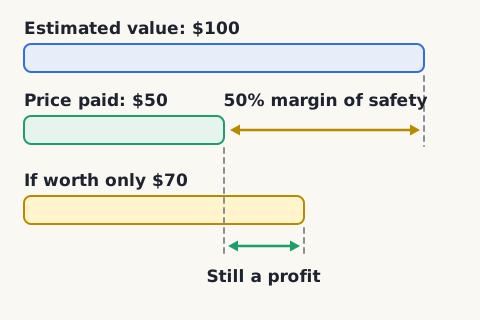
The margin of safety is the heart of the discipline: the gap between a stock's intrinsic value and its market price. If you calculate a company is worth 100 per share but it trades at 50, you have a 50% margin of safety. Even if your estimate is wrong and it's really worth only $70, you still profit. Many value investors look for a margin of 30% to 50%, widening the buffer when the business or the macro picture is more uncertain. The margin isn't a lazy cushion — it's protection against the unavoidable error in any projection.
Modern value investing adds a quality lens, and one of the sharpest tools is ROIC — Return on Invested Capital, calculated as NOPAT (net operating profit after tax) divided by invested capital. Popularized by investors like Michael Mauboussin, ROIC measures how efficiently a company turns capital into profit. A ROIC above 10% is generally acceptable; above 15% is preferable. Companies that sustain high ROIC almost always possess a durable competitive advantage — a moat.
That word, Buffett's coinage, names the thing that protects a company's profits from competitors: pricing power, switching costs, network effects, cost advantages, or intangible assets like brand. Capital-light software businesses can post ROICs of 30–100%+, while commodity businesses scrape by at 5–10%. The combination — a wide moat, a high ROIC, and a price below intrinsic value with a healthy margin of safety — is the modern value investor's ideal target.
Key terms
- Mr. Market
- Graham's metaphor for the stock market: an irrational business partner who offers you a price every day — sometimes euphorically high, sometimes despairingly low. Treat his moods as opportunities, not verdicts.
- Intrinsic value
- What a company is actually worth based on its business fundamentals, independent of its current market price. Estimating it is the central task of value investing.
- Margin of safety
- The difference between a stock's intrinsic value and its current market price. The wider the gap, the more room you have to be wrong and still profit — your buffer against estimation error.
- ROIC
- Return on Invested Capital = NOPAT (net operating profit after tax) divided by invested capital. It measures how efficiently a company turns capital into profit — a favorite quality metric of investors like Michael Mauboussin.
- Economic moat
- Warren Buffett's term for a durable competitive advantage that protects a company's market position — network effects, switching costs, cost advantages, or intangible assets like brand.
Key concepts
Mr. Market
- Benjamin Graham personified the trading world as an irrational partner rather than an oracle.
- This imaginary business partner shows up each day offering to buy or sell — sometimes euphorically high, sometimes despairingly low.
- Graham taught the wise investor to treat this fictional figure's moods as opportunities to exploit, not verdicts to obey.
Intrinsic Value
- One of Graham's three pillars, this is what a company is genuinely worth.
- It exists independently of whatever price the market is charging on a given day.
- Estimating this figure and then buying well below it is precisely what creates a margin of safety.
Return on invested capital (ROIC)
- This modern metric adds a quality lens to old-school value investing.
- Popularized by investors like Michael Mauboussin, it gauges how efficiently a company converts money into profit.
- A reading above 10% is acceptable and above 15% preferable; companies that sustain a high one almost always possess a durable moat.
Key facts
Meet Mr. Market
Benjamin Graham personified the market as 'Mr. Market,' an irrational business partner who shows up every day quoting a price to buy or sell — sometimes euphorically high, sometimes despairingly low.
Margin of safety in practice
If you calculate a company is worth 100 per share but it trades at 50, you have a 50% margin of safety: you're paying half of what you believe the business is worth. Even if your estimate is off and it's really worth only $70, you still profit. Many value investors look for a margin of 30% to 50%; higher uncertainty calls for a wider buffer.
What makes a good return on invested capital (ROIC)
A ROIC above 10% is generally considered acceptable; above 15% is preferable. Companies with consistently high ROIC tend to have durable competitive advantages — pricing power, switching costs, network effects, or cost advantages — that let them compound shareholder value over time.
The ROIC Formula
Return on Invested Capital (ROIC) is calculated as net operating profit after tax (NOPAT) divided by invested capital, a distinct measure from ROA (net income over assets) or ROE (net income over equity).
Room To Be Wrong
The margin of safety is the gap between a stock's intrinsic value and its market price — a buffer that leaves room for a valuation estimate to be wrong and still work out.
Insurance Against Estimation Error
The margin of safety isn't a lazy cushion — it exists specifically to protect against the unavoidable error built into any projection of a stock's intrinsic value.
By the numbers
- At the low end, what margin of safety (percent) do many value investors look for?
- 30 %
- Above what ROIC (percent) is considered preferable for a quality business?
- 15 %
Self-test
Answer each question from memory, then check your work against the answer key.
1. In Graham's metaphor, what does 'Mr. Market' represent?
- AA rational oracle whose price always reflects true value
- BThe company's own management team
- CA government regulator that sets fair stock prices
- DAn irrational business partner who quotes you a buy/sell price every day
2. How should a wise investor treat Mr. Market's daily price offers?
- AAs commands that must be followed immediately
- BAs proof that the investor's thesis was wrong
- CAs opportunities to exploit, not verdicts to obey
- DAs authoritative signals about the stock's true worth
3. Which statement best defines a stock's intrinsic value?
- AWhat a company is actually worth based on business fundamentals, independent of price
- BThe average of a stock's high and low price for the year
- CThe total dividends a company has paid to date
- DThe price at which the stock currently trades on the market
4. In value investing, estimating a company's intrinsic value is described as what?
- ASomething only useful for bonds, not stocks
- BThe central task of the discipline
- CIrrelevant once you know the market price
- DA minor detail left to accountants
5. Which of the following is NOT true of Mr. Market as Graham described him?
- AHe offers you a price every single day
- BHe is an irrational business partner
- CHe always quotes a price equal to the stock's true intrinsic value
- DHis moods swing from euphoric to despairing
6. Guided by Charlie Munger, how did Warren Buffett's philosophy evolve beyond his early bargain-hunting days?
- ABuy a wonderful company at a fair price rather than a fair company at a wonderful price
- BOnly buy stocks trading below their net asset value
- CBuy a fair company at a wonderful price rather than a wonderful company at a fair price
- DSimply buy and hold a broad market index forever
7. How did Buffett begin his investing career, before Munger's influence?
- ABy indexing the whole market and holding forever
- BAs a pure bargain hunter buying stocks below net asset value
- CBy buying wonderful companies at fair prices
- DBy trading options on commodity futures
8. Under Buffett, Berkshire Hathaway transformed from what into a global conglomerate?
- AA regional railroad
- BA struggling newspaper chain
- CA small insurance startup
- DA failing textile mill
9. Which purchase best reflects Buffett's LATER philosophy rather than his early approach?
- AA dominant, high-quality business bought at a fair price
- BA high-quality business, available only at a deep bargain price
- CA mediocre business bought far below its net asset value
- DA failing business trading at a deep discount to book value
10. What is an economic moat?
- AA reserve of cash held for downturns
- BA short-term gap between price and intrinsic value
- CA durable competitive advantage that protects a company's market position
- DA regulatory penalty imposed on monopolies
11. What is the margin of safety in value investing?
- AThe difference between a stock's high and low price
- BA stock's dividend yield above the risk-free rate
- CThe percentage of a portfolio held in cash
- DThe gap between a stock's intrinsic value and its market price
12. What margin of safety do many value investors look for?
- AExactly 100%
- B30% to 50%
- C70% to 80%
- D5% to 10%
13. If you judge a stock is worth $100 per share but it trades at $50, what is your margin of safety?
- A200%
- B30%
- C100%
- D50%
14. When do value investors widen the margin of safety they require?
- AWhen they are highly confident in the estimate
- BWhen interest rates are falling
- CWhen the business or macro picture is more uncertain
- DWhen the stock has already risen sharply
15. The margin of safety primarily protects an investor against what?
- AInflation eroding cash holdings
- BThe unavoidable error in any valuation projection
- CShort-term swings in interest rates
- DBrokerage fees and trading commissions
16. How is Return on Invested Capital (ROIC) calculated?
- ANOPAT (net operating profit after tax) divided by invested capital
- BRevenue divided by invested capital
- CNet income divided by shareholders' equity
- DNet income divided by total assets
17. Above what return on invested capital (ROIC) is generally considered preferable for a quality business?
- A5%
- B15%
- C30%
- D10%
18. What does return on invested capital (ROIC) measure about a company?
- AHow much debt it carries relative to equity
- BHow fast its revenue is growing
- CHow large its dividend payout is
- DHow efficiently it turns capital into profit
19. A company reports net operating profit after tax (NOPAT) of $30M on $150M of invested capital. What is its return on invested capital (ROIC)?
- A45%
- B12%
- C20%
- D5%
20. Which pairing of business type and typical return on invested capital (ROIC) range is correct?
- ACapital-light software: 30–100%+
- BCommodity businesses: 15–30%
- CCommodity businesses: 30–100%+
- DCapital-light software: 5–10%
21. Who is credited with coining the term 'moat' in this investing sense?
- ACharlie Munger
- BWarren Buffett
- CPeter Lynch
- DBenjamin Graham
22. Which of the following is NOT given as an example of an economic moat?
- ASwitching costs
- BIntangible assets like brand
- CNetwork effects
- DA high dividend payout
23. Companies that sustain a high return on invested capital (ROIC) almost always possess what?
- AA large amount of debt
- BA single dominant customer
- CA durable competitive advantage, or moat
- DRazor-thin profit margins
24. A platform grows more valuable to each user as more users join, making rivals hard to start. Which moat is this?
- ANetwork effects
- BSwitching costs
- CIntangible assets
- DCost advantages
Go deeper
- WatchMeet Mr. Market Benjamin Graham taught that a stock is a share of a real business, not just a ticker symbol.
- WatchA Dollar for Fifty Cents Say a stock is worth $100, but it trades at $50. That gap is a 50% margin of safety.
- StudyInvesting 201 in the FlashFeed app
Answer key
- 1. D An irrational business partner who quotes you a buy/sell price every dayGraham personified the market as Mr. Market, an irrational partner offering a price daily — sometimes euphorically high, sometimes despairingly low. He is not an oracle of true value.
- 2. C As opportunities to exploit, not verdicts to obeyThe wise investor treats Mr. Market's moods as opportunities, not verdicts — exploiting price swings rather than being ruled by them.
- 3. A What a company is actually worth based on business fundamentals, independent of priceIntrinsic value is what a company is genuinely worth from its fundamentals, independent of its current market price — the opposite of simply reading the ticker.
- 4. B The central task of the disciplineEstimating intrinsic value is the central task of value investing, because comparing it to price is what reveals a margin of safety.
- 5. C He always quotes a price equal to the stock's true intrinsic valueMr. Market is irrational and his quotes swing between euphoric and despairing — they rarely match intrinsic value, which is exactly why his moods create opportunity.
- 6. A Buy a wonderful company at a fair price rather than a fair company at a wonderful priceBuffett began buying below net asset value, but with Munger evolved toward buying a wonderful company at a fair price rather than a fair company at a wonderful price, prizing business quality over sheer cheapness.
- 7. B As a pure bargain hunter buying stocks below net asset valueBuffett started as a pure bargain hunter buying stocks below net asset value; only later, guided by Munger, did he prize quality businesses.
- 8. D A failing textile millBerkshire Hathaway grew from a failing textile mill into one of the world's largest conglomerates under Buffett's quality-focused philosophy.
- 9. A A dominant, high-quality business bought at a fair priceThe mature Buffett prefers a wonderful company at a fair price. Buying below net asset value, or holding out for a deep bargain regardless of quality, describes his earlier Graham-style bargain hunting.
- 10. C A durable competitive advantage that protects a company's market positionA moat is Buffett's term for a durable competitive advantage — pricing power, switching costs, network effects, cost advantages, or brand — that protects profits.
- 11. D The gap between a stock's intrinsic value and its market priceThe margin of safety is the gap between intrinsic value and market price — the buffer that lets you be wrong and still profit.
- 12. B 30% to 50%Many value investors look for a margin of 30% to 50%, widening it when the business or macro picture is more uncertain.
- 13. D 50%Margin of safety is the discount from intrinsic value: (intrinsic value − price) ÷ intrinsic value = ($100 − $50) ÷ $100 = 50%. Buying a $100 stock for $50 gives a 50% margin of safety, so even if your estimate is too high and it's really worth only $70, you still profit.
- 14. C When the business or macro picture is more uncertainGreater uncertainty in the business or macro picture calls for a wider buffer, because the projection is more likely to be wrong.
- 15. B The unavoidable error in any valuation projectionThe margin isn't a lazy cushion — it is protection against the unavoidable error in any projection of intrinsic value.
- 16. A NOPAT (net operating profit after tax) divided by invested capitalROIC = NOPAT (net operating profit after tax) divided by invested capital, measuring how efficiently a company turns capital into profit. Net income over assets is return on assets (ROA) and net income over equity is return on equity (ROE) — related but distinct metrics.
- 17. B 15%A ROIC above 10% is generally acceptable, but above 15% is preferable. High sustained ROIC usually signals a durable moat.
- 18. D How efficiently it turns capital into profitROIC measures how efficiently a company turns invested capital into profit — a favorite quality metric of investors like Michael Mauboussin.
- 19. C 20%ROIC = NOPAT / invested capital = $30M / $150M = 20%. Dividing the other way ($150M into $30M) or mixing in unrelated figures produces the wrong ratios.
- 20. A Capital-light software: 30–100%+Capital-light software businesses can post ROICs of 30–100%+, while commodity businesses scrape by at 5–10% — the two ranges are reversed in the other options.
- 21. B Warren Buffett'Moat' is Buffett's coinage for the thing that protects a company's profits from competitors.
- 22. D A high dividend payoutMoats include pricing power, switching costs, network effects, cost advantages, and intangibles like brand. A high dividend payout is not a competitive advantage.
- 23. C A durable competitive advantage, or moatSustained high ROIC almost always reflects a durable competitive advantage — a moat — that keeps competitors from eroding profits.
- 24. A Network effectsValue rising with the number of users is the definition of a network effect. Switching costs trap existing users, cost advantages come from cheaper production, and intangibles are things like brand.
Image credits
- Margin of safety in practice: FlashFeed original diagram · CC-BY-4.0
- Insurance Against Estimation Error: Wikimedia Commons · Swethasakthivel · CC0 — commons.wikimedia.org/wiki/File:Folded_Umbrella.jpg
