
Investing 201 study guide · Lesson 8 of 17
The Rule of 72
This is the lesson's study guide from the FlashFeed app, plus its key facts and a self-test.
What you'll be able to do
- Apply the Rule of 72 at higher return rates (8-12%).
- Apply the Rule of 72 at low, savings-like rates (2-4%).
- Work the Rule of 72 backward to find the required return and flag implausible doubling claims.
Some of the most useful tools in investing fit on a napkin. The Rule of 72 is the best of them — a piece of mental arithmetic that turns a return rate into an intuitive sense of how fast money grows, and how fast it can quietly disappear.
The Rule of 72
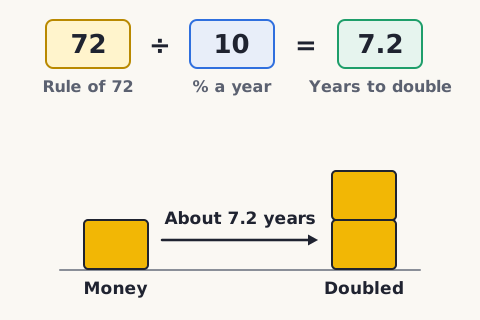
The Rule of 72 estimates how long it takes an investment to double: divide 72 by the annual return percentage. At a 10% return — roughly the long-run S&P 500 average — money doubles in about 7.2 years. At 12% it doubles in 6 years; at 8%, in 9 years; at 4%, the kind of return bonds offer, in 18 years; and at a 2% savings-account rate, a sluggish 36 years. The rule works best for rates between 6% and 10% and loses accuracy at extremes, but as a quick gut-check it's remarkably good.
You can also run it backwards. If you want to double your money in a set number of years, divide 72 by that number to find the return you need. To double in 6 years, you need 72 ÷ 6 = a 12% annual return. This reverse calculation is a powerful sanity check on any investment pitch: if someone promises to double your money in three years, they're implicitly promising a 24% annual return — possible, but a claim that should invite scrutiny rather than trust.
The rule's deeper value is intuition about compounding. Because doublings stack, the back half of a long investment horizon does astonishing work. Consider 10,000 growing at 10%: it doubles to 20,000, then 40,000, then 80,000, then 160,000, then 320,000 — five doublings in about 36 years. The first double takes 7.2 years and adds 10,000; the last takes the same 7.2 years and adds 160,000. The math rewards patience disproportionately, which is why starting early matters so much more than starting big.
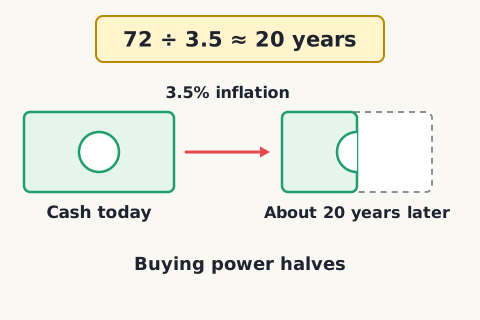
There is a darker mirror to this, and it's just as important to internalize. The Rule of 72 works for losses, too. At 3.5% annual inflation, the purchasing power of your cash halves in roughly 20 years (72 ÷ 3.5). Money sitting idle in a checking account isn't merely failing to grow — it is being actively, silently destroyed. A dollar today buys half as much in two decades at that rate. This is the hidden cost of "safety": holding too much cash feels prudent, but inflation is a guaranteed negative return on it.
Put the two sides together and the Rule of 72 delivers a single lesson. Returns compound in your favor when invested and against you when idle. The same exponential force that turns modest savings into a fortune over decades will, left unopposed, erode the purchasing power of cash on exactly the same schedule. Understanding both directions of the rule is what turns it from a party trick into a genuine guide for where to keep your money.
Key facts
The dark side of the Rule of 72
The Rule of 72 works for losses too. At 3.5% annual inflation, the purchasing power of your cash halves in about 20 years (72 ÷ 3.5). Money sitting idle in a checking account is slowly, quietly being destroyed — which is why even conservative savers need their money invested.
Doubling Time At 10%
At a 10% annual return — roughly the S&P 500's long-run average — the Rule of 72 says money takes about 7.2 years to double.
Bonds Take 18 Years
Bonds have historically returned around 4% a year, and by the Rule of 72 that pace means money takes about 18 years to double.
36 Years To Double
At a typical 2% savings-account return, the Rule of 72 shows money takes a sluggish 36 years to double — far slower than stock-like returns.
By the numbers
- By the Rule of 72, how many years does it take to double your money at a 10% annual return?
- 7.2 years
- By the Rule of 72, how many years to double your money at a 12% annual return?
- 6 years
- By the Rule of 72, how many years to double your money at an 8% annual return?
- 9 years
- By the Rule of 72, how many years to double your money at a 4% annual return (typical of bonds)?
- 18 years
- By the Rule of 72, how many years to double your money at a 2% savings-account return?
- 36 years
- To double your money in 6 years, what annual return (percent) do you need by the Rule of 72?
- 12 %
Self-test
Answer each question from memory, then check your work against the answer key.
1. By the Rule of 72, about how many years does it take to double your money at a 10% annual return?
- A7.2 years
- B10 years
- C6 years
- D9 years
2. By the Rule of 72, how many years does it take to double your money at a 12% annual return?
- A7.2 years
- B6 years
- C5 years
- D8 years
3. By the Rule of 72, how many years does it take to double your money at an 8% annual return?
- A8 years
- B6 years
- C9 years
- D12 years
4. Which annual return doubles your money the FASTEST, by the Rule of 72?
- A6%
- B10%
- C8%
- D12%
5. Which rate-and-doubling-time pairing is NOT correct under the Rule of 72?
- A8% → 9 years
- B12% → 9 years
- C12% → 6 years
- D10% → 7.2 years
6. By the Rule of 72, how many years does it take to double your money at a 4% annual return, typical of bonds?
- A18 years
- B14 years
- C9 years
- D24 years
7. By the Rule of 72, how many years does it take to double your money at a 2% savings-account return?
- A72 years
- B24 years
- C36 years
- D18 years
8. Applying the Rule of 72 to 3.5% annual inflation, how long until cash loses half its purchasing power?
- AAbout 7 years
- BAbout 10 years
- CAbout 36 years
- DAbout 20 years
9. Which rate takes the LONGEST to double your money, by the Rule of 72?
- A10%
- B8%
- C2%
- D4%
10. At savings-like rates, which pairing is NOT correct under the Rule of 72?
- A2% → 36 years
- B2% → 18 years
- C4% → 18 years
- D3.5% → about 20 years
11. By the Rule of 72, if someone promises to double your money in 3 years, what annual return are they implicitly claiming?
- AAbout 12%
- BAbout 18%
- CAbout 36%
- DAbout 24%
12. To double your money in 6 years, what annual return do you need by the Rule of 72?
- A12%
- B18%
- C9%
- D6%
13. To double your money in 4 years, what annual return does the Rule of 72 say you need?
- A24%
- B18%
- C12%
- D16%
14. An advisor promises to double your money in just 2 years. What annual return does that imply by the Rule of 72?
- AAbout 12%
- BAbout 18%
- CAbout 36%
- DAbout 24%
15. A pitch claiming to double your money in 9 years implies roughly what annual return, by the Rule of 72?
- A8%
- B9%
- C12%
- D6%
Go deeper
- WatchRule of 72 Divide 72 by your return to see how fast your money doubles. At 10%, that's about 7.2 years.
- StudyInvesting 201 in the FlashFeed app
Answer key
- 1. A 7.2 years72 ÷ 10 = 7.2 years. 10% is roughly the long-run S&P 500 average, so money doubles in about 7.2 years.
- 2. B 6 years72 ÷ 12 = 6 years. A higher return means faster doubling than the 7.2 years you'd get at 10%.
- 3. C 9 years72 ÷ 8 = 9 years. The rule is especially reliable in this 6–10% range.
- 4. D 12%The higher the return, the smaller 72 ÷ rate becomes. 12% doubles in 6 years, versus 7.2 at 10% and 9 at 8%.
- 5. B 12% → 9 years72 ÷ 12 = 6 years, not 9. The 9-year doubling time belongs to an 8% return (72 ÷ 8).
- 6. A 18 years72 ÷ 4 = 18 years. Lower returns mean far slower doubling than stock-like rates.
- 7. C 36 years72 ÷ 2 = 36 years. At savings-account rates, doubling takes a sluggish 36 years.
- 8. D About 20 years72 ÷ 3.5 ≈ 20 years. The rule works for losses too: idle cash halves in buying power in roughly two decades.
- 9. C 2%The lower the return, the larger 72 ÷ rate becomes. 2% takes 36 years, versus 18 at 4% and far less above that.
- 10. B 2% → 18 years72 ÷ 2 = 36 years, not 18. The 18-year doubling belongs to a 4% bond-like return (72 ÷ 4).
- 11. D About 24%Run the rule backwards: 72 ÷ 3 years ≈ a 24% annual return. This works as a sanity check — a 24% promise is possible, but it should invite scrutiny rather than trust.
- 12. A 12%Run the rule backward: 72 ÷ 6 = 12%. Divide 72 by the target years to find the required return.
- 13. B 18%72 ÷ 4 = 18%. A 4-year doubling demands a high 18% return, a demanding target worth scrutiny.
- 14. C About 36%72 ÷ 2 = 36%. An implied 36% return is implausibly high and should invite scrutiny rather than trust.
- 15. A 8%72 ÷ 9 = 8%. An 8% implied return is realistic, unlike a 2- or 3-year doubling that implies 24–36%.
Image credits
- The dark side of the Rule of 72: FlashFeed original diagram · CC-BY-4.0
- Doubling Time At 10%: FlashFeed original diagram · CC-BY-4.0