
Investing 201 study guide · Lesson 9 of 17
Investment Strategies
Passive investing and funds · Active styles and trading
This is the lesson's study guide from the FlashFeed app, plus its key facts and a self-test.
What you'll be able to do
- Define index funds and ETFs and how they differ.
- Match ETF tickers (SPY, QQQ, VTI) to the indexes they track.
- Distinguish growth, value, and dividend investing.
- Describe dollar-cost averaging and its behavioral benefit.
- Distinguish day, swing, and position trading by time horizon and risk.
There is no single right way to invest, but there are well-worn paths with very different risk, effort, and evidence behind them. This lesson surveys the major strategies — from the boring approach that quietly beats most professionals to the active styles that demand far more time and conviction.
Passive investing and funds
The most empirically supported strategy for most people is also the dullest: buy and hold. Buy diversified index funds or high-quality stocks and hold for decades, ignoring daily noise. The evidence is overwhelming — index funds tracking the S&P 500 consistently beat more than 90% of actively managed funds over 20-year periods. Rather than trying to outsmart the market, index investors simply aim to match it, and most professionals can't reliably do better once fees are subtracted.
The vehicles are index funds and ETFs. An index fund tracks a market index by buying all its constituents in proportion to their weight; an ETF (Exchange-Traded Fund) is a fund that trades intraday on an exchange like a stock, and most ETFs track an index in the same way. Both deliver three big advantages: low fees (expense ratios of 0.03–0.20%, versus roughly 0.5–1.5%, sometimes more, for active funds), instant diversification, and tax efficiency. A few tickers cover most of the market: SPY tracks the S&P 500, QQQ the Nasdaq 100, IWM the small-cap Russell 2000, and VTI the total U.S. stock market. For a beginner, a single broad-market ETF held for decades is a complete strategy on its own.
Active styles and trading
Beyond passive investing lie approaches that demand more work. Growth investing seeks companies expanding revenue and earnings at above-average rates, paying premium valuations in exchange for high future returns, and watching metrics like revenue growth, total addressable market, and net dollar retention. Value investing, the Graham-and-Buffett tradition, buys stocks trading below intrinsic value — dollars for fifty cents — increasingly screening for quality traits like high return on invested capital (ROIC) and durable moats. Dividend investing focuses on companies with consistent, rising payouts; the Dividend Aristocrats, S&P 500 firms with 25+ consecutive years of dividend increases, are the income investor's blue chips.
Dollar-cost averaging (DCA) cuts across all of these: investing a fixed dollar amount at regular intervals regardless of price. It removes the psychological burden of timing the market, automatically buys more shares when prices are low, and smooths volatility — a discipline as much as a strategy.
Then there is the spectrum of trading, defined by holding period. Day trading means buying and selling within a single session; it is extremely high-risk, and most day traders lose money. Swing trading holds for days to weeks based on technical patterns. Position trading holds for months on macro and fundamental views. Long-term investing holds for years or decades and is historically the most reliable. The shorter the horizon, the more the game becomes about prediction and timing — and the more the odds tilt against the individual. For the vast majority of investors, time in the market beats timing the market.
Key terms
- Index fund
- A fund that tracks a market index (like the S&P 500) by buying all its constituents in proportion to their weight. Low fees, instant diversification, and tax efficiency are its hallmarks.
- ETF
- Exchange-Traded Fund — like an index fund but trades intraday on an exchange like a stock. Expense ratios of 0.03–0.20% are common, versus 1–2% for active funds.
- Dividend Aristocrat
- An S&P 500 company that has raised its dividend for 25+ consecutive years. Reinvested dividends compound powerfully and provide income in retirement.
- Dollar-cost averaging (DCA)
- Investing a fixed dollar amount at regular intervals regardless of price. It removes the burden of timing the market and ensures you buy more shares when prices are low.
Key concepts
Buy and Hold
- The dullest yet most empirically supported strategy for most people.
- Instead of trying to outsmart the market, it simply aims to match it over decades while ignoring daily noise.
- Its evidence: index funds tracking the S&P 500 beat over 90% of active funds across 20-year spans, so you own quality and sit tight.
Growth Investing
- An active style that pays premium valuations in exchange for high future returns.
- It seeks companies expanding revenue and earnings at above-average rates.
- Its followers watch total addressable market, revenue expansion, and net dollar retention.
Value Investing
- The Graham-and-Buffett tradition of buying dollars for fifty cents.
- It targets stocks trading below their intrinsic worth.
- It increasingly screens for quality traits like high return on invested capital (ROIC) and durable moats.
Dividend Investing
- An income strategy centered on companies with consistent, rising payouts.
- Its blue chips are S&P 500 firms with 25+ consecutive years of rising payouts.
- Those elite payout-raisers carry the nickname 'the Aristocrats.'
Dollar-Cost Averaging (DCA)
- A discipline as much as a strategy, it cuts across growth, value, and income approaches alike.
- It removes the psychological burden of timing the market by investing on a fixed schedule.
- You put in a fixed sum at regular intervals regardless of price, automatically buying more shares when prices fall.
Key facts
Buy and hold
Buying diversified index funds or high-quality stocks and holding for decades — ignoring daily noise — is the most empirically supported strategy for most investors. It minimizes fees, taxes, and the behavioral mistakes that wreck returns.
Exchange-Traded Funds (ETFs) Trade Like Stocks
Unlike a traditional index fund, an ETF trades intraday on an exchange just like an individual stock, so it can be bought or sold anytime the market is open.
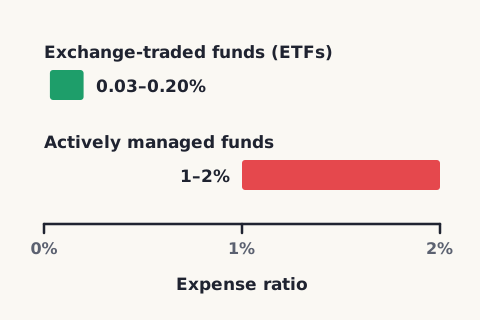
Exchange-Traded Funds' (ETFs) Rock-Bottom Fees
ETFs commonly carry expense ratios of just 0.03–0.20%, versus the 1–2% charged by actively managed funds — one of the core advantages that has fueled passive investing's rise.
Matched pairs
Each item on the left goes with the one on the right.
- SPY
- Exchange-traded fund (ETF) tracking the S&P 500
- QQQ
- Exchange-traded fund (ETF) tracking the Nasdaq 100
- VTI
- Exchange-traded fund (ETF) tracking the total U.S. stock market
- Growth investing
- Pay premium prices for companies expanding revenue and earnings fast
- Value investing
- Buy stocks trading below intrinsic value — dollars for fifty cents
- Day trading
- Buying and selling within a single session; extremely high-risk
- Swing trading
- Holding for days to weeks based on technical patterns
- Position trading
- Holding for months based on macro and fundamental views
Step by step
Evaluate a stock-index exchange-traded fund (ETF) before buying
- Read the prospectus or ETF fact sheet, focusing on the expense ratio.
- Verify the underlying index (S&P 500, Russell 1000, Morgan Stanley Capital International (MSCI) World, etc.).
- Check the assets under management — under $100M flags higher closure risk.
- Compare the 5-year and 10-year returns to the index benchmark.
- Look at the bid-ask spread and average daily volume for liquidity.
- Confirm dividend policy (reinvest vs distribute) and tax efficiency.
Self-test
Answer each question from memory, then check your work against the answer key.
1. What does an index fund do?
- AHolds only bonds to guarantee a fixed annual return
- BHand-picks a few undervalued stocks a manager expects to beat the market
- CTrades in and out of positions daily to exploit short-term price swings
- DTracks a market index by buying all its constituents in proportion to their weight
2. How does an exchange-traded fund (ETF) differ from a traditional index fund?
- AIt trades intraday on an exchange like a stock
- BIt guarantees higher returns than the underlying index
- CIt is only available to institutional investors
- DIt charges no expense ratio at all
3. What is a typical expense ratio for an exchange-traded fund (ETF)?
- A1–2%
- B5–10%
- C0.03–0.20%
- D0.75–1.5%
4. Which is NOT one of the three big advantages of index funds and exchange-traded funds (ETFs)?
- AInstant diversification
- BA guarantee of beating the market
- CTax efficiency
- DLow fees
5. A beginner wants a single vehicle that holds the whole S&P 500 but can be bought and sold anytime the market is open. Which fits best?
- AA Dividend Aristocrats fund
- BAn actively managed mutual fund
- CAn S&P 500 index mutual fund
- DAn ETF
6. Which exchange-traded fund (ETF) ticker tracks the small-cap Russell 2000 index?
- ASPY
- BVTI
- CIWM
- DQQQ
7. Which index does the exchange-traded fund (ETF) ticker SPY track?
- AThe Nasdaq 100
- BThe S&P 500
- CThe total U.S. stock market
- DThe Russell 2000
8. Which index does the exchange-traded fund (ETF) ticker QQQ track?
- AThe Nasdaq 100
- BThe Russell 2000
- CThe total U.S. stock market
- DThe S&P 500
9. Which exchange-traded fund (ETF) ticker tracks the total U.S. stock market?
- AIWM
- BSPY
- CVTI
- DQQQ
10. Which ticker-to-index pairing is INCORRECT?
- AQQQ tracks the S&P 500
- BSPY tracks the S&P 500
- CVTI tracks the total U.S. stock market
- DIWM tracks the Russell 2000
11. What defines growth investing?
- ABuying stocks trading below their intrinsic value
- BInvesting a fixed dollar amount at regular intervals
- CFocusing on firms with consistent, rising dividend payouts
- DPaying premium prices for companies expanding revenue and earnings fast
12. In the Graham-and-Buffett tradition, value investing aims to do what?
- APay premium prices for the fastest-growing companies
- BBuy stocks trading below their intrinsic value
- CCollect 25+ years of rising dividends
- DTrade in and out of positions within a single session
13. What qualifies a company as a Dividend Aristocrat?
- AAn S&P 500 firm that has raised its dividend for 25+ consecutive years
- BA firm whose stock trades below intrinsic value
- CAny company that has paid a dividend at least once
- DA company growing revenue at an above-average rate
14. Which description does NOT match its investing style?
- AGrowth investing: paying premium prices for fast-growing companies
- BValue investing: buying dollars for fifty cents
- CDividend investing: focusing on consistent, rising payouts
- DDividend investing: buying stocks trading below intrinsic value
15. An investor screens for firms with high return on invested capital (ROIC) and durable moats trading for less than they're worth. Which style is this?
- AGrowth investing
- BDay trading
- CValue investing
- DDividend investing
16. What is dollar-cost averaging (DCA)?
- AInvesting a lump sum only when prices look cheapest
- BInvesting a fixed dollar amount at regular intervals regardless of price
- CBuying more shares only after prices rise
- DSelling a fixed fraction of your portfolio each month
17. What is the key behavioral benefit of dollar-cost averaging?
- AIt eliminates all investment risk
- BIt locks in a fixed annual return
- CIt guarantees you buy at the market's lowest price
- DIt removes the psychological burden of timing the market
18. Because the invested dollar amount stays fixed, what does dollar-cost averaging (DCA) automatically do when prices fall?
- APauses investing until prices recover
- BBuys more shares
- CSells shares to raise cash
- DBuys fewer shares
19. Which statement about dollar-cost averaging is FALSE?
- AIt invests a fixed dollar amount at regular intervals
- BIt buys more shares when prices are low
- CIt guarantees a profit regardless of what the market does
- DIt removes the burden of timing the market
20. An investor puts $500 into the same exchange-traded fund (ETF) on the first of every month, no matter the price. Which strategy is this?
- ADollar-cost averaging
- BSwing trading
- CDay trading
- DValue investing
21. What happens to most day traders?
- AMost simply match the market's return
- BMost lose money
- CMost beat index funds over time
- DMost earn a reliable monthly income
22. What holding period defines day trading?
- ABuying and selling within a single session
- BHolding for years or decades
- CHolding for days to weeks
- DHolding for months
23. Swing trading typically holds positions for how long, and on what basis?
- AMonths, based on macro and fundamental views
- BA single trading session, based on intraday moves
- CYears, based on long-term compounding
- DDays to weeks, based on technical patterns
24. Which trading style holds positions for months based on macro and fundamental views?
- ASwing trading
- BDay trading
- CPosition trading
- DLong-term investing
25. Ordered from shortest to longest holding period, which sequence is correct?
- ADay trading, position trading, swing trading
- BSwing trading, day trading, position trading
- CDay trading, swing trading, position trading
- DPosition trading, swing trading, day trading
Go deeper
- WatchThe Dull Strategy That Wins The best-supported strategy for most people is also the dullest: buy index funds and hold them for decades.
- WatchTime in the Market Dollar-cost averaging means investing the same amount on a set schedule. When prices are low, it buys more shares.
- StudyInvesting 201 in the FlashFeed app
Answer key
- 1. D Tracks a market index by buying all its constituents in proportion to their weightAn index fund tracks a market index (like the S&P 500) by holding all its constituents in proportion to weight — aiming to match the market, not beat it.
- 2. A It trades intraday on an exchange like a stockAn ETF is like an index fund but trades intraday on an exchange like a stock. Both still charge low expense ratios and neither guarantees returns.
- 3. C 0.03–0.20%ETFs commonly carry expense ratios of 0.03–0.20%, versus the 1–2% charged by actively managed funds — one of their core advantages.
- 4. B A guarantee of beating the marketThe three advantages are low fees, instant diversification, and tax efficiency. Index funds aim to match the market, not beat it — no returns are guaranteed.
- 5. D An ETFAn ETF (exchange-traded fund) trades intraday on an exchange like a stock, and an S&P 500 ETF holds the whole index. Mutual funds, index or active, are typically priced once a day, after the market closes, and a Dividend Aristocrats fund holds only a subset of the index.
- 6. C IWMIWM tracks the small-cap Russell 2000. SPY tracks the S&P 500, QQQ the Nasdaq 100, and VTI the total U.S. stock market — a handful of tickers covers most of the market.
- 7. B The S&P 500SPY tracks the S&P 500. QQQ tracks the Nasdaq 100, IWM the Russell 2000, and VTI the total U.S. stock market.
- 8. A The Nasdaq 100QQQ tracks the Nasdaq 100. SPY tracks the S&P 500, IWM the Russell 2000, and VTI the total U.S. stock market.
- 9. C VTIVTI tracks the total U.S. stock market. SPY tracks the S&P 500, QQQ the Nasdaq 100, and IWM the small-cap Russell 2000.
- 10. A QQQ tracks the S&P 500QQQ tracks the Nasdaq 100, not the S&P 500 — SPY is the S&P 500 ticker. The other three pairings are correct.
- 11. D Paying premium prices for companies expanding revenue and earnings fastGrowth investing seeks companies growing revenue and earnings above average, paying premium valuations for high future returns. Buying below intrinsic value is value investing.
- 12. B Buy stocks trading below their intrinsic valueValue investing buys stocks below intrinsic value — 'dollars for fifty cents' — increasingly screening for quality like high return on invested capital (ROIC) and durable moats.
- 13. A An S&P 500 firm that has raised its dividend for 25+ consecutive yearsDividend Aristocrats are S&P 500 firms with 25+ consecutive years of dividend increases — the income investor's blue chips.
- 14. D Dividend investing: buying stocks trading below intrinsic valueBuying below intrinsic value is value investing, not dividend investing. Dividend investing focuses on companies with consistent, rising payouts.
- 15. C Value investingScreening for quality traits like high ROIC and durable moats while buying below intrinsic value is the modern value-investing approach.
- 16. B Investing a fixed dollar amount at regular intervals regardless of priceDCA means investing a fixed dollar amount at regular intervals regardless of price — a discipline, not a market-timing bet.
- 17. D It removes the psychological burden of timing the marketDollar-cost averaging's (DCA) main benefit is behavioral: by investing on a schedule it removes the psychological burden of timing the market and smooths volatility.
- 18. B Buys more sharesA fixed dollar amount buys more shares when prices are low and fewer when high, automatically tilting purchases toward cheaper prices.
- 19. C It guarantees a profit regardless of what the market doesDollar-cost averaging (DCA) smooths volatility and removes timing pressure, but it guarantees nothing — it is a discipline, not a promise of profit.
- 20. A Dollar-cost averagingInvesting a fixed dollar amount ($500) at regular intervals (monthly) regardless of price is the definition of dollar-cost averaging.
- 21. B Most lose moneyDay trading — buying and selling within a single session — is extremely high-risk, and most day traders lose money. It's a core reason time in the market beats timing the market.
- 22. A Buying and selling within a single sessionDay trading means buying and selling within a single session — the shortest horizon and extremely high-risk.
- 23. D Days to weeks, based on technical patternsSwing trading holds for days to weeks based on technical patterns — longer than day trading but shorter than position trading.
- 24. C Position tradingPosition trading holds for months on macro and fundamental views. Day trading is intraday, swing trading spans days to weeks, and long-term investing runs years to decades.
- 25. C Day trading, swing trading, position tradingHorizons lengthen from day trading (one session) to swing trading (days to weeks) to position trading (months). Shorter horizons tilt the odds against the individual.
Image credits
- Exchange-Traded Funds' (ETFs) Rock-Bottom Fees: FlashFeed original diagram · CC-BY-4.0