
Investing 201 study guide · Lesson 10 of 17
Sector Rotation and the Business Cycle
The business cycle · Phases, sectors, and Cramer
This is the lesson's study guide from the FlashFeed app, plus its key facts and a self-test.
What you'll be able to do
- Recall the frequency and average length of U.S. business cycles.
- Explain the GICS system and its 11 S&P 500 sectors.
- Match business-cycle phases to the sectors that outperform.
The economy breathes in and out — expanding, peaking, contracting, recovering — and different parts of the market lead at different moments in that rhythm. Sector rotation is the practice of leaning toward whatever the current phase rewards. You don't have to trade it aggressively to benefit from understanding it.
The business cycle
The U.S. economy has run through 12 business cycles since 1945, with the average full cycle lasting around 6 years — expansions averaging about five years and four months, contractions a much shorter ten months. The asymmetry matters: good times last far longer than bad ones, which is one reason staying invested through downturns pays off. Astute investors track which phase the economy occupies and position accordingly.
The market is organized for this kind of analysis by the Global Industry Classification Standard (GICS), which divides the S&P 500 into 11 sectors: Consumer Discretionary, Consumer Staples, Energy, Financials, Health Care, Industrials, Information Technology, Materials, Real Estate, Communication Services, and Utilities. Sector rotation is simply the strategy of shifting emphasis among these eleven as the cycle turns — favoring the groups whose earnings tend to accelerate in the current environment and trimming those about to face headwinds.
Phases, sectors, and Cramer
The cycle is conventionally split into four phases, each with characteristic leaders. In the early cycle — a sharp recovery with accelerating growth and easy credit — financials, consumer discretionary, and real estate tend to outperform. The mid cycle, marked by steady growth, favors technology, industrials, and communication services. The late cycle, with slowing growth, rising inflation, and tightening credit, rewards energy, materials, and consumer staples. And in recession, defensive sectors hold up best: utilities, healthcare, and consumer staples, the things people buy regardless of conditions.
Interest rates are a useful overlay. In a rising-rate environment — typically late cycle — energy and materials often outperform as commodity-linked earnings hold up while credit tightens. When the Fed pivots to cutting rates in an early recovery, growth stocks and real estate usually lead, since lower discount rates lift the present value of distant cash flows.
The discipline behind all this is captured by Jim Cramer, host of CNBC's Mad Money since 2005, who preaches a homework-first approach: never buy a stock without personal insight into the underlying business — its revenue model, competition, and management. Cramer is also candid about his own mistakes, and they double as a checklist of what to avoid: holding losers too long, overconfidence in strong brands, panic selling on short-term news, following advice blindly without weighing the source's track record, and relying on a single indicator. That last one is worth underlining: the inverted yield curve is a respected recession signal, but on its own it does not reliably predict every downturn. Cross-check it against purchasing manager indexes, unemployment, and consumer confidence before acting on any one number.
Key terms
- GICS
- Global Industry Classification Standard — the system that organizes the S&P 500 into 11 sectors, from Information Technology and Financials to Utilities and Energy.
Key concepts
Early Cycle
- One of the four phases the economy runs through: a sharp recovery with accelerating growth and easy credit.
- When the Fed pivots to cutting rates in this recovery, growth stocks and real estate usually lead.
- Its outperformers are financials, consumer discretionary, and real estate.
Mid Cycle
- One of the four phases the economy runs through, defined simply by steady, ongoing growth.
- It lacks both the sharp acceleration of the recovery phase and the rising inflation of the slowdown that follows.
- Its favored sectors are technology, industrials, and communication services.
Late Cycle
- One of the four phases the economy runs through, defined by slowing growth, rising inflation, and tightening credit.
- In its typically rising-rate environment, financials gain from wider lending margins and energy often outperforms.
- Its characteristic leaders are energy, materials, and consumer staples.
Recession
- The contraction phase of the business cycle - historically the shorter half, averaging only about ten months.
- In it, defensive sectors that people buy regardless of conditions hold up best.
- Its winners are utilities, healthcare, and consumer staples.
Key facts
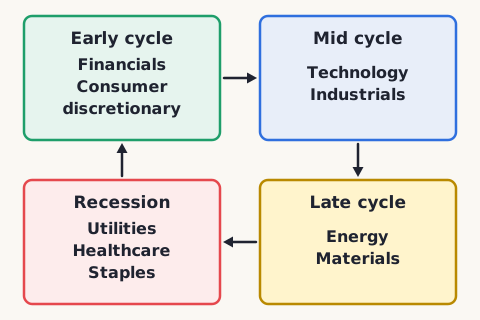
Rotating with the cycle
Different sectors lead at different points in the cycle. Early-cycle recoveries favor financials and consumer discretionary; mid-cycle favors technology and industrials; late-cycle favors energy and materials; recessions favor defensive utilities, healthcare, and staples. Rotation means leaning toward whatever the current phase rewards.

12 Cycles Since 1945
The U.S. economy has cycled through 12 full business cycles since 1945, each one alternating between expansion and contraction.

Good Times Outlast Bad
U.S. economic contractions have historically lasted about 10 months on average, versus roughly five years for the average expansion. Good times, in other words, have historically outlasted bad ones by a wide margin.
What GICS Stands For
GICS, short for Global Industry Classification Standard, is the system that sorts every company in the S&P 500 into one of 11 distinct sectors.
Following the Fed
In a rising-rate environment, typically late cycle, energy and materials tend to outperform as commodity-linked earnings hold up while credit tightens. When the Fed pivots to cutting rates in an early recovery, growth stocks and real estate usually lead the charge.

Cramer's homework rule
Jim Cramer, host of CNBC's Mad Money since 2005, preaches a disciplined homework approach: never buy a stock without personal insight into the underlying company. Understanding the business — its revenue model, competition, and management — is the price of admission for owning it.
Cramer's five mistakes
Cramer shares five mistakes he learned the hard way: holding losers too long, overconfidence in strong brands, panic selling on short-term news, following others' advice blindly, and relying on a single indicator like the yield curve. Each is a discipline failure more than an analytical one.
Mid-Cycle Sector Leaders
In the mid cycle — a period of steady growth following early recovery — technology, industrials, and communication services stocks have tended to lead the market.
Recession's Defensive Sectors
During recessions, defensive sectors like utilities, healthcare, and consumer staples have tended to hold up best — the things people keep buying regardless of conditions.
By the numbers
- How many U.S. business cycles have occurred since 1945?
- 12 cycles
- About how many years does the average full U.S. business cycle last?
- 6 years
- Into how many sectors does the GICS divide the S&P 500?
- 11 sectors
Matched pairs
Each item on the left goes with the one on the right.
- Early cycle (recovery)
- Financials, consumer discretionary, real estate outperform
- Late cycle (slowing, inflation)
- Energy, materials, consumer staples outperform
- Recession
- Utilities, healthcare, consumer staples hold up best
Self-test
Answer each question from memory, then check your work against the answer key.
1. How many business cycles has the U.S. economy run through since 1945?
- A6
- B12
- C20
- D11
2. About how long does the average full U.S. business cycle last?
- A6 years
- B10 months
- C12 years
- D6 months
3. On average, how long do U.S. economic expansions last?
- AAbout 2 years
- BAbout 6 years
- CAbout 5 years
- DAbout 10 months
4. On average, how long do U.S. economic contractions last?
- AAbout 5 years
- BAbout 3 years
- CAbout 6 years
- DAbout 10 months
5. Expansions average ~5 years while contractions average ~10 months. What does this asymmetry mainly imply for investors?
- AThe cycle is perfectly symmetric year to year
- BGood times last far longer, so staying invested through downturns pays off
- CContractions are more frequent than expansions
- DDownturns erase more wealth than expansions create
6. Which of the following is NOT one of the 11 Global Industry Classification Standard (GICS) sectors of the S&P 500?
- AReal Estate
- BUtilities
- CTransportation
- DMaterials
7. Into how many sectors does the Global Industry Classification Standard (GICS) divide the S&P 500?
- A10
- B500
- C12
- D11
8. What does the acronym GICS stand for?
- AGlobal Industry Classification Standard
- BGlobal Investment Category Standard
- CGrouped Industry Coding Scheme
- DGeneral Index Classification System
9. Which of the following IS one of the 11 Global Industry Classification Standard (GICS) sectors?
- AAerospace & Defense
- BTransportation
- CBanking
- DReal Estate
10. The Global Industry Classification Standard (GICS) framework is used to classify the sectors of which index?
- AThe Russell 2000
- BThe S&P 500
- CThe Nasdaq 100
- DThe Dow Jones Industrial Average
11. In the mid cycle — steady growth after the early recovery — which sectors tend to lead?
- AEnergy, materials, and consumer staples
- BUtilities, healthcare, and consumer staples
- CTechnology, industrials, and communication services
- DFinancials, consumer discretionary, and real estate
12. In the early cycle — a sharp recovery with accelerating growth and easy credit — which sectors tend to outperform?
- AFinancials, consumer discretionary, and real estate
- BTechnology, industrials, and communication services
- CEnergy, materials, and consumer staples
- DUtilities, healthcare, and consumer staples
13. The late cycle — slowing growth, rising inflation, tightening credit — tends to reward which sectors?
- ATechnology, industrials, and communication services
- BUtilities, healthcare, and consumer staples
- CEnergy, materials, and consumer staples
- DFinancials, consumer discretionary, and real estate
14. During a recession, which defensive sectors hold up best?
- ATechnology, industrials, and communication services
- BUtilities, healthcare, and consumer staples
- CEnergy, materials, and consumer staples
- DFinancials, consumer discretionary, and real estate
15. When the Fed pivots to cutting rates in an early recovery, which tend to lead?
- AUtilities and consumer staples
- BEnergy and financials
- CMaterials and industrials
- DGrowth stocks and real estate
Go deeper
- WatchGood Times Last Longer The U.S. economy has run through 12 business cycles since 1945.
- WatchEvery Phase Has Leaders In the early cycle, growth speeds up and credit is easy. Financials, consumer discretionary and real estate tend to lead.
- StudyInvesting 201 in the FlashFeed app
Answer key
- 1. B 12The U.S. economy has run through 12 business cycles since 1945. 6 is the average cycle length in years and 11 is the number of Global Industry Classification Standard (GICS) sectors.
- 2. A 6 yearsThe average full cycle lasts around 6 years. 10 months is the average contraction length, not the full cycle.
- 3. C About 5 yearsExpansions average about five years and four months. The much shorter ~10 months is the average contraction, and ~6 years is the full cycle.
- 4. D About 10 monthsContractions average a much shorter ten months, versus about five years for expansions. This asymmetry means good times last far longer than bad ones.
- 5. B Good times last far longer, so staying invested through downturns pays offBecause expansions last far longer than contractions, staying invested through downturns tends to pay off. The asymmetry favors patience, not exiting during weakness.
- 6. C TransportationThe 11 GICS sectors include Utilities, Materials, and Real Estate. Transportation is not a standalone GICS sector — it falls under Industrials.
- 7. D 11GICS divides the S&P 500 into 11 sectors. 12 is the number of business cycles since 1945, not sectors.
- 8. A Global Industry Classification StandardGICS is the Global Industry Classification Standard, the system that organizes the S&P 500 into its 11 sectors.
- 9. D Real EstateReal Estate is one of the 11 GICS sectors. Transportation, banking, and aerospace are not standalone GICS sectors; they fall under Industrials or Financials.
- 10. B The S&P 500GICS organizes the S&P 500 into 11 sectors, providing the structure sector rotation relies on.
- 11. C Technology, industrials, and communication servicesThe mid cycle, marked by steady growth, favors technology, industrials, and communication services. Financials/discretionary/real estate lead the early cycle, energy/materials/staples the late cycle, and defensives lead in recession.
- 12. A Financials, consumer discretionary, and real estateThe early cycle rewards financials, consumer discretionary, and real estate. Energy/materials/staples lead late cycle; defensives lead in recession.
- 13. C Energy, materials, and consumer staplesThe late cycle rewards energy, materials, and consumer staples. Financials/discretionary/real estate lead the early cycle and tech/industrials the mid cycle.
- 14. B Utilities, healthcare, and consumer staplesIn recession, defensive utilities, healthcare, and consumer staples hold up best — the things people buy regardless of conditions.
- 15. D Growth stocks and real estateLower rates lift the present value of distant cash flows, so growth stocks and real estate usually lead. Financials and energy instead benefit from rising rates late cycle.
Image credits
- Rotating with the cycle: FlashFeed original diagram · CC-BY-4.0
- 12 Cycles Since 1945: AI-generated (gpt-image-1.5)
- Good Times Outlast Bad: Wikimedia Commons · Zach Dischner · CC BY 2.0 — commons.wikimedia.org/wiki/File:Night_Drive_(4721988525).jpg
- Cramer's homework rule: Wikimedia Commons · Bear Bull Traders · CC BY 2.0 — commons.wikimedia.org/wiki/File:Andrew_Aziz_Cramer_(cropped).jpg
- Mid-Cycle Sector Leaders: Wikimedia Commons · eks Engel GmbH & Co. KG · CC BY-SA 3.0 de — commons.wikimedia.org/wiki/File:Eks_Medienkonverter2_Industrial_Ethernet_Switch.jpg


