
The Last Economy (book) study guide · Lesson 7 of 15
The New Physics: Intelligence Theory
Intelligence Theory
Unofficial study guide for The Last Economy: A Guide to the Age of Intelligent Economics by Emad Mostaque. FlashFeed is not affiliated with the author or publisher.
This is the lesson's study guide from the FlashFeed app, plus its key facts and a self-test.
What you'll be able to do
- Define Intelligence Theory as the physics of value creation, grounded in the Second Law of Thermodynamics that Eddington called the supreme law.
- Explain Maxwell's Demon as the secret of value creation through sorting, published the same year as Das Kapital.
- Explain how Landauer resolved the paradox in 1961 by proving intelligence has an irreducible thermodynamic cost.
Intelligence Theory
Mostaque's wager is that economics took a wrong turn at its foundations by ignoring physics. Chapter 6 lays a new cornerstone: Intelligence Theory (IT) — the foundational science of the book, the physics of how information is processed to create value, order, and persistence.
The one law that matters
The starting point is the Second Law of Thermodynamics, which the physicist Arthur Eddington called "the supreme law of Nature." Everything falls apart; entropy is the universe's default setting, "the ultimate tax on existence." For centuries economics ignored this, building models of perpetual growth and perfect equilibrium. Yet the deepest question is not why things decay but why anything persists at all. Every star, cell, and functioning economy is a pocket of astonishing order in a sea of encroaching chaos — a temporary victory against the inevitable. That framing makes entropy the invisible constraint on every economic act.
Maxwell's Demon
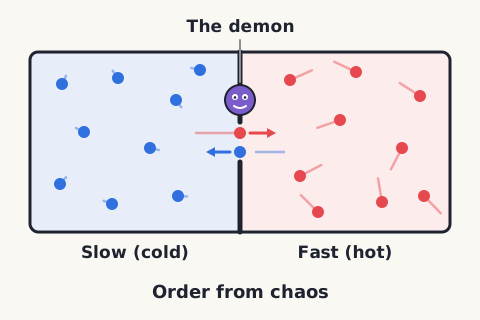
In 1867, as Marx was publishing Das Kapital, the physicist James Clerk Maxwell imagined a tiny intelligent being guarding a door between two chambers of gas. By selectively passing fast (hot) molecules one way and slow (cold) ones the other, the demon creates a temperature gradient — order from chaos. Mostaque's reading: "This is the secret of all value creation." The entrepreneur is the demon; the market is the gas. Every act of economic value is an act of sorting, and profit is the temporary surplus of low entropy an intelligent agent creates before the cost of its own thinking catches up.
The Sorter's Price
Maxwell's Demon seemed to violate the Second Law until Rolf Landauer resolved the paradox in 1961. He proved that erasing a single bit of information from memory has an irreducible thermodynamic cost: it dissipates heat into the environment. The final accounting is exact: the decrease in entropy inside the box is always less than or equal to the increase outside. The Second Law is saved. But in saving it we learn the most important truth for the new economics: intelligence is a physical process with a real, unavoidable cost.
The Persistence Bridge
Why do complex systems — firms, markets, DNA, brains — persist against the odds? A skeptic says survivorship bias: they are the lucky gamblers who have not yet gone bust. Mostaque's rebuttal: compare the Lucky Gambler to the Dumb Clockmaker, who uses a simple non-random model of the world. In one contest the gambler might win; over a million contests the Clockmaker always wins. "Time is the engine that separates luck from competence." Any selection process that rewards persistence implicitly rewards one meta-capability: creating maximum predictive order at minimum thermodynamic cost.
The three costs of thinking
Mostaque formalizes the sorter's total effort as a Lagrangian (L = H + C + K). Predictive Error (H) is the cost of being wrong — the drive for accuracy. Model Complexity (C) is the cost of running the model — the drive for simplicity. Update Cost (K) is the cost of changing the model — the drive for efficiency. Any successful sorting agent, from a bacterium to a multinational, minimizes this sum. This is the operating manual the book derives everything else from.
AI: the perfect sorting machine
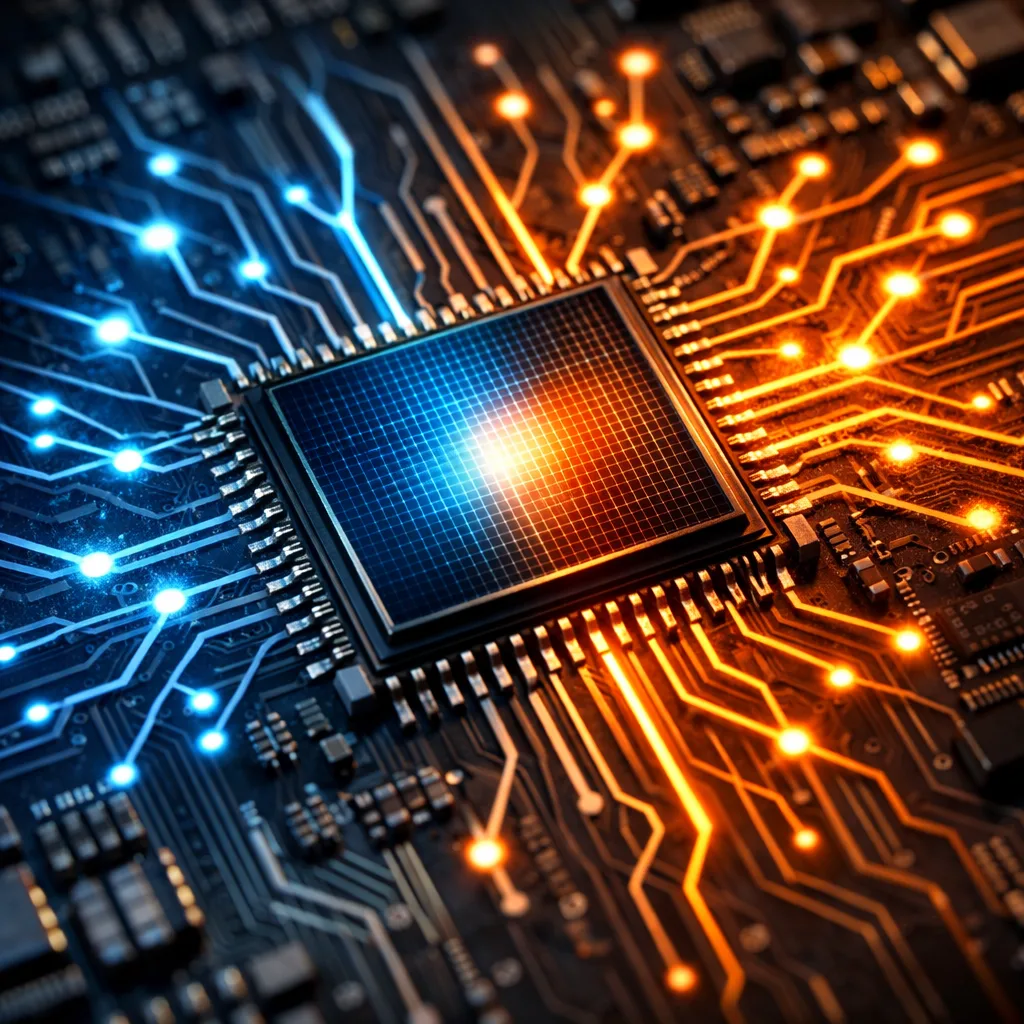
For millennia the only intelligent agents were biological brains — slow, capped at roughly 20 watts, mortal, fixed in architecture. From Babbage through Turing to modern neural networks, we have built a new class of sorting agent in silicon: superhumanly fast, thermodynamically efficient, perfectly scalable, immortal, and — critically — uncapped, capable of recursive self-improvement. The arrival of AI is not another incremental shift; it is a phase transition in the efficiency of entropy reduction. Value is not a pre-existing substance that scarcity divides up; it is a state of low entropy achieved by intelligent agents sorting their environment.
Key terms
- Intelligence Theory (IT)
- The foundational science of the book: the physics of how information is processed to create value, order, and persistence. Its core claim — the economy, as a complex adaptive system, evolves to favor configurations most efficient at creating predictive models of their environment. Any system that persists against entropy is implicitly optimizing for the efficient conversion of energy into predictive intelligence.
Key concepts
Arthur Eddington
- A physicist who ranked the laws of nature and crowned a single supreme winner.
- He called the Second Law of Thermodynamics 'the supreme law of Nature' — the principle Mostaque makes the cornerstone of Intelligence Theory.
James Clerk Maxwell
- In 1867, as Marx was publishing Das Kapital, this physicist devised a famous thought experiment.
- He imagined a tiny intelligent being guarding a door between two gas chambers, sorting fast molecules from slow to build a temperature gradient.
- Mostaque reads that sorting being as 'the secret of all value creation' — the entrepreneur is the demon, the market is the gas.
Rolf Landauer
- In 1961 this physicist resolved a century-old paradox that seemed to let intelligent sorting cheat the Second Law.
- He proved that erasing a single bit of information from memory carries an irreducible thermodynamic cost — it dissipates heat.
- His result delivers Intelligence Theory's key truth: thinking is a physical process with a real, unavoidable cost.
Key facts

The one law that matters
Mostaque builds his new economics on the Second Law of Thermodynamics — what Arthur Eddington called 'the supreme law of Nature.' Everything falls apart; entropy is the universe's default setting, 'the ultimate tax on existence.' For centuries economics ignored this, assuming perpetual growth and equilibrium were natural. 'The most interesting question is not why things fall apart, but why anything exists at all.' Every star, cell, and economy is a temporary victory against the inevitable.
Maxwell's Demon
In 1867, as Marx was publishing Das Kapital, the physicist James Clerk Maxwell imagined a tiny intelligent being guarding a door in a box of gas. It lets fast (hot) molecules pass one way and slow (cold) ones the other, creating a temperature gradient — order from chaos. Mostaque: 'This is the secret of all value creation.' Every act of economic value is an act of sorting. The entrepreneur is the demon; profit is the temporary surplus of low entropy an intelligent agent creates.
The Sorter's Price
Maxwell's Demon seemed to violate the Second Law — until 1961, when IBM physicist Rolf Landauer proved that erasing a single bit of information from memory has an irreducible thermodynamic cost: it dissipates heat. The decrease in entropy inside the box is always less than or equal to the increase outside. The Second Law is saved — and we learn the deepest truth for the new economics: intelligence is a physical process with a real, unavoidable cost.
The Persistence Bridge
Why do complex systems — firms, DNA, brains — persist against the odds? A skeptic says survivorship bias: they are just the lucky gamblers who haven't gone bust yet. Mostaque's rebuttal: consider the Lucky Gambler versus the Dumb Clockmaker, who uses a simple non-random model. In a single contest the gambler might win, but over a million contests the Clockmaker always wins. 'Time is the engine that separates luck from competence.' Persistent systems are learners.
The three costs of thinking
Mostaque's Lagrangian (L = H + C + K) breaks a persistent system's total computational cost into three irreducible parts: Predictive Error (H) — the cost of being wrong, driving accuracy; Model Complexity (C) — the cost of thinking, driving simplicity; and Update Cost (K) — the cost of learning, driving efficiency. Minimizing this total cost is 'the operating manual for any successful sorting agent.'
AI: the perfect sorting machine
For millennia the only intelligent agents were biological brains — slow, mortal, capped at about 20 watts and a fixed architecture. From Babbage to Turing to modern neural networks, we have built a new class of sorting agent in silicon: superhumanly fast, thermodynamically efficient, perfectly scalable, immortal, and — crucially — uncapped, subject to recursive self-improvement. 'We have unleashed a far more powerful intelligence into the system.'
By the numbers
- Year Rolf Landauer proved erasing a bit has a thermodynamic cost
- 1961 year
- Year Marx published Das Kapital
- 1867 year
- Year Maxwell published his thought experiment about the demon
- 1867 year
Self-test
Answer each question from memory, then check your work against the answer key.
1. How does Mostaque define Intelligence Theory, the foundational science of the book?
- AThe physics of how information is processed to create value, order, and persistence
- BA model of perpetual growth and perfect market equilibrium
- CThe study of biological brains and their fixed 20-watt limit
- DThe economics of dividing scarce resources fairly among agents
2. Which physicist called the Second Law of Thermodynamics 'the supreme law of Nature'?
- ACharles Babbage
- BArthur Eddington
- CRolf Landauer
- DJames Clerk Maxwell
3. Intelligence Theory grounds the new economics in which physical law?
- AThe Law of Supply and Demand
- BThe First Law of Thermodynamics
- CThe Second Law of Thermodynamics
- DNewton's Second Law of Motion
4. How is entropy characterized?
- AThe secret of all value creation
- BThe heat released when a bit is erased
- CA temporary surplus of order created by a sorter
- DThe universe's default setting — the ultimate tax on existence
5. Under Intelligence Theory, value is best understood as what?
- AA state of low entropy achieved by intelligent agents sorting their environment
- BThe total heat dissipated during computation
- CA pre-existing substance that scarcity divides up
- DThe equilibrium price set by supply and demand
6. What does Maxwell's Demon do inside the box of gas?
- ARuns a simple non-random clockwork model of the gas
- BDivides scarce resources evenly between the two chambers
- CSorts fast (hot) and slow (cold) molecules to create a temperature gradient
- DErases bits of information to dissipate heat into the environment
7. In Mostaque's reading of Maxwell's Demon, who is the demon and what is the gas?
- AThe AI is the demon; the brain is the gas
- BThe Clockmaker is the demon; luck is the gas
- CThe government is the demon; the economy is the gas
- DThe entrepreneur is the demon; the market is the gas
8. Maxwell imagined his demon the same year Marx published which work?
- AThe Wealth of Nations
- BDas Kapital
- CThe Communist Manifesto
- DThe General Theory of Employment
9. In what year did Maxwell publish his thought experiment about the demon?
- A1859
- B1867
- C1961
- D1776
10. According to Mostaque, profit is best described as what?
- AThe equilibrium margin set by supply and demand
- BThe heat dissipated whenever a bit of information is erased
- CThe reward for surviving purely on luck over time
- DThe temporary surplus of low entropy an intelligent agent creates before its thinking cost catches up
11. Rolf Landauer resolved the Maxwell's Demon paradox in 1961 by proving what about information?
- AErasing a single bit dissipates heat — an irreducible thermodynamic cost
- BInformation carries no physical cost at all
- CThe demon is physically impossible to build
- DMolecules cannot be sorted by temperature
12. In what year did Rolf Landauer resolve the Maxwell's Demon paradox?
- A1867
- B1948
- C1961
- D1975
13. What is the irreducible thermodynamic cost of erasing a single bit of information?
- AIt creates a temperature gradient in the gas
- BIt sorts molecules by their speed
- CIt carries no measurable physical cost
- DIt dissipates heat into the environment
14. In Landauer's accounting, the entropy decrease inside the box is always ___ the increase outside.
- Aexactly equal to
- Bless than or equal to
- Cgreater than
- Dcompletely unrelated to
15. What key truth for the new economics does Landauer's result establish?
- AIntelligence is a physical process with a real, unavoidable cost
- BInformation processing carries no physical cost
- CThe Second Law can be violated by a clever demon
- DValue is a pre-existing substance scarcity divides up
Go deeper
- ReadThe Last Economy by Emad Mostaque · on Amazon ↗
- StudyThe Last Economy (book) in the FlashFeed app
These are affiliate links: if you buy a book through one, FlashFeed may earn a small commission at no extra cost to you. The commission helps pay for FlashFeed's servers.
As an Amazon Associate we earn from qualifying purchases.
Answer key
- 1. A The physics of how information is processed to create value, order, and persistenceIntelligence Theory is defined as the physics of how information is processed to create value, order, and persistence. The other options are the older economics IT rejects or a narrow subtopic, not the definition.
- 2. B Arthur EddingtonEddington gave the Second Law that title. Maxwell devised the demon, Landauer proved the bit-erasure cost, and Babbage built early computing machines — none coined this phrase.
- 3. C The Second Law of ThermodynamicsIT starts from the Second Law of Thermodynamics — entropy as the universe's default. The First Law (energy conservation), Newton's motion law, and supply-and-demand are not its cornerstone.
- 4. D The universe's default setting — the ultimate tax on existenceEntropy is 'the universe's default setting' and 'the ultimate tax on existence.' The surplus of order is what a sorter fights against it to make; sorting and bit-erasure heat are separate ideas.
- 5. A A state of low entropy achieved by intelligent agents sorting their environmentIT reframes value as a low-entropy state created by sorting, not a fixed substance scarcity splits, an equilibrium price, or dissipated heat (which is a cost, not the value).
- 6. C Sorts fast (hot) and slow (cold) molecules to create a temperature gradientThe demon selectively passes fast and slow molecules, building a temperature gradient — order from chaos. Bit-erasure is Landauer's point; the clockmaker is a separate parable.
- 7. D The entrepreneur is the demon; the market is the gasMostaque maps the entrepreneur onto the demon and the market onto the gas — every act of value is sorting. The other pairings are not the analogy the book draws.
- 8. B Das KapitalIn 1867 Maxwell devised the demon as Marx published Das Kapital. The Communist Manifesto (1848), Wealth of Nations (1776), and Keynes's General Theory (1936) are other eras.
- 9. B 1867Maxwell's demon dates to 1867. 1961 is Landauer's resolution, 1859 is Darwin's Origin, and 1776 is The Wealth of Nations.
- 10. D The temporary surplus of low entropy an intelligent agent creates before its thinking cost catches upProfit is the temporary low-entropy surplus a sorter creates before the thermodynamic cost of thinking catches up. Erasure heat is a cost, and equilibrium/luck are ideas IT rejects.
- 11. A Erasing a single bit dissipates heat — an irreducible thermodynamic costLandauer proved erasing one bit has an unavoidable thermodynamic cost — heat dissipated to the environment — so the entropy drop inside the box never exceeds the rise outside. The Second Law holds, and intelligence is a physical process with a real cost.
- 12. C 1961Landauer resolved it in 1961. 1867 is Maxwell's demon and Das Kapital; 1948 and 1975 are distractor dates from information-theory history.
- 13. D It dissipates heat into the environmentLandauer proved erasing a bit must dissipate heat — an unavoidable cost. Creating a gradient and sorting molecules are the demon's actions, and 'no cost' is exactly the myth he disproved.
- 14. B less than or equal toThe drop inside is always less than or equal to the rise outside, so the Second Law holds. If it were greater or unrelated, the law would be violated; 'exactly equal' misstates the inequality.
- 15. A Intelligence is a physical process with a real, unavoidable costSaving the Second Law reveals that intelligence itself has an unavoidable thermodynamic cost. The other options are exactly what Landauer's proof refutes.
Image credits
- The one law that matters: ~jar{} (Openverse) · by 2.0 — www.flickr.com/photos/34615979@N00/5012344135
- Maxwell's Demon: FlashFeed original diagram · CC-BY-4.0
- AI: the perfect sorting machine: AI-generated (gpt-image-1.5)