
The Last Economy (book) study guide · Lesson 4 of 15
The Seven Fatal Lies
The Factory School and the first lies · The rest of the lies and the Bonfire
Unofficial study guide for The Last Economy: A Guide to the Age of Intelligent Economics by Emad Mostaque. FlashFeed is not affiliated with the author or publisher.
This is the lesson's study guide from the FlashFeed app, plus its key facts and a self-test.
What you'll be able to do
- Explain how the Prussian Factory School and Lie #1 (scarcity is fundamental) laid the groundwork for the other myths.
- Recognize the first four fatal lies (scarcity, human labor has value, growth requires resources, markets find equilibrium) and their evidence.
- Recognize lies 5-7 (money measures value, rational agents optimize, distribution follows contribution) and the platform mechanism behind Lie #6.
- Cite the 1973-2023 productivity-versus-wage divergence as evidence that distribution follows ownership, not contribution.
The Factory School and the first lies
Mostaque opens his demolition of mainstream economics not with a theorem but with a classroom — because the lies were installed before we were old enough to question them. Four of the seven foundational myths are examined here.
The Factory School
The Factory School was never really about learning. Imported from 19th-century Prussia, it was an industrial compliance engine: bells segment the day, grades rank human worth, and obedience is the only skill that counts from kindergarten through graduation. Mostaque's point is that this was intentional design, not neglect — the system produced workers who would tolerate monotony and defer to authority without asking why. Before any of the seven economic lies could take hold, the Factory School first dismantled the habit of critical inquiry. Every myth that follows was easier to believe because that groundwork was already laid.
Lie #2: Human Labor Has Value
Lie #2 is the myth that human effort retains economic worth. Previous waves of automation displaced muscle, and workers pivoted to cognitive tasks. That pivot is no longer available. For a growing share of mental work, the economic value of a human contribution is now negative — a human slows the process down and introduces error that a model does not. The policy response of mass reskilling is built on the assumption that there is always a next tier of work to move into. Mostaque argues that assumption is false: we are building lifeboats while the sea level itself rises. The professional human mind was already available for about $36/hour in 2020 — a price ceiling that AI has since collapsed through the floor.
Lie #3: Growth Requires Resources
Lie #3 is the myth that economic expansion means consuming more of the physical world. Classical economics inherited this from an era when wealth was land, cattle, and coal. The reality of the AI economy is that an intelligence model can serve a billion simultaneous users, generate infinitely varied outputs, and improve rather than deplete through use. Growth decoupled from material inputs is not a theoretical possibility — it is the observed operating model of every major platform. Mostaque frames the new equation as value coming "not from extracting more atoms, but from better arranging bits."
Lie #4: Markets Find Equilibrium
Lie #4 is the myth of the self-correcting invisible hand. Digital markets invert the classical model: network effects cause dominant players to compound their dominance rather than attract competition. Google holds roughly 91% of search; Meta holds roughly 74% of social media. These are not temporary imbalances that the market will correct — they are stable attractors. Mostaque's phrase is pointed: "There is no equilibrium, only acceleration toward singularity." Antitrust frameworks built for 19th-century railroad monopolies are applied to 21st-century data monopolies with predictably little effect, because the mechanism of concentration is structurally different.
Lie #1 — that scarcity is fundamental and economics is the study of allocating scarce resources — underlies all four myths above and is explored in the broader lesson context.
The rest of the lies and the Bonfire
The final three of Mostaque's seven fatal lies share a common feature: each one renders abundance invisible. Together they constitute what he calls the Bonfire — the pyre on which the old economic framework is consumed.
Lie #5: Money Measures Value
Lie #5 is the myth that GDP is a reliable gauge of human welfare. Mostaque's sharpest illustration: Wikipedia hosts billions of pages of free, high-quality knowledge that have genuinely improved billions of lives — yet its GDP contribution is negative, because it destroyed the encyclopedia industry. A Britannica set once sold for $1,400; Wikipedia charges nothing. The measurement system "literally cannot see abundance." When knowledge becomes free it registers as economic collapse rather than as the civilizational gain that it is. Any policy debate anchored to GDP as the primary metric is, by design, blind to the most important value the AI economy produces.
Lie #6: Rational Agents Optimize
Lie #6 is the myth of Homo economicus — the rational, self-interested optimizer that classical models assume. The reality is that humans are biological organisms with well-documented and exploitable cognitive biases, now living inside environments engineered by thousands of the world's best designers and data scientists to hijack those biases. Every major social platform uses variable-ratio reinforcement — the same mechanism that makes slot machines addictive — to maximize engagement at the expense of the user's actual interests. In the age of AI, the asymmetry between the system and the individual does not narrow; it becomes absolute. The "rational actor" is not a useful simplification; it is a defenseless target misidentified as a free agent.
Lie #7: Distribution Follows Contribution
Lie #7 is the myth that rewards flow to those who create value — that markets, however imperfect, roughly align effort with outcome. The book cites a precise divergence: from 1973 to 2023, U.S. worker productivity rose 246% while wages rose only 115%. Mostaque's point is that this is not a gap that emerged gradually — the link was severed. In an economy where value is generated by owning platforms, algorithms, and data pipelines rather than by doing cognitive or physical work, distribution follows ownership, not contribution. The question the book poses — "When a machine does all the work, who deserves the rewards?" — has no satisfying answer inside the existing framework, because the framework was built on the assumption that work and reward travel together.
Critically, Mostaque does not present these seven lies as seven independent errors that can each be patched with a targeted reform. They are mutually reinforcing pillars of a single worldview, and that is why dismantling one at a time has always failed to change the overall structure.
Key terms
- Lie #1: Scarcity is Fundamental
- The myth that economics is the study of allocating scarce resources. The reality check: a single AI model can write a million legal briefs or compose infinite symphonies at near-zero marginal cost. We have not approached post-scarcity in intelligence — we have arrived. When supply becomes infinite, price approaches zero and traditional economics approaches meaninglessness.
Key concepts
Scarcity Is Fundamental
- The foundational myth Mostaque says underlies all the others — the bedrock lie the rest are built on.
- It defines economics as the study of allocating limited resources among unlimited wants.
- It insists that shortage is the permanent, built-in condition of the world — a claim abundance in intelligence directly contradicts.
Human Labor Has Value
- The second myth: that a person's effort still commands real economic worth even as automation advances.
- Its policy child is mass reskilling — the faith that there is always a higher tier of work to climb into.
- Mostaque notes the professional mind was already available for about $36/hour in 2020, a ceiling AI has since collapsed through the floor.
Growth Requires Resources
- The third myth, inherited from an era when wealth meant land, cattle, and coal.
- It assumes economic expansion must mean consuming ever more of the physical world.
- Mostaque counters that value now comes 'not from extracting more atoms, but from better arranging bits.'
Markets Find Equilibrium
- The fourth myth: faith in a self-correcting invisible hand that keeps any one player from dominating for long.
- In the digital world, network effects do the opposite — dominant players compound their lead instead of attracting rivals.
- Its refutation: Google's ~91% of search and Meta's ~74% of social are stable attractors, not imbalances that will correct.
Money Measures Value
- The fifth myth: that a currency total is a trustworthy gauge of human welfare.
- Mostaque says the metric behind it 'literally cannot see abundance' — free goods register as collapse.
- His proof is Wikipedia: billions of free pages that improved billions of lives yet count as negative because they killed the $1,400 encyclopedia set.
Rational Agents Optimize
- The sixth myth, personified by the figure of Homo economicus.
- It assumes a cool, self-interested calculator — but humans are biological organisms full of exploitable cognitive biases.
- Every major platform uses variable-ratio reinforcement — the slot-machine mechanism — to hijack those biases, making the 'free actor' a defenseless target.
Distribution Follows Contribution
- The seventh and final myth: that rewards flow to whoever creates the value.
- Mostaque says the link was not stretched but severed — reward now tracks ownership of platforms, algorithms, and data, not effort.
- His evidence: from 1973 to 2023 U.S. worker productivity rose 246% while wages rose just 115%.
Key facts

The Factory School
Before we could think critically, Mostaque argues, we were enrolled in the Factory School — a system imported from 19th-century Prussia, designed not for education but for compliance. Its hidden curriculum: sit still, follow bells, ask permission, accept that your worth is a letter grade. It was the perfect training program for producing interchangeable human cogs — and it indoctrinated us to believe seven economic lies.
Lie #2: Human Labor Has Value
The myth that work equals worth. The reality: previous automation replaced muscle and we pivoted to our minds — but there is nowhere left to pivot. For a growing majority of cognitive tasks the economic value of a human is now negative. Clinging to the fiction that everyone can be 'reskilled' keeps us building lifeboats while the sea level itself rises over our heads.
Lie #3: Growth Requires Resources
The myth that economic growth means consuming more of the planet. The reality: an AI model serves a billion users without depletion, generates infinite unique outputs, and improves through use. Intelligence is a primary driver of growth fundamentally decoupled from material consumption. Future value comes 'not from extracting more atoms, but from better arranging bits.'

Lie #4: Markets Find Equilibrium
The myth of the self-correcting invisible hand. The reality: digital markets are self-amplifying. Network effects create monopolies as naturally as gravity creates black holes — Google holds about 91% of search, Meta about 74% of social media. 'There is no equilibrium, only acceleration toward singularity.' We apply antitrust laws designed for 19th-century railroads to 21st-century data monopolies.

Lie #1: Scarcity Is Fundamental
Lie #1 claims economics is fundamentally the study of allocating scarce resources — the scarcity assumption Mostaque argues AI's near-zero marginal cost demolishes.
Lie #5: Money Measures Value
The myth that GDP tells us how well we are doing. The reality: Wikipedia provides billions of pages of free knowledge with incalculable value — but its GDP contribution is negative, because it destroyed the encyclopedia industry (a Britannica set once cost $1,400). Our measurement system 'literally cannot see abundance. When knowledge becomes free, it registers as economic collapse.'
Lie #6: Rational Agents Optimize
The myth of Homo economicus, the rational actor. The reality: we are biological creatures with predictable cognitive biases, now living in an environment engineered to exploit them. Every platform is an addiction machine using variable-ratio reinforcement to hijack our dopamine. In the age of AI, this asymmetry becomes absolute: the 'rational actor' is not a fiction, it is a defenseless target.

Lie #7: Distribution Follows Contribution
The myth that rewards flow to those who create value — 'you get what you deserve.' The reality: from 1973 to 2023, U.S. worker productivity rose 246% while wages rose only 115%. The link was not weakened; it was severed. In an economy where value comes from owning platforms and algorithms, distribution follows ownership, not effort. 'When a machine does all the work, who deserves the rewards?'

Wikipedia's GDP Paradox
Wikipedia gave billions of people free knowledge, yet by destroying the paid encyclopedia industry it registered as a negative contribution to GDP — proof, it is argued, that the metric cannot see abundance.
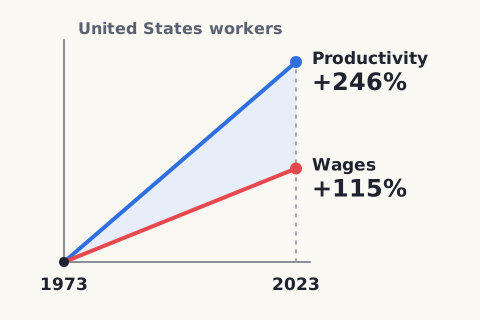
The Productivity-Wage Gap
From 1973 to 2023, U.S. worker productivity rose 246% while wages grew only 115% — evidence, the book argues, that the link between how much people produce and what they're paid has been severed.
By the numbers
- Cost of a professional human mind in 2020, per the book (dollars/hour)
- 36 $/hour
- U.S. worker productivity growth 1973–2023, per the book (%)
- 246 %
- Google's share of the search market, per the book (%)
- 91 %
- U.S. wage growth 1973 to 2023, per the book (%)
- 115 %
Matched pairs
Each item on the left goes with the one on the right.
- Lie #5 in Mostaque's list of economic myths
- Money measures value, which GDP cannot see when knowledge becomes free
Self-test
Answer each question from memory, then check your work against the answer key.
1. Mostaque's 'Factory School' — the system he says installed the seven lies before we could question them — was imported from where and built to produce what?
- APostwar America; creative innovators
- BVictorian Britain; a literate citizenry
- CAncient Rome; disciplined soldiers
- D19th-century Prussia; obedient, compliant workers
2. Before any of the seven economic lies could take hold, what did the Factory School first dismantle?
- AThe habit of critical inquiry
- BThe apprenticeship system
- CThe extended family
- DReligious authority
3. Lie #1 holds that economics is fundamentally the study of what?
- AMaximizing shareholder value
- BForecasting market cycles
- CAllocating scarce resources
- DControlling inflation
4. What do grades do within the Factory School system?
- AMeasure classroom attendance
- BRank human worth
- CCertify subject mastery
- DDetermine bell schedules
5. Mostaque insists the Factory School's compliance function was best understood as what?
- AA postwar reform
- BAn intentional design choice
- CA short-lived wartime measure
- DAn accident of overcrowding
6. Under Lie #2, what is a human's economic value now said to be for a growing share of cognitive tasks?
- ARising steadily
- BEqual to a model's
- CFixed at minimum wage
- DNegative
7. Per the book, the professional human mind was already available in 2020 for about what hourly price?
- A$36/hour
- B$12/hour
- C$75/hour
- D$150/hour
8. Lie #3 says growth requires resources. How is the source of new value reframed?
- AFrom mining rarer materials
- BFrom consuming more energy per capita
- CFrom better arranging bits rather than extracting more atoms
- DFrom expanding into new territories
9. Which market-share figures are cited as evidence against Lie #4 (markets find equilibrium)?
- AGoogle ~74% of search, Meta ~91% of social media
- BGoogle ~60% of search, Meta ~50% of social media
- CAmazon ~91% of retail, Apple ~74% of phones
- DGoogle ~91% of search, Meta ~74% of social media
10. Which of the following is NOT one of the first four fatal lies?
- AMoney measures value
- BGrowth requires resources
- CHuman labor has value
- DMarkets find equilibrium
11. Lie #6 rejects 'Homo economicus.' What mechanism does the book say every major platform uses to hijack our cognitive biases?
- ASubliminal images flashed below awareness
- BFixed once-daily reward schedules
- CVariable-ratio reinforcement — the same trick that makes slot machines addictive
- DRandomized price discounts
12. Which example is used to show GDP registering a civilizational gain as economic collapse (Lie #5)?
- AStreaming services replacing DVD rentals
- BWikipedia, whose free knowledge destroyed the paid encyclopedia industry
- CEmail displacing postal mail
- DSmartphones absorbing the standalone camera market
13. A Britannica encyclopedia set once sold for roughly how much, versus Wikipedia charging nothing?
- A$3,600
- B$14,000
- C$250
- D$1,400
14. Lie #6 rejects which classical model of the human decision-maker?
- AThe invisible hand of the market
- BHomo economicus, the rational self-interested optimizer
- CThe median voter
- DThe marginal consumer
15. Lie #7 assumes distribution follows contribution. What do rewards actually follow?
- AOwnership of platforms, algorithms, and data
- BSeniority within a firm
- CIndividual effort and hours worked
- DEducational credentials
16. From 1973 to 2023, by how much did U.S. worker productivity rise, per the book?
- A115%
- B91%
- C246%
- D173%
17. Over the same 1973–2023 span, how much did U.S. wages rise, per the book?
- A46%
- B115%
- C200%
- D246%
18. Using the book's 1973-2023 figures, by roughly how many percentage points did U.S. productivity growth outpace wage growth?
- ARoughly 91 points
- BRoughly 361 points
- CRoughly 131 points
- DRoughly 46 points
19. What does Mostaque say the 1973–2023 productivity-wage gap proves?
- ADistribution follows ownership, not contribution
- BWorkers simply need better reskilling
- CWages always catch up eventually
- DProductivity was mismeasured
20. How does Mostaque characterize what happened to the productivity-wage link?
- AIt gradually strengthened
- BIt was never real
- CIt was temporarily paused
- DIt was severed, not merely weakened
Go deeper
- ReadThe Last Economy by Emad Mostaque · on Amazon ↗
- StudyThe Last Economy (book) in the FlashFeed app
These are affiliate links: if you buy a book through one, FlashFeed may earn a small commission at no extra cost to you. The commission helps pay for FlashFeed's servers.
As an Amazon Associate we earn from qualifying purchases.
Answer key
- 1. D 19th-century Prussia; obedient, compliant workersThe Factory School was a 19th-century Prussian import — an industrial compliance engine of bells, grades, and obedience designed to produce interchangeable workers, dismantling critical inquiry so the economic lies could take hold unchallenged.
- 2. A The habit of critical inquiryThe Factory School dismantled the habit of critical inquiry, so every myth that followed was easier to believe once that groundwork was laid.
- 3. C Allocating scarce resourcesLie #1, 'scarcity is fundamental,' frames economics as allocating scarce resources — the assumption the book says AI's near-zero marginal cost demolishes.
- 4. B Rank human worthThe Factory School's bells segment the day while its grades rank human worth, with obedience -- not mastery -- the only skill that counts from kindergarten through graduation.
- 5. B An intentional design choiceMostaque's point is that the school's production of obedient, monotony-tolerant workers was intentional design, not neglect — deliberately laying groundwork before the economic lies.
- 6. D NegativeLie #2 is that human labor has value; the reality is that for a growing majority of cognitive tasks a human's economic value is negative — the person slows the process and adds error a model does not.
- 7. A $36/hourA professional human mind cost roughly $36/hour in 2020 — a ceiling AI has since collapsed through the floor.
- 8. C From better arranging bits rather than extracting more atomsAgainst Lie #3, AI-era value comes 'not from extracting more atoms, but from better arranging bits' — growth decoupled from material inputs.
- 9. D Google ~91% of search, Meta ~74% of social mediaLie #4 is refuted by network-effect monopolies: Google at roughly 91% of search and Meta at roughly 74% of social media are cited as stable attractors, not temporary imbalances.
- 10. A Money measures value'Money measures value' is Lie #5, part of the later Bonfire trio. The first four are scarcity is fundamental, human labor has value, growth requires resources, and markets find equilibrium.
- 11. C Variable-ratio reinforcement — the same trick that makes slot machines addictiveLie #6 says the rational actor is a defenseless target. Platforms deploy variable-ratio reinforcement — the unpredictable rewards that make slot machines addictive — to hijack dopamine, so the asymmetry between system and individual becomes absolute.
- 12. B Wikipedia, whose free knowledge destroyed the paid encyclopedia industryLie #5 is 'money measures value.' Wikipedia gave billions free knowledge yet contributed negatively to GDP by destroying the encyclopedia industry — proof the metric 'cannot see abundance.'
- 13. D $1,400A Britannica set once sold for $1,400, versus Wikipedia's price of zero — the value that GDP records as loss rather than gain.
- 14. B Homo economicus, the rational self-interested optimizerLie #6 targets Homo economicus — the rational, self-interested optimizer — arguing humans are bias-ridden organisms in engineered environments. The invisible hand belongs to Lie #4.
- 15. A Ownership of platforms, algorithms, and dataLie #7 is refuted by the claim that in an economy of platforms and algorithms, distribution follows ownership, not contribution — so those who own the pipelines capture the rewards.
- 16. C 246%The book cites a 246% rise in U.S. worker productivity from 1973 to 2023 — against only 115% wage growth — as evidence the productivity-wage link was severed.
- 17. B 115%Wages rose only 115% from 1973 to 2023 while productivity rose 246% — the divergence the book uses to argue distribution follows ownership, not contribution.
- 18. C Roughly 131 pointsProductivity rose 246% and wages 115%, so the divergence is about 131 percentage points. 361 wrongly adds the two figures instead of subtracting them.
- 19. A Distribution follows ownership, not contributionThe gap is the book's core evidence for Lie #7's refutation: rewards flow to owners of platforms and algorithms, so distribution follows ownership rather than contribution.
- 20. D It was severed, not merely weakenedMostaque stresses the link was not weakened gradually but severed — the divergence reflects a structural break where value accrues to ownership.
Image credits
- The Factory School: cdsessums (Openverse) · by 2.0 — www.flickr.com/photos/53313745@N00/4389889668
- Lie #4: Markets Find Equilibrium: European Southern Observatory (Openverse) · by 2.0 — www.flickr.com/photos/51207680@N04/30723876707
- Lie #1: Scarcity Is Fundamental: Jno.skinner (Openverse) · by-sa 4.0 — commons.wikimedia.org/w/index.php?curid=100196966
- Lie #7: Distribution Follows Contribution: Stefan Czapski (Openverse) · by-sa 2.0 — www.geograph.org.uk/photo/4172989
- Wikipedia's GDP Paradox: bradleygee (Openverse) · by 2.0 — www.flickr.com/photos/13951072@N00/2532673887
- The Productivity-Wage Gap: FlashFeed original diagram · CC-BY-4.0