
The Let Them Theory study guide · Lesson 5 of 5
Practical Mastery and Daily Application
Difficult Conversations and Verbal Scripts · Sustained Emotional Freedom and Self-Trust
Unofficial study guide for The Let Them Theory: A Life-Changing Tool That Millions of People Can't Stop Talking About by Mel Robbins, Sawyer Robbins. FlashFeed is not affiliated with the author or publisher.
This is the lesson's study guide from the FlashFeed app, plus its key facts and a self-test.
What you'll be able to do
- Identify clean communication (borrowed from Nonviolent Communication), the 4-Step De-Escalation Script, and scripts for holding boundaries under tension.
- Identify the daily micro-acts that rebuild self-trust, the Sovereignty Integration Loop's checkpoints, and how Let Them leaders build psychological safety.
Difficult Conversations and Verbal Scripts
The true test of relational sovereignty occurs in real-time interpersonal encounters when emotions run high, boundaries are tested, and external pressure mounts. To navigate difficult conversations with clarity and grace, it helps to borrow from a separate framework, Dr. Marshall Rosenberg's Nonviolent Communication (NVC). In that spirit, clean communication strips away defensiveness, historical grievances, sarcasm, and counter-attacks, relying on objective observations, clear boundary statements, and calm de-escalation. (NVC itself is built on four components: observations, feelings, needs, and requests.)
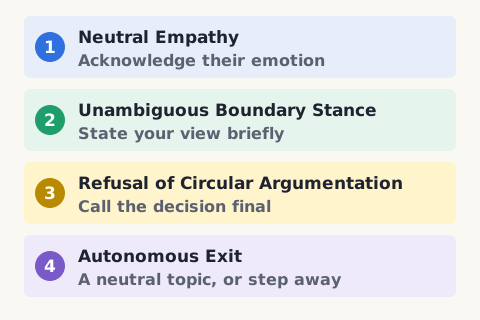
When confronted with interpersonal hostility, circular debates, or emotional volatility, individuals can use this lesson's 4-Step De-Escalation Script:
- Step 1: Neutral Empathy / Validation. Acknowledge the other party's emotional intensity neutrally without validating false accusations or conceding agreement ("I hear that you feel strongly about this topic").
- Step 2: Unambiguous Boundary Stance. State your perspective with brevity and clarity while explicitly declaring an unwillingness to enter a debate ("I see this differently, and I am not willing to debate it").
- Step 3: Refusal of Circular Argumentation. Firmly refuse repetitive counter-arguments by stating that your decision is final and will not be further justified ("My decision is final, and I am not going to justify it further").
- Step 4: Autonomous Exit / Transition. Offer an immediate transition to a neutral topic or create physical space by stepping away ("Let's move on to dinner, or I can step out so we both have space").
To provide actionable guidance across everyday life, here are example scripts, written for this lesson in the spirit of Let Them and Let Me, grouped into four domains:
- Workplace and Leadership Dynamics:
- Managing Unrealistic Demands and Scope Creep: Clarify workload trade-offs by placing managerial responsibility back where it belongs: "I understand this project is a top priority. Given my current commitments to Project Alpha and Project Beta, I cannot take this on without compromising those deadlines. Which priority would you like me to deprioritize, or should we schedule this for next month?"
- Halting Colleague Gossip: Exit toxic triangulation cleanly: "It sounds like you have some serious concerns with Sarah's workflow. I encourage you to bring that directly to her. I'm going to focus on finishing these reports."
- Managing a Micromanaging Supervisor: Proactively structure visibility to satisfy managerial anxiety while preserving daily operational autonomy: "I appreciate you keeping a close eye on this project. To give you full visibility, I will send a comprehensive progress update every Friday at 3:00 PM so we can keep our daily meetings focused on high-level strategy."
- Handling a Credit-Taking Colleague: Secure appropriate visibility: "During the presentation, you mentioned leading the analysis. As I conducted the data modeling and authored the deck, I want to ensure leadership has accurate visibility. Moving forward, I will present my deliverables directly."
- Family and In-Law Dynamics:
- Unsolicited Parenting Advice: Express polite gratitude while shutting down unsolicited advice firmly: "Thank you for sharing what worked for you. We have a clear plan with our pediatrician, and we've got this handled."
- Intrusive Lifestyle or Relationship Questions: Pivot gracefully: "I know you're curious about my dating life. When there's news to share, you'll be the first to know. Right now, tell me about your recent vacation."
- Aggressive Political Baits at Family Dinners: Dissolve provocation and protect family harmony: "I hear how passionate you are about this topic. I'm here today to enjoy family time and eat good food, so I'm not participating in political debates. Pass the potatoes!"
- Holiday Guilt-Tripping: Stand firm on holiday boundaries: "I understand you're disappointed we won't be there for Thanksgiving. We are spending this holiday at home, but we look forward to celebrating together in January."
- Romantic and Intimate Dynamics:
- Late-Night Circular Fighting: Halt nocturnal arguments fueled by cognitive depletion: "I love you, and this topic matters to both of us. However, we are exhausted and saying things out of frustration. I am going to sleep. Let's sit down with coffee tomorrow morning at 9:00 AM to work this through."
- Partner Moodiness and Door Slamming: Acknowledge overwhelm while insulating personal peace: "I can see you're feeling really overwhelmed right now. I'm going to give you some quiet space. Let me know when you want to connect, and I'll be in the living room reading."
- Sharing Domestic Responsibilities: State clean standards: "I need us to share the household responsibilities equally. I am happy to handle the kitchen and laundry, but I need you to own the trash and grocery runs. If that doesn't work, let's look at hiring a cleaning service."
- Friendships and Social Circles:
- Chronic Last-Minute Flakiness: Release resentment and observe effort: "Thanks for letting me know you can't make it. I'm going to go ahead and enjoy my evening. Take care!" (Internal 'Let Me': Do not pursue future invitations; observe whether they initiate).
- Friends Engaging in Emotional Dumping: Limit exposure while affirming care: "I love you and want to support you, but I only have 15 minutes before my next meeting, and I don't have the emotional capacity for a deep vent today. Let's catch up over coffee this weekend when I can give you my full attention."
- Dealing with Peer Pressure: Maintain clear personal standards: "That looks like a lot of fun, but it's not for me tonight. I'm sticking with water and heading home early. You all have a great time!"
Executing verbal scripts effectively requires a steady delivery, which this lesson calls Holding Frame: calm, grounded composure during difficult conversations. Verbal eloquence is insufficient if your nervous system signals panic. To hold frame:
- Vocal Pitch and Pacing: Lower your vocal register slightly, project from the diaphragm, and deliberately decelerate your verbal cadence to communicate grounded authority.
- Physical Stillness: Maintain an open, grounded posture with both feet flat on the floor, avoiding defensive arm-crossing or nervous fidgeting.
- The Power of the Micro-Silence: After delivering a boundary statement, deliberately pause in silence to allow the words to land rather than rushing to fill the void with nervous chatter.
Sustained Emotional Freedom and Self-Trust
The ultimate culmination and highest objective of The Let Them Theory is the restoration and deepening of unshakeable Self-Trust. Self-trust is the deep internal confidence and self-reliance built through unbroken personal integrity, consistent boundary enforcement, and self-loyalty.
Every time an individual engages in chronic people-pleasing, tolerates boundary violations, or micromanages others to soothe internal anxiety, they commit an act of micro-self-betrayal (this lesson's term). Over years and decades, these cumulative micro-betrayals can wear down the relationship with oneself and erode self-trust. Self-trust is rebuilt not through massive dramatic gestures, but through consistent, daily micro-acts of self-loyalty:
- Allowing others to misunderstand you without mounting a frantic, defensive justification.
- Enforcing boundaries and declining invitations that compromise your physical or emotional well-being.
- Allowing adult children, partners, and peers to experience the natural consequences of their choices.
- Fulfilling daily commitments to your personal health, creative projects, and morning routines.
The spirit of the theory is letting other people be who they are while you focus on who you are becoming. Releasing the exhausting burden of curating and managing others unlocks the cognitive and energetic bandwidth required to author your own evolution.
As Robbins frames it, substituting the urgent impulse to fix with the "Let Them" cognitive pause gives the thinking part of the brain (in neuroscience terms, the prefrontal cortex) time to settle your first reaction (the threat alarm linked to the amygdala). That is a way of describing the practice, and it is not a measured change in your brain or body. In family systems terminology (Friedman, 1985), you aim to become a Non-Anxious Presence: someone whose grounded emotional regulation tends to steady the people around them.
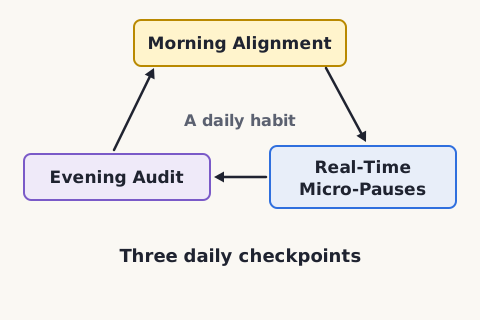
To sustain this mastery across a lifetime, this lesson suggests the Daily Sovereignty Integration Loop, consisting of three daily checkpoints:
- Morning Alignment (The Proactive Stance): Spend two minutes before accessing digital devices or email reviewing your sphere of control. Affirm: "Today, I have zero control over the traffic, the weather, my coworkers' moods, or my family's opinions. I have 100% control over my attention, my effort, my boundaries, and my kindness."
- Real-Time Micro-Pauses (The Operational Shield): Treat daily interpersonal triggers as workouts for building a cognitive detachment habit with the Let Them pause; this is a framing of the practice, not a measured change in the body.
- Evening Audit (The Self-Loyalty Review): Review your day with curiosity rather than self-judgment. Identify instances where you leaked energy into managing others, and celebrate moments of successful boundary keeping and "Let Me" agency.
The transformative impact of The Let Them Theory ripples across relational, family, and organizational culture. In executive leadership, embodying "Let Them" dismantles toxic workplace cultures of blame, fear, and micromanagement. By establishing high psychological safety (Amy Edmondson), leaders grant employees genuine autonomy and treat operational mistakes as valuable data. In parenting, mothers and fathers who embody "Let Them" aim to raise resilient, confident, and self-directed children by honoring the dignity of their individual life journeys.
Over time, this continuous practice creates a profound state of emotional sovereignty. When you no longer deplete your nervous system by fighting external reality, you cultivate an unshakable core of self-loyalty and inner peace. Interpersonal friction ceases to be a source of panic and becomes instead an invitation to deepen your self-trust. You realize that your serenity was never held in the hands of other people; it was always generated by the clarity of your own boundaries and the courage of your choices.
Ultimately, The Let Them Theory is a profound invitation to lay down a burden you were never designed to carry. Surrendering the exhausting struggle to control the external world unlocks the boundless reservoir of power within you. You let them think what they want, make their choices, and walk their paths. And in that vast, open space of freedom, you step forward into your own life with uncompromising authenticity and declare: Let Me.
Key terms
- Holding Frame
- staying physically and vocally steady while delivering a boundary in a tense conversation
- Non-Anxious Presence
- someone whose steady emotional regulation calms the social systems around them
- Ventral Vagal Complex
- a term from polyvagal theory for the parasympathetic pathway linked to calm and social connection
Key facts
Nonviolent Communication's Clean Core
Drawing on Dr. Marshall Rosenberg's Nonviolent Communication (NVC), clean communication strips out defensiveness, sarcasm, historical grievances, and counter-attacks — relying instead on objective observations, clear boundary statements, and calm de-escalation.
The 4-Step De-Escalation Script
When a conversation turns hostile, the script runs in four steps: (1) Neutral Empathy acknowledges the other person's emotion without agreeing to false claims; (2) an Unambiguous Boundary Stance states your view briefly and declines to debate; (3) Refusal of Circular Argumentation shuts down repeated debate by calling the decision final; (4) Autonomous Exit pivots to a neutral topic or steps away.
Workplace Boundary Scripts
For scope creep, a workplace script puts prioritization back on the manager: "Which priority would you like me to deprioritize, or should we schedule this for next month?" For gossip, exit the triangulation cleanly: "I encourage you to bring that directly to her. I'm going to focus on finishing these reports."
Proactive Visibility with Micromanaging Supervisors
To manage a micromanaging supervisor without conflict, professionals can proactively structure visibility by scheduling comprehensive weekly progress updates (e.g., every Friday at 3:00 PM), satisfying managerial anxiety while preserving daily operational autonomy and reserving meetings for high-level strategy.
Family Boundary Scripts
For unsolicited parenting advice: "Thank you for sharing what worked for you. We have a clear plan with our pediatrician, and we've got this handled." For political baiting at family dinners: "I'm here today to enjoy family time and eat good food, so I'm not participating in political debates. Pass the potatoes!"
Romantic Conflict Scripts
For late-night circular fighting: "We are exhausted and saying things out of frustration. I am going to sleep. Let's sit down with coffee tomorrow morning at 9:00 AM." For a moody, door-slamming partner: "I can see you're feeling overwhelmed. I'm going to give you some quiet space. Let me know when you want to connect."

Holding Frame
Holding Frame is the physical embodiment of composure during a hard conversation: lower your vocal pitch slightly, breathe and project from the diaphragm, and deliberately slow your speaking cadence. Verbal eloquence means nothing if your nervous system is visibly signaling panic.
The Power of the Micro-Silence
The practice of Micro-Silence involves deliberately pausing in quiet stillness after delivering a boundary statement. This prevents nervous chatter, allows the reality of the boundary to land with the other person, and communicates grounded internal authority.
Self-Trust: Betrayed, Then Rebuilt
Self-trust, the ultimate goal of the Let Them Theory, is deep internal confidence built through consistent integrity and boundary-keeping. Every act of people-pleasing or tolerated boundary violation is what this lesson calls a micro-self-betrayal that erodes it. It's rebuilt the same way it's lost: through daily micro-acts of self-loyalty, like honoring your limits and keeping your commitments.
The Let Them Pause and Staying Calm
Robbins frames the "Let Them" pause as giving the thinking part of your brain time to settle your first reaction to what other people do. In neuroscience terms, that thinking part is the prefrontal cortex, and the first reaction is the threat alarm linked to the amygdala. That is a way of describing the practice, not a measured change in your brain or body.
Becoming a Non-Anxious Presence
Embodying The Let Them Theory transforms an individual into what family systems theorist Edwin Friedman termed a Non-Anxious Presence—a person whose regulated autonomic state and grounded emotional boundaries exert a natural calming and stabilizing effect on anxious social systems.
The Daily Sovereignty Integration Loop
Long-term mastery runs on three daily checkpoints: Morning Alignment, Real-Time Micro-Pauses, and the Evening Audit. Together they turn the Let Them philosophy from an occasional insight into a repeatable daily habit.
Morning Alignment
Morning Alignment spends two minutes before touching a phone or email to affirm your sphere of control: zero control over the weather, traffic, or other people's moods — and 100% control over your own attention, effort, boundaries, and kindness.
Micro-Pauses as Daily Workouts
The Daily Loop treats each interpersonal trigger as a workout: using the Let Them pause in real time builds the cognitive-detachment habit, the way repeated practice builds any skill. That is a framing of the practice, not a measured change in the body.
The Evening Audit
The Evening Audit reviews the day with curiosity, not harsh self-judgment — noticing where energy leaked into managing others, and celebrating moments of successful boundary-keeping and "Let Me" agency.
Let Them in Leadership
Leaders who embody "Let Them" dismantle toxic cultures of blame, fear, and micromanagement. Drawing on Amy Edmondson's research on psychological safety, they treat operational mistakes not as grounds for punishment but as valuable data that deepens learning and autonomy.
Final Synthesis: The Architecture of Pure Freedom
Surrendering the exhausting struggle to control external people and events unlocks boundless internal power. Releasing the burden of managing others creates the expansive freedom to step forward into one's own life with uncompromising authenticity and declare: Let Me.
Matched pairs
Each item on the left goes with the one on the right.
- The Power of the Micro-Silence
- pausing in silence after a boundary statement instead of filling the gap
- Friedman, 1985
- family-systems source for the calming-presence term used in the book
Self-test
Answer each question from memory, then check your work against the answer key.
1. Whose framework underlies the 'clean communication' approach in difficult conversations?
- ANedra Glover Tawwab
- BSawyer Robbins
- CBrené Brown
- DMarshall Rosenberg
2. Which step of the 4-Step De-Escalation Script states your view briefly while declining to debate it?
- AAutonomous Exit/Transition
- BRefusal of Circular Argumentation
- CUnambiguous Boundary Stance
- DNeutral Empathy/Validation
3. What proactive step does the script for a micromanaging supervisor recommend?
- AWeekly Friday 3pm progress update
- BDaily one-on-one check-ins
- CCopy the supervisor on all emails
- DRequest a formal performance review
4. Which of these is NOT part of this lesson's Holding Frame during a difficult conversation?
- ALowering vocal pitch and pacing
- BSpeeding up speech to fill silence
- CPausing in micro-silence after a boundary
- DMaintaining open, still posture
5. A colleague claims credit for leading your data-modeling work. Which script response fits this situation?
- AAsk which priority to deprioritize
- BOffer a weekly Friday progress update
- CEncourage them to raise it with her directly
- DEnsure leadership has visibility on my work
6. What is described as the ultimate, highest objective of The Let Them Theory?
- ASelf-Trust
- BNon-Anxious Presence
- CEmotional Intelligence
- DPsychological Safety
7. What term does this lesson use for the act of chronic people-pleasing or tolerating boundary violations?
- ANon-Anxious Presence
- BCognitive dissonance
- CMicro-self-betrayal
- DEmotional dumping
8. Whose research on psychological safety informs treating mistakes as learning data, not punishment?
- AMarshall Rosenberg
- BAmy Edmondson
- CMurray Bowen
- DBrené Brown
9. Which is NOT one of the three checkpoints in this lesson's Daily Sovereignty Integration Loop?
- AMidday Gratitude Journal
- BEvening Audit
- CMorning Alignment
- DReal-Time Micro-Pauses
10. In the lesson's framing, which brain structure gets time to settle the amygdala's reaction when you use the 'Let Them' pause?
- AHypothalamus
- BPrefrontal cortex
- CLimbic system
- DCerebellum
Go deeper
- ListenLesson 5 episode
- WatchOut of the Circle Some arguments go in circles. A 4-step script can end one calmly.
- WatchSmall Acts of Loyalty Every false yes is a small betrayal of yourself. Over the years, they add up to self-doubt.
- ReadThe Let Them Theory by Mel Robbins, Sawyer Robbins · on Amazon ↗
- StudyThe Let Them Theory in the FlashFeed app
These are affiliate links: if you buy a book through one, FlashFeed may earn a small commission at no extra cost to you. The commission helps pay for FlashFeed's servers.
As an Amazon Associate we earn from qualifying purchases.
Answer key
- 1. D Marshall RosenbergClean communication draws on Dr. Marshall Rosenberg's Nonviolent Communication (NVC); none of the other three people developed NVC.
- 2. C Unambiguous Boundary StanceStep 2, the Unambiguous Boundary Stance, states your perspective briefly and declares you won't debate it; the other steps validate, refuse repetition, or exit.
- 3. A Weekly Friday 3pm progress updateThe script offers a comprehensive progress update every Friday at 3:00 PM, satisfying the supervisor's need for visibility while preserving daily autonomy.
- 4. B Speeding up speech to fill silenceHolding Frame calls for a slower cadence, stillness, and micro-silence -- rushing to fill silence with nervous chatter is exactly what it warns against.
- 5. D Ensure leadership has visibility on my workThe credit-taking script secures visibility on your own deliverables directly; the others address micromanagement, gossip, or scope creep, not stolen credit.
- 6. A Self-TrustSelf-Trust is described as the theory's ultimate culmination; the others are related but distinct concepts.
- 7. C Micro-self-betrayalThis lesson calls chronic people-pleasing and tolerated boundary violations micro-self-betrayal; the other terms describe different ideas.
- 8. B Amy EdmondsonPsychological safety research is credited to Amy Edmondson; Brené Brown is known for vulnerability and shame research, Rosenberg founded Nonviolent Communication (NVC), and Bowen is cited for family systems theory.
- 9. A Midday Gratitude JournalThe loop's three checkpoints are Morning Alignment, Real-Time Micro-Pauses, and the Evening Audit; a midday gratitude journal isn't part of it.
- 10. B Prefrontal cortexThe lesson frames the pause as giving the thinking part of the brain, the prefrontal cortex, time to settle the amygdala's reaction. It is a framing, not a measured result.
Sources
- The Let Them Theory — Mel Robbins and Sawyer Robbins
- The Let Them Theory (Mel Robbins and Sawyer Robbins); the link to Rosenberg's Nonviolent Communication is this lesson's
- The Let Them Theory
- The Let Them Theory (Mel Robbins and Sawyer Robbins); the 4-Step De-Escalation Script is this lesson's synthesis
- The Let Them Theory (Mel Robbins and Sawyer Robbins); the example scripts are this lesson's own
- The Let Them Theory (Mel Robbins and Sawyer Robbins); Holding Frame and the micro-silence are this lesson's terms
- The Let Them Theory (Mel Robbins and Sawyer Robbins); the Daily Sovereignty Integration Loop is this lesson's synthesis
Image credits
- The 4-Step De-Escalation Script: FlashFeed original diagram · CC-BY-4.0
- Holding Frame: Andrew · CC BY 2.0 — en.wikipedia.org/wiki/Body_language
- The Daily Sovereignty Integration Loop: FlashFeed original diagram · CC-BY-4.0