
The Let Them Theory study guide · Lesson 4 of 5
The 'Let Me' Inversion and Radical Ownership
The 'Let Me' Pivot and Agency · Clear Boundaries and Non-Negotiables
Unofficial study guide for The Let Them Theory: A Life-Changing Tool That Millions of People Can't Stop Talking About by Mel Robbins, Sawyer Robbins. FlashFeed is not affiliated with the author or publisher.
This is the lesson's study guide from the FlashFeed app, plus its key facts and a self-test.
What you'll be able to do
- Identify the 'Let Me' pivot's internal locus of control and the 4-step 'Let Me' practice sequence, and how it balances 'Let Them.'
- Identify the six boundary categories (physical, emotional, time/energy, conversational, material/financial, relational role) and 3-phase boundary enforcement.
The 'Let Me' Pivot and Agency
While the phrase "Let Them" serves as an extraordinary cognitive pattern interrupt to arrest interpersonal micromanagement, anxiety, and surveillance, Mel Robbins and Sawyer Robbins make a vital theoretical clarification: "Let Them" is only half of the complete relational operating system. Releasing the compulsive urge to control external reality and other people's behaviors is an essential first step, but if an individual halts at detachment, the framework remains dangerously incomplete and structurally vulnerable.
Halting at "Let Them" without engaging the proactive second engine risks, in this framework's view, sliding into passive resignation and a sense of helplessness. Releasing control over other people does not mean abdicating sovereign responsibility for your own life, decisions, and environment. Once you have stepped back to acknowledge that another person has the total, sovereign freedom to make their own choices, hold their own opinions, and navigate their own path, you must immediately pivot to the empowering second engine of the framework: "Let Me."
In this lesson's wording, the "Let Me" engine poses one central operational question: given what this person is doing, what am I going to do about it? Where "Let Them" steps back to honor external autonomy, "Let Me" steps forward to exercise internal self-determination. Where "Let Them" grants others the freedom to be who they are, "Let Me" exercises 100% radical ownership over your own standards, physical environment, time allocation, career trajectory, emotional health, and boundaries. It shifts your focus completely away from managing someone else's behavior and anchors it firmly upon authoring your own life.
In psychological science, this pivot echoes the concept of locus of control — a construct from psychologist Julian Rotter's research — as the practical shift from an external to an internal locus of control:
- External Locus of Control (what this lesson calls victim consciousness): The disempowering belief that one's emotional well-being, success, and daily peace are governed by outside forces, other people's behaviors, or uncontrollable external conditions. Individuals operating from an external locus believe statements such as "My peace depends on their mood," "They ruined my entire day," or "I am completely helpless until they change their behavior." This posture breeds chronic bitterness, reactivity, and powerlessness.
- Internal Locus of Control (what this lesson calls radical sovereignty): The belief that what happens in your life depends mainly on your own choices and actions rather than on luck, fate, or other people. In this lesson, that means putting your energy into your own choices, responses, and self-directed actions instead of other people's. Individuals with an internal locus declare: "I control my choices and actions," "I author my own happiness," and "I choose how I will respond to reality."
"Let Me" is the behavioral manifestation of an internal locus of control. Executing the "Let Me" pivot transforms an individual from a reactive extra trapped in someone else's emotional drama into the active, self-authored protagonist of their own life. Instead of waiting for a partner to become romantic, a coworker to become organized, a boss to become appreciative, or a relative to become respectful, you take radical responsibility for your own experience. The "Let Me" engine reallocates vitality directly into personal goal attainment, physical vitality, creative output, and unshakeable self-loyalty.
To execute the "Let Me" pivot systematically in daily life, this lesson organizes the practice into a 4-Step 'Let Me' Practice Sequence (a teaching aid distilled from the book's guidance, not a named framework from the text itself):
- Step 1: Objective Reality Audit. State the empirical reality factually, objectively, and neutrally, stripping away all emotional embellishment, cognitive distortions, and catastrophizing narratives (for example: "My colleague has missed three consecutive deadlines on our joint project deliverables").
- Step 2: The Self-Referential Question. Rotate your mental attention 180 degrees away from the other person's motivations, psychology, or excuses, and ask the self-referential operational question: given what they are doing, what am I going to do about it?
- Step 3: Values-Aligned Decision Making. Filter your available courses of personal action through your core integrity, professional standards, physical energy, and emotional health to select the most proactive and integrous response (for example: "I am going to complete my section, submit it directly to leadership, and clarify the division of deliverables").
- Step 4: Clean, Unapologetic Execution. Take decisive action immediately without lecturing, nagging, making passive-aggressive remarks, or seeking external validation and permission.
Understanding the mutual interdependence and complementary nature of the two engines is essential for long-term emotional freedom. Releasing control over others without self-directed action collapses into passive resignation and boundary erosion. Practicing "Let Them" without "Let Me" leads directly to victimhood, helplessness, and permitting others to walk all over your limits. Conversely, practicing "Let Me" without "Let Them" produces hyper-controlling aggression, micromanagement, and chronic interpersonal frustration as you attempt to force the world to bend to your will. Integrated together, the two engines create an unshakeable operating system where external acceptance fuels internal sovereignty.
Clear Boundaries and Non-Negotiables
A pervasive source of confusion in modern self-help and popular psychology is conflating authentic boundary-setting with attempts to control other adults. Individuals often believe they are establishing healthy boundaries when they are actually formulating controlling rules designed to restrict another person's free will, leading to escalating conflict and frustration.
This lesson draws a practical distinction, echoed elsewhere in boundary-setting literature, between controlling rules and authentic boundaries:
- Controlling rules (violate autonomy): Rules attempt to dictate what the other person must or must not do. They rely on coercion, surveillance, argument, policing, and continuous monitoring. Examples include statements such as "You are not allowed to drink around me!" or "You must answer my text messages within ten minutes!" Controlling rules inevitably fail because no adult possesses the power to control another adult's free will, and attempts to enforce rules breed resentment, rebellion, and exhaustion.
- Authentic boundaries (exercise self-sovereignty): Boundaries dictate what I will do to protect my own well-being, emotional safety, calendar, and physical space. They respect the other person's right to act however they choose ("Let Them"), while exercising personal sovereignty over proximity, participation, and access ("Let Me"). Examples include statements such as "If you choose to drink at this dinner, I will leave the gathering and drive home" or "I do not answer work-related emails after 7:00 PM; I will respond tomorrow morning at 9:00 AM."
To provide structural clarity, this lesson organizes boundaries into six practical categories:
- Physical Boundaries: Governing personal space, bodily touch, physical privacy, and entry into living quarters or private rooms.
- Emotional Boundaries: Protecting personal emotional bandwidth by refusing guilt trips, emotional dumping, unsolicited venting, and mood contagion.
- Time and Energy Boundaries: Safeguarding calendar commitments, dedicated work hours, sleep schedules, and restorative personal downtime against unreasonable demands.
- Conversational Boundaries: Establishing explicit limits around participating in office gossip, invasive personal questioning, political provocation, and verbal cruelty.
- Material and Financial Boundaries: Regulating personal loans, financial bailouts, asset allocation, and the usage or borrowing of personal property.
- Relational Role Boundaries: Maintaining structural clarity in relationships by refusing to act as a parent to a romantic partner or to treat minor children as emotional peers and confidants.
In this lesson's framing, a boundary without an executed consequence is merely an empty complaint. When an individual repeatedly articulates a boundary but fails to enforce the corresponding consequence when that boundary is breached, they erode their own relational credibility, damage their self-respect, and actively train others to disregard their stated limits. A boundary only becomes real when the consequence is consistently and cleanly enacted.
To enforce boundaries cleanly, effectively, and without unnecessary drama, this lesson organizes the practice into a 3-Phase Boundary Enforcement approach:
- Phase 1: Transparent Articulation. State the boundary and the corresponding self-directed action clearly, kindly, and once. Communicate with clean clarity, eliminating filler words, defensive justifications, and unnecessary apologies (for example: "I value calm communication. If you continue to yell at me during this discussion, I will end this phone call and we can talk tomorrow").
- Phase 2: Observation Without Intervention. Step back completely and allow the other person total freedom to respect or violate the boundary. Refrain from repeating warnings multiple times, hovering anxiously, or attempting to coerce their compliance. You observe their unforced choice as pure behavioral data.
- Phase 3: Immediate Consequence Execution. If a boundary violation occurs, execute the pre-announced self-action cleanly, immediately, and without entering into debate (for example: "I am hanging up now. We will talk tomorrow"). When enforcing a consequence, firmly refuse to engage in circular arguments about whether you have the right to hang up, leave the room, or protect your peace. You simply take action and allow the consequence to stand.
By integrating clear boundaries with radical self-ownership, you establish a life anchored in mutual respect, emotional stability, and authentic sovereignty. You no longer waste time or emotional energy begging other people to treat you well, nag them into compliance, or complain about their shortcomings. Instead, you grant others complete freedom to show you who they are, while trusting yourself completely to take whatever actions are necessary to protect your peace, honor your values, and build a fulfilling life.
Key terms
- External Locus of Control
- the belief that one's peace and success are governed by other people or outside forces
- Controlling rules
- statements that try to dictate what the other person must do, enforced by pressure and monitoring
- Authentic boundaries
- statements defining what a person will do to protect their own well-being and space
Key facts
The Essential Dual-Engine Architecture
Mel and Sawyer Robbins establish that 'Let Them' represents only the first half of a complete relational operating system. To achieve genuine sovereignty and peace, detachment must be immediately paired with the proactive agency of 'Let Me.'
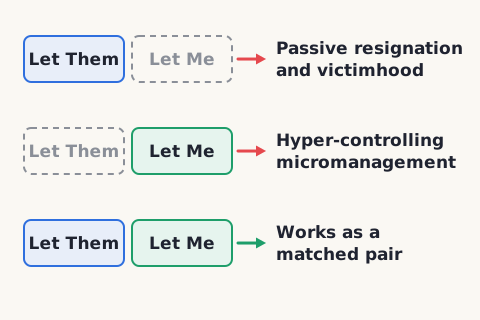
Two Ways the System Breaks
The Let Them Theory only works as a matched pair. Practicing "Let Them" without "Let Me" collapses into passive resignation, emotional numbness, and victimhood, letting people walk over your limits. Practicing "Let Me" without "Let Them" swings the other way, producing hyper-controlling aggression, micromanagement, and chronic frustration as you try to force the world to comply.
The Self-Referential Question
The "Let Me" practice turns on one self-referential question, in this lesson's wording: given what this person is doing, what am I going to do about it? This is the second step of the 'Let Me' practice sequence. It rotates your attention 180 degrees away from analyzing the other person's motives and back onto your own choices.
Locus of Control: External vs Internal
Dr. Julian Rotter (1966) distinguished an external locus of control (believing what happens to you depends mainly on luck, fate, or other people) from an internal locus of control (believing it depends mainly on your own choices and actions). This lesson treats "Let Me" as the behavioral expression of an internal locus: full ownership over your standards, time, and boundaries.
Protagonist, Not a Reactive Extra
Executing the "Let Me" pivot turns you from a reactive extra trapped in someone else's drama into the self-authored protagonist of your own life. Where "Let Them" steps back to honor another person's external autonomy, "Let Me" steps forward to exercise your own internal self-determination — the two roles are opposite but complementary.
Step 1: The Objective Reality Audit
The 'Let Me' pivot breaks down into a practice sequence, starting with what we call the Objective Reality Audit: state what actually happened factually and neutrally, stripped of emotional embellishment or catastrophizing — for example, "My colleague has missed three consecutive deadlines," not "My colleague doesn't care about this project at all."
Step 4: Clean, Unapologetic Execution
The fourth step of the 'Let Me' practice sequence is Clean, Unapologetic Execution: carry out the decision immediately, without lecturing, nagging, passive-aggressive remarks, or waiting for someone else's permission or approval.
Rechanneling Cognitive Bandwidth
The 'Let Me' engine channels energy reclaimed from micromanaging others into personal development, health, career goals, and steadfast self-trust.
Controlling rules vs. authentic boundaries
Controlling rules seek to police another person's behavior through coercion. Authentic boundaries respect external autonomy ('Let Them') while governing personal proximity, time, and safety ('Let Me').
Time and Energy Boundaries
Time and energy boundaries protect your calendar, dedicated work blocks, sleep schedule, and restorative downtime from unreasonable demands on your schedule and stamina.
Conversational Boundaries
Conversational boundaries set explicit limits on which topics, tones, and interactions you'll engage with — giving you a clean way to exit office gossip, invasive questions, political provocation, or verbal cruelty.
Material and Financial Boundaries
Material and financial boundaries govern personal loans, asset allocation, and the borrowing or use of property — setting clear terms for what money and possessions you will and won't share.
Relational Role Boundaries
Relational role boundaries keep relationships structurally clear — a romantic partner should be treated as an equal adult, never as a child to be parented, and a minor child should never be treated as an emotional peer or confidant.
The Enforcement Imperative
A boundary without an executed consequence is merely an empty complaint. Failing to enact stated consequences erodes relational credibility and trains others to disregard boundaries.
Phase 1: State It Once, Cleanly
The first phase of enforcing a boundary is to state the boundary and your intended self-action clearly, kindly, and once — cutting filler words, defensive justifications, and unnecessary apologies. Example: "If you continue to yell, I will end this call and we'll talk tomorrow."
Phases 2-3: Observe, Then Execute
Phase 2 requires stepping back completely and letting the other person freely choose to respect or violate the boundary — no repeating warnings or hovering. If they violate it, Phase 3 executes the pre-announced consequence immediately and cleanly, refusing to debate whether you have the right to enforce it.
Matched pairs
Each item on the left goes with the one on the right.
- Dr. Julian Rotter
- formulated the locus-of-control construct in 1966
- Step 2: The Self-Referential Question
- turns attention 180 degrees away from the other person's motivations or excuses
Self-test
Answer each question from memory, then check your work against the answer key.
1. Which psychological construct, formulated by Dr. Julian Rotter in 1966, underpins the 'Let Me' mindset?
- AThe cognitive dissonance theory of attitude change
- BThe attachment styles model of adult relational bonding
- CThe hierarchy of human needs and self-actualization drives
- DThe continuum between external and internal locus of control
2. During Step 3 of the 'Let Me' practice sequence (Values-Aligned Decision Making), how are response options evaluated?
- ABy choosing whatever action guarantees approval and praise from peers
- BBy filtering choices through personal integrity, standards, and emotional health
- CBy calculating which action requires the least personal discomfort and effort
- DBy assessing which option will inflict the greatest remorse on the other party
3. What relational pattern emerges when an individual exercises 'Let Me' without practicing 'Let Them'?
- AHyper-controlling aggression, micromanagement, and constant frustration
- BChronic emotional numbness and withdrawal from social interactions
- CComplete people-pleasing and fawning compliance with others' demands
- DSubmissive avoidance of difficult conversations and conflict
4. What does Step 1 of the 'Let Me' practice sequence require you to do?
- AAsk what you will do about their behavior
- BFilter responses through personal values and integrity
- CState the situation factually and neutrally
- DExecute your decision without seeking approval
5. Step 4 (Clean, Unapologetic Execution) says to act without doing which of these?
- AFiltering choices through personal values
- BAsking what you will do about their behavior
- CStating the situation factually, objectively, and neutrally
- DNagging, lecturing, or seeking permission first
6. Which boundary category establishes explicit limits around participation in workplace gossip and verbal cruelty?
- ARelational role boundaries regarding parental expectations
- BMaterial boundaries regarding asset distribution and borrowing
- CConversational boundaries regarding permissible topics and tone
- DPhysical boundaries regarding personal territory and contact
7. What is the key requirement of Phase 1 in the 3-Phase Boundary Enforcement approach?
- AState the boundary and corresponding self-action clearly, kindly, and once
- BNegotiate compromises repeatedly until the other person agrees to comply
- CIssue repeated emotional warnings until behavioral changes are observed
- DImmediately sever the relationship without giving prior explanation
8. When enacting a consequence like ending a call or leaving a room, what should an individual firmly refuse to do?
- ARemain calm and maintain emotional composure throughout the departure
- BEngage in circular debates regarding whether they have the right to leave
- CFollow through on the exact consequence that was previously announced
- DProvide a neutral, factual reason for stepping away from the interaction
9. Which category of personal boundaries governs bodily touch, personal space, and entry into private rooms?
- APhysical boundaries
- BEmotional boundaries
- CTime and energy boundaries
- DRelational role boundaries
10. What must you do during Phase 2 of the Boundary Enforcement approach, after stating the boundary?
- AEnd the relationship immediately
- BNegotiate a modified boundary
- CRepeat the warning with rising urgency
- DStep back and let them choose freely
Go deeper
- ListenLesson 4 episode
- WatchThen, Let Me Let them is only half of the idea. The other half is let me.
- WatchRule or Boundary You can't drink around me. That sounds like a boundary, but it is a rule.
- ReadThe Let Them Theory by Mel Robbins, Sawyer Robbins · on Amazon ↗
- StudyThe Let Them Theory in the FlashFeed app
These are affiliate links: if you buy a book through one, FlashFeed may earn a small commission at no extra cost to you. The commission helps pay for FlashFeed's servers.
As an Amazon Associate we earn from qualifying purchases.
Answer key
- 1. D The continuum between external and internal locus of controlDr. Julian Rotter formulated the concept of Locus of Control, distinguishing between attributing life outcomes to external forces versus internal agency.
- 2. B By filtering choices through personal integrity, standards, and emotional healthStep 3 filters available courses of action through core values, professional integrity, and emotional well-being to select the most proactive response.
- 3. A Hyper-controlling aggression, micromanagement, and constant frustrationAttempting to take action ('Let Me') without accepting external reality ('Let Them') results in coercive attempts to force others to change.
- 4. C State the situation factually and neutrallyStep 1 of this lesson's practice sequence, the Objective Reality Audit, requires stating what happened factually and neutrally, stripped of catastrophizing. The other options describe Steps 3, 2, and 4.
- 5. D Nagging, lecturing, or seeking permission firstStep 4 requires immediate, clean execution without lecturing, nagging, or seeking external validation. The other options describe Steps 3, 1, and 2.
- 6. C Conversational boundaries regarding permissible topics and toneConversational boundaries define which topics, interactions, and verbal tones you are willing to engage with, allowing you to exit gossip or cruelty.
- 7. A State the boundary and corresponding self-action clearly, kindly, and oncePhase 1 requires articulating the boundary and your intended response cleanly, kindly, and exactly once, with zero defensive justification.
- 8. B Engage in circular debates regarding whether they have the right to leaveEngaging in debates over your right to enforce a consequence invalidates the boundary; consequences should be enacted without seeking the other person's agreement.
- 9. A Physical boundariesPhysical boundaries govern personal space, bodily touch, and privacy, including entry into bedrooms or workspaces; the other categories cover emotional bandwidth, schedules, and relationship structure.
- 10. D Step back and let them choose freelyPhase 2 requires stepping back completely and letting the other person freely choose to respect or violate the boundary, without repeating warnings or hovering.
Sources
- The Let Them Theory — Mel Robbins and Sawyer Robbins
- The Let Them Theory
- Julian Rotter, Psychological Monographs 80(1), 1966
Image credits
- Two Ways the System Breaks: FlashFeed original diagram · CC-BY-4.0