
The Let Them Theory study guide · Lesson 3 of 5
Overcoming People-Pleasing and Anxiety
Breaking People-Pleasing and Peacekeeping · Anxiety, Over-Functioning, and Energy Leaks
Unofficial study guide for The Let Them Theory: A Life-Changing Tool That Millions of People Can't Stop Talking About by Mel Robbins, Sawyer Robbins. FlashFeed is not affiliated with the author or publisher.
This is the lesson's study guide from the FlashFeed app, plus its key facts and a self-test.
What you'll be able to do
- Identify chronic people-pleasing as the anxiety-driven Fawning Response — an appeasement adaptation, not genuine kindness.
- Explain Bowen's over-functioning and under-functioning pattern (the seesaw) and recognize common Energy Leaks.
Breaking People-Pleasing and Peacekeeping
Society frequently praises people-pleasers as selfless, compassionate, and agreeable individuals who prioritize the comfort of others above their own desires. Mel Robbins strips away this flattering cultural facade, defining chronic people-pleasing not as genuine kindness, but as an anxiety-driven strategy of impression management and covert manipulation. When an individual chronically pleases others at the expense of their own truth, they are attempting to control external perceptions so that other people do not get angry, leave, judge, or create conflict.
People-pleasing is inherently dishonest. By continually suppressing authentic limits, opinions, and desires to accommodate external demands, the people-pleaser deprives others of knowing the real person while secretly harboring deep resentment toward those whose requests were voluntarily accepted. The internal cycle of the people-pleasing reflex operates through a predictable chain:
- Experience an acute fear of disapproval, rejection, or interpersonal conflict.
- Suppress authentic feelings, preferences, and boundaries.
- Utter a false "yes" that compromises personal limits, time, and physical energy.
- Accumulate internal resentment, silent bitterness, and chronic exhaustion.
- Experience emotional burnout or an eventual passive-aggressive relational rupture.
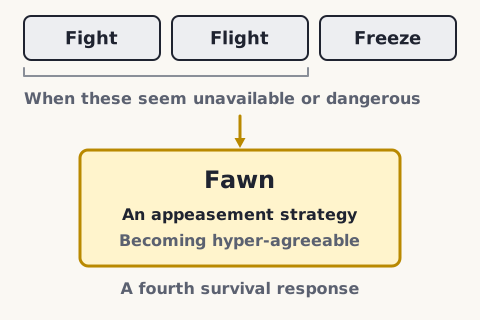
Trauma therapist Pete Walker named chronic people-pleasing the Fawning Response, a survival adaptation alongside fight, flight, and freeze (first in a 2003 article, then in his 2013 book on complex trauma). When a threat cannot be fought or fled, the person tries to neutralize danger by becoming hyper-agreeable, compliant, and self-effacing to appease a perceived aggressor. Some clinicians link this to Dr. Stephen Porges' Polyvagal Theory, which is itself debated. In childhood, fawning may have protected an individual from an emotionally volatile or hyper-critical caregiver. In adulthood, however, continuing to fawn ensures perpetual exhaustion and self-alienation. Deploying the cognitive interrupt "Let Them" can help you pause before the compliance reflex takes over, and gives you a moment to choose a response.
A critical dimension of breaking free from people-pleasing is learning to tolerate being misunderstood. Mel Robbins offers a liberating aphorism that dismantles interpersonal defensiveness: "Let them judge you. Let them misunderstand you. Let them gossip about you." When someone forms an unflattering, inaccurate, or critical opinion of you, the instinctive impulse is to over-explain, write multi-paragraph text messages, and defend your reputation. This defensive urge is magnified by the Spotlight Effect (Gilovich, Medvec, & Savitsky, 2000), a cognitive bias leading people to egocentrically overestimate the degree to which others are observing, evaluating, and scrutinizing their behavior.
The truth is that human beings view others through the prism of their own personal wounds, cognitive biases, limitations, and emotional maturity rather than objective truth. You possess zero control over the internal narrative another person constructs inside their mind. Spending vital cognitive energy attempting to convince a critical or unsupportive person of your integrity is an exhausting waste. When confronted with unfair labels or misinterpretations of your motives, the sovereign response is to let them believe what they choose without mounting a defense.
Furthermore, the framework draws a sharp distinction between Peacekeeping and Peacemaking:
- Peacekeeping (False Harmony): A fear-based pattern of swallowing personal needs to avoid upsetting others. Peacekeeping maintains superficial external calm while igniting an internal war of resentment. It is fragile, conflict-avoidant, and ultimately destructive to self-worth and genuine intimacy.
- Peacemaking (Authentic Integrity): A values-based practice of speaking truth with kindness and clarity. Peacemaking is willing to tolerate temporary external friction and difficult conversations to achieve lasting alignment, mutual respect, and authentic peace.
Breaking the peacekeeping reflex requires cultivating Distress Tolerance, a foundational concept developed by Dr. Marsha Linehan in Dialectical Behavior Therapy (DBT). Distress tolerance is the capacity to endure interpersonal tension, disappointment, and negative emotions without reacting impulsively to soothe the other person. You must recognize that another person's disapproval, irritation, or bad mood is not an emergency requiring your immediate intervention; it is simply their internal emotional weather. When you stop treating other people's emotional reactions as crises that you must immediately solve, you reclaim your emotional sovereignty and permit others the dignity of experiencing their own feelings.
Anxiety, Over-Functioning, and Energy Leaks
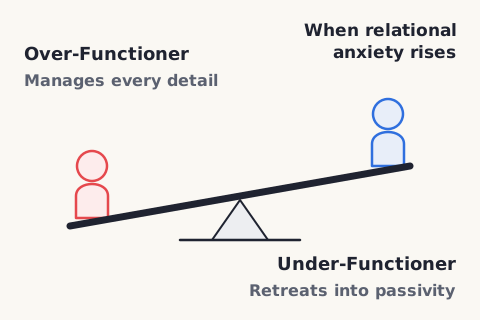
In systems theory and family psychology, relational anxiety consistently manifests through the Over-Functioning / Under-Functioning Seesaw, a way to picture the over-functioning and under-functioning pattern described by Dr. Murray Bowen (1978). In any group, family, or workplace dynamic, when anxiety rises, roles become polarized:
- The Over-Functioner: Driven by acute internal anxiety and catastrophizing cognitive schemas, the over-functioner operates under the irrational belief that if they do not manage every single logistical detail, organize every schedule, and solve every problem, catastrophe will strike. They feel perpetually exhausted, martyred, and resentful, taking on the emotional and logistical weight of the entire system.
- The Under-Functioner: Driven by avoidance and learned passivity, the under-functioner retreats into procrastination, helplessness, and abdication of responsibility, feeling controlled, incompetent, and infantilized by the over-functioner's constant supervision.
The over-functioner's compulsive intervention actively disables the people around them. The more responsibility the over-functioner absorbs, the further the under-functioning counterpart tends to withdraw, and each side's behavior reinforces the other's. The only mechanism to dismantle this dysfunctional reciprocity is for the over-functioner to consciously step down. When you deploy "Let Them" and cease managing alarm clocks, laundry, schedules, and deliverables, you create a functional void. The other person may stumble initially, but tolerating that temporary void is the necessary precondition for them to develop genuine functional competence and self-efficacy.
Interpersonal anxiety is further amplified by Emotional Contagion, documented extensively by psychologists Elaine Hatfield, John Cacioppo, and Richard Rapson (1994). Emotional contagion is the automatic, unconscious neurobiological tendency to mimic and synchronize facial expressions, vocal tones, postures, and emotional energies with those around us. If a spouse walks into the room irritated, an unshielded partner immediately experiences sympathetic nervous system arousal. If a coworker panics over a deadline, the entire office absorbs the tension.
The Let Them Theory serves as a vital Emotional Firewall. An emotional firewall is a cognitive and somatic boundary that insulates your autonomic nervous system from absorbing surrounding emotional stress. It allows you to witness another person's emotional storm without allowing that storm to invade your physiology. You remind yourself: "They are having an emotional storm. Let them have it. It belongs to them, not to me." By maintaining an emotional firewall, you become an island of calm stability rather than an amplifier of chaos, allowing others to regulate without dragging you into their dysregulation.
A central practice for conserving cognitive bandwidth is identifying and plugging Relational Energy Leaks. An Energy Leak is defined as any habitual mental or emotional fixation that consumes cognitive resources without producing constructive real-world change. Common examples of energy leaks, ways attention drains into things you cannot control, include:
- Ruminating over ambiguous tone or punctuation in incoming electronic messages, emails, or texts.
- Rehearsing imaginary confrontational dialogues and sharp comebacks in the shower, car, or during solitary walks.
- Compulsively monitoring social media status, read receipts, active indicators, and online timestamps of associates and peers.
- Hyper-actively attempting to manage, fix, or cheer up a family member's foul mood at the dinner table.
- Offering unsolicited advice, unprompted solutions, and life guidance to adult siblings, parents, or friends.
- Catastrophizing uncontrollable logistical and environmental disruptions, such as traffic jams or bad weather.
- Expending mental and emotional energy trying to convert others to one's own political, dietary, philosophical, or spiritual beliefs.
- Preemptively fixing mistakes made by competent adults before they experience the natural learning consequences of their actions.
- Obsessing over whether people in a room are evaluating, judging, or criticizing your appearance, outfit, or demeanor.
- Agonizing over turning down invitations, events, or commitments that you never wanted to accept in the first place.
When you systematically examine these energy leaks, you realize how much vital life energy is surrendered to matters entirely outside your sphere of influence. Every minute spent stewing over an unreturned text or rehearsing an imaginary argument in traffic is a minute stolen from your creative ambitions, physical health, and personal peace. Applying "Let Them" directly to these energy leaks plugs the cognitive drains in your daily life, immediately restoring mental clarity, emotional equilibrium, and physiological vitality. By reclaiming this trapped bandwidth, you create the internal foundation necessary to step into radical agency and purposeful living.
Key terms
- Fawning Response
- An automatic survival state that makes a threatened person overly agreeable and compliant to appease danger.
- Spotlight Effect
- A bias that makes people overestimate how closely others notice and judge their behavior.
- Relational Energy Leak
- A habitual mental fixation that drains cognitive resources without producing real change.
Key facts
People-Pleasing Breeds Resentment
People-pleasing is inherently dishonest: suppressing your real limits and opinions to keep others happy hides the authentic you and quietly breeds resentment toward the very people you're accommodating. The pattern runs in a predictable loop — fear of conflict, a false "yes," accumulating resentment, and eventual burnout or a passive-aggressive blowup.
The Fawning Response
In a 2003 article, trauma therapist Pete Walker named Fawning a fourth survival response alongside Fight, Flight, and Freeze: an appeasement strategy. When fighting or fleeing a threat seems unavailable or dangerous, a person tries to neutralize it by becoming hyper-agreeable instead. Some clinicians link this to Dr. Stephen Porges' Polyvagal Theory, which is itself debated.
Pausing the Fawning Reflex
Saying "Let Them" can help you pause before the urge to appease takes over, giving you a moment to choose a response instead of reflexively complying.
Others' Judgments Are Filtered
Mel Robbins reminds us: "Let them judge you. Let them misunderstand you. Let them gossip about you." People view you through the lens of their own biases and wounds, not objective truth, so you have zero control over the story they build in their head. Emotional sovereignty means letting someone hold an unfair label or misunderstanding of you without mounting a defense — defending yourself only hands them your power.
The Spotlight Effect
The Spotlight Effect (Gilovich, Medvec & Savitsky, 2000) is the cognitive bias that makes people believe others are watching, judging, and remembering their appearance and mistakes far more closely than they actually are. Most people are too absorbed in their own lives to scrutinize yours the way you fear.
Peacekeeping vs Peacemaking
Peacekeeping swallows your real needs to avoid friction, buying superficial calm at the cost of an internal war of resentment. Peacemaking is different: it speaks truth with kindness and tolerates temporary discomfort to reach honest, lasting alignment. Immediately accommodating someone just to avoid tension is peacekeeping, not peacemaking.
Distress Tolerance
Dr. Marsha Linehan's Dialectical Behavior Therapy concept of Distress Tolerance is the capacity to sit with interpersonal tension, disapproval, or someone's bad mood without rushing to fix it or appease them. Treating another person's irritation as their own passing "emotional weather," rather than an emergency, is what breaks the peacekeeping reflex.
Nervous System Insulation Through Appeasement
People-pleasing functions as an impression management strategy designed to protect one's own autonomic nervous system from the dysregulating distress of external anger, judgment, or abandonment.
The Over/Under-Functioning Seesaw
Dr. Murray Bowen (1978) described over-functioning and under-functioning in families, and the Over-Functioning / Under-Functioning Seesaw is a way to picture it: when relational anxiety rises, one person compulsively manages every detail (the Over-Functioner) while the other retreats into passivity (the Under-Functioner). The over-functioner isn't just organized — they're driven by anxiety and a catastrophizing belief that disaster will strike if they don't control everything.
Breaking the Over-Functioning Cycle
The more responsibility an over-functioner takes on, the further the under-functioning partner tends to withdraw — and more supervision only deepens the imbalance. The only way to break the cycle is for the over-functioner to step down and tolerate a temporary void, giving the other person room to build real competence.
Emotional Contagion
Psychologists Elaine Hatfield, John Cacioppo, and Richard Rapson (1994) documented Emotional Contagion: the automatic, unconscious tendency to mimic and absorb the facial expressions, tone, and mood of people around you. Walk into a room with an irritated spouse or a panicked coworker, and your own nervous system can pick up their state without you choosing to.
The Let Them Emotional Firewall
The Let Them Theory establishes an emotional firewall—a cognitive and somatic boundary that allows you to observe another person's emotional storm without permitting their distress to dysregulate your own physiology.

What Is an Energy Leak
An Energy Leak is any habitual mental or emotional fixation that drains your cognitive resources without producing any constructive change: rumination, rehearsed arguments, and worry over things you can't control all count. Each common leak is worth plugging on its own.
Energy Leak #1: Text Rumination
The first Relational Energy Leak is obsessing over the tone or punctuation of a text, email, or brief message — spinning worst-case interpretations out of a period or a short reply. It wastes real cognitive bandwidth on a message that was probably neutral all along.
Energy Leak #2: Rehearsed Arguments
The second Relational Energy Leak is rehearsing imaginary confrontations and sharp comebacks in the shower, the car, or on a solitary walk. These mental dress rehearsals trigger real sympathetic nervous system arousal for a conversation that may never even happen.
Energy Leak #3: Digital Surveillance
Compulsively monitoring read receipts, active status indicators, and online activity logs drains cognitive energy and generates needless relational paranoia.
Energy Leak #4: Fixing Others' Moods
The fourth Relational Energy Leak is jumping in to fix or cheer up a family member's foul mood at the dinner table. Trying to manage someone else's emotional state comes from your own discomfort with tension — letting them have their mood while staying grounded protects your energy and respects theirs.
Energy Leak #5: Unsolicited Advice
The fifth Relational Energy Leak is dispensing unrequested advice and solutions to autonomous adult siblings, parents, or friends. It infringes on their independence, generates friction, and drains your own bandwidth without producing any real change in their behavior.
Energy Leak #6: Resisting Uncontrollable Logistics
Reacting to traffic delays, inclement weather, and flight disruptions with intense anger or panic is an energy leak that wastes emotional resources on circumstances outside human control.
Energy Leak #7: Converting Others
The seventh Relational Energy Leak is spending emotional energy trying to convert an acquaintance to your political, dietary, or philosophical beliefs. Forcing ideological alignment produces resentment, not closeness — real relational peace comes from letting people hold their own convictions.
Energy Leak #8: Rescuing Adults
The eighth Relational Energy Leak is preemptively fixing a competent adult's mistake before they experience its natural consequence. Constant rescuing exhausts the rescuer and denies the other person the experiential learning that would actually help them grow.
Matched pairs
Each item on the left goes with the one on the right.
- Peacekeeping
- A fear-based pattern of swallowing personal needs to avoid upsetting others.
- Peacemaking
- Tolerates temporary friction and hard conversations to reach lasting alignment and respect.
- Hatfield, Cacioppo, and Rapson
- Documented Emotional Contagion, the unconscious mimicking of others' emotional states.
- Emotional Firewall
- A boundary that insulates your nervous system from absorbing others' emotional stress.
Self-test
Answer each question from memory, then check your work against the answer key.
1. Who conceptualized chronic people-pleasing as the 'Fawning Response'?
- APete Walker
- BStephen Porges
- CMarsha Linehan
- DMurray Bowen
2. In Pete Walker's account, under what condition does the fawning response take over?
- AWhen cognitive prefrontal control entirely overrides primitive brainstem survival reflexes
- BWhen the dorsal vagal system completely shuts down all metabolic and social processing
- CWhen a person senses that fighting or fleeing a threat is unavailable or dangerous
- DWhen the ventral vagal complex is fully activated in a state of mutual psychological safety
3. Sam swallows his frustration and agrees with his roommate just to avoid an argument, even though he's fuming inside. This is:
- ADistress Tolerance
- BPeacekeeping
- CEmotional Sovereignty
- DPeacemaking
4. How does the Let Them Theory define chronic people-pleasing?
- AA proactive conflict-resolution skill that fosters mutual interdependence
- BA conscious negotiation technique designed to secure reciprocal professional favors
- CAn innate personality trait rooted in high empathy and altruistic compassion
- DAn anxiety-driven strategy of impression management and covert manipulation
5. In the people-pleasing cycle, a suppressed 'false yes' most directly leads to:
- AImmediate reconciliation
- BReduced anxiety
- CInternal resentment
- DGenuine intimacy
6. Who described the over-functioning and under-functioning pattern that is often pictured as a seesaw?
- APete Walker
- BMurray Bowen
- CMarsha Linehan
- DStephen Porges
7. A coworker panics about a deadline and soon the whole office feels anxious too. This illustrates:
- ASpotlight Effect
- BDistress Tolerance Skills
- CFawning Response
- DEmotional Contagion
8. In this lesson, an 'Energy Leak' is best defined as:
- AA mental habit that uses up attention but changes nothing
- BA deliberate rest taken after a draining conversation
- CA physical symptom of chronic stress
- DA fixed personality trait
9. Which of the following is NOT an example of an energy leak from this lesson?
- AGiving unsolicited advice to adults
- BAsking a friend for advice on your own decision
- CRehearsing imaginary arguments in the shower
- DFixing a competent adult's mistake
10. How does Murray Bowen's Family Systems Theory describe the reciprocal dynamic triggered by relational anxiety?
- AThe Approach-Avoidance Attachment Trap
- BThe Fight-or-Flight Polarization Loop
- CThe Demand-Withdraw Dynamic Spiral
- DThe Over-Functioning / Under-Functioning Seesaw
Go deeper
- ListenLesson 3 episode
- WatchThe False Yes People-pleasing looks like kindness. Robbins sees it as a way to control what other people think of you.
- WatchThe Seesaw The more one person does, the less the other person often does.
- ReadThe Let Them Theory by Mel Robbins, Sawyer Robbins · on Amazon ↗
- StudyThe Let Them Theory in the FlashFeed app
These are affiliate links: if you buy a book through one, FlashFeed may earn a small commission at no extra cost to you. The commission helps pay for FlashFeed's servers.
As an Amazon Associate we earn from qualifying purchases.
Answer key
- 1. A Pete WalkerTrauma therapist Pete Walker named chronic people-pleasing the Fawning Response in a 2003 article; some clinicians link it to Porges' Polyvagal Theory, but Porges did not coin the term.
- 2. C When a person senses that fighting or fleeing a threat is unavailable or dangerousIn Pete Walker's account, fawning is an appeasement response that tries to neutralize a threat when fighting or fleeing seems impossible or dangerous.
- 3. B PeacekeepingSwallowing frustration just to avoid conflict is Peacekeeping (false harmony); Peacemaking instead speaks truth with kindness even at the cost of friction.
- 4. D An anxiety-driven strategy of impression management and covert manipulationMel Robbins deconstructs people-pleasing by demonstrating that it is not authentic kindness or altruism, but rather a defensive mechanism driven by anxiety to control external perceptions and avoid conflict.
- 5. C Internal resentmentStep 4 of the people-pleasing cycle is accumulating internal resentment after a false 'yes' -- the opposite of the intimacy people-pleasing claims to protect.
- 6. B Murray BowenDr. Murray Bowen (1978) described over-functioning and under-functioning in family systems theory, and the seesaw is a way to picture it. The other names belong to different concepts.
- 7. D Emotional ContagionA panicked coworker spreading anxiety through an office is Emotional Contagion -- the automatic, unconscious mimicry of others' emotional states.
- 8. A A mental habit that uses up attention but changes nothingAn Energy Leak is a habitual mental or emotional fixation that consumes cognitive resources without producing constructive change -- not a physical symptom, a fixed trait, or a deliberate rest.
- 9. B Asking a friend for advice on your own decisionRehearsing imaginary arguments, rescuing competent adults from consequences, and giving unsolicited advice are energy leaks; asking a friend for advice on your own decision is an ordinary habit, not a fixation that drains attention.
- 10. D The Over-Functioning / Under-Functioning SeesawBowen Family Systems Theory describes over-functioning and under-functioning as a reciprocal pattern, often pictured as a seesaw, in which one person's anxious management induces and reinforces another person's passivity.
Sources
- The Let Them Theory — Mel Robbins and Sawyer Robbins
- The Let Them Theory
- The Let Them Theory (Mel Robbins and Sawyer Robbins); the energy-leak definition and examples are this lesson's
- The Let Them Theory (Mel Robbins and Sawyer Robbins); the numbered energy-leak examples are this lesson's
Image credits
- The Fawning Response: FlashFeed original diagram · CC-BY-4.0
- The Over/Under-Functioning Seesaw: FlashFeed original diagram · CC-BY-4.0
- What Is an Energy Leak: donjd2 (Openverse) · by 2.0 — www.flickr.com/photos/28156071@N00/5217115094