
The Let Them Theory study guide · Lesson 1 of 5
The Core 'Let Them' Philosophy
The Origin and Mechanism of 'Let Them' · Emotional Detachment vs. Apathy
Unofficial study guide for The Let Them Theory: A Life-Changing Tool That Millions of People Can't Stop Talking About by Mel Robbins, Sawyer Robbins. FlashFeed is not affiliated with the author or publisher.
This is the lesson's study guide from the FlashFeed app, plus its key facts and a self-test.
What you'll be able to do
- Define the Let Them Theory: detach from attempting to control other adults and redirect mental energy to your own emotional agency.
- Identify emotional micromanagement and anxiety-driven control habits, distinguishing cold apathy from loving detachment.
The Origin and Mechanism of 'Let Them'
Human beings spend an extraordinary proportion of their waking lives entangled in the emotional, mental, and behavioral affairs of other people. In families, workplaces, romantic partnerships, and broader social circles, individuals chronically over-function: they anticipate other people's needs, manage other people's emotional reactions, offer unprompted advice, fret over other people's life paths, and attempt to orchestrate external circumstances to match their internal expectations. While often justified under the banner of love, helpfulness, leadership, or concern, this pervasive pattern is fundamentally an anxiety-driven mechanism of control.
The Let Them Theory, formulated by motivational speaker, author, and former attorney Mel Robbins alongside her daughter and co-author Sawyer Robbins, offers a profound and accessible antidote to this chronic relational exhaustion. The framework operates on an uncompromising psychological premise: the attempt to control other people is an illusion, an energetic drain, and a destructive force that erodes intimacy, breeds resentment, and paralyzes personal growth. By learning to consciously step back, release unsolicited management, and grant other human beings the total freedom to make their own choices, individuals can reclaim their cognitive bandwidth, regulate their nervous systems, and restore authentic peace.
The origin of The Let Them Theory was born in the relatable chaos of a family milestone. Mel Robbins tells it this way: at the pre-prom photo party for her son, Oakley, she got worked up over a string of details. It was raining, Oakley had no umbrella, and the group planned to eat at a taco stand instead of a nicer restaurant.
As Mel watched the plans unravel, she tried to take charge and steer the teenagers toward something more traditional. Her frantic interventions were driven by classic anticipatory catastrophizing, the urge to control how the evening would go.
Her daughter stopped her. She told Mel that it was Oakley's prom, not hers, and that if the kids wanted to eat tacos in the pouring rain before prom, Mel should let them.
Mel says the phrase hit her like a magic wand. Her frustration left her body, and her attention went back to herself. She began using "Let them" every day.
The architecture of The Let Them Theory is structured as a dual-engine operating system combining external radical acceptance ("Let Them") with internal radical ownership ("Let Me"). The "Let Them" outer engine operates as an immediate cognitive pattern interrupt when encountering other people's behaviors, choices, opinions, moods, procrastination, lifestyle choices, or relational distance. Attempting to manage, lecture, or coerce other adults is fundamentally an anxiety-driven impulse operating as control disguised as care. People often rationalize micromanagement by telling themselves they are merely helping, but true care honors autonomy, whereas unsolicited fixing is an attempt to soothe one's own internal discomfort.
This dynamic is closely linked to what psychologist Dr. Ellen Langer (1975) identified as the Illusion of Control—the cognitive bias wherein individuals overestimate their ability to control outcomes, even ones determined by chance; this lesson applies the same idea to other people's choices. Trying to control other people is a biological and energetic dead end. Expending mental energy attempting to manage another person's habits, career trajectory, emotional state, or diet drains attention and energy, producing mental fatigue and emotional burnout.
Furthermore, The Let Them Theory shifts individuals from primary control strategies that attempt to manipulate the environment to secondary control strategies rooted in internal adaptability, a shift that parallels the two-process model of perceived control developed by Fred Rothbaum, John Weisz, and Samuel Snyder (1982). When individuals lack faith in their secondary coping mechanisms, they reflexively try to control external variables; "Let Them" restores faith in one's capacity to adapt to whatever unfolds.
To bridge the gap between intellectual understanding and real-time behavioral change, this lesson breaks the practice into four practical steps for pausing before you react:
- Stage 1: Somatic Trigger Recognition. Detect interoceptive bodily cues such as a racing pulse, tight shoulders, a clenched jaw, and an urgent impulse to intervene before speaking or acting.
- Stage 2: Cognitive Interruption Mantra. Deploy the linguistic circuit breaker "Let Them" to interrupt automated rumination and reactive behavioral loops.
- Stage 3: Breath and Pause. Take a slow breath, such as a physiological sigh (two quick inhales through the nose followed by one long exhale through the mouth), drop the shoulders, and hold a few moments of committed silence before you speak or act.
- Stage 4: Mental Bandwidth Reallocation. Physically disengage from the immediate interpersonal arena, step back, and reallocate cognitive attention back toward one's own responsibilities and agency.
The same practice applies online, where read receipts, active status indicators, and real-time location sharing on platforms like Find My or Snap Map can feel like a digital panopticon: a space where everyone can watch and feel watched. Applying "Let Them" to digital interactions (letting messages sit on read, letting peers post differing views, and letting friends make separate plans without taking it personally) can ease that anxiety and protect your emotional sovereignty.
Emotional Detachment vs. Apathy
A central misconception surrounding detachment frameworks is the concern that they promote cynicism, emotional abandonment, or passive-aggressive withdrawal. Detachment is easily mistaken for coldness, so it helps to separate loving detachment from cold apathy (or cynical resignation).
Loving detachment is an emotionally mature state where one maintains warmth, compassion, and presence while completely relinquishing the urge to rescue, fix, or manage another person. When you practice loving detachment, you remain connected, caring, and available for genuine support, but you allow the other person to hold their own emotional weight. Cold apathy, by contrast, is an ego-driven defense mechanism born of wounded pride and unresolved resentment. It weaponizes silence, sarcasm, and contempt to punish others for failing to conform to personal expectations ("Fine, ruin your life, see if I care").
In terms of Dr. Stephen Porges' Polyvagal Theory (an influential but contested model), loving detachment can be described as operating from a regulated ventral vagal state of calm safety and open social engagement. Cold apathy can be described as defensive dorsal vagal shutdown, emotional numbing, or sympathetic freeze. Communication in loving detachment is direct, kind, transparent, and non-reactive, whereas cold apathy relies on sarcasm, passive-aggressive remarks, and the silent treatment. When another person makes mistakes, loving detachment offers empathetic presence without fixing ("That sounds tough; I'm here for you"), while cold apathy delivers contemptuous, vindictive judgment ("I told you so; don't come crying to me"). Loving detachment establishes healthy protective boundaries while keeping one's heart open, whereas cold apathy builds rigid defensive walls to isolate and shut others out. The underlying motivation of loving detachment is honoring sovereignty and preserving inner peace; cold apathy seeks to inflict punitive emotional harm.
A foundational pillar of this philosophy is Dr. Marsha Linehan's Dialectical Behavior Therapy (DBT) principle of Radical Acceptance. A widely used formulation of this idea -- popularized by meditation teacher Shinzen Young, not Linehan herself -- holds that psychological suffering equals pain multiplied by resistance: $\text{Suffering} = \text{Pain} \times \text{Resistance}$ Pain is an unavoidable facet of human existence, but suffering arises when individuals actively resist and deny reality. Saying "Let Them" represents radical acceptance of empirical facts. Crucially, acceptance is not endorsement: acknowledging that someone is behaving irresponsibly, making poor financial choices, or acting coldly does not mean you approve of it, agree with it, or consider it acceptable for yourself. It simply means you accept the empirical reality of their actions without wasting energy fighting what already exists.
As Mel Robbins explains, practicing "Let Them" is not an act of giving in or giving up; it is about releasing oneself from an illusion of control that was never possessed in the first place. This insight aligns seamlessly with classical Stoic philosophy. In the Enchiridion, Epictetus formulated the foundational dichotomy of control, categorizing phenomena into things within our power (ta eph' hemin: personal opinions, pursuits, desires, aversions, and our own actions) and things outside our power (ta ouk eph' hemin: the body, property, reputation, office, and in a word whatever is not our own doing, which takes in other people's actions). Marcus Aurelius reinforced this in his Meditations, observing that it is our judgment about external things, not the things themselves, that disturbs us (Meditations 8.47). In Stoic thought, other people's behaviors are categorized as adiaphora—morally neutral external indifferents outside one's sovereign moral agency.
A vital warning: detachment must not slide into what this lesson calls the Resignation Trap, in which an individual confuses detachment with learned helplessness (Martin Seligman, 1975). In this distorted state, a person tolerates abuse, mistreatment, or negligence, rationalizing that "Let Them" requires enduring boundary breaches without consequence. "Let Them" is never a license to become a doormat. Its true function is to clear away relational fog and micromanagement so that another person's authentic character and choices become visible. Once reality is revealed without distortion, an individual must immediately pivot to self-directed action and boundary enforcement through "Let Me."
Ultimately, the practice of loving detachment liberates both parties in a relationship. By surrendering the futile compulsion to control the thoughts, feelings, and choices of others, you dismantle the exhausting cycles of surveillance and chronic anxiety. You grant loved ones the space to learn through their own life experiences, while anchoring yourself in calm stability and grounded self-respect. In this state of genuine sovereignty, detachment is revealed not as cold unconcern, but as the highest and most transformative expression of relational love.
Key terms
- Digital Panopticon
- An online world where read receipts, status indicators, and location sharing let everyone watch and feel watched.
- Resignation Trap
- Mistaking detachment for tolerating abuse or mistreatment without setting boundaries.
Key facts
The Prom Night Origin Story
Mel Robbins tells it this way: at the pre-prom photo party for her son Oakley, she got worked up over the details, from the rain to the group heading to a taco stand instead of a nice dinner. Her daughter told her it was Oakley's prom, not hers, and that if the kids wanted to eat tacos in the rain, she should LET THEM. The phrase hit Mel like a magic wand, and her frustration left her body.
The Dual-Engine Operating System
The Let Them Theory functions as a dual-engine relational operating system combining external radical acceptance ('Let Them') with internal radical ownership ('Let Me').
Let Them Interrupts Control-as-Care
Saying "Let Them" works as an immediate cognitive pattern interrupt that halts the automatic urge to manage another adult's choices, moods, or habits. Chronic unsolicited advice and micromanaging — whether aimed at a friend, relative, or a romantic partner's career and habits — is not genuine care; it is control dressed up as care, driven by a wish to soothe your own anxiety rather than to help. True care honors the other person's autonomy instead of trying to fix it.
The Illusion of Control
Psychologist Dr. Ellen Langer coined the Illusion of Control in 1975 to describe the tendency to overestimate how much personal influence we have over outcomes that are actually governed by chance. This lesson applies the same idea to chronic micromanagement of other adults' choices.
Micromanaging Drains Your Energy
Trying to manage another adult's habits, career, or emotions costs real mental fuel: it drains attention and energy, producing mental fatigue and emotional burnout. Effort spent monitoring someone else is effort unavailable for your own thinking, decisions, and self-control.
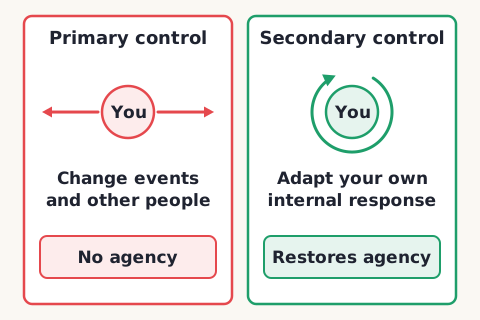
Primary vs Secondary Control
Fred Rothbaum, John Weisz, and Samuel Snyder (1982) distinguished primary control (trying to change external events and other people) from secondary control (adapting your own internal response to whatever happens). The Let Them Theory pushes people toward secondary control: when you stop trying to manipulate the world outside you and instead trust your own capacity to adapt, you restore a sense of agency that primary control can never deliver.
Stage 1: Somatic Trigger Recognition
The first stage of the practice involves detecting interoceptive physical cues—such as a racing pulse, tight shoulders, or a clenched jaw—and pausing before taking reactive action.
Stage 3: Breath and Pause
Stage 3 slows you down: take a slow breath, such as a physiological sigh (two short inhales through the nose, one long exhale through the mouth), drop the shoulders, and hold a few moments of committed silence before you speak or act.
Stage 4: Reclaim Your Bandwidth
Stage 4 completes the sequence: physically step back from the interpersonal situation and redirect your mental attention onto your own responsibilities and choices instead of the other person's. This is the moment detachment converts into usable focus.
Let Them in the Digital Panopticon
"Let Them" applies to digital life too: letting text messages sit on read, letting friends post opinions you disagree with, and letting people make plans without you, without taking any of it personally. It can ease the anxiety of being watched that comes with read receipts, location-sharing apps, and real-time status indicators.
Loving Detachment
Loving detachment is an emotionally mature state where one maintains warmth, compassion, and presence while completely relinquishing the urge to rescue, fix, or manage another person.
Cold Apathy vs Loving Detachment
Cold apathy is an ego-driven defense born of wounded pride and resentment that punishes someone through sarcasm, contempt, and the silent treatment, even meeting their mistakes with scorn ("I told you so"). Loving detachment is the opposite: it communicates directly, kindly, and calmly, offering empathetic presence without fixing, motivated by honoring the other person's sovereignty rather than punishing them. In Polyvagal Theory's terms (an influential but contested model), the first can be described as dorsal-vagal shutdown and the second as a regulated ventral-vagal state.
Radical Acceptance Isn't Endorsement
Dr. Marsha Linehan's Dialectical Behavior Therapy introduced Radical Acceptance as a core skill for reducing suffering. A related formula popularized by meditation teacher Shinzen Young -- Suffering = Pain x Resistance -- captures the same insight: pain is unavoidable, but resisting reality turns it into prolonged suffering. Saying "Let Them" is an act of this radical acceptance -- but accepting that someone is behaving irresponsibly or coldly is not the same as approving of it; it simply means you stop spending energy fighting a reality that already exists.
Emancipation from the Illusion of Control
Practicing 'Let Them' is not an act of surrender or giving in, but rather emancipating oneself from a fictional premise of control over other adults that was never possessed.

The Stoic Roots of Let Them
In the Enchiridion, Epictetus taught that only our own judgments, desires, and choices lie "within our power" (ta eph' hemin) — everyone else's actions are outside it. Marcus Aurelius wrote in Meditations (8.47) that it is our judgment about an external thing, not the thing itself, that disturbs us. Stoics called those uncontrollable externals — including other people's behavior — adiaphora: morally neutral indifferents beyond our moral agency.
The Resignation Trap
The Resignation Trap occurs when someone confuses "Let Them" with learned helplessness (Martin Seligman, 1975), using it as an excuse to tolerate abuse, mistreatment, or repeated boundary violations. "Let Them" is never a license to become a doormat — once it reveals someone's true character, the next move must be to pivot into boundary-setting action ("Let Me"), not passive endurance.
Matched pairs
Each item on the left goes with the one on the right.
- Mel's daughter (prom night)
- Interrupted her mother's anxiety and delivered the reframing that inspired the theory's name.
- Dr. Stephen Porges' Polyvagal Theory
- An influential but contested model that can cast loving detachment as ventral vagal calm and cold apathy as dorsal shutdown.
- Dr. Marsha Linehan
- Introduced Radical Acceptance as a core Dialectical Behavior Therapy (DBT) skill for reducing suffering.
Self-test
Answer each question from memory, then check your work against the answer key.
1. What is cold apathy, in contrast to loving detachment?
- AA calm, regulated ventral vagal state of emotional maturity and compassionate presence
- BAn ego-driven defense mechanism born of wounded pride and resentment that weaponizes contempt
- CA proactive boundary enforcement technique that preserves relational trust and intimacy
- DA form of learned helplessness where someone passively resigns to enduring mistreatment
2. Which communication pattern distinguishes loving detachment from cold apathy?
- AUsing sharp sarcastic humor to diminish the other person's confidence
- BDelivering aggressive ultimatums followed by immediate emotional cutoff
- CMaintaining direct, kind, transparent, and non-reactive communication
- DEmploying prolonged silent treatments and subtle passive-aggressive comments
3. What primary insight is revealed when one ceases micromanaging others and practices 'Let Them'?
- AThat the other person will now quietly conform to your original expectations
- BThat the other person now owes you an unspoken debt of gratitude
- CThat you no longer care at all about what happens to them
- DThe authentic, unforced character and choices of the other individual become clear
4. What is the underlying psychological motivation driving cold apathy?
- APunishing another person for failing to conform to internal expectations
- BEstablishing mutual relational vulnerability and deepening emotional intimacy
- CEncouraging self-reliance and autonomous problem-solving in loved ones
- DPreserving internal nervous system regulation and fostering compassionate warmth
5. According to the Stoic philosopher Epictetus in the Enchiridion, which factor lies strictly within our power?
- AThe actions, lifestyle choices, and personal opinions of other adults
- BThe physical health, genetic traits, and longevity of our bodies
- COur personal judgments, desires, impulses, and conscious choices
- DOur public reputation, career standing, and external social status
6. What event sparked the creation of The Let Them Theory?
- AOakley's rainy prom-night tacos
- BKendall's college graduation
- CA delayed book-tour flight
- DA Boston leadership conference
7. In Robbins' framework, what kind of tool is the phrase 'Let Them' meant to be?
- AA behavior-negotiation tactic
- BA passive-aggressive weapon
- CA communication cutoff excuse
- DA cognitive pattern interrupt
8. Which cognitive bias, formulated by Dr. Ellen Langer in 1975, describes the belief that one can influence outcomes governed by chance?
- AThe Retrospective Hindsight Bias
- BThe Illusion of Control Bias
- CThe Status Quo Preservation Bias
- DThe Fundamental Attribution Error
9. What does 'secondary control' mean in Rothbaum, Weisz, and Snyder's model, as applied by Let Them?
- AAdapting internally to reality
- BEnforcing strict boundaries
- CPersuading other adults to change
- DManipulating external events
10. In the four-stage pause, what action completes Stage 4 once you have disengaged from a situation you can't control?
- ADemand a sincere verbal apology
- BJournal their transgressions
- CIssue a firm ultimatum
- DRefocus on your own priorities
Go deeper
- ListenLesson 1 episode
- WatchTacos in the Rain It started with prom, rain and tacos.
- WatchNot Cold Let them does not mean you stop caring.
- ReadThe Let Them Theory by Mel Robbins, Sawyer Robbins · on Amazon ↗
- StudyThe Let Them Theory in the FlashFeed app
These are affiliate links: if you buy a book through one, FlashFeed may earn a small commission at no extra cost to you. The commission helps pay for FlashFeed's servers.
As an Amazon Associate we earn from qualifying purchases.
Answer key
- 1. B An ego-driven defense mechanism born of wounded pride and resentment that weaponizes contemptCold apathy is an ego-driven defense mechanism rooted in wounded pride and unresolved resentment, using silence and contempt as punitive weapons.
- 2. C Maintaining direct, kind, transparent, and non-reactive communicationLoving detachment uses direct, kind, transparent, and non-reactive communication, whereas cold apathy relies on punitive silence, sarcasm, and passive-aggressive withdrawal.
- 3. D The authentic, unforced character and choices of the other individual become clearThe primary function of 'Let Them' is to clear away relational fog and micromanagement so that another person's true, unforced character and choices can be seen clearly.
- 4. A Punishing another person for failing to conform to internal expectationsWhile loving detachment is motivated by honoring sovereignty and preserving peace, cold apathy is driven by a desire to punish others for failing to meet one's expectations.
- 5. C Our personal judgments, desires, impulses, and conscious choicesEpictetus defined things within our power (ta eph' hemin) as our own opinions, pursuits, desires, and choices, while external outcomes and other people's actions lie outside our control.
- 6. A Oakley's rainy prom-night tacosThe theory began, as Mel Robbins tells it, when her son Oakley and his friends planned to eat tacos in the rain before prom, not from a book tour, a conference, or a graduation.
- 7. D A cognitive pattern interrupt'Let Them' works as an immediate cognitive pattern interrupt that halts the urge to control others -- it is not a weapon, a negotiating tactic, or an excuse to cut people off.
- 8. B The Illusion of Control BiasDr. Ellen Langer coined the term Illusion of Control to describe the human tendency to overestimate personal influence over outcomes governed by chance.
- 9. A Adapting internally to realitySecondary control means adapting your own internal response to whatever happens, unlike primary control, which tries to change other people or outside events.
- 10. D Refocus on your own prioritiesStage 4 completes the sequence by physically stepping back and reallocating attention to your own responsibilities, not demanding apologies or issuing ultimatums.
Sources
- The Let Them Theory — Mel Robbins and Sawyer Robbins
- The Let Them Theory
- Ellen Langer, "The Illusion of Control" (1975)
- The Let Them Theory (Mel Robbins and Sawyer Robbins); the four-stage pause is this lesson's synthesis
- The Let Them Theory (Mel Robbins and Sawyer Robbins); the digital-panopticon application is this lesson's
- The Let Them Theory on detaching with care; the loving-detachment vs cold-apathy contrast is this lesson's synthesis
- The Let Them Theory (Mel Robbins and Sawyer Robbins) on not tolerating mistreatment; the Resignation Trap label is this lesson's
Image credits
- Primary vs Secondary Control: FlashFeed original diagram · CC-BY-4.0
- The Stoic Roots of Let Them: Wikimedia Commons · Combirom2 · CC BY-SA 4.0 — commons.wikimedia.org/wiki/File:Group_of_ancient_hellenistic_an_roan_oil_lamps.jpg
