
Man's Search for Meaning study guide · Lesson 6 of 6
Clinical Techniques, Tragic Optimism & Responsibility
Clinical Practice: Paradoxical Intention and Dereflection · The Tragic Triad, Tragic Optimism, and the Statue of Responsibility
Unofficial study guide for Man's Search for Meaning by Viktor E. Frankl. FlashFeed is not affiliated with the author or publisher.
This is the lesson's study guide from the FlashFeed app, plus its key facts and a self-test.
What you'll be able to do
- Master clinical logotherapy techniques: Paradoxical Intention for anticipatory anxiety and Dereflection for hyper-reflection.
- Explain the Tragic Triad (Pain, Guilt, Death), Tragic Optimism, the Psychiatric Credo, and the Statue of Responsibility.
Clinical Practice: Paradoxical Intention and Dereflection
The Pathological Feedback Loop of Anticipatory Anxiety
In clinical psychotherapy, Viktor Frankl observed that phobic neuroses, panic attacks, and obsessive-compulsive disorders are maintained by a vicious psychological circle driven by anticipatory anxiety (Erwartungsangst).
When a patient fears a specific symptom (such as trembling, sweating, fainting, or stammering), the very fear of the symptom produces the autonomic physiological arousal that triggers the symptom itself. This creates a self-fulfilling feedback loop:
- Anticipatory Fear: The patient fears that a symptom will occur in a social or performance setting.
- Hyper-Arousal: The fear triggers sympathetic nervous system activation (sweating, palpitations).
- Symptom Occurrence: The feared symptom actually takes place.
- Reinforced Phobia: The occurrence confirms the patient's dread, locking them into chronic anxiety.
Paradoxical Intention
To dismantle this pathogenic feedback loop, Frankl developed the clinical technique of Paradoxical Intention (paradoxe Intention).
In paradoxical intention, the patient is instructed by the logotherapist to intend, wish for, or deliberately perform the very thing they fear, utilizing the human capacity for self-detachment (Selbstdistanzierung) and humor:
- A patient suffering from severe hyperhidrosis (excessive sweating in social settings) is instructed to say to himself: "I only sweated a liter before; now I am going to sweat at least ten liters of water for everyone to see!"
- A patient suffering from chronic insomnia (who stays awake trying desperately to sleep) is instructed: "Tonight I must stay awake all night and not sleep a single second!"
By wishing for the feared symptom, the patient reverses their emotional attitude: fear is replaced by a paradoxical wish. Because the symptom requires anxiety to manifest, the paradoxical wish instantaneously cuts the ground from under the anticipatory anxiety, and the symptom dissolves.
Hyper-Reflection and Dereflection
The second major clinical technique of logotherapy is Dereflection (Derestriktion / Dereflexion), designed to treat neuroses caused by hyper-reflection (Hyperreflexion—excessive self-observation) and hyper-intention (Hyperintention—excessive striving).
Whenever an individual pays obsessive attention to an automatic, involuntary biological process, the process becomes disrupted:
- Sexual Dysfunction: Male impotence and female anorgasmia are frequently caused by hyper-intention (striving desperately to perform) and hyper-reflection (monitoring one's own bodily responses like an observer).
- Stammering / Swallowing: Paying intense conscious attention to automatic throat muscles triggers paralysis.
The Dereflection Protocol
Dereflection heals the patient by redirecting attention away from the self and the symptom toward an external object, task, or partner.
In sexual therapy, the patient is instructed to forget about performance, cease self-observation, and focus entirely on giving love and affection to the partner. By taking attention off the self, involuntary biological functions spontaneously normalize.
The Tragic Triad, Tragic Optimism, and the Statue of Responsibility
The Tragic Triad of Human Existence
In the celebrated 1984 Postscript to Man's Search for Meaning, Viktor Frankl synthesized his mature existential philosophy into the concept of the Tragic Triad (die tragische Trias).
The Tragic Triad encompasses the three tragic facets of human existence that no human being can escape:
- Pain (Schmerz / unavoidable suffering).
- Guilt (Schuld / the awareness of moral fallibility and human imperfection).
- Death (Tod / the radical transitoriness and mortality of existence).
Tragic Optimism: Saying Yes to Life in Spite of Everything
Frankl asked: How is it possible to maintain hope and say yes to life in the face of the Tragic Triad?
His answer was the practice of Tragic Optimism (tragischer Optimismus)—an optimism in the teeth of tragedy that presupposes that life is unconditionally meaningful under all circumstances. Tragic optimism achieves a threefold transformation of the Tragic Triad:
- Transforming Pain into Human Achievement: Converting suffering into heroic endurance and moral growth.
- Transforming Guilt into Positive Change: Utilizing moral remorse as the catalyst for self-improvement and ethical reform.
- Transforming Death into an Incentive for Action: Recognizing that the transitoriness of life makes every moment precious, transforming mortality into an urgent incentive for responsible action.
The Granary of the Past
Frankl attacked the popular illusion that transitoriness makes life meaningless. Pessimists view the passing of time like someone watching their calendar leaves grow fewer each day.
The tragic optimist, however, is like someone who tears off each leaf, writes a diary entry upon it, and files it neatly away. Nothing in the past is lost forever; everything is irrevocably stored in the granary of the past (in die Scheunen der Vergangenheit). Having been (Gewesen-sein) is the surest form of being; past realities can never be undone.
The Psychiatric Credo
Frankl formulated his foundational clinical manifesto—the Psychiatric Credo (das psychiatrische Kredo): Frankl held that a person who is psychotically ill does not lose his dignity as a human being: the human spirit (der geistige Kern) remains intact behind the veil of psychiatric psychosis.
Even in cases of severe psychosis, Alzheimer's dementia, or catastrophic brain trauma, the innermost spiritual core of the human being remains indestructible, possessing unconditional dignity.
The Statue of Responsibility on the West Coast
Frankl concluded his message to the modern world with an urgent civic and ethical plea:
"Freedom is in danger of degenerating into mere arbitrariness unless it is lived in terms of responsibleness. That is why I recommend that the Statue of Liberty on the East Coast be supplemented by a Statue of Responsibility on the West Coast."
Freedom without responsibility is empty license. True human maturity requires balancing liberty with accountability to truth, conscience, and our fellow human beings.
Key terms
- Paradoxical Intention
- The clinical logotherapy technique where a patient is instructed to deliberately wish for or intend the exact symptom or event they dread.
- Dereflection
- The therapeutic technique of deliberately shifting conscious attention away from oneself and neurotic symptoms toward an external task, cause, or partner.
- Tragic Optimism
- The philosophical posture of maintaining genuine hope and affirming the unconditional meaning of life in spite of the Tragic Triad of pain, guilt, and death.
Key facts
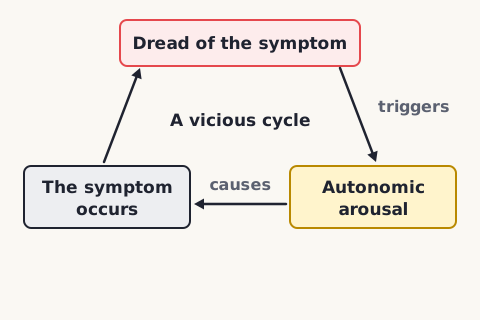
Anticipatory Anxiety Feedback Loop
The vicious psychological cycle where the dread of experiencing a neurotic symptom triggers the autonomic arousal that causes the symptom to occur.
Paradoxical Intention: Wishing for the Fear
Frankl's clinical technique Paradoxical Intention breaks a phobia's feedback loop by having the patient deliberately wish for or intend the very thing they dread, using humor and self-detachment — the distinct human capacity to step outside oneself and laugh at one's own symptoms. Because fear is what fuels the symptom, the paradoxical wish itself unravels it.
Paradoxical Intention in Practice
Frankl gave patients concrete scripts. A man terrified of sweating in public was told to say to himself, "I only sweated a liter before; now I am going to sweat at least ten liters of water for everyone to see!" A chronic insomniac was instructed to try as hard as possible to stay awake all night, and the anxiety-driven barrier to sleep dissolved almost immediately.
Hyper-Reflection and Hyper-Intention
Frankl named two related traps: hyper-reflection, excessive, compulsive self-observation, and hyper-intention, excessive striving that ends up sabotaging the very involuntary reflex it's aimed at. Both work by disrupting automatic biological processes that function best left alone.
Dereflection: Redirecting Attention Outward
Dereflection treats problems caused by hyper-reflection by deliberately shifting attention away from oneself and one's symptoms toward an external task, cause, or partner. In sexual dysfunctions like impotence, this means dropping performance-monitoring and focusing on the partner instead; the same self-monitoring habit, aimed at speech, disrupts automatic muscle coordination and worsens stammering.
A CBT Precursor
Historians of psychotherapy have noted that Frankl practiced paradoxical intention as early as 1929 and first described it in a 1939 publication, anticipating strategies later used in Cognitive Behavioral Therapy (CBT) — though scholars distinguish its mechanism (having the patient amplify the dreaded symptom) from classic exposure therapy's habituation model.
Symptom Relief in Service of Meaning
Logotherapy's clinical techniques aren't just about erasing symptoms for their own sake. Frankl used tools like paradoxical intention specifically to clear away neurotic symptoms so that a patient could get back to pursuing what actually mattered: the deeper, ongoing search for meaning in their life.
The Paradoxical Intention Protocol
Applying paradoxical intention clinically follows a sequence: identify the patient's specific phobic fear and what triggers their anticipatory anxiety, encourage self-detachment and a humorous reframing of the fear, have the patient boldly wish for and even exaggerate the dreaded symptom, then watch the autonomic fear-loop collapse as the anxiety dissolves.
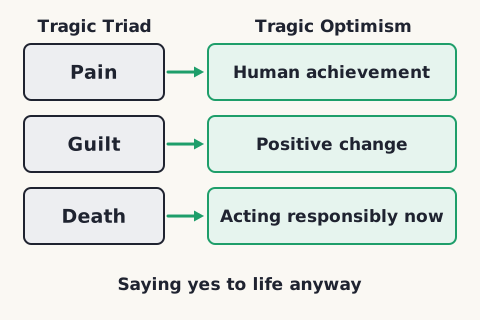
The Tragic Triad and Tragic Optimism
Frankl named three facts no human being escapes — pain, guilt, and death — the Tragic Triad. Tragic Optimism means saying yes to life anyway: turning pain into human achievement, guilt into fuel for positive change, and the transience of death into an urgent incentive to act responsibly now.
The Granary of the Past
Frankl's metaphor asserting that everything an individual accomplishes, loves, and bravely suffers is permanently preserved in the past, safe from destruction.
The Psychiatric Credo
Frankl's foundational clinical principle: "A man who is psychotically ill does not lose his dignity as a human being." Even in severe psychosis or catastrophic brain trauma, he held, the innermost human spirit remains intact and indestructible, entitled to unconditional dignity.

The Statue of Responsibility
Frankl closed his message to the modern world with a proposal: since "freedom is in danger of degenerating into mere arbitrariness unless it is lived in terms of responsibleness," he recommended that the Statue of Liberty on the East Coast be balanced by a Statue of Responsibility on the West Coast — freedom is empty license without accountability.
Optimism Cannot Be Commanded
Frankl rejected the idea that hope can simply be willed into existence through positive thinking alone. Genuine optimism, he argued, cannot be commanded — it has to be grounded in an actual, concrete reason to be optimistic, or it's just synthetic and hollow.
The Tragic Optimism Protocol
Frankl's practice for cultivating tragic optimism: confront pain, guilt, and mortality honestly rather than denying them, reframe unavoidable suffering as a chance for heroic achievement, turn moral guilt into active fuel for ethical improvement, and treat life's transience as an urgent incentive for responsible action now.
Auschwitz and the Two Sides of Man
Frankl concluded that man is the being who invented the gas chambers of Auschwitz, but he is also the being who entered those gas chambers upright, with the Lord's Prayer or the Shema Yisrael on his lips.
The Book's Central Thesis
Across memoir and clinical theory alike, Man's Search for Meaning argues one central claim: human existence carries unconditional meaning under every conceivable condition. Frankl demonstrated it three ways — meaning found through work, through love, and through the very unavoidable suffering that might otherwise seem to make life meaningless.
Matched pairs
Each item on the left goes with the one on the right.
- Hyper-Reflection
- Excessive Compulsive Self-Observation
- Hyper-Intention
- Excessive Striving That Sabotages Involuntary Reflexes
- Pain (Tragic Triad)
- Transformation into Human Achievement
- Guilt (Tragic Triad)
- Transformation into Positive Moral Change
- Death (Tragic Triad)
- Transformation into an Incentive for Responsible Action
Step by step
Clinical Paradoxical Intention Protocol
- Identify the patient's primary phobic fear and its anticipatory anxiety triggers.
- Encourage the patient to utilize self-detachment and formulate a humorous perspective.
- Instruct the patient to boldly wish for and intentionally exaggerate the feared symptom.
- Observe the immediate collapse of the autonomic symptom loop as fear dissolves.
Cultivating Tragic Optimism Protocol
- Confront the reality of pain, guilt, and mortality without denial.
- Reframe unavoidable suffering into an opportunity for heroic achievement.
- Convert moral guilt into an active catalyst for positive ethical reform.
- Treat the transitoriness of life as an urgent incentive for responsible action.
Self-test
Answer each question from memory, then check your work against the answer key.
1. What human capacities are primarily mobilized during the execution of paradoxical intention?
- AUnquestioning obedience to external psychiatric commands within society
- BExtreme athletic exhaustion and deliberate caloric starvation
- CThe capacity for humor and self-detachment from neurotic fears
- DDeep hypnotic regression and suppressed childhood trauma recall
2. How does dereflection successfully treat sexual dysfunctions such as impotence or frigidity?
- ABy shifting focus away from performance anxiety to loving the partner
- BBy enforcing mandatory six-month periods of total marital celibacy in everyday life
- CBy requiring patients to log detailed performance stopwatch charts in everyday life
- DBy administering daily synthetic testosterone chemical injections in everyday life
3. What term names the cycle where fearing a symptom triggers the arousal that produces it?
- AHyper-intention
- BHyper-reflection
- CDereflection
- DAnticipatory anxiety
4. Frankl told a chronic insomniac to deliberately try to stay awake all night. Which technique is this?
- ADereflection
- BParadoxical intention
- CHyper-intention
- DHyper-reflection
5. Which pair of problems does Dereflection target, as opposed to the anticipatory-anxiety cycle Paradoxical Intention treats?
- AAnticipatory fear and hyper-arousal
- BHyper-reflection and hyper-intention
- CSymptom occurrence and reinforced phobia
- DHyper-arousal and reinforced phobia
6. What core clinical principle is declared in Viktor Frankl's 'Psychiatric Credo'?
- AA psychotically ill person never loses their spiritual dignity or humanity
- BPatients with psychosis must be permanently segregated from civil society
- CAll mental disorders stem strictly from inherited genetic cellular
- DSevere cognitive dementia completely extinguishes the human soul forever
7. What three unavoidable facets of existence make up Frankl's Tragic Triad?
- ALoneliness, failure, and grief
- BFear, anger, and despair
- CPoverty, illness, and war
- DPain, guilt, and death
8. Frankl proposed a Statue of Responsibility to balance which existing landmark?
- ALincoln Memorial
- BGolden Gate Bridge
- CStatue of Liberty
- DWashington Monument
9. Which of these is NOT one of Tragic Optimism's three transformations of the Tragic Triad?
- APain into human achievement
- BGuilt into positive change
- CFear into courage
- DDeath into incentive for action
10. In Frankl's 'Granary of the Past' metaphor, what happens to a person's past experiences?
- AThey are converted into physical monuments
- BThey are irrevocably stored and preserved forever
- CThey fade completely and become meaningless
- DThey must be forgotten to move forward
11. Per Frankl's Psychiatric Credo, what remains intact even in severe psychosis or dementia?
- AThe full range of voluntary muscle coordination
- BThe patient's full rational intelligence and capacity for reasoning
- CThe patient's memory of prior traumatic events
- DThe human spirit's innermost core and dignity
12. What name did Frankl give to his manifesto on dignity surviving mental illness?
- AThe Psychiatric Credo
- BThe Statue of Responsibility
- CThe Tragic Triad
- DThe Granary of the Past
Go deeper
- ReadMan's Search for Meaning by Viktor E. Frankl · on Amazon ↗
- StudyMan's Search for Meaning in the FlashFeed app
These are affiliate links: if you buy a book through one, FlashFeed may earn a small commission at no extra cost to you. The commission helps pay for FlashFeed's servers.
As an Amazon Associate we earn from qualifying purchases.
Answer key
- 1. C The capacity for humor and self-detachment from neurotic fears
- 2. A By shifting focus away from performance anxiety to loving the partner
- 3. D Anticipatory anxietyAnticipatory anxiety is the fear-driven cycle Frankl described; hyper-reflection and hyper-intention involve self-monitoring or striving, and dereflection is a treatment, not the cycle itself.
- 4. B Paradoxical intentionWishing for the feared outcome (staying awake) is paradoxical intention; dereflection redirects attention outward, while hyper-reflection and hyper-intention are the problems it treats, not techniques.
- 5. B Hyper-reflection and hyper-intentionDereflection specifically treats hyper-reflection and hyper-intention (excessive self-monitoring and striving); the other pairs are stages of the anticipatory-anxiety feedback loop that paradoxical intention addresses instead.
- 6. A A psychotically ill person never loses their spiritual dignity or humanity
- 7. D Pain, guilt, and deathFrankl's Tragic Triad names pain, guilt, and death as the three tragic facets of existence no human being can escape.
- 8. C Statue of LibertyFrankl said the Statue of Liberty on the East Coast should be supplemented by a Statue of Responsibility on the West Coast, balancing freedom with accountability.
- 9. C Fear into courageTragic Optimism transforms pain into achievement, guilt into positive change, and death into an incentive for action; fear-into-courage is not one of the three.
- 10. B They are irrevocably stored and preserved foreverLike diary entries filed away in a granary, Frankl held that past experiences are irrevocably preserved; having-been is the surest form of being.
- 11. D The human spirit's innermost core and dignityThe Psychiatric Credo holds that the innermost human spirit and its dignity survive even severe mental illness.
- 12. A The Psychiatric CredoFrankl called this foundational clinical manifesto the Psychiatric Credo.
Sources
- Man's Search for Meaning — Viktor E. Frankl
- Part Two: Logotherapy in a Nutshell
- Postscript 1984: The Case for a Tragic Optimism
Image credits
- Anticipatory Anxiety Feedback Loop: FlashFeed original diagram · CC-BY-4.0
- The Tragic Triad and Tragic Optimism: FlashFeed original diagram · CC-BY-4.0
- The Statue of Responsibility: Wikimedia Commons · AskALotl · CC0 — commons.wikimedia.org/wiki/File:Front_view_of_Statue_of_Liberty_(cropped).jpg
