
Man's Search for Meaning study guide · Lesson 5 of 6
The Three Avenues of Meaning & Attitudinal Values
Creative and Experiential Values: Creation, Beauty, and Love · Attitudinal Values: The Meaning of Suffering and Dignity
Unofficial study guide for Man's Search for Meaning by Viktor E. Frankl. FlashFeed is not affiliated with the author or publisher.
This is the lesson's study guide from the FlashFeed app, plus its key facts and a self-test.
What you'll be able to do
- Apply the Categorical Imperative of Logotherapy and explain creative values (work) and experiential values (love/art).
- Master attitudinal values: discovering meaning in unavoidable suffering, transforming tragedy into human achievement, and dignity.
Creative and Experiential Values: Creation, Beauty, and Love
The Categorical Imperative of Logotherapy
Viktor Frankl formulated the foundational ethical motto of his system—the Categorical Imperative of Logotherapy:
"Live as if you were living already for the second time and as if you had acted the first time as wrongly as you are about to act now!"
This imperative confronts the individual with the radical responsibility (Verantwortlichkeit) and transitoriness (Vergänglichkeit) of existence:
- It invites a person to imagine the present moment as the past.
- It invites them to imagine that their past actions were flawed, and that they now possess the miraculous second chance to correct their mistake.
- This thought experiment instantly instills deep mindfulness and moral gravity into every decision.
Life Questioning Man: The Copernican Turn
In classical philosophy, humans constantly ask: "What is the meaning of life?" Frankl reversed this question in a profound Copernican turn:
- Man should not ask what the meaning of his life is.
- Rather, he must recognize that it is he who is being asked.
- In life, every individual is questioned by life; and they can only answer to life by answering for their own life—by being responsible.
Meaning is not an abstract, universal formula like the best chess move in the world; there is no universal best move independent of a specific board position. Meaning is always concrete, unique, and situational (konkreter Sinn).
The Three Avenues to Meaning
Frankl identified three distinct, universal avenues through which human beings can discover and actualize meaning in life:
- Creative Values (schöpferische Werte).
- Experiential Values (Erlebniswerte).
- Attitudinal Values (Einstellungswerte).
1. Creative Values: Creation and Action
Creative values are realized through creating a work or doing a deed. This includes:
- Artistic creation (painting, writing, composing, sculpting).
- Scientific and intellectual innovation.
- Craftsmanship, engineering, and productive labor.
- Dedication to professional service and social contributions.
The value of work lies not in its prestige or financial compensation, but in the personal attitude and uniqueness that an individual infuses into their task.
2. Experiential Values: Truth, Nature, and Love
Experiential values are realized by experiencing something—such as truth, goodness, and beauty through nature or culture—or by encountering someone through love (Liebe).
In logotherapy, love is not viewed as a biological drive or an emotional illusion. Love is the direct, intuitive grasp of the innermost uniqueness and potential of another human being. By loving someone:
- The lover perceives the essential spiritual traits and hidden possibilities of the beloved.
- By enabling the beloved to see their own potential, the lover empowers them to actualize their highest self.
Attitudinal Values: The Meaning of Suffering and Dignity
The Supreme Rank of Attitudinal Values
When an individual is confronted with an unchangeable fate—such as an incurable disease, inoperable cancer, or imprisonment in a concentration camp—the possibilities for creative work and experiential enjoyment are stripped away. Yet, it is precisely in this crucible of helplessness that the highest and most profound avenue to meaning opens: Attitudinal Values (Einstellungswerte).
Attitudinal values are realized by the attitude a person takes toward unavoidable, unchangeable suffering. Frankl asserted that suffering challenges a human being to achieve the highest possible moral victory:
"In some way, suffering ceases to be suffering at the moment it finds a meaning, such as the meaning of a sacrifice."
The Case of the Bereaved General Practitioner
To illustrate the clinical application of attitudinal meaning, Frankl recounted a famous case from his psychiatric practice in Vienna. An elderly general practitioner visited Frankl in the depths of severe, suicidal depression following the death of his beloved wife, whom he had loved more than anything in the world.
Instead of offering generic condolences or psychoanalyzing the doctor's childhood, Frankl asked him a single, piercing question:
"What would have happened, Doctor, if you had died first, and your wife had survived you?"
The elderly doctor was horrified and replied: "Oh, for her this would have been terrible; how she would have suffered!"
Frankl then gently pointed out the profound truth:
"You see, Doctor, such a suffering has been spared her, and it was you who have spared her this suffering—to be sure, at the price that now you have to survive and mourn her."
The doctor did not say a word. He shook Frankl's hand warmly and calmly walked out of the clinic. His suffering had not been removed, but it had been given meaning as a sacrifice of love, instantly transforming his despair into heroic endurance.
Unavoidable vs. Avoidable Suffering
Frankl established a vital ethical distinction regarding suffering:
- Avoidable Suffering: If suffering can be prevented or removed (such as curing a treatable disease or eliminating social injustice), the meaningful task is to remove the cause of suffering. To endure avoidable suffering when a solution exists is not heroic; it is masochism.
- Unavoidable Suffering: Only when a person is confronted with an unalterable fate does attitudinal meaning apply—transforming a personal tragedy into a human triumph.
Human Dignity in Extreme Helplessness
Even a paralyzed patient on their deathbed retains unconditional human dignity. Frankl cited cases of patients who, facing imminent death, comforted their grieving relatives and demonstrated radiant inner peace. Life never ceases to hold meaning up to its very last breath.
Key terms
- Logotherapeutic Love
- The intuitive capacity to perceive the innermost spiritual uniqueness and latent potential of another human being.
- Non-Utilitarian Meaning
- The principle that the value of human suffering cannot be measured by economic productivity, but by the spiritual dignity with which it is borne.
Key facts
The Categorical Imperative and Responsibleness
Frankl's ethical motto: "Live as if you were living already for the second time and as if you had acted the first time as wrongly as you are about to act now!" This thought experiment forces mindfulness onto every decision, reflecting what Frankl called the very essence of human existence: responsibleness, the duty to answer life's unique, concrete demands.
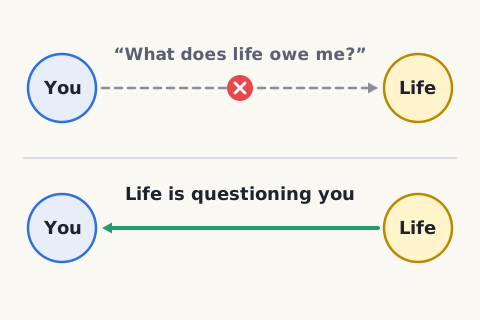
The Copernican Turn in Meaning
Frankl's fundamental philosophical inversion stating that humans should not ask what life owes them, but recognize that life is questioning them.
Meaning Like a Chess Move
Frankl compared the search for life's meaning to a chess grandmaster's next move: there's no single, universal best move independent of the actual board position. In the same way, meaning is never an abstract formula — it's always concrete, unique, and situational, depending entirely on a person's specific, unfolding circumstances.
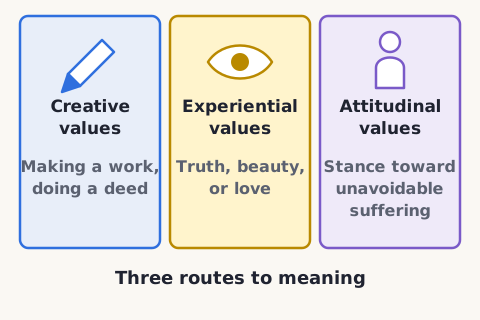
The Three Avenues to Meaning
Frankl identified three universal routes to meaning: Creative Values, realized by making a work or doing a deed; Experiential Values, realized by experiencing truth, beauty, or love; and Attitudinal Values, realized by one's stance toward unavoidable suffering. Creative values involve actively giving to life, while experiential values involve receptively taking life in.
Love: Perceiving Another's Hidden Potential
In logotherapy, love isn't a biological drive or emotional illusion — it's the intuitive grasp of another person's innermost spiritual uniqueness and potential, seen through and past their surface traits. By perceiving what someone could become, a lover helps that person actually grow into it.
The Dignity of Any Honest Work
Frankl insisted that creative meaning isn't reserved for prestigious careers like medicine or academia. Any honest labor, no matter how humble, can carry creative meaning — what matters is the personal dedication and responsibility a worker brings to the task, not the job's status or pay.
Each Life: An Unrepeatable Task
Frankl insisted that everyone has a specific, unrepeatable mission in life: "Everyone has his own specific vocation or mission in life... Therein he cannot be replaced, nor can his life be repeated." No one else can carry out your particular task, just as no one else can live your specific story.
A Practice for Experiential Meaning
To unlock experiential meaning day to day, Frankl's approach comes down to a simple practice: pause the habit of multitasking, meet nature, music, or art with full receptive attention, look at a loved one with real appreciation for who they are, and recognize that a moment of transcendent awe is valuable on its own.
Attitudinal Values: Dominion Over Response
When creative work and experiential enjoyment are stripped away by an unchangeable fate, Frankl said, the highest avenue to meaning opens: attitudinal values, realized purely through the attitude one takes toward unavoidable suffering. Even in total helplessness, a person is never a fully helpless victim, because they always retain dominion over that one response.
Transformation of Suffering
Frankl's core axiom that suffering ceases to be destructive anguish the moment it acquires meaning, such as a sacrifice of love.
The Bereaved Doctor: Grief as Sacrifice
An elderly doctor came to Frankl in suicidal despair after his wife's death. Frankl asked one question: "What would have happened, Doctor, if you had died first, and your wife had survived you?" Realizing his own survival had spared her that grief, the doctor's despair lifted immediately — his suffering hadn't been removed, but reframed as a sacrifice of love.
Avoidable Suffering: Remove, Don't Endure
Frankl drew a hard line between two kinds of suffering: if it's avoidable — a treatable illness, a fixable injustice — the meaningful task is to remove its cause; enduring it anyway isn't heroic, it's masochism. Only unavoidable, unalterable suffering opens the door to attitudinal meaning, where a noble response can turn tragedy into triumph.
Unconditional Meaning to the Last Breath
Logotherapy's core tenet: human life retains unconditional meaning under every circumstance, all the way to a person's very last breath. Even a paralyzed, dying patient, Frankl observed, can retain full human dignity — some comforted grieving relatives from their own deathbed, radiating inner peace to the end.
Heroism in Adversity
Unavoidable suffering offers man his greatest opportunity to fulfill the highest value: demonstrating moral courage and turning tragic fate into human triumph.
The Logotherapist as an Eye Doctor
Frankl described the logotherapist's role with an analogy: like an eye doctor who doesn't paint a picture for a patient but widens their own field of vision so they can see the world clearly, the logotherapist doesn't hand a patient a ready-made meaning — he helps them see the meaning already present in their own life.
The Attitudinal Reframing Protocol
Frankl's method for facing unavoidable hardship: acknowledge that the suffering is genuinely unchangeable, refuse to collapse into passive despair or futile rage, search out any moral meaning or sacrifice embedded in it, and adopt a dignified, courageous stance that can even comfort the people around you.
Non-Utilitarian Meaning
Frankl insisted human suffering can't be measured by economic productivity or usefulness. Its value lies instead in the spiritual dignity with which a person bears it — a principle that protects the meaning of lives society might otherwise dismiss as unproductive.
Frankl's Despair Equation
Frankl expressed the psychology of despair as a simple equation: Despair = Suffering minus Meaning (D = S − M). Suffering alone doesn't create despair; it's suffering stripped of any meaning that does. Add meaning back in, and even severe suffering becomes bearable.
Suffering Is Not Required for Meaning
Frankl clarified a point often misunderstood about his work: suffering is not necessary to find meaning. His claim is narrower and more hopeful — meaning remains possible even in the presence of suffering, not that suffering must be sought out or is required to have a meaningful life.
Matched pairs
Each item on the left goes with the one on the right.
- Creative Values
- Fulfillment Through Creating Works and Deeds
- Experiential Values
- Fulfillment Through Nature, Art, and Love
- Logotherapist's Role
- An Eye Doctor Widening the Patient's Vision
Step by step
Unlocking Experiential Meaning in Daily Life
- Pause habitual multitasking to focus conscious attention on the present moment.
- Encounter nature, music, or art with receptive aesthetic mindfulness.
- Gaze upon the beloved person with deep appreciation for their unique essence.
- Acknowledge the self-sufficient value of transcendent experiential awe.
Attitudinal Reframing Protocol
- Acknowledge that external suffering is completely unavoidable and unchangeable.
- Refuse to surrender to passive despair or futile rage against fate.
- Identify the potential moral meaning or sacrifice embedded in the hardship.
- Adopt a dignified, courageous posture that uplifts and comforts others.
Self-test
Answer each question from memory, then check your work against the answer key.
1. What ethical maxim forms the Categorical Imperative of Logotherapy formulated by Viktor Frankl?
- ALive as if you were living already for the second time and had acted wrongly the first time
- BLive to maximize sensual pleasure in the present without regret and throughout all human interactions
- CStrive to dominate external political institutions through willpower and throughout all human interactions
- DSave every material resource to insulate against future economic crises and throughout all human interactions
2. How does authentic love empower the beloved person to grow, according to Frankl?
- ABy imposing strict behavioral guidelines to correct character faults within society
- BBy isolating them from external social influences and peers within society
- CBy revealing their latent potential and inspiring them to actualize it
- DBy providing unconditional financial trust funds and material assets
3. How do creative values and experiential values complement each other in human fulfillment?
- AThey are mutually exclusive drives that perpetually compete for mental energy and throughout all human interactions
- BCreative values involve active giving to life, while experiential values involve receptive taking in
- CThey are identical neurochemical reactions produced by dopamine surges and throughout all human interactions
- DThey are temporary coping fantasies that vanish when physical hardship strikes and throughout all human interactions
4. According to Frankl, what makes work carry creative meaning, regardless of job status?
- AThe number of academic degrees required
- BThe job's prestige and salary
- CThe size of the employing organization
- DPersonal dedication brought to the task
5. Which three avenues to meaning are identified in Frankl's logotherapeutic framework?
- ACreative values, experiential values, and attitudinal values
- BAbraham Maslow's hierarchy of physiological, safety, and belonging needs
- CFinancial wealth, political power, and public social status within society
- DBiological instincts, unconscious drives, and physical pleasures
6. How did Viktor Frankl successfully counsel the suicidal elderly doctor grieving his deceased wife?
- ABy urging him to marry immediately to replace his lost marital companionship within society
- BBy prescribing heavy barbiturate sedatives to induce prolonged artificial sleep within society
- CBy using clinical hypnosis to erase all conscious memories of his deceased
- DBy reframing his mourning as a loving sacrifice that spared his wife that agony
7. What is the ultimate accomplishment enabled by the realization of attitudinal values?
- AAchieving everlasting worldwide fame and being remembered by history forever
- BSecuring guaranteed corporate monopolies across international markets
- CTransforming unavoidable personal tragedy into a noble human achievement
- DAttaining supreme judicial and military authority over provincial governments
8. What is the meaningful response to AVOIDABLE suffering, per Frankl?
- AEndure it stoically as a spiritual test
- BRemove the cause of the suffering
- CSearch for hidden meaning within it
- DReframe it as a sacrifice of love
9. Which equation captures Frankl's psychology of despair?
- ADespair equals Suffering minus Meaning
- BDespair equals Suffering plus Meaning
- CDespair equals Suffering minus Hope
- DDespair equals Suffering divided by Time
10. Which is NOT part of Frankl's protocol for facing unavoidable suffering?
- AAcknowledge the suffering is unchangeable
- BSuppress and deny the pain until it fades
- CAdopt a dignified, courageous stance
- DSearch for moral meaning within it
Go deeper
- ReadMan's Search for Meaning by Viktor E. Frankl · on Amazon ↗
- StudyMan's Search for Meaning in the FlashFeed app
These are affiliate links: if you buy a book through one, FlashFeed may earn a small commission at no extra cost to you. The commission helps pay for FlashFeed's servers.
As an Amazon Associate we earn from qualifying purchases.
Answer key
- 1. A Live as if you were living already for the second time and had acted wrongly the first time
- 2. C By revealing their latent potential and inspiring them to actualize it
- 3. B Creative values involve active giving to life, while experiential values involve receptive taking in
- 4. D Personal dedication brought to the taskFrankl held that creative meaning comes from the personal dedication and attitude a worker brings to a task, not its prestige, pay, or scale.
- 5. A Creative values, experiential values, and attitudinal values
- 6. D By reframing his mourning as a loving sacrifice that spared his wife that agony
- 7. C Transforming unavoidable personal tragedy into a noble human achievement
- 8. B Remove the cause of the sufferingFrankl taught that avoidable suffering, like a treatable illness, should be removed, not endured — enduring it anyway is masochism, not heroism.
- 9. A Despair equals Suffering minus MeaningFrankl's formula (D = S minus M) shows suffering alone doesn't cause despair; it's suffering stripped of meaning that does.
- 10. B Suppress and deny the pain until it fadesFrankl's protocol calls for facing suffering honestly and finding meaning in it, not suppressing or denying the pain, which avoids rather than transforms it.
Sources
- Man's Search for Meaning — Viktor E. Frankl
- Part Two: Logotherapy in a Nutshell
- Part One: Experiences in a Concentration Camp
Image credits
- The Copernican Turn in Meaning: FlashFeed original diagram · CC-BY-4.0
- The Three Avenues to Meaning: FlashFeed original diagram · CC-BY-4.0