
Man's Search for Meaning study guide · Lesson 4 of 6
Foundations of Logotherapy & The Will to Meaning
The Will to Meaning vs. Pleasure and Power, Noögenic Neuroses · Noö-Dynamics, The Existential Vacuum, and Sunday Neurosis
Unofficial study guide for Man's Search for Meaning by Viktor E. Frankl. FlashFeed is not affiliated with the author or publisher.
This is the lesson's study guide from the FlashFeed app, plus its key facts and a self-test.
What you'll be able to do
- Distinguish the Will to Meaning from Freud's Will to Pleasure and Adler's Will to Power, and define noögenic neuroses.
- Explain noö-dynamics, the existential vacuum, Sunday neurosis, and societal pathologies of conformism and totalitarianism.
The Will to Meaning vs. Pleasure and Power, Noögenic Neuroses
The Third Viennese School of Psychotherapy
Viktor Frankl founded Logotherapy (Logotherapie), universally recognized in clinical psychiatry as the Third Viennese School of Psychotherapy, succeeding the foundational movements of his predecessors:
- First Viennese School (Sigmund Freud): Centered on Psychoanalysis and the Will to Pleasure (Lustprinzip), viewing human behavior as driven by unconscious sexual and instinctual drives seeking gratification.
- Second Viennese School (Alfred Adler): Centered on Individual Psychology and the Will to Power (Geltungstrieb), viewing human motivation as striving for superiority and overcoming inferiority complexes.
- Third Viennese School (Viktor Frankl): Centered on Logotherapy and the Will to Meaning (Wille zum Sinn), viewing man's primary motivational force as the deep, intrinsic striving to find and fulfill a concrete purpose in life.
The term Logotherapy derives from the Greek word logos (λόγος), which signifies both "meaning" and "spirit". Logotherapy focuses on the future—on the meanings to be fulfilled by the patient in their future life.
The Will to Meaning as Primary Human Drive
Frankl argued that the search for meaning is not a secondary rationalization of instinctual impulses, nor is it a defense mechanism. It is the primary motivation in human life.
When the Will to Pleasure is pursued directly (hedonism), it defeats itself; pleasure is a natural byproduct or side-effect of fulfilling a meaning, never a goal in itself. Similarly, power is a means to an end, and wealth is a tool; neither can provide ultimate existential satisfaction.
Existential Frustration and Noögenic Neuroses
When a person's striving for meaning is blocked or thwarted, they fall into a state of existential frustration (existentielle Frustration). This condition can lead to a distinct category of neuroses that Frankl classified as noögenic neuroses (noogene Neurosen).
In clinical diagnosis, Frankl drew a sharp distinction:
- Psychogenic Neuroses: Neuroses originating from psychological complexes, instinctual conflicts, and repressed childhood traumas (the domain of traditional psychoanalysis).
- Somatogenic Neuroses: Disorders originating from physical or neurochemical dysfunctions in the central nervous system.
- Noögenic Neuroses: Psychological distress and neuroses originating in the noëtic (spiritual/existential) dimension of human existence—arising from existential crises, moral conflicts, and the feeling of utter meaninglessness.
Frankl emphasized that existential despair is not a disease; it is a sign of spiritual maturity and authentic human awareness.
Self-Transcendence of Human Existence
A cornerstone of logotherapy is the principle of self-transcendence (Selbsttranszendenz). Human existence always points beyond itself toward something or someone other than the self:
- Toward a meaning to be fulfilled (a work, a cause, a creation).
- Toward another human being to be encountered through love.
The more an individual forgets themselves—by giving themselves to a cause or loving another person—the more human they become and the more fully they actualize themselves.
Noö-Dynamics, The Existential Vacuum, and Sunday Neurosis
The Fallacy of Mental Homeostasis
A pervasive error in twentieth-century mental health models was the belief that psychological well-being requires a tensionless state—known in biology and psychoanalysis as homeostasis (psychological equilibrium).
Viktor Frankl radically rejected this premise. He argued that mental health does not require equilibrium or the complete absence of tension. On the contrary, human beings require a healthy, dynamic tension between who they are in the present and what they ought to become in the future:
"What man actually needs is not a tensionless state but rather the striving and struggling for a worthwhile goal, a freely chosen task."
The Principle of Noö-Dynamics
Frankl formulated the concept of noö-dynamics (Noo-Dynamik): the existential polar tension within the spiritual dimension between:
- The subject (the individual in their current state of being).
- The objective meaning (the task or goal waiting to be fulfilled).
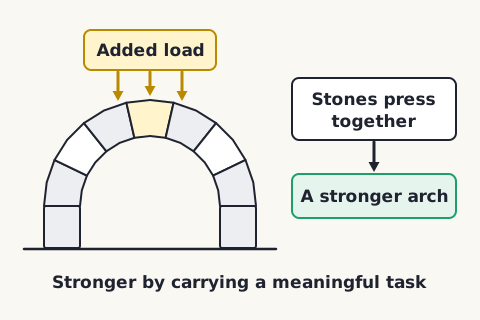
Frankl illustrated this with an architectural metaphor: if an architect wishes to strengthen a decrepit arch that is threatening to collapse, they do not remove weight; they increase the load placed upon it. By bearing weight, the stones arch tightly together and achieve structural stability. Similarly, placing a meaningful responsibility upon a struggling person strengthens their mental resilience.
The Existential Vacuum
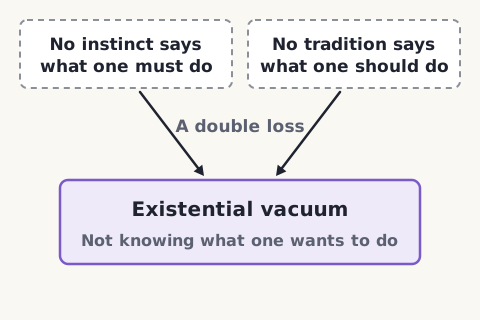
The twentieth century witnessed the emergence of a widespread cultural crisis that Frankl termed the existential vacuum (existentielles Vakuum). This condition of profound inner emptiness, boredom, and meaninglessness resulted from a double loss in human history:
- Loss of Animal Instincts: Unlike animals, man has no instinctual programming dictating what he must do.
- Loss of Traditions: Unlike pre-modern humans, modern man no longer has unquestioned traditions telling him what he should do.
Lacking both instincts and traditions, modern man frequently does not know what he wants to do. This vacuum leads to two major societal pathologies:
- Conformism: Doing what everybody else does (the mass pathology of the West).
- Totalitarianism: Doing what other people dictate (the mass pathology of the East).
Sunday Neurosis and Compensatory Drives
The existential vacuum becomes painfully acute during periods of unstructured leisure, giving rise to Sunday neurosis (Sonntagsneurose). During the busy workweek, the routine of employment distracts individuals from their inner void. When Sunday arrives and the rush of work halts, the lack of underlying content in their lives rises to conscious awareness, resulting in depression, anxiety, and dread.
When the Will to Meaning is frustrated by the existential vacuum, individuals seek compensatory substitutes:
- The Will to Power: Manifesting as financial greed, aggressive status-seeking, and workaholism.
- The Will to Pleasure: Manifesting as compulsive sexual escapism, substance abuse, and consumerist entertainment.
Key terms
- Logos
- The ancient Greek word signifying 'meaning' and 'spirit', adopted by Viktor Frankl to define meaning-centered psychotherapy.
- Existential Vacuum
- A widespread state of profound inner emptiness, boredom, and meaninglessness resulting from the loss of traditional values and instinctual guidance.
Key facts
The Third Viennese School and 'Logos'
Frankl's Logotherapy is known in psychiatric history as the Third Viennese School of Psychotherapy, following Freud's and Adler's schools. The name comes from the Greek word logos, meaning both "meaning" and "spirit" — reflecting a therapy centered on the future meanings a patient has yet to fulfill.
Three Wills: Pleasure, Power, and Meaning
Frankl positioned his Will to Meaning against two earlier Viennese theories: Freud's Will to Pleasure, which grounded behavior in unconscious sexual and instinctual drives, and Adler's Will to Power, which grounded it in the drive for superiority. Frankl argued the search for meaning, not pleasure or power, is the primary motivational force in human life.
The Pleasure Paradox
The clinical principle that pleasure cannot be attained by direct pursuit; it emerges only as a natural byproduct of fulfilling a meaningful task.
Noögenic Neuroses: Meaning, Not Instinct
When a person's striving for meaning is blocked, Frankl said, they suffer existential frustration, which can trigger a noögenic neurosis — distress rooted in the spiritual/existential dimension rather than repressed instinctual conflict (a psychogenic neurosis). He insisted this kind of despair over life's meaning is a sign of spiritual maturity, not a mental disease.
Self-Transcendence and Logotherapy's Future Focus
Frankl defined self-transcendence as directing one's consciousness outward — toward a cause to serve or a person to love — rather than inward toward one's own feelings. Unlike psychoanalysis, which digs into the past, logotherapy is deliberately prospective, orienting a patient toward the future meanings still waiting to be fulfilled.
Self-Actualization as Byproduct
Frankl asserted that self-actualization cannot be attained through direct self-absorption; it is achieved purely as an unintended consequence of self-transcendence and devotion to meaningful tasks.
Student Surveys: The Priority of Meaning
Frankl cited empirical university surveys of students that found an overwhelming priority: more than wealth, entertainment, or career ambition, students ranked discovering the meaning and purpose of their lives as what they wanted most — real-world evidence for the will to meaning as a primary human drive.
The Logotherapeutic Method
In practice, a logotherapist follows a clear sequence: identify the patient's existential frustration or sense of emptiness, distinguish it from an ordinary psychogenic complex, confront the patient with concrete responsibilities waiting in their future life, and guide them toward self-transcendence through creative work or love.
Empirical Grounding of Logotherapy
Frankl's concentration camp experiences served as the ultimate real-world clinical validation of his psychological theory: that man's primary motivation is the search for meaning, not pleasure or power.
Rejecting Homeostasis: The Arch Under Load
Frankl rejected the popular idea that mental health means a tensionless, balanced state (homeostasis). Instead he compared a person to a weakening architectural arch: an architect doesn't remove weight to save it, but adds load, so the stones press tightly together for strength. A person, likewise, grows stronger by carrying a meaningful task, not by escaping all tension.
Noö-Dynamics
The healthy spiritual tension between an individual's current state of existence and the future meaning they are called to fulfill.
The Existential Vacuum: A Double Loss
Frankl traced modern meaninglessness — the existential vacuum — to a double loss: unlike animals, humans have no instincts dictating what they must do, and unlike earlier generations, modern people no longer have unquestioned traditions telling them what they should do. Lacking both, many people simply don't know what they want to do.
Conformism and Totalitarianism
Frankl saw the existential vacuum spawning two opposite societal pathologies: conformism, doing whatever everyone else does, and totalitarianism, blindly obeying whatever the state dictates. He linked conformism to the mass psychology of the West and totalitarianism to that of the East.
Sunday Neurosis, Retirement, and Unemployment
Frankl named Sunday neurosis: the depression that surfaces on a day off, once the busy workweek stops masking an underlying lack of purpose. He saw the same mechanism behind crises that often follow retirement and, elsewhere, youth unemployment — take away the routine that made someone feel useful, and the void beneath it becomes impossible to ignore.
Substitutes for a Frustrated Will
When the Will to Meaning is frustrated, Frankl observed, people reach for substitutes: a Will to Power curdling into financial greed and status-seeking, a hyper-inflated sexuality offering fleeting synthetic gratification, or, especially among young people who feel useless, thrill-seeking, delinquency, and drug abuse.
Boredom as Modern Pathology
Frankl asserted that chronic boredom poses a greater danger to modern mental health than physical deprivation, often precipitating depression, addiction, and antisocial aggression.
Resolving the Existential Vacuum
Frankl's clinical approach to the existential vacuum follows a sequence: diagnose the boredom, conformism, or Sunday neurosis at its root, strip away superficial compensations like greed or hedonism, awaken the patient to their unique and irreplaceable responsibilities, and establish a healthy noö-dynamic tension toward a freely chosen future goal.
Matched pairs
Each item on the left goes with the one on the right.
- Sigmund Freud (First School)
- Will to Pleasure (Psychoanalysis)
- Alfred Adler (Second School)
- Will to Power (Individual Psychology)
- Loss of Animal Instincts
- No Inborn Rules for What Man Must Do
Step by step
Logotherapeutic Meaning Orientation
- Identify the patient's acute feelings of existential frustration or vacuum.
- Distinguish between psychogenic complexes and genuine noögenic meaning crises.
- Challenge the patient to confront concrete responsibilities in their future life.
- Guide the patient toward self-transcendence through creative work or love.
Resolving the Existential Vacuum
- Diagnose the presence of existential boredom, conformism, or Sunday neurosis.
- Deconstruct superficial compensatory behaviors (greed, status obsession, hedonism).
- Awaken the patient to their unique, irreplaceable responsibilities in life.
- Establish dynamic polar tension (noö-dynamics) toward a chosen future goal.
Self-test
Answer each question from memory, then check your work against the answer key.
1. What did Viktor Frankl identify as the primary motivational drive in human beings?
- AThe relentless accumulation of capital and material wealth reserves within society
- BThe biological drive to satisfy basic physiological and sexual impulses
- CThe Will to Power and establishing social superiority over others
- DThe Will to Meaning and the striving to fulfill concrete life purpose
2. Which psychiatrist's theory grounded human behavior in the Will to Pleasure and unconscious instinctual drives?
- ACarl Jung
- BSigmund Freud
- CAlfred Adler
- DViktor Frankl
3. What did Alfred Adler identify as the primary human motivational drive?
- AWill to Power over others
- BWill to Meaning and purpose
- CWill to Pleasure and instinct
- DAccumulation of wealth
4. What origin distinguishes a noögenic neurosis from a psychogenic one, per Frankl?
- ARepressed childhood conflict
- BInherited genetic defect
- CExistential meaning crisis
- DPhysical brain dysfunction
5. A patient feels persistent emptiness and purposelessness, with no repressed childhood trauma driving it. Frankl would classify this as which type of neurosis?
- ASunday neurosis
- BSomatogenic neurosis
- CPsychogenic neurosis
- DNoögenic neurosis
6. How did Frankl use the architectural arch metaphor to explain human mental resilience?
- ABy polishing exterior surfaces with wax to prevent cosmetic moisture decay
- BBy placing weight upon an arch to force its stones tightly together for strength
- CBy removing keystones to allow individual stones to move freely in wind
- DBy excavating foundational earth to let the masonry settle into soft clay
7. What causes the specific psychological affliction termed 'Sunday neurosis'?
- ADisruption of the body's natural sleep and wake cycle over the weekend
- BReligious guilt resulting from failing to memorize liturgical scripture passages
- CThe cessation of weekly work routines unmasking the lack of life purpose
- DSevere physical exhaustion from continuous manual agricultural labor on farms
8. According to Frankl, noö-dynamics is the tension between a person's current state and what?
- AA future meaning to be fulfilled
- BA repressed childhood memory
- CAn unconscious biological drive
- DA perfectly balanced homeostasis
9. Frankl linked one societal pathology to the mass psychology of the West and another to the East. Which did he link to the West?
- AIndividualism
- BAuthoritarianism
- CConformism
- DTotalitarianism
10. Besides the loss of animal instincts, what other loss did Frankl say produces the existential vacuum?
- ALoss of unquestioned traditions
- BLoss of religious institutions
- CLoss of government social programs
- DLoss of extended family networks
Go deeper
- ReadMan's Search for Meaning by Viktor E. Frankl · on Amazon ↗
- StudyMan's Search for Meaning in the FlashFeed app
These are affiliate links: if you buy a book through one, FlashFeed may earn a small commission at no extra cost to you. The commission helps pay for FlashFeed's servers.
As an Amazon Associate we earn from qualifying purchases.
Answer key
- 1. D The Will to Meaning and the striving to fulfill concrete life purpose
- 2. B Sigmund FreudFreud's First Viennese School (psychoanalysis) centered on the Will to Pleasure; Adler's was Will to Power, Frankl's was Will to Meaning, and Jung is not one of the three schools discussed.
- 3. A Will to Power over othersAdler's Second Viennese School (Individual Psychology) centered on the Will to Power; Freud's drive was pleasure, Frankl's was meaning, and wealth was only a tool, not the true motivator.
- 4. C Existential meaning crisisNoögenic neuroses arise from existential/spiritual meaning crises; psychogenic ones stem from repressed conflicts, while physical or genetic causes describe somatogenic neuroses instead.
- 5. D Noögenic neurosisNoögenic neuroses stem from existential meaninglessness, not repressed conflict (psychogenic) or physical dysfunction (somatogenic); Sunday neurosis is one specific manifestation, not this broader category.
- 6. B By placing weight upon an arch to force its stones tightly together for strength
- 7. C The cessation of weekly work routines unmasking the lack of life purpose
- 8. A A future meaning to be fulfilledNoö-dynamics describes the healthy spiritual tension between who a person is now and the objective meaning or task waiting to be fulfilled, not a tensionless balance.
- 9. C ConformismFrankl linked conformism (doing what everyone else does) to the West and totalitarianism (obeying state dictates) to the East; authoritarianism and individualism are not the terms he used.
- 10. A Loss of unquestioned traditionsFrankl traced the existential vacuum to a double loss: animal instincts (what one must do) and unquestioned traditions (what one should do); religion, family, and welfare are not the losses he named.
Sources
- Man's Search for Meaning — Viktor E. Frankl
- Part Two: Logotherapy in a Nutshell
- Part One: Experiences in a Concentration Camp
Image credits
- Rejecting Homeostasis: The Arch Under Load: FlashFeed original diagram · CC-BY-4.0
- The Existential Vacuum: A Double Loss: FlashFeed original diagram · CC-BY-4.0