
Mythology: Greek, Norse & Egyptian study guide · Lesson 8 of 15
A Relational Norse Cosmos
World-Making and the Relational Cosmos · Æsir, Vanir, Jötnar, and Unstable Boundaries
This is the lesson's study guide from the FlashFeed app, plus its key facts and a self-test.
What you'll be able to do
- Explain creation as transformation and gifted capacity while noting variants. Use the tree as a network while refusing an unsupported canonical nine-world map.
- Interpret beings through kinship, exchange, alliance, and conflict rather than moral species boxes.
World-Making and the Relational Cosmos
World-Making and the Relational Cosmos
Norse world-making is best understood as transformation, not creation from nothing. In poems about the beginning, the earth, mountains, sea, and sky are made from Ymir, a primordial being. Snorri’s prose tells a connected version of this transformation, but the poems remain independent evidence rather than illustrations of his account. The result is an ordered world built from material already present, with violence at its foundation; Ymir is killed and dismembered, though the sources do not need graphic embellishment to make that point.
Miðgarðr—often anglicized as Midgard—is the protected enclosure associated with human life. “Enclosure” is the useful idea: order exists, but it has boundaries and remains vulnerable. The cosmos is not a set of perfectly sealed zones. Its inhabitants cross borders, exchange resources, form kinship ties, and threaten or reinforce the arrangements around them.
The first humans are Ask and Embla. In Völuspá, three gods give them capacities necessary for human life. Snorri also tells the episode, but the divine names and the gifts do not line up exactly with the poem. The difference matters more than forcing a single combined checklist. Ask and Embla may invite comparison with other first-human stories, but calling them simply a Norse Adam and Eve would hide the distinctive action of divine gifts and the variants within the Norse record itself.
The accessible Bellows translation helps locate the relevant Eddic stanzas, but this guide treats the current Codex Regius electronic edition as the textual control and does not make Bellows’s wording the final authority.
The same emphasis on relationship rather than a sealed diagram carries from Miðgarðr and the first humans into the descriptions of Yggdrasil and the many named places around it.
Yggdrasil is the great tree around which poems connect wells, divine assembly, regions, creatures, damage, and continuing care. Thinking of it as a network is more useful than imagining it as a trunk holding a stack of fantasy planets. The tree organizes relationships and routes: beings gather around it, live near it, affect it, and depend on a cosmos that is maintained even while it is being harmed.
The poems do mention nine worlds, but no surviving source supplies a definitive list and geometric arrangement of all nine. Popular diagrams often fill that gap by selecting place-names from across the corpus and assigning each to a neat level. Such diagrams can be helpful modern teaching devices only when labeled as reconstructions. They are not recovered ancient maps.
The texts name many kinds of place: halls, fields, rivers, roads, wells, and broad regions. These terms do not automatically describe equivalent units. A god’s hall is not necessarily a “world,” and a field need not occupy a separate cosmic tier. Relationships also vary between sources. Even accounts of Yggdrasil’s three roots differ between a poem and Snorri. A responsible picture therefore shows which links a particular source actually states instead of smoothing every passage into one canonical system.
Æsir, Vanir, Jötnar, and Unstable Boundaries
Names such as Æsir, Vanir, and jötnar identify groups in the mythic corpus, but they are not biological races with fixed moral alignments. The Æsir and Vanir are divine groupings whose relations include conflict and truce. The poetic account of their war is compressed and difficult, which makes confident modern stories about two neatly opposed peoples more certain than the evidence allows.
A jötunn—plural jötnar—is often translated as “giant,” but physical size is not a complete definition. Jötnar can oppose the gods, yet they can also be their kin, spouses, holders of wisdom, or owners of resources the gods seek. Their position changes with the relationship and the episode. Treating them all as huge evil monsters turns a complex field of alliances and exchanges into a simple battle between moral species.
The same caution applies to the gods. Major deities have overlapping activities rather than tidy job descriptions. A figure may be connected with knowledge, conflict, poetry, fertility, protection, or magic in combinations that shift by source and story. Loki especially cannot be understood by importing the single role of “Norse devil.” Across the wider corpus, categories are porous: kin can become opponents, outsiders can hold essential knowledge, and a truce can matter as much as a battle.
This relational approach makes the cosmos easier to learn, not harder. Instead of memorizing an unsupported chart, ask four questions: Who is connected to whom? What crosses the boundary? What is exchanged or threatened? Which source tells this version? Those questions preserve both the structure of the myths and their productive instability.
That distinction also protects learners from reading a compressed poem as a historical report. The Æsir–Vanir conflict and truce survive in difficult, abbreviated material. The evidence supports conflict, exchange, and an altered relationship, but not a confident account of two biological peoples whose war transparently records an invasion. Likewise, overlapping divine activities are not errors in a modern reference chart. They show why one-name, one-job summaries are only starting points. A source-bound reading accepts that the cosmos has recognizable patterns without pretending its boundaries are fixed.
Sources
- Codex Regius of the Poetic Edda: electronic edition
- The Poetic Edda — accessible passage locator
- Snorri Sturluson: Edda — Prologue and Gylfaginning
- Old Norse Mythology
- Jǫtnar in War and Peace
- The (De)Construction of Mythic Ethnography II
- Ymir, Baldr, and the Grand Narrative Arc of Mythological History
Key terms
- Miðgarðr
- The protected enclosure associated with human life in the Norse cosmos; its order is real but remains vulnerable.
- Yggdrasil
- The great tree associated with wells, divine assembly, multiple regions, creatures, damage, and continuing care.
- jötunn
- A member of a complex mythic grouping whose members may be opponents, kin, spouses, wisdom holders, or resource owners; “giant” is incomplete.
Key facts
A World Made from Ymir
Norse poems describe earth, mountains, sea, and sky as made from the primordial being Ymir. Creation transforms an existing being rather than beginning from nothing.
Ask and Embla Receive Life
In Völuspá, three gods give Ask and Embla capacities needed for human life. Snorri tells a related version, but the divine names and gifts differ.
Miðgarðr Is an Enclosure
Miðgarðr is the protected human enclosure within an ordered but vulnerable cosmos. Its boundaries matter because beings and threats can cross them.
Yggdrasil as a Network
Yggdrasil connects wells, divine assembly, regions, creatures, continuing damage, and continuing care. It is better understood through relationships than as a stack of sealed planets.
Nine Worlds, No Canonical Map
Poems mention nine worlds, but no surviving source gives a definitive list or geometric arrangement. A neat modern chart is a reconstruction, not an ancient master map.
Places Are Not Interchangeable
The corpus names halls, fields, rivers, roads, wells, and regions whose relationships vary. Even three-root schemes differ between a poem and Snorri.
Groups Defined by Relations
Æsir, Vanir, and jötnar are relational and sometimes contested groupings. They are not biological races with permanently fixed moral alignments.
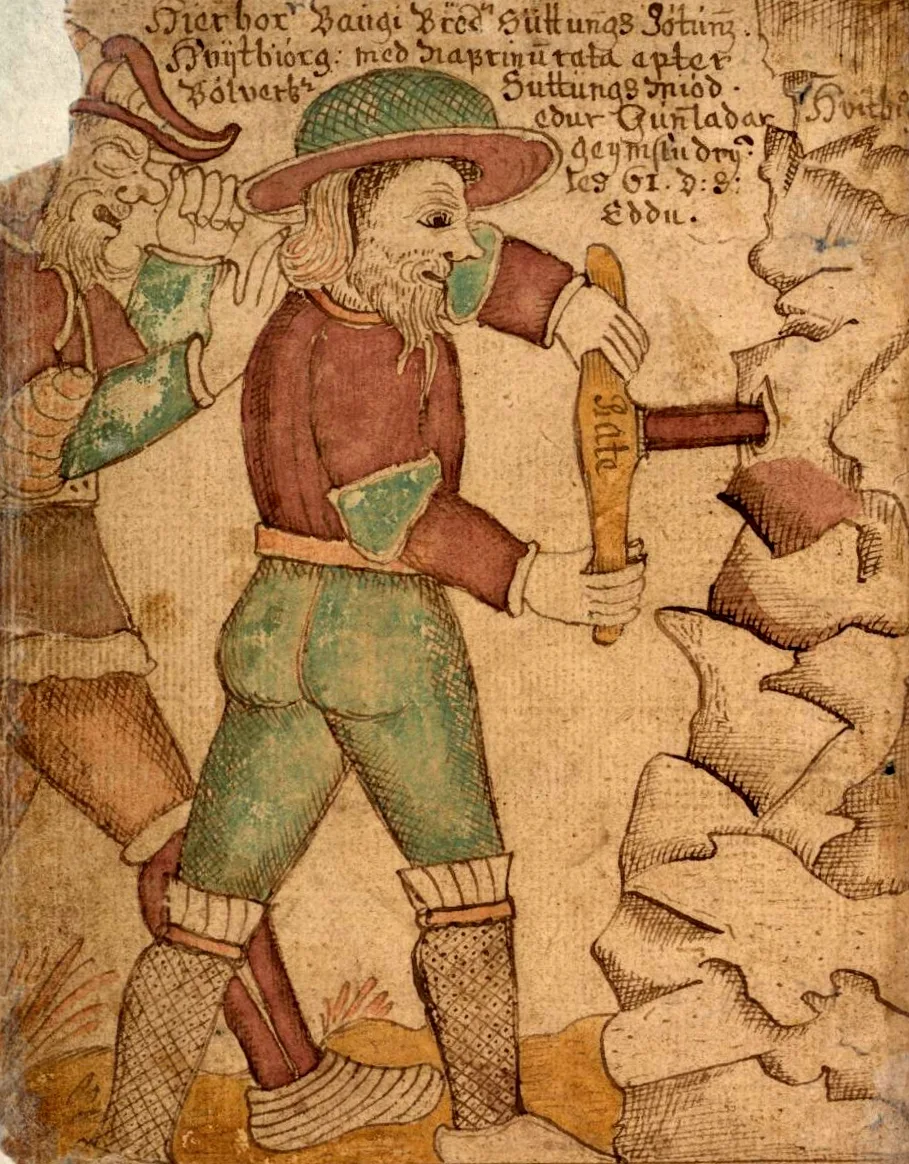
Jötnar Are More Than Monsters
Jötnar can be opponents, kin, spouses, wisdom holders, and resource owners. The English word “giant” is an imperfect gloss and does not define every role or size.
Conflict Does Not Make a Race War
The poetic Æsir–Vanir war and truce are compressed and difficult. Major deities also have overlapping roles rather than one tidy portfolio each.
Matched pairs
Each item on the left goes with the one on the right.
- Ymir
- Primordial being whose body becomes major parts of the ordered world
- Nine worlds
- An attested number without a surviving definitive list or geometry
- Æsir, Vanir, and jötnar
- Relational groupings rather than biological moral races
Self-test
Answer each question from memory, then check your work against the answer key.
1. What is the safest conclusion about Ask and Embla?
- AThe story is a direct retelling of a Christian creation scene
- BTheir story describes creation from nothing
- CThe poem and Snorri differ over divine names and gifts
- DThe poem and Snorri preserve matching names but different gifts
2. Which approach best represents Norse cosmic places?
- ACount each divine hall as an independent cosmic realm
- BKeep halls, fields, roads, and regions source-bound and relational
- CArrange the named places as nine separate physical planets
- DMerge the root schemes into a single reconstructed geography
3. How do Norse poems describe the origin of earth, mountains, sea, and sky?
- ATransformed from the body of Ymir, a primordial being
- BHatched from an egg at the base of Yggdrasil
- CAssembled by the Æsir gods from nothing
- DReshaped from Miðgarðr after a great flood
4. In Voluspa, who gives Ask and Embla the capacities needed for human life?
- AThree giants
- BTwo gods and one giant
- CA single god
- DThree gods
5. Which statement about the nine worlds is best supported by the sources?
- ANo surviving source gives a definitive nine-world map
- BSnorri gives an exact geometric diagram of all nine
- CThe Poetic Edda lists all nine worlds in order
- DArchaeological finds confirm the nine-world layout
6. What should a learner avoid claiming about the Æsir–Vanir conflict?
- ADivine roles can overlap across groups
- BThe story includes conflict and truce
- CIt proves a historical invasion by two biological races
- DThe poetic account is compressed and difficult
7. Which best describes jotnar according to the sources?
- AA uniformly evil monster race
- BNature spirits unrelated to the gods
- CA subgroup of the Vanir
- DComplex beings, allies, kin, or foes by context
8. Which English word is called an incomplete gloss for jotunn?
- ATroll
- BGiant
- CDwarf
- DElf
9. Instead of using a fixed chart, which question should you ask about Aesir, Vanir, and jotnar?
- AWho has a single ancestor
- BWhich group is morally good
- CWho has the most strength
- DWhat crosses the boundary
10. Which role is NOT attributed to jotnar in the sources?
- AHolders of wisdom the gods seek
- BKin of the gods
- CFormal judges who arbitrate disputes among the gods
- DSpouses of the gods
Go deeper
Answer key
- 1. C The poem and Snorri differ over divine names and giftsThe sources share a first-human episode but preserve meaningful differences that should not be harmonized away.
- 2. B Keep halls, fields, roads, and regions source-bound and relationalThe relationships and categories vary, so a diagram must remain a labeled reconstruction.
- 3. A Transformed from the body of Ymir, a primordial beingPoems describe the ordered world as transformed from Ymir's body, not created from nothing, hatched from an egg, or reshaped from Miðgarðr — ideas absent from the sources.
- 4. D Three godsVoluspa credits three gods with giving Ask and Embla their human capacities, though Snorri's version differs in the specific names and gifts.
- 5. A No surviving source gives a definitive nine-world mapPoems mention nine worlds, but no source supplies a definitive list or geometry; popular diagrams are modern reconstructions.
- 6. C It proves a historical invasion by two biological racesThe surviving mythic evidence does not establish a racialized historical invasion narrative.
- 7. D Complex beings, allies, kin, or foes by contextJotnar can be opponents, kin, spouses, or wisdom holders depending on the story, not a fixed monstrous race.
- 8. B Giant"Giant" is the common translation for jotunn, but it fails to capture the full range of roles and sizes.
- 9. D What crosses the boundaryThe question to ask is what crosses boundaries between groups, instead of ranking strength, ancestry, or morality.
- 10. C Formal judges who arbitrate disputes among the godsThe sources attest jotnar as kin, spouses, and wisdom holders, but not as formal judges arbitrating divine disputes.
Sources
- The Codex Regius of the Poetic Edda: GKS 2365 4to, Electronic Edition — eae.ku.dk/q?p=eae%2Fvols%2Ftext%2F1
- The Poetic Edda — www.gutenberg.org/cache/epub/73533/pg73533-images.html
- Snorri Sturluson: Edda — Prologue and Gylfaginning — vsnr.org/editions/snorri-sturluson-edda-prologue-and-gylfaginning/
- Ymir, Baldr, and the Grand Narrative Arc of Mythological History — www.cambridge.org/core/books/abs/myth-and-history-in-celtic-and-scandinavian-traditions/ymir-baldr-and-the-grand-narrative-arc-of-mythological-history/BD3464F071C2E5E507582BD104665D9A
- Old Norse Mythology — academic.oup.com/book/41179
- The (De)Construction of Mythic Ethnography II: Hrímþurs and Cosmogony — researchportal.helsinki.fi/en/publications/the-deconstruction-of-mythic-ethnography-ii-hr%C3%ADm%C3%BEurs-and-cosmogon/
- Evidence synthesis — see lesson sources
- Jǫtnar in War and Peace — hi.is/frettir/doktorsvorn_i_norraenni_tru_ingunn_asdisardottir
Image credits
- Jötnar Are More Than Monsters: Wikimedia Commons · Unknown author · Public domain — commons.wikimedia.org/wiki/File:Processed_SAM_rati.jpg
