
The Science of Sticky Apps study guide · Lesson 6 of 11
Engineering Viral Growth
The K-factor · The three growth loops · Shareable artifacts & referrals
Unofficial study guide for Hooked: How to Build Habit-Forming Products by Nir Eyal, Ryan Hoover. FlashFeed is not affiliated with the author or publisher.
This is the lesson's study guide from the FlashFeed app, plus its key facts and a self-test.
What you'll be able to do
- Compute and interpret the K-factor (K = i x c) and the K > 1 threshold for self-sustaining growth.
- Define CAC and explain how viral growth lowers it, using Duolingo's CAC from IPO to Q1 2025.
- Distinguish the viral, content/ASO, and paid acquisition loops and explain why mature products run all three in parallel.
- Define LTV and explain the LTV-greater-than-CAC condition that keeps the paid acquisition loop viable.
- Explain shareable artifacts (Spotify Wrapped, Top 1% badge) and why double-sided referrals outperform single-sided via reciprocity.
The K-factor
Viral growth is not a mood — it is a measurement. Once you can quantify how the product spreads, you can tune it the same way an engineer tunes a system.
Virality is a number, not a vibe
The viral coefficient, written as K-factor, measures how many new users each existing user generates. The formula is K = i × c — invitations sent multiplied by the conversion rate on those invitations. A K of 0.2 means five users collectively produce one additional user over their lifetime; a K above 1 is the inflection point where the product is genuinely self-replicating — each cohort is larger than the last without additional spend. Below 1, virality still helps but the product depends on paid or organic top-of-funnel to survive. The K-factor is also a direct proxy for product-market fit and low CAC: users only bother to refer something they value, and a rising K means the product is earning those referrals. That combination — fit and cheap acquisition — is what a K above 1 signals simultaneously.
Duolingo's falling CAC
CAC (Customer Acquisition Cost) is the dollar amount spent to land one new user. It is the denominator that viral dynamics attack. By some analyst estimates, Duolingo's CAC fell from roughly 41 at its IPO to roughly 33 by Q1 2025 — not because the ad budget shrank but because a larger and more engaged user base was doing more of the recruiting itself. Every dollar of referral-driven organic install is a dollar not spent on performance marketing. Watching CAC trend over time is one of the clearest ways to tell whether your viral loops are compounding or decaying; a flat or rising CAC at scale is a warning sign that organic growth has stalled.
The three growth loops
Growth at scale rarely runs on a single mechanism. Durable products stack multiple self-reinforcing loops so that when one weakens, the others carry the load.
Three loops that compound
The viral loop is the most celebrated: users recruit users through sharing, invitations, or social artifacts. It costs almost nothing per incremental install. The content/ASO loop is subtler — user activity (posts, reviews, public profiles) becomes indexable content that lifts App Store and search visibility, pulling in cold-search installs without a media buy. Both of these loops are compounding and nearly free at the margin. The paid acquisition loop works differently: ad spend buys installs whose in-app revenue (or LTV signal) funds more ad spend. It can scale fast but it only works when LTV (Lifetime Value) — the total value a user generates over their lifetime — far exceeds CAC. If the unit economics are negative, the paid loop accelerates losses rather than growth. Mature products use all three in parallel: the viral and content loops lower blended CAC so the paid loop can reach users who would never arrive organically, and the resulting scale generates more content and more referrers, reinforcing the first two.
Shareable artifacts & referrals
The most efficient acquisition channel is one where the user wants to do the work. Shareable artifacts and well-designed referral programs get there by aligning the app's growth interest with the user's self-interest.
The user promotes themselves
A shareable artifact is content a user chooses to broadcast because it reflects well on them — not the app. Spotify Wrapped is the canonical example: an identity-affirming yearly summary that detonates across social every December with zero paid media. Users are not promoting Spotify; they are performing a version of themselves — "I am the kind of person who listened to 40,000 minutes of ambient jazz." The app is the medium. The Duolingo 'Top 1% of learners' badge works the same way: it signals discipline to a user's social graph, and in doing so pulls curious onlookers into the funnel. The design principle is straightforward — create an output that makes the user look good, and distribution takes care of itself.
Give a ride, get a ride
Double-sided referral programs — where both the referrer and the new user receive value — consistently outperform single-sided ones because they exploit reciprocity norms: giving someone a benefit makes them feel obligated to act on it, and the referrer feels less like a salesperson when they are genuinely handing something over. Uber's original 'give a friend a free ride, get a free ride' structure is the textbook example. The more sophisticated version embeds the referral in content value rather than a discount — 'unlock this deck by inviting a study partner' — because it ties the incentive directly to the product's core loop rather than appending a cash reward that looks like a bribe. That framing also attracts users who want the product, not users who want the coupon.
Key terms
- Viral coefficient (K-factor)
- A measure of how many new users each existing user generates, calculated as K = i × c (invitations sent × conversion rate). K greater than 1 means exponential, self-sustaining growth.
- CAC (Customer Acquisition Cost)
- The cost to acquire one new user. A K-factor above 1 lowers CAC because users recruit each other, cutting the paid-acquisition spend needed to hit growth targets.
- Viral loop
- A growth loop in which users naturally recruit others through sharing, invitations, or social artifacts. It works best when sharing is intrinsic to the core value loop, not a bolted-on 'Share' button.
- Content/ASO loop
- A compounding growth engine where user activity generates content (reviews, shared artifacts, UGC), which increases App Store visibility, which drives downloads, which generates more content — essentially free marketing powered by your most engaged users.
- LTV (Lifetime Value)
- The total value a user generates over their lifetime. Paid acquisition loops are sustainable only when it greatly exceeds CAC.
- Shareable artifact
- Content a user wants to share because it reflects well on them — Spotify Wrapped, a 'Top 1% of learners' badge. The user is promoting themselves, not the app; the app is merely the medium.
Key concepts
The viral loop
- Of the three growth engines, this is the most celebrated — and it costs almost nothing per additional install.
- It works by having existing users recruit new ones through sharing, invitations, and social artifacts.
- This compounding, nearly-free growth engine is measured directly by the K-factor: invitations sent times conversion rate.
The content/ASO loop
- This subtler growth engine turns ordinary user activity into a free discovery channel.
- Posts, reviews, and public profiles become indexable material that lifts App Store and search visibility.
- It pulls in cold-search installs with no media buy, because user activity itself becomes the searchable asset that raises store ranking.
The paid acquisition loop
- Unlike the two compounding engines, this growth mechanism can scale fast but only under the right unit economics.
- Ad spend buys installs whose in-app revenue funds still more ad spend.
- It is sustainable only when a user's lifetime value far exceeds the cost to land them — negative unit economics make it accelerate losses instead of growth.
Key facts
Virality is a number, not a vibe
Growth teams don't hope a product spreads — they measure it. The viral coefficient, or K-factor, quantifies how many new users each existing user generates. Once you can put a number on it, you can engineer it.
Duolingo's falling CAC
Duolingo's customer acquisition cost dropped from an estimated ~41 at IPO to ~33 in Q1 2025 — a direct measure of improving viral dynamics as the user base grew more self-referencing. Cheaper acquisition is what viral growth looks like on a spreadsheet.
Pricing A New User
Customer Acquisition Cost, or CAC, is the dollar amount a company spends to land one new user. It's the denominator that viral growth mechanics are designed to shrink.
Five Users, One New One
A K-factor of 0.2 means it takes five existing users, collectively, to generate one additional user over their lifetime. That's below the K-above-1 threshold for self-sustaining growth, so it's a reciprocal relationship, not a multiplier.
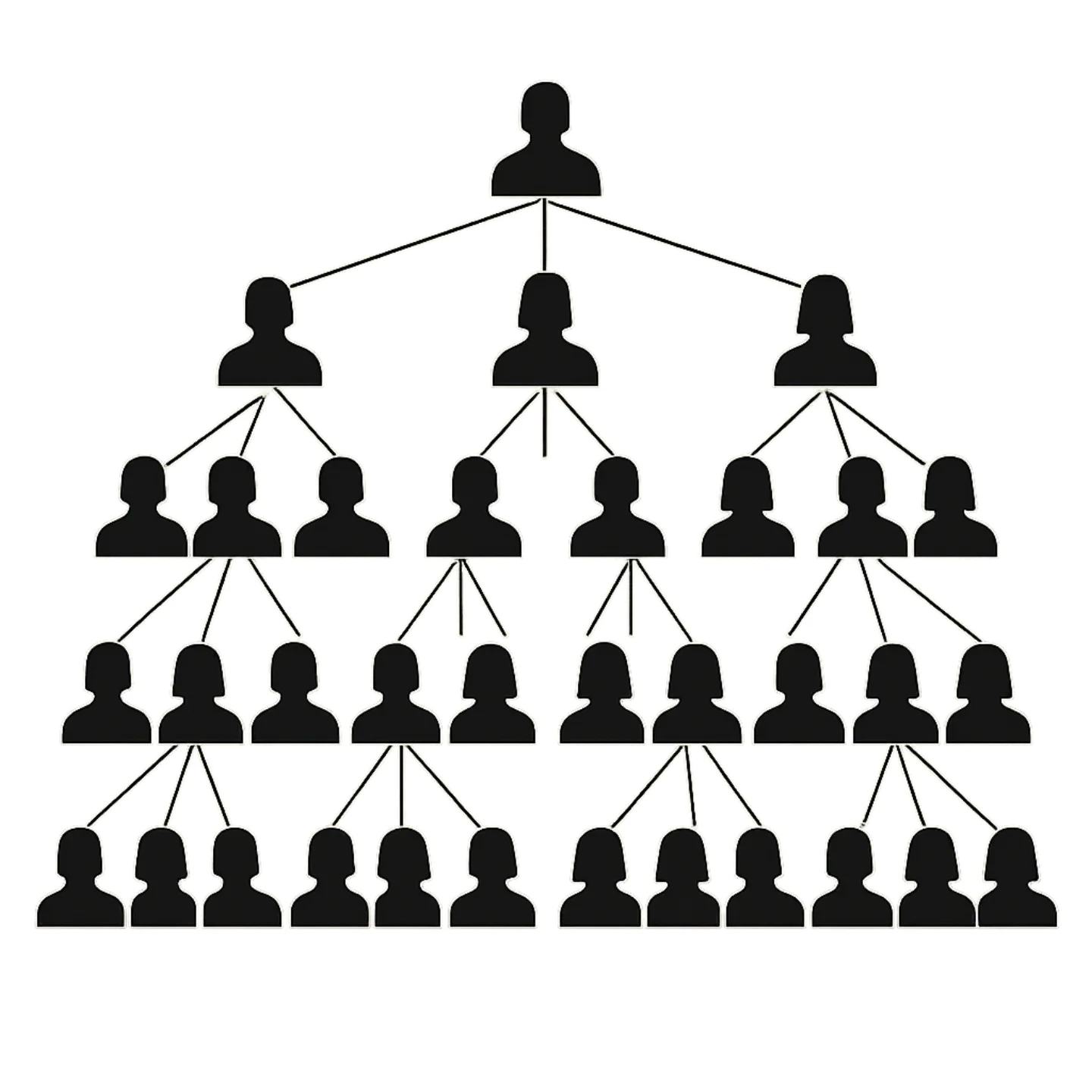
What K Above 1 Signals
When a product's K-factor climbs above 1, each user is recruiting more than one new user — self-sustaining growth that signals strong product-market fit, a low customer acquisition cost, and a genuinely good user experience.
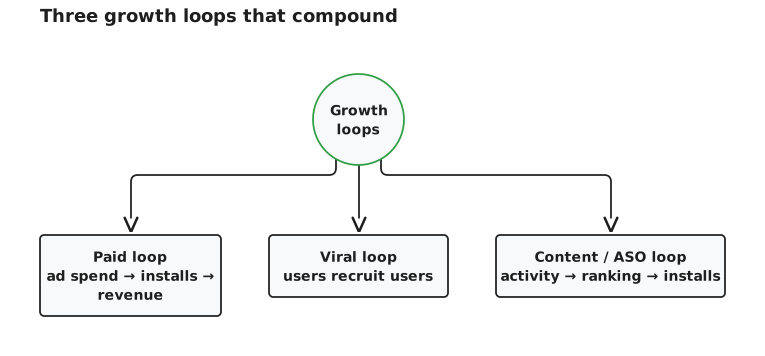
Three loops that compound
Sustainable growth runs on three engines: the viral loop (users recruit users), the content/ASO loop (activity becomes content that lifts store visibility), and the paid acquisition loop (ad spend buys installs that fund more spend). The first two are nearly free; the third only works when LTV far exceeds CAC.
Posts That Feed Search
The content/ASO loop turns everyday user activity — posts, reviews, and public profiles — into indexable material that lifts App Store and search visibility. It's how cold-search installs happen, distinct from direct recruiting or paid ads.
Ads That Fund More Ads
The paid acquisition loop works by spending on ads to buy installs, then reinvesting the in-app revenue those installs generate into more ad spend. Unlike the viral and content loops, it isn't nearly free at the margin.
Users Recruiting Users
The viral loop grows a product through users recruiting other users — via sharing, invitations, or social artifacts — at almost no cost per install. It works best when sharing is built into the core experience, not bolted on as a separate button.
The user promotes themselves
The most efficient acquisition channel is an artifact users want to share because it reflects well on them. Spotify Wrapped is the archetype: an identity-affirming summary that explodes across social every December with zero paid media. The user isn't promoting the app — they're promoting themselves. The app is just the medium.
Give a ride, get a ride
Double-sided referral programs — where both the referrer and the new user get value — beat single-sided ones by exploiting reciprocity norms. Uber's 'give a friend a free ride, get a free ride' is canonical. The advanced move: embed the referral in content value instead of a discount — 'unlock this deck by inviting a study partner.'
Spotify's December Detonation
Spotify Wrapped is the archetypal shareable artifact: an identity-affirming yearly summary that spreads across social media every December without any paid media behind it.
The Top 1% Badge
Duolingo's 'Top 1% of learners' badge works as a shareable artifact: it signals discipline to the user's social graph, and curious onlookers get pulled into the app.
Unlock It, Don't Bribe
The more sophisticated referral embeds its incentive in content value tied to the core loop, like unlocking a deck by inviting a partner — it draws people who want the product, not the coupon.
By the numbers
- K-factor threshold above which growth becomes exponential and self-sustaining
- 1 x
- K-factor where 5 users still generate 1 additional user 'for free' over their lifetime
- 0.2 x
- Duolingo's estimated customer acquisition cost (CAC) at IPO
- 41 USD
- Duolingo's estimated customer acquisition cost (CAC) in Q1 2025
- 33 USD
Matched pairs
Each item on the left goes with the one on the right.
- Viral loop
- Users recruiting users through sharing and invitations
- Content/ASO loop
- User activity becoming content that lifts App Store visibility
- Paid acquisition loop
- Ad spend buying installs whose revenue funds more spend
- Spotify Wrapped
- Identity-affirming yearly summary shared with zero paid media
- Duolingo 'Top 1% of learners' badge
- Achievement that signals discipline to a user's social graph
- Shareable artifact (Spotify Wrapped)
- Serotonin — content that markets the user, not the app
Step by step
Sequence the three growth loops as a startup scales
- Engineer the viral loop from day one — bake sharing into the core value, not a bolted-on Share button.
- Run the paid acquisition loop to buy your first installs, sustainable only while LTV far exceeds CAC.
- Use that paid spend to reach critical mass — enough active users to seed real activity.
- Let the content/ASO loop kick in as user activity generates reviews and artifacts that lift store visibility.
- Watch the viral and content loops self-sustain organic growth, reducing reliance on paid spend.
Virality is engineered from day one; paid acquisition bootstraps reach until the organic loops compound on their own.
Self-test
Answer each question from memory, then check your work against the answer key.
1. A K-factor above 1 is a direct signal of which combination?
- AWeak retention but strong onboarding
- BRising CAC and stalled organic growth
- CHigh churn and heavy ad spend
- DProduct-market fit and low CAC
2. The K-factor is calculated as the product of which two quantities?
- ALifetime value and retention rate
- BCustomer acquisition cost and conversion rate
- CInvitations sent and the conversion rate on those invitations
- DInstalls and churn rate
3. Above what K value is a product genuinely self-replicating, with each cohort larger than the last without extra spend?
- A0.2
- B1
- C0.5
- D10
4. What does a K-factor of 0.2 mean in practice?
- AFive users collectively produce one additional user over their lifetime
- BEach user recruits five new users
- CThe user base doubles every cycle
- DThe product loses one in five users
5. Which statement about a product with a K-factor below 1 is TRUE?
- AIt is guaranteed to lose users every cohort
- BIt grows exponentially on its own without any spend
- CVirality still helps, but the product depends on paid or organic top-of-funnel to survive
- DIt needs no marketing because it is self-replicating
6. What does CAC (Customer Acquisition Cost) measure?
- AThe dollar amount spent to land one new user
- BThe share of users who convert on an invitation
- CThe total revenue a user generates over their lifetime
- DThe number of users each existing user recruits
7. Roughly what was Duolingo's estimated CAC at its IPO?
- A$33
- B$41
- C$28
- D$52
8. Roughly what had Duolingo's estimated CAC fallen to by Q1 2025?
- A$41
- B$21
- C$47
- D$33
9. Why did Duolingo's CAC fall from IPO to Q1 2025?
- AIt stopped tracking performance marketing
- BThe company slashed its advertising budget
- CA larger, more engaged user base did more of the recruiting itself
- DIt raised subscription prices to offset ad spend
10. A flat or rising CAC at scale is a warning sign of what?
- AOrganic growth has stalled and viral loops may be decaying
- BLTV is climbing rapidly
- CViral loops are compounding faster than ever
- DThe K-factor has just crossed above 1
11. Why do mature products run all three growth loops in parallel rather than relying on the paid acquisition loop alone?
- ARunning all three loops eliminates the need to track LTV
- BThe paid loop generates the content that feeds the other two loops
- CThe paid loop is the only one of the three that compounds over time
- DThe viral and content loops lower blended CAC, letting the paid loop reach users who'd never arrive organically
12. Which growth loop turns user activity such as posts, reviews, and public profiles into indexable material that lifts App Store and search visibility?
- AThe retention loop
- BThe content/ASO loop
- CThe viral loop
- DThe paid acquisition loop
13. How does the paid acquisition loop work?
- AAd spend buys installs whose in-app revenue funds more ad spend
- BPublic profiles generate cold-search installs for free
- CUsers recruit users through sharing and invitations
- DUser activity becomes content that lifts store rankings
14. Which of these growth loops is NOT nearly free at the margin?
- AThe viral loop
- BThe referral loop
- CThe content/ASO loop
- DThe paid acquisition loop
15. The viral loop drives growth primarily through which mechanism?
- ASubscription revenue reinvested into retention
- BAd spend that buys installs which fund more spend
- CUsers recruiting other users through sharing, invitations, or social artifacts
- DUser reviews that raise App Store rankings
16. What does LTV (Lifetime Value) measure?
- AThe share of trials that convert to paid
- BThe total value a user generates over their lifetime
- CThe cost to acquire one new user
- DThe number of invitations a user sends
17. The paid acquisition loop is sustainable only when which condition holds?
- ALTV far exceeds CAC
- BThe K-factor stays below 1
- CCAC far exceeds LTV
- DInvitations exceed conversions
18. If a product's unit economics are negative (CAC exceeds LTV), what does scaling the paid loop do?
- AAutomatically lifts the K-factor above 1
- BCompounds free organic installs
- CAccelerates losses rather than growth
- DLowers CAC through reciprocity
19. When LTV comfortably exceeds CAC, what happens as the paid acquisition loop scales?
- AIt stops needing any further ad spend at all
- BIt buys installs whose revenue funds even more ad spend
- CIt becomes functionally the same as the viral loop mechanism
- DIt automatically guarantees the K-factor rises above one
20. To judge whether the paid acquisition loop is viable, which two figures do you compare?
- ARetention against conversion rate
- BInvitations against installs
- CK-factor against churn
- DLTV against CAC
21. Why do double-sided referral programs outperform single-sided ones?
- AThey guarantee a K-factor above 1, whatever the conversion rate
- BThey exploit reciprocity norms by rewarding both the referrer and the new user
- CThey swap the user's social graph for a machine-curated interest graph
- DThey pay rewards in cash only, which users value more than app credit
22. A shareable artifact is content a user chooses to broadcast primarily because it:
- AIs required before they can keep using the app
- BDirectly advertises the app's newest features
- CPays them a cash reward for each share
- DReflects well on them, letting them perform a version of themselves
23. Which is the canonical shareable artifact that detonates across social every December with zero paid media?
- ADuolingo's streak freeze
- BUber's free-ride referral
- CSpotify Wrapped
- DThe App Store featured banner
24. How does Duolingo's 'Top 1% of learners' badge pull new users into the funnel?
- AIt signals discipline to the user's social graph, drawing curious onlookers
- BIt buys App Store ad placements
- CIt gives referred friends a cash bonus
- DIt forces users to invite friends to continue
25. What is the more sophisticated version of a referral that avoids looking like a cash bribe?
- ARemoving all incentives from the referral
- BEmbedding the incentive in content value tied to the core loop, e.g. 'unlock this deck by inviting a partner'
- CDoubling the cash reward for both sides
- DRewarding only the referrer with a discount
Go deeper
- ReadHooked by Nir Eyal, Ryan Hoover · on Amazon ↗
- StudyThe Science of Sticky Apps in the FlashFeed app
These are affiliate links: if you buy a book through one, FlashFeed may earn a small commission at no extra cost to you. The commission helps pay for FlashFeed's servers.
As an Amazon Associate we earn from qualifying purchases.
Answer key
- 1. D Product-market fit and low CACK>1 means each user recruits more than one new user — self-sustaining growth that signals product-market fit, low customer acquisition cost, and a strong user experience.
- 2. C Invitations sent and the conversion rate on those invitationsK = i x c: invitations sent multiplied by the conversion rate on those invitations. The other pairs mix in unrelated metrics like LTV, CAC, or churn.
- 3. B 1K above 1 is the inflection point for self-sustaining, exponential growth. A K of 0.2 still helps but leaves the product dependent on paid or organic top-of-funnel.
- 4. A Five users collectively produce one additional user over their lifetimeK = 0.2 means it takes five existing users to generate one additional user. It is below the K>1 self-sustaining threshold, so it is a reciprocal, not a multiplier of five.
- 5. C Virality still helps, but the product depends on paid or organic top-of-funnel to surviveBelow 1, virality contributes but cannot sustain growth alone, so paid or organic top-of-funnel is still required. Only K above 1 is self-replicating.
- 6. A The dollar amount spent to land one new userCAC is the cost to acquire one new user, the denominator that viral dynamics attack. The other options describe LTV, conversion rate, and the K-factor.
- 7. B $41Duolingo's CAC was estimated at roughly $41 at IPO and had fallen to about $33 by Q1 2025 as its base became more self-referencing.
- 8. D $33CAC fell to roughly $33 by Q1 2025, down from about $41 at IPO. The drop reflects a larger, more engaged base doing more of the recruiting.
- 9. C A larger, more engaged user base did more of the recruiting itselfDuolingo's CAC fell not because the ad budget shrank, but because a bigger, more engaged base recruited more users organically, replacing paid installs.
- 10. A Organic growth has stalled and viral loops may be decayingWatching CAC over time reveals whether viral loops compound or decay; a flat or rising CAC at scale signals stalled organic growth, the opposite of compounding virality.
- 11. D The viral and content loops lower blended CAC, letting the paid loop reach users who'd never arrive organicallyThe viral and content/ASO loops are compounding and nearly free at the margin, so they lower blended CAC — letting the paid loop profitably reach users who'd never arrive organically. The resulting scale then feeds more content and referrals, reinforcing the first two.
- 12. B The content/ASO loopThe content/ASO loop converts posts, reviews, and profiles into indexable material that pulls in cold-search installs. The viral loop is about direct recruiting; the paid loop buys installs.
- 13. A Ad spend buys installs whose in-app revenue funds more ad spendThe paid loop reinvests in-app revenue from bought installs into more ad spend. The other options describe the viral and content/ASO loops, which are nearly free at the margin.
- 14. D The paid acquisition loopThe viral and content/ASO loops are compounding and nearly free per incremental install; the paid loop costs ad dollars for every install and only works when LTV far exceeds CAC.
- 15. C Users recruiting other users through sharing, invitations, or social artifactsThe viral loop is users recruiting users, costing almost nothing per install. It works best when sharing is intrinsic to the core value loop, not a bolted-on Share button.
- 16. B The total value a user generates over their lifetimeLTV is the total value a user produces over their lifetime. The cost to acquire a user is CAC; the paid loop is viable only when LTV far exceeds CAC.
- 17. A LTV far exceeds CACPaid loops only work when the lifetime value of a bought user greatly exceeds the cost to acquire them. If CAC exceeds LTV, the loop accelerates losses.
- 18. C Accelerates losses rather than growthWith negative unit economics, spending more on ads buys installs that lose money faster, so the paid loop accelerates losses instead of growth.
- 19. B It buys installs whose revenue funds even more ad spendThe paid loop can scale fast because ad spend buys installs whose in-app revenue funds still more ad spend, but only once LTV far exceeds CAC. It doesn't merge with the viral loop or by itself lift K.
- 20. D LTV against CACViability of the paid loop is the LTV-versus-CAC comparison: LTV must greatly exceed CAC. The other pairings mix unrelated growth metrics.
- 21. B They exploit reciprocity norms by rewarding both the referrer and the new userWhen both sides receive value, the offer taps reciprocity norms — the referrer feels they're giving a genuine gift, not just farming a bonus. Uber's early referral program, which credited both the referrer and the invited friend with ride credit, is a well-known example.
- 22. D Reflects well on them, letting them perform a version of themselvesA shareable artifact makes the user look good; they promote themselves, and the app is merely the medium. It is not a paid or forced share.
- 23. C Spotify WrappedSpotify Wrapped is the archetypal identity-affirming yearly summary that spreads with no paid media. Uber's free ride is a referral, not a self-expressive artifact.
- 24. A It signals discipline to the user's social graph, drawing curious onlookersThe badge is a shareable artifact: it signals discipline to a user's social graph, and curious onlookers get pulled in. It relies on self-presentation, not cash or ads.
- 25. B Embedding the incentive in content value tied to the core loop, e.g. 'unlock this deck by inviting a partner'Tying the reward to content value in the core loop attracts users who want the product, not the coupon, and avoids the bribe framing of a cash reward.
Sources
- The Science of Sticky Apps — research compilation (Perplexity)
- Uber's early dual-sided ride-credit referral program (widely documented growth-marketing case study)
Image credits
- What K Above 1 Signals: AI-generated (gpt-image-1.5)
- Three loops that compound: FlashFeed original diagram · CC-BY-4.0