
The Science of Sticky Apps study guide · Lesson 2 of 11
The Brain Chemistry of Engagement
Dopamine: wanting, not liking · The four neurochemicals · The Default Mode Network
Unofficial study guide for Hooked: How to Build Habit-Forming Products by Nir Eyal, Ryan Hoover. FlashFeed is not affiliated with the author or publisher.
This is the lesson's study guide from the FlashFeed app, plus its key facts and a self-test.
What you'll be able to do
- Explain that dopamine drives wanting and seeking and fires in anticipation via Reward Prediction Error, not at the reward itself.
- Identify variable-ratio reinforcement as the unpredictable, slot-machine schedule behind compulsive use.
- Map each of the four neurochemicals (dopamine, oxytocin, serotonin, endorphins) to the human drive it powers.
- Determine which neurochemical lever a given feature pulls and reject mismatched chemical-to-drive pairings.
- Explain how habitual, frictionless scrolling shifts control from the prefrontal cortex to the Default Mode Network and basal ganglia ('zoning out').
Dopamine: wanting, not liking
The single most misunderstood molecule in tech discourse, dopamine does not deliver pleasure — it drives pursuit. Getting that distinction right changes how you read every engagement mechanic you encounter.
Dopamine fires before the reward
Dopamine is not a reward signal; it is an anticipation signal. The brain releases it during the expectation of something good, not when the good thing arrives. That timing gap is the engine of compulsive use: the feed holds your attention not because the next post is satisfying but because the dopamine hit comes from the act of seeking it. Satisfaction, if it arrives at all, is a different, quieter system.
Wanting vs. liking
Neuroscientist Kent Berridge demonstrated through decades of lesion studies that wanting and liking are neurochemically separable. Dopamine governs the wanting/seeking system; opioid circuits govern liking/enjoyment. An app can ramp your craving for the next swipe while the swipe itself leaves you flat — the two experiences draw on entirely different brain hardware. This is why "I don't even enjoy this anymore but I can't stop" is neurologically coherent, not a contradiction.
The brain runs on surprise
The VTA (Ventral Tegmental Area) encodes Reward Prediction Error (RPE): the difference between what you expected and what actually happened. When an outcome exceeds expectation, dopamine spikes. When it meets expectation, the signal is flat. When it falls short, dopamine dips below baseline. The practical consequence: a perfectly predictable reward trains dopamine out of existence. Uncertainty is the fuel, not the content.
The pocket-sized Skinner box
B.F. Skinner showed in the 1950s that rats pressing a lever on a variable-ratio schedule — rewarded unpredictably, not on a fixed interval — pressed far more relentlessly than those on any predictable schedule. The variable-ratio pattern is the slot machine. It is also the social-media notification, the loot box, and the streak reminder. The schedule, not the reward's quality, drives compulsion. Every modern engagement loop is a lever and a variable-ratio payoff, running on the same neurobiology Skinner's rats demonstrated seventy years ago.
The four neurochemicals
App engagement does not run on a single chemical. It pulls four distinct neurochemical levers, each tied to a different human drive. Recognising which lever a feature targets tells you both why it works and how durable that retention will be.
Four chemicals, four levers
Dopamine drives seeking and anticipation — the pull toward the next notification, the next variable reward. Oxytocin drives social bonding and trust — the warmth from peer acknowledgment, cooperative features, or a message from a friend. Serotonin drives status and belonging — leaderboards, follower counts, and any visible signal that you rank somewhere meaningful among others. Endorphins suppress pain and reward exertion — the release that comes from finishing a hard lesson or completing a workout. Each chemical maps to a design pattern; each design pattern is legible once you know the map.
Why social features stick harder
When a user receives social acknowledgment — a reply, a co-op win, recognition from peers — the brain does not release one chemical. In this model it releases oxytocin followed by serotonin, and that coordinated sequence lands in the nucleus accumbens, the brain's primary reward center. The pairing matters: bonding (oxytocin) and status (serotonin) are delivered together to the same circuit that dopamine targets. The result is qualitatively richer and more durable than solo-use dopamine loops alone. In this model, a leaderboard or follower count works through serotonin; a hard lesson you finish works through endorphins. The serotonin link is contested: animal studies tie serotonin signaling to social hierarchies, but a 2022 Neuropsychopharmacology study notes that direct evidence in humans is lacking. Knowing the lever tells you which population will respond and how long the effect will last.
The Default Mode Network
The Default Mode Network (DMN) is the brain network associated with mind-wandering, self-referential thought, and inward drift. When a task becomes automatic, the DMN takes over from deliberate attention — and engagement designers know exactly how to get you there.
Zoning out is the design goal
Under conscious, deliberate use, the prefrontal cortex maintains executive control: you can decide to stop. But when scrolling becomes habitual and the interface presents no friction, control shifts to the basal ganglia, the brain's habit-execution system, and the DMN takes the wheel. Users describe this as zoning out. For the platform it is not an accident or a failure mode — it is the objective. A DMN-dominant user has effectively lost active decision-making over whether to continue. The dopamine-seeking loop runs without the prefrontal cortex's permission.
The longer you scroll, the harder it gets to stop
Active attentional control is a depletable resource. Prolonged screen exposure raises cognitive load, which drains the prefrontal cortex's capacity for inhibition — the mental muscle responsible for saying "stop." The cruel arithmetic is this: the longer a session runs, the weaker the stop signal becomes. Infinite scroll removes the natural pause points (page turns, load screens) that would otherwise give inhibitory capacity a moment to reassert itself. A depleted brain encountering no structural stopping cue is a brain that will not stop. The design is not indifferent to this; it relies on it.
Key terms
- Reward Prediction Error (RPE)
- The mechanism, first described by Wolfram Schultz, in which dopamine fires strongly in the VTA when an outcome exceeds expectations and is suppressed when it falls below — meaning the system runs on uncertainty, not certainty.
- Variable-ratio reinforcement
- A reinforcement schedule, from B.F. Skinner's 1950s experiments, in which rewards arrive after an unpredictable number of actions. Rats on this schedule pressed the lever far more often and persistently than those on fixed schedules.
- Default Mode Network (DMN)
- The brain network associated with mind-wandering and self-referential thought. When scrolling becomes habitual and easy, the DMN dominates and prefrontal executive control goes offline — users describe it as 'zoning out.'
Key concepts
Dopamine
- This neurochemical is the most misunderstood molecule in tech discourse — it does not deliver pleasure, it drives pursuit.
- It fires during the anticipation of something good, not when the good thing arrives, which is why seeking a feed can hold attention more than the content does.
- In the wanting-versus-liking split, it runs the wanting/seeking system while opioid circuits handle enjoyment.
Oxytocin
- One of the four neurochemical levers app design pulls, this one drives social bonding and trust.
- It produces the warmth from peer acknowledgment, cooperative features, or a message from a friend.
- On social acknowledgment it releases first, followed by a status chemical, the pair landing together in the nucleus accumbens.
Serotonin
- One of the four neurochemical levers, this one drives status and belonging.
- Leaderboards, follower counts, and any visible signal that you rank meaningfully among others work through it.
- After social acknowledgment it follows the bonding chemical, and the two hit the nucleus accumbens together.
Endorphins
- One of the four neurochemical levers, this one suppresses pain and rewards exertion.
- It is the release that comes from finishing a hard lesson or completing a workout.
- Among the four levers it is the one tied to effort and physical push rather than seeking, bonding, or status.
Key facts
Dopamine fires before the reward
The most common misconception in app design is that dopamine is the brain's pleasure chemical. It isn't. The brain releases dopamine during the anticipation of a reward, not when the reward arrives. This is why scrolling a feed stays compulsive even when the content itself barely satisfies.
Wanting vs. liking
Neuroscientist Kent Berridge established that dopamine governs wanting and seeking — not liking and satisfaction. These run on two distinct neurochemical systems. An app can make you crave the next swipe without making the swipe enjoyable: the craving and the enjoyment are wired separately.
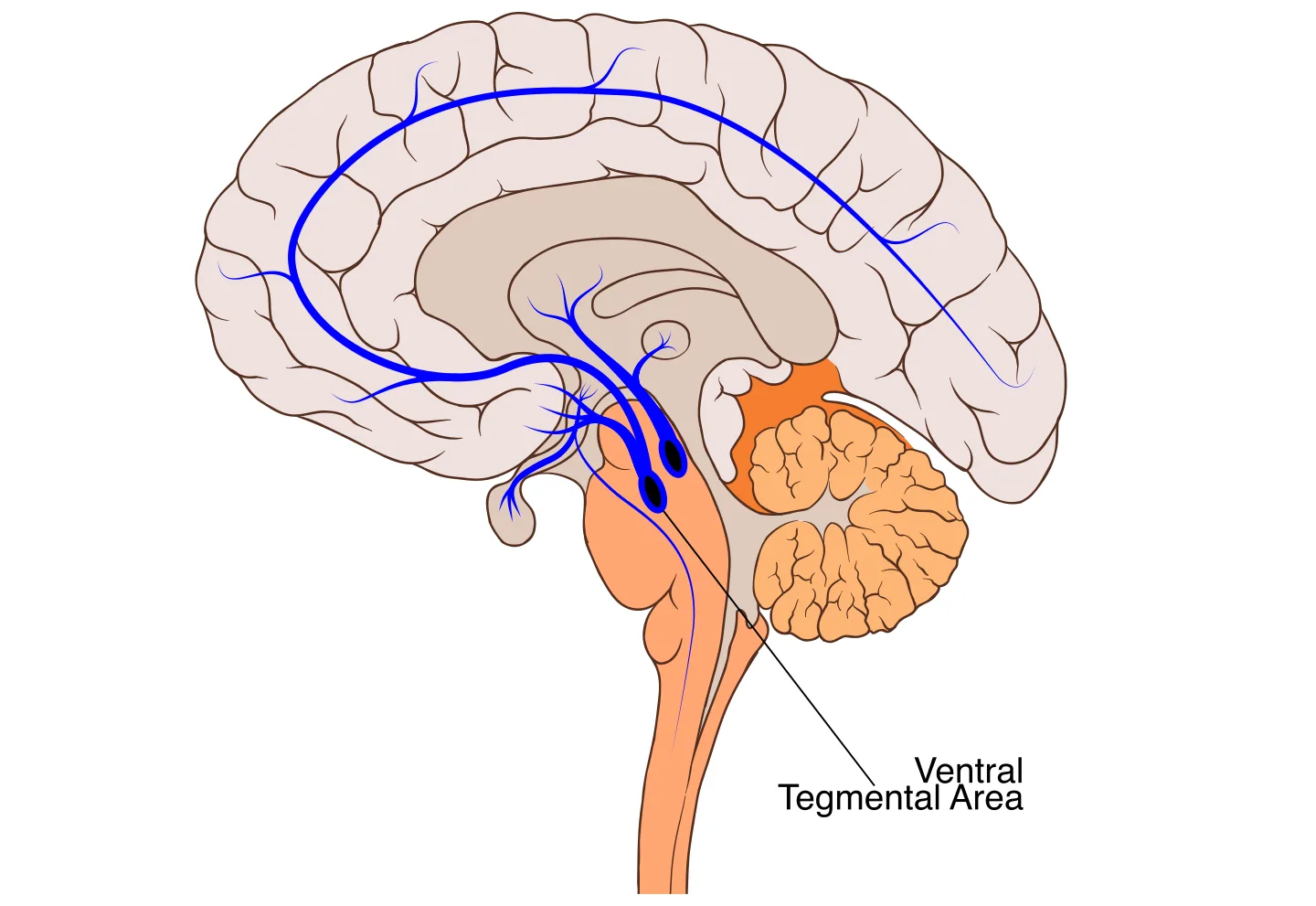
The brain runs on surprise
Under Reward Prediction Error, the Ventral Tegmental Area (VTA) fires hardest when an outcome beats expectations and goes quiet when it disappoints. The designer's takeaway: the dopamine system is driven by uncertainty, not certainty. A reward you can perfectly predict stops producing the signal.

The pocket-sized Skinner box
B.F. Skinner's 1950s rats pressed a lever far more relentlessly when rewards came on a variable-ratio schedule — unpredictable payoffs — than on a fixed one. That same schedule is the slot machine, the social-media notification, the loot box, and the Snapchat streak reminder. All obey one neurobiology.
Predictable Rewards Go Flat
A reward that becomes perfectly predictable stops triggering dopamine almost entirely — the signal trains itself out of existence, which is why uncertainty, not consistency, keeps a habit loop alive.
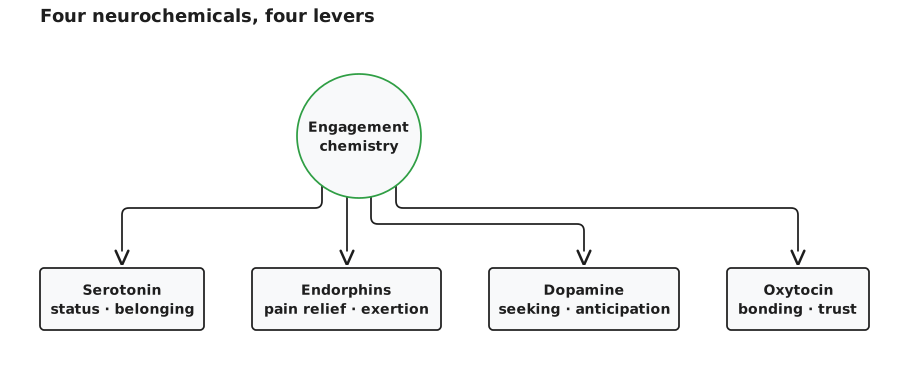
Four chemicals, four levers
App engagement pulls on four neurochemicals. Dopamine drives seeking and anticipation (variable rewards, notifications). Oxytocin drives social bonding and trust (peer acknowledgment, co-op features). Serotonin drives status and belonging (leaderboards, follower counts). Endorphins suppress pain and reward exertion (finishing a hard lesson or workout).

Earned Through Exertion
Endorphins fire when you push through something hard — finishing a tough lesson or workout produces genuine euphoria by suppressing pain and rewarding the effort.
A Thank-You Triggers Oxytocin
When a co-op partner thanks you inside an app, that peer acknowledgment pulls the oxytocin lever — the bonding-and-trust chemical, distinct from the status hit of a leaderboard.
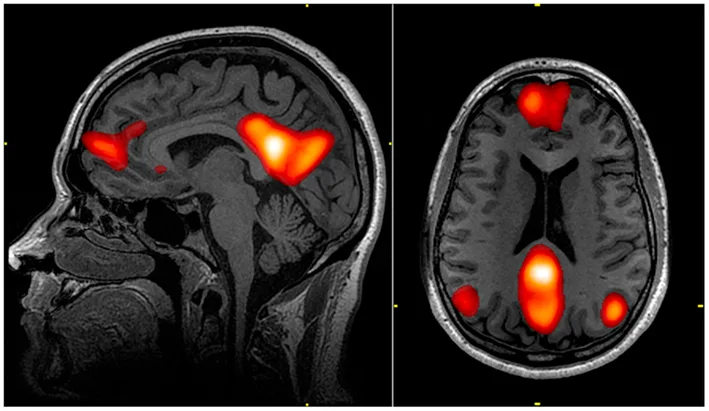
The Mind-Wandering Network
The Default Mode Network is the brain system behind mind-wandering and self-referential thought — the inward drift that takes over once scrolling stops feeling deliberate.
Scroll Removes The Pauses
Infinite scroll strips away the page turns and load screens that used to be natural pause points — moments where a depleted brain could reassert inhibition and stop.
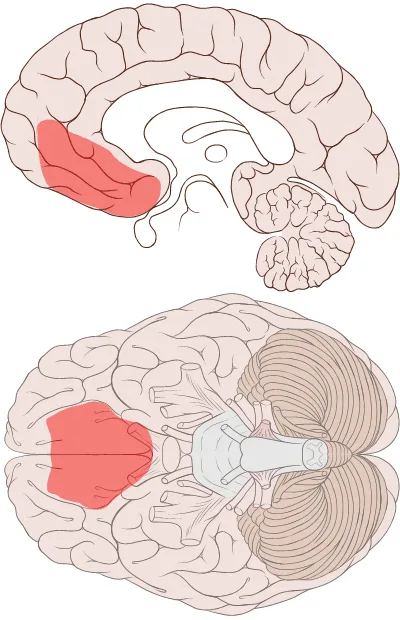
Your Brain's Off Switch
The prefrontal cortex is what holds executive control during deliberate use — it's the part of your brain that actually lets you decide to stop scrolling.
Matched pairs
Each item on the left goes with the one on the right.
- Variable-ratio reinforcement
- The slot machine / notification model
- Dopamine
- Seeking & anticipation
- Oxytocin
- Social bonding & trust
- Serotonin
- Status & belonging
- Endorphins
- Pain suppression & exertion
- Default Mode Network dominant
- 'Zoning out' while scrolling
Self-test
Answer each question from memory, then check your work against the answer key.
1. Under Reward Prediction Error, when does dopamine fire most strongly in the VTA?
- AWhen an outcome falls below expectation
- BWhen an outcome exactly matches expectation
- COnly when no reward is expected at all
- DWhen an outcome exceeds expectation
2. Kent Berridge's lesion studies showed dopamine governs which system?
- ALiking and enjoyment
- BWanting and seeking
- CPain suppression
- DSocial bonding and trust
3. In an engagement loop, dopamine is released mainly during which moment?
- AThe instant the reward arrives
- BOnly when the reward is guaranteed
- CThe anticipation before the reward
- DAfter satisfaction fades
4. What happens to the dopamine signal for a reward that becomes perfectly predictable?
- AIt flattens toward nothing
- BIt converts into liking
- CIt spikes higher than before
- DIt grows stronger each time
5. Which statement about dopamine is NOT accurate?
- AIt is the brain's pleasure and liking chemical
- BIt governs wanting and seeking
- CIts signal is driven by uncertainty
- DIt fires in anticipation of a reward
6. Variable-ratio reinforcement delivers rewards on what basis?
- AAt fixed time intervals
- BAfter an unpredictable number of actions
- COnly after the very first action
- DAfter a fixed number of actions
7. Whose 1950s lever-pressing experiments established the variable-ratio schedule?
- AIvan Pavlov
- BKent Berridge
- CWolfram Schultz
- DB.F. Skinner
8. Which everyday design is the clearest real-world analog of the variable-ratio schedule?
- AA daily alarm clock
- BA fixed loyalty punch card
- CThe slot machine
- DA monthly subscription bill
9. Compared with fixed schedules, how did Skinner's variable-ratio rats press the lever?
- ASlightly less often
- BFar more relentlessly
- CAt the same rate
- DOnly when hungry
10. Which is NOT an example of a variable-ratio engagement loop?
- AA social-media notification
- BA loot box
- CA reward that unlocks at a set hour each day
- DA spin-to-win prize wheel
11. Which neurochemical drives seeking and anticipation?
- AEndorphins
- BSerotonin
- COxytocin
- DDopamine
12. Which neurochemical drives social bonding and trust?
- AOxytocin
- BEndorphins
- CSerotonin
- DDopamine
13. Which neurochemical drives status and belonging?
- AEndorphins
- BOxytocin
- CSerotonin
- DDopamine
14. Endorphins are tied to which human drive?
- AStatus and belonging
- BSeeking and anticipation
- CSocial bonding and trust
- DSuppressing pain and rewarding exertion
15. Which chemical-to-drive pairing is INCORRECT?
- AEndorphins suppress pain and reward exertion
- BSerotonin drives social bonding and trust
- COxytocin drives social bonding and trust
- DDopamine drives seeking and anticipation
16. Which app moment most directly triggers endorphins?
- AFinishing a hard lesson or workout
- BBeing acknowledged by a co-op partner
- CReceiving an unpredictable notification
- DGaining a follower or climbing a leaderboard
17. A co-op feature where a partner thanks you most directly pulls which neurochemical lever?
- ADopamine
- BSerotonin
- CEndorphins
- DOxytocin
18. A designer claims a follower count works by releasing endorphins. Why is that wrong?
- AFollower counts are status signals, which run on serotonin
- BFollower counts run on oxytocin, not endorphins
- CEndorphins apply only to notifications
- DFollower counts release no neurochemical at all
19. An unpredictable push notification pulls primarily on which neurochemical?
- AOxytocin
- BEndorphins
- CDopamine
- DSerotonin
20. A user's post gets warm replies from friends. In the four-lever model, which chemicals does that social acknowledgment release, in order?
- ADopamine, then endorphins
- BOxytocin, then serotonin
- CSerotonin, then oxytocin
- DEndorphins, then dopamine
21. When scrolling becomes habitual and the interface offers no friction, executive control shifts away from the prefrontal cortex to which brain system, letting the Default Mode Network take over?
- AThe basal ganglia
- BThe cerebellum
- CThe amygdala
- DThe hippocampus
22. The Default Mode Network is associated with what kind of mental activity?
- ADeliberate executive control
- BMotor coordination
- CMemory encoding
- DMind-wandering and self-referential thought
23. Under deliberate, conscious use, which region maintains the executive control that lets you decide to stop?
- AThe Default Mode Network
- BThe VTA
- CThe prefrontal cortex
- DThe basal ganglia
24. Why does stopping get harder the longer a scroll session runs?
- AThe DMN gradually shuts down
- BCognitive load depletes the prefrontal cortex's inhibitory capacity
- CDopamine simply runs out
- DThe basal ganglia tires and hands control back
25. How does infinite scroll specifically make stopping harder?
- AIt raises the reward quality of each post
- BIt removes the natural pause points that let inhibition reassert itself
- CIt boosts serotonin with every swipe
- DIt re-engages the prefrontal cortex
Go deeper
- ReadHooked by Nir Eyal, Ryan Hoover · on Amazon ↗
- StudyThe Science of Sticky Apps in the FlashFeed app
These are affiliate links: if you buy a book through one, FlashFeed may earn a small commission at no extra cost to you. The commission helps pay for FlashFeed's servers.
As an Amazon Associate we earn from qualifying purchases.
Answer key
- 1. D When an outcome exceeds expectationDopamine fires strongly when an outcome exceeds expectations, reinforcing the preceding behavior; it is suppressed when the outcome falls below expectation. The signal is driven by surprise.
- 2. B Wanting and seekingBerridge separated wanting from liking: dopamine drives the wanting/seeking system, while opioid circuits govern liking/enjoyment. That is why craving and satisfaction can come apart.
- 3. C The anticipation before the rewardDopamine is an anticipation signal, not a reward signal. The hit comes from seeking, which is why a feed stays compulsive even when the content barely satisfies.
- 4. A It flattens toward nothingUnder Reward Prediction Error, meeting expectation produces a flat signal. A perfectly predictable reward trains dopamine out of existence; uncertainty is the fuel.
- 5. A It is the brain's pleasure and liking chemicalThe pleasure/liking claim is the common misconception. Dopamine drives wanting and anticipation; liking runs on separate opioid circuits.
- 6. B After an unpredictable number of actionsOn a variable-ratio schedule, rewards arrive after an unpredictable number of actions. That uncertainty, not the reward's quality, drives relentless repetition.
- 7. D B.F. SkinnerSkinner's 1950s rat experiments defined variable-ratio reinforcement. Berridge studied wanting vs. liking; Schultz described Reward Prediction Error.
- 8. C The slot machineThe slot machine is the archetypal variable-ratio payoff. Subscriptions, alarms, and punch cards are all fixed and predictable, so they lack the uncertainty that drives compulsion.
- 9. B Far more relentlesslyRats on the variable-ratio schedule pressed far more relentlessly and persistently than those on any predictable schedule. The schedule, not the reward, drove the behavior.
- 10. C A reward that unlocks at a set hour each dayA reward on a set daily schedule is fixed and predictable, so it isn't variable-ratio. Notifications, loot boxes, and spin-to-win wheels all pay off on unpredictable odds — true variable-ratio schedules.
- 11. D DopamineDopamine powers seeking and anticipation, the pull toward the next notification or variable reward. Oxytocin bonds, serotonin signals status, endorphins reward exertion.
- 12. A OxytocinOxytocin drives social bonding and trust, the warmth from peer acknowledgment or a friend's message. Serotonin handles status, dopamine seeking, endorphins exertion.
- 13. C SerotoninSerotonin drives status and belonging, which is what leaderboards and follower counts feed. Dopamine handles seeking, oxytocin bonding, endorphins exertion.
- 14. D Suppressing pain and rewarding exertionEndorphins suppress pain and reward exertion, like the release from finishing a hard lesson or workout. The other drives map to serotonin, oxytocin, and dopamine.
- 15. B Serotonin drives social bonding and trustSerotonin drives status and belonging, not bonding. Bonding and trust are oxytocin's role; the other three pairings are correct.
- 16. A Finishing a hard lesson or workoutEndorphins suppress pain and produce pleasure from exertion — finishing a hard challenge triggers genuine euphoria. Notifications hit dopamine, status hits serotonin, peer acknowledgment hits oxytocin.
- 17. D OxytocinPeer acknowledgment and cooperative recognition run on oxytocin, the bonding-and-trust chemical. Status signals would be serotonin; exertion would be endorphins.
- 18. A Follower counts are status signals, which run on serotoninA follower count is a visible status signal, so it feeds serotonin, not endorphins. Endorphins reward physical exertion and effort, like finishing a hard challenge.
- 19. C DopamineAn unpredictable notification is a variable reward, which drives the dopamine seeking system. Serotonin is status, oxytocin is bonding, endorphins are exertion.
- 20. B Oxytocin, then serotoninIn the four-lever model, social acknowledgment releases oxytocin (bonding) followed by serotonin (status), and the pair lands in the nucleus accumbens, the reward center dopamine also targets. The serotonin link is contested in humans. Endorphins reward exertion instead.
- 21. A The basal gangliaOnce scrolling is automatic and frictionless, control shifts from the prefrontal cortex to the basal ganglia — the brain's habit-execution system — and the DMN takes the wheel. Users call it 'zoning out'; the dopamine loop then runs without conscious permission.
- 22. D Mind-wandering and self-referential thoughtThe DMN is the network of mind-wandering, self-referential thought, and inward drift. When scrolling turns automatic, it takes over from deliberate attention.
- 23. C The prefrontal cortexThe prefrontal cortex holds executive control during deliberate use. As scrolling becomes habitual, control shifts to the basal ganglia and the DMN takes over.
- 24. B Cognitive load depletes the prefrontal cortex's inhibitory capacityAttentional control is depletable. Prolonged exposure raises cognitive load, draining the prefrontal cortex's inhibition, so the stop signal weakens over time.
- 25. B It removes the natural pause points that let inhibition reassert itselfInfinite scroll strips out page turns and load screens, the natural pauses where inhibitory capacity could reassert. A depleted brain with no stopping cue keeps going.
Sources
- Janet et al. — Regulation of social hierarchy learning by serotonin transporter availability, Neuropsychopharmacology (2022) — pmc.ncbi.nlm.nih.gov/articles/PMC9630526/
Image credits
- The brain runs on surprise: Jtneill · CC BY-SA 4.0 — commons.wikimedia.org/wiki/File:Ventral_tegmental_area.svg
- The pocket-sized Skinner box: Tristan Surtel · CC BY-SA 4.0 — commons.wikimedia.org/wiki/File:Slot_machines_at_Monte_Carlo_hotel,_Las_Vegas.jpg
- Predictable Rewards Go Flat: Wikimedia Commons · Mewtow · CC BY-SA 4.0 — commons.wikimedia.org/wiki/File:Aires_c%C3%A9r%C3%A9brales_de_la_motricit%C3%A9_volontaire.jpg
- Four chemicals, four levers: FlashFeed original diagram · CC-BY-4.0
- Earned Through Exertion: Wikimedia Commons · Kiet Le · CC BY 2.0 — commons.wikimedia.org/wiki/File:HIIT_Workout.jpg
- The Mind-Wandering Network: John Graner, Neuroimaging Department, National Intrepid Center of Excellence, Wa · Public domain — commons.wikimedia.org/wiki/File:Default_mode_network-WRNMMC.jpg
- Your Brain's Off Switch: Wikimedia Commons · Patrick J. Lynch, edited by finereach · CC BY 3.0 — commons.wikimedia.org/wiki/File:Ventromedial_prefrontal_cortex.png


