
The Science of Sticky Apps study guide · Lesson 3 of 11
The Psychological Frameworks
The Hook Model · Fogg's B=MAP & loss aversion · Flow, difficulty & open loops
Unofficial study guide for Hooked: How to Build Habit-Forming Products by Nir Eyal, Ryan Hoover. FlashFeed is not affiliated with the author or publisher.
This is the lesson's study guide from the FlashFeed app, plus its key facts and a self-test.
What you'll be able to do
- Order the Hook Model's four stages (Trigger, Action, Variable Reward, Investment) and state each stage's role.
- Explain why unpredictable rewards release more dopamine than predictable ones and how Investment raises switching cost via the Endowment Effect.
- Apply Fogg's B = MAP to diagnose why a behavior fails, prioritizing ability/friction over more motivation.
- Explain loss aversion and the endowment effect, including the roughly 2x loss-versus-gain asymmetry from Prospect Theory.
- Describe the flow channel and Dynamic Difficulty Adjustment, and how the Zeigarnik effect weaponizes unfinished tasks.
The Hook Model
Nir Eyal's Hooked (2014) gave product teams the first clean framework for understanding why certain apps become reflexive. The model isn't about persuasion — it's about habit formation through repeated loops.
The Hook Model
Nir Eyal named four stages that, cycled enough times, shift an app from something a user chooses to something a user reaches for without deciding: Trigger → Action → Variable Reward → Investment.
Triggers are internal (boredom, loneliness, anxiety) or external (a notification, a badge). The goal is to pair the app with an existing internal trigger so users open it before any external prompt fires. Action is the simplest behavior the product can deliver — the lower the friction, the more reliably it happens. Variable reward is the mechanism borrowed from behavioral psychology: unpredictable outcomes (a funny post, a good trade, a match) release more dopamine than predictable ones, which is why a slot machine outperforms a vending machine as a habit engine.
Investment is the stage most product teams underweight. Every piece of data a user loads in — contacts, preferences, history — raises the switching cost.
Eyal calls these deposits stored value: content, data, followers, reputation and skill that accrue the more the product is used. This is the Endowment Effect at work: users overvalue what they already own, including their accumulated profile and social graph inside a product. The investment also re-enters the loop, improving future triggers and rewards, compounding retention over time.
The loop only needs to run through external triggers early on. Eyal's point is that a well-designed product gradually transfers control to internal triggers until the app becomes the user's default response to an emotional state, not a deliberate choice.
Fogg's B=MAP & loss aversion
Two frameworks — one about what makes behavior happen, one about what makes people afraid to stop — together explain most of the engagement mechanics in habit-forming apps.
B = MAP
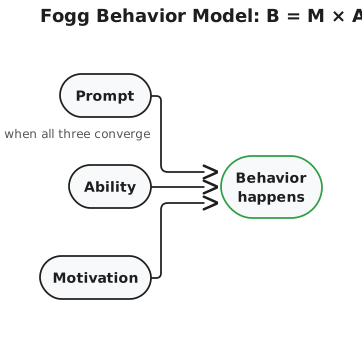
BJ Fogg's Behavior Model compresses a large body of social psychology into a single diagnostic: B = Motivation × Ability × Prompt. Behavior occurs only when a prompt arrives at a moment when motivation and ability are both sufficient. Miss any one factor and the behavior doesn't fire.
The practical implication is almost always the same: most teams over-invest in motivation — better copy, stronger emotional appeals — when the real blocker is ability. If completing the action requires too many steps, too much cognitive load, or too much time, a highly motivated user still won't do it. The Fogg prescription is to reduce friction first: simplify the action and cut steps. Prompts (push notifications, UI nudges) are only useful if the other two factors are already in place; firing more prompts into a low-ability experience accelerates uninstalls.
The streak as a sunk-cost engine
A 100-day Duolingo streak is accumulated sunk cost — past investment that has no bearing on future value but feels devastatingly real. Snapping the streak triggers loss aversion: in Prospect Theory, Kahneman and Tversky established that a loss feels roughly 2× as painful as an equivalent gain feels good. The dread of resetting to zero outweighs the motivation to learn, which is why streaks drive retention far more effectively than any equivalent reward would.
Snapchat's hourglass
Snapchat operationalized loss aversion with blunt precision. An hourglass emoji appears when a Snapstreak is at risk, producing immediate anxiety calibrated to feel like an emergency. Users have shared account credentials with friends just to keep a counter from resetting while they were away — behavior that is clearly irrational unless you understand that the Endowment Effect inflates the perceived value of what's about to be lost. The hourglass is loss aversion as a product feature.
Flow, difficulty & open loops
Two psychological phenomena — one about the conditions for peak engagement, one about the pull of the unfinished — give product designers precise levers for extending sessions and pulling users back.
Flow: challenge meets skill
Mihaly Csikszentmihalyi described a narrow channel where challenge and skill are balanced: inside it, attention is total, time distorts, and effort feels effortless. This is the flow state. Above the channel, excess difficulty produces anxiety; below it, insufficient challenge produces boredom. Both states drive churn.
Dynamic Difficulty Adjustment is the engineering answer to this problem. Systems that track performance in real time and modulate challenge accordingly keep users inside the flow channel longer. Duolingo tunes course structure to the pace at which each individual user is actually learning — not a fixed curriculum, but a personalized difficulty curve. When a task is perfectly calibrated to current skill, the user doesn't disengage; they level up and keep going.
Weaponizing the open loop
The Zeigarnik Effect is the reliable finding that people remember and are drawn back to incomplete tasks more strongly than completed ones. Bluma Zeigarnik documented this in the 1920s; app designers discovered it makes a reliable retention mechanic.
Progress bars that stick at 95%, nudges that say "just 2 more cards to complete Level 1," and session endings that unlock the next chapter without letting you start it all manufacture the same cognitive itch. The brain treats the incomplete task as an open file it can't close. That itch is then targeted by a push notification timed to arrive when the user is idle — closing the Zeigarnik loop is exactly what re-opening the app does. The cycle is deliberate: end the session on a cliff, fire the notification at the right moment, bring the user back to finish.
Key terms
- Hook Model
- Nir Eyal's four-stage habit loop from his 2014 book Hooked: Trigger → Action → Variable Reward → Investment. Each pass through the loop makes the product harder to leave and more likely to be opened again.
- B = MAP (Fogg Behavior Model)
- Behavior = Motivation × Ability × Prompt — a behavior occurs only when a prompt arrives while motivation and ability are both sufficient.
- Loss aversion
- From Kahneman and Tversky's Prospect Theory: losses feel roughly twice as psychologically powerful as equivalent gains. It is the engine behind streaks — breaking one triggers pain disproportionate to what was actually lost.
- Endowment effect
- The tendency to value something more highly simply because you own it. Investment inside an app (data, content, reputation) activates this effect, making the product feel more valuable and raising switching costs.
- Flow state
- Mihaly Csikszentmihalyi's channel of optimal engagement where challenge matches skill. Too easy breeds boredom; too hard breeds anxiety; both drive churn. The design goal is to keep users inside the flow channel.
- Dynamic Difficulty Adjustment
- Systems that analyze a user's performance in real time and modulate challenge to keep them inside the flow channel — Duolingo tunes course structure to how fast each user learns.
- Zeigarnik effect
- The finding that people remember and are drawn back to incomplete tasks more strongly than completed ones. Apps weaponize it with progress bars stuck at 95%, '2 more cards' prompts, and chapters that unlock but don't let you start.
Key concepts
The Endowment Effect
- A cognitive bias in which people overvalue what they already own.
- In the Hook Model's investment stage, it's why loading in contacts, preferences, and history raises a user's switching cost.
- It also explains sharing account credentials rather than letting a Snapstreak reset — the about-to-be-lost thing feels inflated in value.
Prospect Theory
- A behavioral-economics framework from Kahneman and Tversky about how people weigh gains against losses.
- Its central finding: a loss feels roughly twice as painful as an equivalent gain feels good.
- It's the reason a 100-day streak's threatened reset drives retention harder than any equal-sized reward could.
The Flow State
- Mihaly Csikszentmihalyi described this as a narrow channel where challenge and skill are balanced.
- Inside it, attention is total, time distorts, and effort feels effortless.
- Rise above the channel and excess difficulty breeds anxiety; drop below and too little challenge breeds boredom — both drive churn.
Dynamic Difficulty Adjustment
- The engineering answer to keeping users inside the balanced-challenge channel.
- Systems that track performance in real time and modulate the challenge to match keep users engaged longer.
- Duolingo applies it by tuning course structure to each learner's actual pace instead of a fixed curriculum.
Key facts
The Hook Model
In Hooked (2014), Nir Eyal distilled how habit-forming products work into a four-stage loop: Trigger → Action → Variable Reward → Investment. Run a user through it enough times and the app stops needing to remind them — they reach for it on their own.
What Starts The Loop
In the Hook Model, the Trigger is the cue that kicks off the loop — it can be external, like a notification, or internal, like boredom.

Open, Scroll, Tap
The Hook Model's Action stage is the simplest possible behavior done in anticipation of a reward — opening the app, scrolling, tapping. The lower the friction, the more reliably it happens.

Why Leaving Feels Like Losing
The Hook Model's Investment stage works through the Endowment Effect: users overvalue the profile, history, and social graph they've already built, so every bit invested raises the cost of switching apps.
B = MAP
BJ Fogg's Behavior Model says behavior happens only when three things converge at once: B = Motivation × Ability × Prompt. A prompt fires, but it only succeeds if motivation and ability are both high enough at that moment. Miss any factor and nothing happens.
Teams Over-Invest In Motivation
Product teams tend to pour effort into motivation — better copy, stronger appeals — when the real blocker is usually ability. A highly motivated user still won't act if the steps are too many.
More Prompts, More Uninstalls
Prompts only work once motivation and ability are already in place. Firing more push notifications into a low-ability experience just annoys people and accelerates uninstalls.
Flow: challenge meets skill
Mihaly Csikszentmihalyi's Flow Theory describes a channel of optimal engagement where challenge matches skill. Too easy and the user is bored; too hard and they're anxious — both drive churn. The sticky app keeps the user inside the channel.
Weaponizing the open loop
Designers exploit the Zeigarnik Effect with progress bars stuck at 95%, 'just 2 more cards to complete Level 1' nudges, and session endings that unlock the next chapter without letting you start it. The itch of the unfinished loop is then closed by a push notification — perfectly timed to pull you back.

Csikszentmihalyi Named Flow
Psychologist Mihaly Csikszentmihalyi described the flow state — the channel where challenge and skill are in balance. Other researchers named different mechanisms: Eyal's Hook Model, Fogg's B=MAP, and Zeigarnik's pull of unfinished tasks.
When Challenge Outpaces Skill
Push difficulty too far above a user's skill and flow theory predicts anxiety, not engagement — the user feels overwhelmed and churns. Drop it too far below and boredom does the same job in reverse.
Dynamic Difficulty Adjustment
Dynamic Difficulty Adjustment tracks a user's performance in real time and tunes challenge to keep them inside the flow channel. Duolingo applies the idea at the course level, adjusting structure to each learner's pace instead of running one fixed curriculum.
By the numbers
- In Prospect Theory, a loss feels about how many times as powerful as an equal gain?
- 2 x
Matched pairs
Each item on the left goes with the one on the right.
- Trigger
- The cue that starts the loop — external (notification) or internal (an emotion)
- Action
- The simplest behavior done in anticipation of reward — open, scroll, tap
- Variable Reward
- An unpredictable outcome — a funny post, a good trade, a match
- Investment
- Something the user puts in — data, content, reputation — that improves the next use
- Low motivation, high ability
- Use a 'spark' — emotional appeal, social proof, a FOMO trigger
- Both motivation and ability high
- A simple signal suffices — the notification sound alone drives the behavior
- Challenge far below skill
- Boredom — the user disengages and churns
- Challenge far above skill
- Anxiety — the user feels overwhelmed and churns
Step by step
Run a user through one turn of the Hook Model loop
- Trigger — fire an external cue (notification, badge) or catch an internal one (boredom, loneliness).
- Action — make the user do the simplest behavior in anticipation of reward (open, scroll, tap).
- Variable Reward — deliver an unpredictable outcome (a funny post, a good trade, a match).
- Investment — get the user to put something in (data, content, reputation) that improves the next loop.
Each pass through investment loads the next trigger and raises switching costs, tightening the loop over time.
Self-test
Answer each question from memory, then check your work against the answer key.
1. What is the correct order of the four stages of Nir Eyal's Hook Model?
- AAction → Trigger → Investment → Variable Reward
- BTrigger → Action → Variable Reward → Investment
- CTrigger → Variable Reward → Action → Investment
- DInvestment → Trigger → Action → Variable Reward
2. In the Hook Model, what is the role of the Trigger stage?
- AData the user loads in that improves the next use
- BThe simplest behavior done in anticipation of reward
- CThe unpredictable payoff that releases dopamine
- DThe cue that starts the loop — external or internal
3. Which Hook Model stage is 'the simplest behavior done in anticipation of a reward — open, scroll, tap'?
- AInvestment
- BVariable Reward
- CAction
- DTrigger
4. An app delivers an unpredictable payoff to keep dopamine high and users coming back. Which Hook stage is this?
- AVariable Reward
- BTrigger
- CAction
- DInvestment
5. Which of the following is NOT one of the four stages of the Hook Model?
- AInvestment
- BReinforcement
- CTrigger
- DAction
6. In the Hook Model, the Investment stage raises a user's switching cost by exploiting which psychological bias?
- AEndowment Effect
- BLoss aversion
- CSunk cost fallacy
- DAvailability heuristic
7. Why does an unpredictable in-app reward drive more compulsive return visits than a predictable one?
- AUnpredictable rewards make the Action stage easier to perform
- BUnpredictable rewards require the user to invest data first
- CUnpredictable outcomes release more dopamine than predictable
- DUnpredictable rewards are objectively larger in value than predictable ones
8. According to the Hook Model, what does a user invest that raises switching costs?
- AExtra storage space bought inside the app
- BA one-time subscription payment at signup
- CThe time spent during the onboarding tutorial
- DContacts, preferences, and history
9. In the Hook Model, what does a completed Investment stage do for the next pass through the loop?
- AIt permanently resets the app's Variable Reward system to fixed payouts
- BIt converts the Action stage into a one-time event
- CIt removes the need for any future Trigger stage
- DIt improves the next Trigger and Reward, deepening the loop
10. Why does loading contacts, preferences, and history into an app raise a user's switching cost?
- AMotivation mechanically rises with each data point added
- BThe Endowment Effect makes users overvalue what they already own
- CNotifications automatically increase with more data
- DThe app becomes technically impossible to export data from
11. A user has high motivation but low ability to complete the action. What does the Fogg model say to do?
- AReduce friction — simplify the action and cut steps
- BWait for motivation to rise on its own
- CSend more notifications
- DAdd a FOMO spark to raise motivation
12. In Fogg's Behavior Model (B=MAP), how do Motivation, Ability, and a Prompt combine to produce a behavior?
- AThey must occur in a fixed sequence
- BThey add together to cross a behavior threshold
- CThey multiply — if any one is zero, the behavior won't happen
- DOnly the strongest of the three decides the outcome
13. According to Fogg, which factor do most teams over-invest in while missing the real blocker?
- AReward
- BAbility
- CPrompt
- DMotivation
14. When both motivation and ability are already high, what does the Fogg model say is enough to fire the behavior?
- AA larger, more unpredictable reward
- BA simple prompt or signal, like a notification sound
- CCutting even more steps to raise ability
- DA strong emotional spark to lift motivation further
15. In a low-ability experience, what does firing more prompts (push notifications) tend to do?
- ASubstitute for the missing motivation
- BReliably trigger the target behavior
- CAccelerate uninstalls
- DRaise the user's ability to act
16. In Prospect Theory, a loss feels roughly how many times as psychologically powerful as an equivalent gain?
- AAbout 2×
- BAbout 5×
- CAbout 10×
- DAbout 1.5×
17. Loss aversion and the roughly 2x loss-versus-gain asymmetry come from whose Prospect Theory?
- AKahneman and Tversky
- BMihaly Csikszentmihalyi
- CBluma Zeigarnik
- DFogg and Eyal
18. The endowment effect is best defined as the tendency to:
- AKeep going because of past investment that can't be recovered
- BFeel losses about twice as strongly as equivalent gains
- CValue something more highly simply because you own it
- DBe drawn back more strongly to unfinished tasks
19. Users share account credentials with friends just to keep a Snapstreak alive. Which explains this best?
- AA variable reward, like a slot machine
- BThe Zeigarnik effect closing an open loop
- CThe flow state and dynamic difficulty adjustment
- DLoss aversion inflated by the endowment effect
20. Which statement about loss aversion is FALSE?
- AIt comes from Kahneman and Tversky's Prospect Theory
- BA loss and an equal gain feel about equally powerful
- CLosses feel roughly twice as powerful as equal gains
- DIt is the engine behind streak mechanics
21. Which design tactic weaponizes the Zeigarnik effect to pull users back into an app?
- AShowing a completion certificate the moment a course hits 100%
- BEnding a session just as the next chapter unlocks but won't let you start it
- CGiving a flat daily login bonus regardless of progress
- DDisplaying a leaderboard of the top scorers
22. Who described the flow state — the channel where challenge and skill are balanced?
- ABluma Zeigarnik
- BBJ Fogg
- CNir Eyal
- DMihaly Csikszentmihalyi
23. In flow theory, what happens when challenge is far above the user's skill?
- AFlow — total absorption and time distortion
- BMastery — the user levels up and continues
- CAnxiety — the user feels overwhelmed and churns
- DBoredom — the user disengages and churns
24. What is Dynamic Difficulty Adjustment designed to do?
- ATrack performance in real time and modulate challenge to keep users in the flow channel
- BFire a push notification whenever the user goes idle
- CInsert unpredictable rewards into a scrolling feed
- DReset a streak counter to zero to trigger loss aversion
25. The Zeigarnik effect is the finding that people are drawn back most strongly to which kind of task?
- ATasks that offer the largest rewards
- BTasks done together with friends
- CTasks left incomplete
- DTasks they have fully finished
Go deeper
- ReadHooked by Nir Eyal, Ryan Hoover · on Amazon ↗
- StudyThe Science of Sticky Apps in the FlashFeed app
These are affiliate links: if you buy a book through one, FlashFeed may earn a small commission at no extra cost to you. The commission helps pay for FlashFeed's servers.
As an Amazon Associate we earn from qualifying purchases.
Answer key
- 1. B Trigger → Action → Variable Reward → InvestmentEyal's loop runs Trigger → Action → Variable Reward → Investment. The cue starts it, the action is the simple behavior, the reward is unpredictable, and investment feeds back into the next loop.
- 2. D The cue that starts the loop — external or internalThe Trigger is the cue that starts the loop; it can be external (a notification) or internal (an emotion like boredom). The other options describe Variable Reward, Action, and Investment.
- 3. C ActionAction is the simplest behavior a user performs expecting a reward. The lower the friction, the more reliably it happens.
- 4. A Variable RewardVariable Reward is the unpredictable payoff. Unpredictable outcomes release more dopamine than predictable ones, which is why a slot machine beats a vending machine as a habit engine.
- 5. B ReinforcementThe four stages are Trigger, Action, Variable Reward, and Investment. 'Reinforcement' is not one of them.
- 6. A Endowment EffectInvestment works through the Endowment Effect: users overvalue what they already own — their accumulated profile, history, and social graph inside the app. Each piece of data loaded in raises switching costs and compounds retention over time.
- 7. C Unpredictable outcomes release more dopamine than predictableEyal's Hook Model relies on the finding that unpredictable outcomes release more dopamine than predictable ones — the reason a slot machine outperforms a vending machine as a habit engine.
- 8. D Contacts, preferences, and historyThe Investment stage is built from what users load in — contacts, preferences, and history — which raises switching costs and feeds back into future triggers and rewards.
- 9. D It improves the next Trigger and Reward, deepening the loopEach pass through Investment feeds back into the loop: the data a user adds improves future Triggers and Rewards, compounding retention over time.
- 10. B The Endowment Effect makes users overvalue what they already ownInvestment works through the Endowment Effect: users overvalue their accumulated profile and social graph, so leaving feels like losing something valuable. That raises switching cost and compounds retention.
- 11. A Reduce friction — simplify the action and cut stepsMotivation is already high, so the blocker is ability. Simplify the action — cut taps and steps — to lower the ability threshold the prompt needs.
- 12. C They multiply — if any one is zero, the behavior won't happenB = MAP is multiplicative: Motivation, Ability, AND a Prompt must all be present at once. If any factor is zero the product is zero and no behavior occurs — which is why it's × not +.
- 13. D MotivationTeams over-invest in motivation — better copy, stronger appeals — when the real blocker is usually ability. A highly motivated user still won't act if the action has too many steps.
- 14. B A simple prompt or signal, like a notification soundWith motivation and ability both sufficient, a simple signal suffices — the notification alone drives the behavior. Sparks are for low motivation; simplifying is for low ability.
- 15. C Accelerate uninstallsPrompts only help when motivation and ability are already in place. Firing more prompts into a low-ability experience just annoys users and accelerates uninstalls.
- 16. A About 2×Kahneman and Tversky established that a loss feels roughly 2× as painful as an equivalent gain feels good — the asymmetry that makes breaking a streak so effective at driving retention.
- 17. A Kahneman and TverskyKahneman and Tversky's Prospect Theory established loss aversion and the ~2x asymmetry. Fogg (B=MAP), Csikszentmihalyi (flow), and Zeigarnik (open loops) are associated with other ideas.
- 18. C Value something more highly simply because you own itThe endowment effect is overvaluing what you own. Feeling losses about twice as strongly is loss aversion, the pull of unfinished tasks is the Zeigarnik effect, and staying for sunk investment is the sunk-cost fallacy.
- 19. D Loss aversion inflated by the endowment effectThe behavior is irrational unless the endowment effect inflates the perceived value of the streak about to be lost, and loss aversion makes that loss feel devastating. The hourglass is loss aversion as a feature.
- 20. B A loss and an equal gain feel about equally powerfulThe false statement is that losses and gains feel equal — Prospect Theory shows losses feel about 2× as powerful, which is exactly why streaks drive retention.
- 21. B Ending a session just as the next chapter unlocks but won't let you start itThe Zeigarnik effect is the pull of unfinished tasks. Designers manufacture that itch — a chapter that unlocks but won't start, or progress stuck at 95% — then fire a push notification when you're idle to bring you back and close the loop.
- 22. D Mihaly CsikszentmihalyiCsikszentmihalyi described the flow channel. Eyal built the Hook Model, Fogg the B=MAP model, and Zeigarnik documented the pull of unfinished tasks.
- 23. C Anxiety — the user feels overwhelmed and churnsAbove the flow channel, excess difficulty produces anxiety; below it, insufficient challenge produces boredom. Both drive churn.
- 24. A Track performance in real time and modulate challenge to keep users in the flow channelDDA tracks performance in real time and tunes challenge to keep users inside the flow channel — Duolingo tunes course structure to each user's learning pace rather than a fixed curriculum.
- 25. C Tasks left incompleteThe Zeigarnik effect is that incomplete tasks are remembered and pull us back more strongly than completed ones. The brain treats the unfinished task as an open file it can't close.
Sources
- Dan Silvestre — Hooked by Nir Eyal: Summary and Notes — dansilvestre.com/summaries/hooked-book-summary/
- Nir Eyal — Hooked: How to Build Habit-Forming Products (official book site) — www.nirandfar.com/hooked/
- Nir Eyal, Hooked: How to Build Habit-Forming Products (2014)
- The Science of Sticky Apps — research compilation (Perplexity)
Image credits
- Open, Scroll, Tap: Openverse · cc0 1.0 — www.rawpixel.com/image/6113725/photo-image-iphone-phone-public-domain
- Why Leaving Feels Like Losing: AI-generated (gpt-image-1.5)
- B = MAP: FlashFeed original diagram · CC-BY-4.0
- Csikszentmihalyi Named Flow: Wikimedia Commons · Ehirsh · Public domain — commons.wikimedia.org/wiki/File:Mihaly_Csikszentmihalyi.jpg
