
The Science of Sticky Apps study guide · Lesson 4 of 11
Gamification Mechanics
PBL & Octalysis · The streak mechanic (Duolingo) · Goal gradient & reward schedules
Unofficial study guide for Hooked: How to Build Habit-Forming Products by Nir Eyal, Ryan Hoover. FlashFeed is not affiliated with the author or publisher.
This is the lesson's study guide from the FlashFeed app, plus its key facts and a self-test.
What you'll be able to do
- Define the PBL (Points, Badges, Leaderboards) surface layer and explain why it is shallow gamification prone to habituation.
- Identify Octalysis's eight Core Drives and the principle of stacking several at once; recognize Epic Meaning and Ownership.
- Explain the Duolingo streak and Streak Freeze as loss-aversion engines that turn a habit into protected sunk cost.
- Cite Duolingo's DAU and DAU/MAU growth from IPO to Q1 2025 as evidence the streak mechanic drives retention.
- Explain the Goal Gradient Effect (Saga Map, pre-stamped card) and classify the four reinforcement schedules.
PBL & Octalysis
Gamification begins with the tools most designers reach for first — points, badges, leaderboards — and the framework that explains why those tools alone are rarely enough.
The PBL stack
Points, Badges, and Leaderboards are the surface layer of gamification: visible, legible reward elements that are straightforward to implement and easy for users to understand. That legibility is also their liability. When every app runs the same system, nothing feels distinctive, and users habituate — the reward loses salience because repetition flattens it. PBL works best as scaffolding, not as the whole structure. Designers who stop at PBL tend to see strong early engagement followed by a plateau, because novelty accounts for most of the lift. The deeper work of retention requires reaching further down into what actually drives human behavior: identity, narrative, and social meaning.
Stack the drives
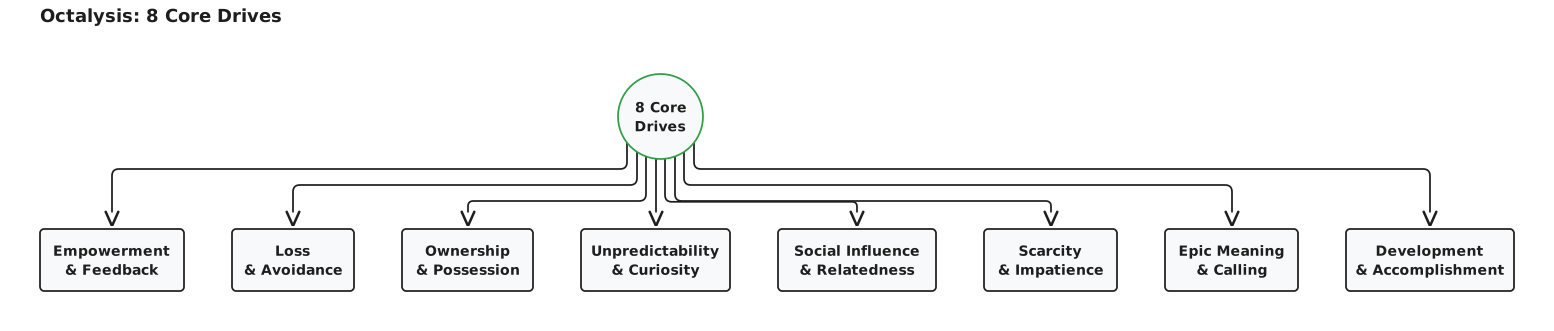
Yu-kai Chou's Octalysis framework maps motivation onto 8 Core Drives: Epic Meaning & Calling, Development & Accomplishment, Empowerment of Creativity, Ownership & Possession, Social Influence & Relatedness, Scarcity & Impatience, Unpredictability & Curiosity, and Loss & Avoidance. Epic Meaning is the drive of belonging to something larger than yourself — the pull of a mission, a story, a community with stakes bigger than one person. Ownership & Possession is the drive to accumulate and protect things you feel are yours — virtual currency, streaks, customized profiles. No single drive sustains engagement indefinitely; each has a ceiling. The craft is engaging several at once, so when one drive weakens its grip, another picks up the slack. The most durable apps are rarely optimized for one Core Drive — they are surfaces that fire multiple drives simultaneously, keeping users tethered through different psychological channels at different moments.
The streak mechanic (Duolingo)
Loss aversion is one of the most reliable levers in behavioral design. Duolingo's streak mechanic is the industry's clearest example of that principle operating at scale.
The streak as a hostage
Duolingo's streak counts consecutive days of practice. The framing is critical: a streak is not a prize you collect — it is something you can lose. Miss a single day and the counter resets to zero. That reset is the mechanism's engine. Behavioral economics calls it loss aversion: the pain of losing something already held outweighs the pleasure of gaining something equivalent. A streak of 90 days holds more psychological weight than a promise of a future badge, because it already exists and is already at risk. The longer it runs, the larger the sunk cost, and the harder it becomes to rationalize walking away. Duolingo amplifies this with the Streak Freeze — a purchasable or earnable item that protects the streak during an absence — which is itself a product of the streak's value. Users buy insurance for a number.
Motivated or stressed — both come back
Duolingo users report mixed reactions to the streak — some describe it as motivating, others as stressful — but the retention outcome is the same either way: both groups keep coming back. Anxiety is engagement without pleasure. From a product standpoint, Duolingo captures both. The data behind the mechanic is hard to dismiss: Duolingo had 9.1 million daily active users in Q2 2021, the quarter of its IPO; by Q1 2025 that figure was 46.6 million — a 412% increase. Its DAU/MAU ratio climbed from about 24% to about 36%, meaning a growing share of monthly users became daily habits.
Goal gradient & reward schedules
Two well-established behavioral principles underpin most reward system design: the Goal Gradient Effect and Skinnerian reinforcement schedules. Understanding both explains why some reward systems produce compulsion while others produce indifference.
The Saga Map
Duolingo's Saga Map — a winding path of lesson nodes with progress clearly marked — is a direct implementation of the Goal Gradient Effect: the empirical finding that people accelerate their effort as they approach a goal. Completion rates spike near checkpoints, not because the task gets easier but because proximity to a reward increases perceived value of reaching it. The design principle that follows is simple: always show users how close they are to the next milestone. Progress bars, node maps, and experience-point counters all exploit the same mechanism. Hiding progress — or making it vague — removes the accelerant.
The pre-stamped punch card
A pre-stamped coffee loyalty card with two of ten holes already punched dramatically outperforms a blank ten-hole card, even though both require exactly ten purchases to redeem. The pre-stamps create an illusion of being already underway, triggering the Goal Gradient Effect before any real investment has occurred. This is the logic behind starter bonuses, welcome XP, and "you're 30% of the way there" onboarding messages. Reinforcement schedules from B.F. Skinner's operant conditioning research set the reward timing layer: fixed ratio (10 XP per 10 cards), fixed interval (daily login bonus), variable ratio (mystery chest / loot box), and variable interval (when the next match arrives). Variable-ratio reinforcement produces the highest and most persistent response rates — and the greatest resistance to extinction — which is why loot boxes and randomized drops are so widely used.
Key terms
- PBL (Points, Badges, Leaderboards)
- The surface layer of gamification: visible, legible reward elements that are also easy to habituate to. Durable engagement requires deeper mechanics at the level of narrative, identity, and social positioning.
- Octalysis
- Yu-kai Chou's framework identifying eight Core Drives that motivate behavior — from Epic Meaning to Ownership to Social Influence. The most durable apps engage multiple core drives at once.
- Streak Freeze
- A purchasable or earnable item that protects a streak during an absence. It converts the streak from a source of attrition-driving anxiety into a resource-management meta-game that deepens investment.
- Goal Gradient Effect
- The tendency to accelerate effort as you approach a milestone — the closer the reward, the harder people push toward it.
- Variable-ratio reinforcement
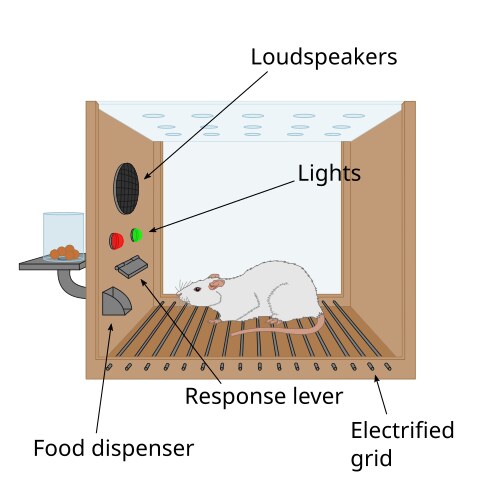
- A reinforcement schedule, from B.F. Skinner's 1950s experiments, in which rewards arrive after an unpredictable number of actions. Rats on this schedule pressed the lever far more often and persistently than those on fixed schedules.
Key concepts
Fixed-Ratio Reinforcement
- One of four operant-conditioning schedules that set the reward-timing layer of a gamified system.
- This one pays out after a set number of actions, and its predictability makes it far less compulsive than the unpredictable schedules.
- Duolingo's textbook example: 10 XP for every 10 cards you complete.
Fixed-Interval Reinforcement
- One of the four operant-conditioning schedules from Skinner's research.
- It delivers its reward after a set amount of time passes, no matter how much activity you put in.
- The everyday app version is the once-a-day login bonus.
Variable-Interval Reinforcement
- One of the four operant-conditioning schedules, and one of the two unpredictable ones.
- Its reward arrives after an unpredictable amount of time rather than after a set count of actions.
- In app terms, it's the open-ended wait for when your next match shows up.
Key facts
The PBL stack
Points, Badges, and Leaderboards are the surface layer of gamification — visible, legible, and easy to bolt on. They're also easy to habituate to. The deeper mechanics work at the level of narrative, identity, and social positioning.
Stack the drives
Octalysis names eight Core Drives. The trick isn't picking the right one — it's engaging several at once. The most durable apps fire multiple Core Drives simultaneously, so when one loses its grip another keeps the user tethered.
The PBL Plateau
Rely on points, badges, and leaderboards alone and engagement typically follows a familiar arc: a strong early lift, then a plateau. Most of that initial lift comes from novelty, and once the shine wears off, PBL alone can't keep growth going.
Belonging To Something Bigger
In Octalysis, the Epic Meaning & Calling Core Drive is the pull of feeling part of something larger than yourself — a mission, story, or community with stakes bigger than one person.
The Ownership Drive
Octalysis' Ownership & Possession Core Drive is the pull to accumulate and protect things that feel like yours — virtual currency, streaks, and customized profiles are its typical expressions.
The streak as a hostage
Duolingo's streak is the canonical case of loss aversion at retention scale. A streak isn't a reward you earn — it's a thing you can lose. Miss a day and the counter resets to zero. The longer it runs, the more you have at stake, and the harder it is to walk away.
Motivated or stressed — both come back
Duolingo users report mixed reactions to the streak — some find it motivating, others stressful — yet both groups keep coming back. Duolingo profits either way: anxiety is engagement that simply doesn't feel good.
Insuring The Streak
Duolingo's Streak Freeze is a purchasable or earnable item that protects a streak during an absence. It's effectively insurance for a number — itself proof of how much value users place on the streak.
Too Deep To Quit
The longer a Duolingo streak runs, the harder it becomes to walk away — each additional day adds to a growing sunk cost the user is reluctant to forfeit. It's the escalating investment, not new rewards, that raises the stakes over time.
Duolingo's 521% Climb
Duolingo's daily active users grew from 7.5 million at its 2021 IPO to 46.6 million by Q1 2025 — a 521% increase, and the headline evidence that the streak mechanic drives retention.
The Saga Map
Duolingo's Saga Map — a winding path of nodes showing how far you've come — exploits the Goal Gradient Effect. Completion rates climb sharply near checkpoints. The design rule it teaches: always show users how close they are to the next reward.
The pre-stamped punch card
A coffee-shop loyalty card with two of ten holes pre-stamped dramatically outperforms a blank ten-hole card — even though both require ten purchases. Faking early progress triggers the Goal Gradient Effect: people who feel underway accelerate toward the finish.
The Goal Gradient Effect
The Goal Gradient Effect is the finding that people accelerate their effort the closer they get to a goal — proximity to a reward makes it feel more valuable, so the final stretch gets the most energy.
Reward Every Ten Cards
A fixed-ratio schedule delivers a reward after a set number of actions, like 10 XP for every 10 cards reviewed. It's one of several reinforcement patterns — loot boxes run on variable ratio, and daily login bonuses run on fixed interval.
Why Loot Boxes Work
Variable-ratio reinforcement — rewards after an unpredictable number of actions — produces the highest, most persistent response rates of any schedule, with the greatest resistance to extinction. That's why loot boxes and randomized drops are so widely used.
By the numbers
- How many Core Drives does Yu-kai Chou's Octalysis Framework identify?
- 8 drives
- Duolingo's daily active users at its 2021 IPO
- 7.5 million-users
- Duolingo's daily active users in Q1 2025
- 46.6 million-users
- Duolingo's DAU growth from its 2021 IPO to Q1 2025
- 521 %
- Duolingo's DAU/MAU ratio at its 2021 IPO
- 21 %
- Duolingo's improved DAU/MAU ratio by Q1 2025
- 36 %
Matched pairs
Each item on the left goes with the one on the right.
- Epic Meaning
- The drive of belonging to something larger than yourself
- Ownership & Possession
- The drive to accumulate and protect things you feel are yours
- Variable Ratio
- Mystery chest / loot box
- Fixed Ratio
- 10 XP per 10 cards
- Fixed Interval
- Daily login bonus
- Variable-interval reinforcement
- When will the next match arrive?
Step by step
The Streak Freeze meta-loop that makes Duolingo's streak nearly impossible to abandon
- Build a long streak through daily practice, raising the stakes of breaking it.
- Feel loss aversion intensify as the counter climbs.
- Acquire Streak Freezes — by purchase or by earning them in-app — as insurance.
- Engage with the app specifically to stock up on that insurance.
- When a day is missed, a Freeze spends itself and the streak survives.
- Return with the streak intact and the loss-aversion grip unbroken.
The genius is recursive: users now engage with the app to insure the very thing that makes them engage with the app.
Rank the four main reward schedules from MOST to LEAST durable (resistance to extinction)
- Variable Ratio — unpredictable number of actions per reward; very high resistance (the slot machine).
- Variable Interval — unpredictable time between rewards; high resistance and sustained anticipation.
- Fixed Ratio — a reward every Nth action; low resistance, fast habituation.
- Fixed Interval — a reward on a predictable clock; low resistance and easily gamed.
Variable beats fixed; ratio beats interval. The variable-ratio schedule is the backbone of infinite scroll and notification pacing.
Self-test
Answer each question from memory, then check your work against the answer key.
1. Why is the PBL (Points, Badges, Leaderboards) layer considered shallow gamification?
- AIt cannot be layered with any other game mechanic
- BIt depends entirely on real-money purchases to work
- CIt's visible and legible but easy to habituate to
- DIt rewards only the top-ranked users and ignores everyone else
2. What does PBL stand for in the surface layer of gamification?
- APoints, Badges, Leaderboards
- BProgress, Bonuses, Levels
- CPoints, Boosts, Loot
- DPerks, Badges, Ladders
3. Which of these is NOT one of the three elements of the PBL surface layer?
- ALeaderboards
- BStreaks
- CPoints
- DBadges
4. What engagement pattern do designers typically see when they rely on PBL alone?
- AImmediate churn with no early lift at all
- BSteady linear growth that never plateaus
- CLow initial uptake that compounds over years
- DStrong early engagement followed by a plateau
5. Durable engagement beyond PBL requires reaching deeper into which level of motivation?
- ANarrative, identity, and social positioning
- BHigher point values and more badges
- CLarger leaderboards with more competitors
- DFaster loading times and cleaner UI
6. Octalysis names **eight ___**. The trick isn't picking the right one — it's engaging *several at once*. The most durable apps fire multiple ___ simultaneously, so when one loses its grip another keeps the user tethered.
- AReward Schedules
- BPlayer Types
- CCore Drives
- DBehavior Triggers
7. How many Core Drives does Yu-kai Chou's Octalysis framework identify?
- A10
- B8
- C12
- D6
8. In Octalysis, which Core Drive is defined as belonging to something larger than yourself?
- AOwnership & Possession
- BScarcity & Impatience
- CDevelopment & Accomplishment
- DEpic Meaning & Calling
9. Which Octalysis Core Drive covers virtual currency, streaks, and customized profiles?
- AUnpredictability & Curiosity
- BEmpowerment of Creativity
- CSocial Influence & Relatedness
- DOwnership & Possession
10. What does Octalysis say is the craft of durable design, given that each Core Drive has a ceiling?
- AOptimize relentlessly for one dominant Core Drive
- BEngage several Core Drives at once so another picks up the slack
- CRank users on how many drives they respond to
- DRotate to a new single drive every week
11. Which behavioral-economics principle is the engine behind Duolingo's streak mechanic?
- AGoal gradient effect
- BReciprocity
- CLoss aversion
- DSunk cost fallacy
12. What is Duolingo's Streak Freeze?
- AA purchasable or earnable item that protects a streak during an absence
- BA daily reminder notification to keep the streak alive
- CA leaderboard that ranks the longest streaks
- DA penalty that pauses XP earning after a missed day
13. What happens to a Duolingo streak if the user misses a single day of practice?
- AIt drops by one day
- BThe counter resets to zero
- CIt loses points but keeps the day count
- DIt pauses until the next login
14. Why does a Duolingo streak become progressively harder to abandon the longer it runs?
- ALonger streaks unlock exponentially rarer badges
- BThe app raises the daily goal in step with the streak length
- CEach extra day multiplies the amount of XP the streak is worth
- DThe accumulated days act as a growing sunk cost the user is reluctant to forfeit
15. Some Duolingo users call the streak motivating and others call it stressful. Why does Duolingo capture both groups?
- AOnly the motivated users actually return the next day
- BStressed users eventually quit, an acceptable loss for the app
- CBoth reactions bring the user back — anxiety is engagement without pleasure
- DThe two groups cancel out, so the streak has no net effect
16. How many daily active users did Duolingo have at its 2021 IPO?
- A7.5 million
- B21 million
- C4.6 million
- D46.6 million
17. By Q1 2025, how many daily active users did Duolingo report?
- A36 million
- B52 million
- C41.5 million
- D46.6 million
18. What was Duolingo's DAU growth from its 2021 IPO to Q1 2025?
- A521%
- B236%
- C121%
- D46.6%
19. What was Duolingo's DAU/MAU ratio at its 2021 IPO?
- A62%
- B46%
- C21%
- D36%
20. Duolingo's DAU/MAU ratio climbed to 36% by Q1 2025. What does a rising DAU/MAU ratio indicate?
- ATotal downloads fell while revenue rose
- BA growing share of monthly users became daily habits
- CDaily users are opening the app fewer times each day
- DMonthly users are churning faster than before
21. Duolingo's 521% DAU growth is linked to which pattern as evidence the streak mechanic drives retention?
- ALaunch of variable-ratio loot box rewards
- BHigher revenue from Streak Freeze purchases
- CA drop in DAU offset by higher badge counts
- DRising DAU/MAU ratio showing daily-habit conversion
22. What does the DAU/MAU ratio rising from 21% to 36% indicate about the streak's retention effect?
- AUsers shifted from streaks to the Saga Map
- BMonthly active users declined overall
- CA growing share of monthly users became daily habits
- DStreak Freeze purchases replaced daily practice
23. A coffee loyalty card pre-stamped with 2 of 10 holes outperforms a blank 8-hole card, even though both require exactly eight purchases. Why?
- AThe pre-stamps create an illusion of being already underway, triggering the Goal Gradient Effect
- BCustomers feel reciprocity toward a shop that gave them a head start
- CThe pre-stamped card requires fewer total purchases to redeem
- DThe two free stamps act as a variable-ratio reward that boosts motivation
24. What is the Goal Gradient Effect?
- AUnpredictable rewards produce the strongest habits
- BPeople accelerate their effort as they approach a goal
- CEffort declines steadily as a task drags on
- DRewards feel larger the longer you wait for them
25. Duolingo's Saga Map — a winding path of lesson nodes with progress marked — is a direct implementation of which principle?
- ALoss aversion
- BReciprocity
- CThe Goal Gradient Effect
- DVariable-ratio reinforcement
26. Which reinforcement schedule is correctly matched to its example?
- AFixed ratio — 10 XP per 10 cards
- BVariable interval — 10 XP per 10 cards
- CFixed interval — mystery chest / loot box
- DVariable ratio — daily login bonus
27. Which Skinnerian reinforcement schedule produces the highest, most persistent response and the greatest resistance to extinction?
- AFixed interval
- BVariable interval
- CFixed ratio
- DVariable ratio
Go deeper
- ReadHooked by Nir Eyal, Ryan Hoover · on Amazon ↗
- StudyThe Science of Sticky Apps in the FlashFeed app
These are affiliate links: if you buy a book through one, FlashFeed may earn a small commission at no extra cost to you. The commission helps pay for FlashFeed's servers.
As an Amazon Associate we earn from qualifying purchases.
Answer key
- 1. C It's visible and legible but easy to habituate toPBL operates on the surface — points, badges, and leaderboards are easy to see and easy to tire of. Durable engagement comes from deeper drives like narrative, identity, and social positioning.
- 2. A Points, Badges, LeaderboardsPBL is Points, Badges, and Leaderboards — the visible, legible reward elements that are easy to bolt on but also easy to habituate to.
- 3. B StreaksPBL is Points, Badges, and Leaderboards. Streaks are a deeper loss-aversion mechanic, not part of the PBL surface layer.
- 4. D Strong early engagement followed by a plateauDesigners who stop at PBL tend to see strong early engagement then a plateau, because novelty accounts for most of the lift. Once the novelty of visible rewards fades, PBL alone can't sustain growth.
- 5. A Narrative, identity, and social positioningPBL works as scaffolding, not the whole structure. The deeper work of retention operates at the level of narrative, identity, and social meaning — not bigger versions of the same surface rewards.
- 6. C Core Drives
- 7. B 8Octalysis maps motivation onto eight Core Drives, from Epic Meaning & Calling to Loss & Avoidance.
- 8. D Epic Meaning & CallingEpic Meaning & Calling is the pull of a mission, story, or community with stakes bigger than one person. Ownership is about accumulating things you feel are yours.
- 9. D Ownership & PossessionOwnership & Possession is the drive to accumulate and protect things you feel are yours — virtual currency, streaks, and customized profiles are its typical expressions.
- 10. B Engage several Core Drives at once so another picks up the slackNo single drive sustains engagement indefinitely — each has a ceiling. The craft is firing several drives simultaneously, so when one weakens another keeps the user tethered.
- 11. C Loss aversionThe streak is framed as something you can lose, not a prize you collect. Loss aversion means the pain of losing an existing streak outweighs an equivalent future gain — so a 90-day streak already at risk pulls harder than a promised badge.
- 12. A A purchasable or earnable item that protects a streak during an absenceThe Streak Freeze is bought or earned and protects the streak during an absence. Users buy insurance for a number — itself a product of the streak's perceived value.
- 13. B The counter resets to zeroMiss one day and the counter resets to zero. That reset is the engine: the threat of losing an existing streak drives loss aversion.
- 14. D The accumulated days act as a growing sunk cost the user is reluctant to forfeitThe longer a streak runs, the larger the sunk cost and the harder it is to rationalize walking away. The escalating investment — not new rewards — is what raises the stakes over time.
- 15. C Both reactions bring the user back — anxiety is engagement without pleasureThe reactions feel opposed, but the retention outcome is identical: both groups came back. Anxiety is engagement without pleasure, so Duolingo profits either way.
- 16. A 7.5 millionDuolingo reported 7.5 million daily active users at its 2021 IPO, the baseline against which later growth is measured.
- 17. D 46.6 millionDuolingo's DAU reached 46.6 million by Q1 2025, up from 7.5 million at its 2021 IPO.
- 18. A 521%Growing from 7.5 million to 46.6 million DAU is a 521% increase, the headline evidence the streak mechanic drives retention.
- 19. C 21%The DAU/MAU ratio was 21% at the 2021 IPO; it later climbed to 36% by Q1 2025.
- 20. B A growing share of monthly users became daily habitsDAU/MAU rising from 21% to 36% means a growing share of monthly users turned into daily habits — the stickiness the streak mechanic is designed to produce.
- 21. D Rising DAU/MAU ratio showing daily-habit conversionDAU/MAU climbing from 21% to 36% means a growing share of monthly users became daily habits, the retention signal linked to the streak.
- 22. C A growing share of monthly users became daily habitsThe rising ratio means a growing share of monthly users became daily habits, the retention outcome credited to the streak mechanic.
- 23. A The pre-stamps create an illusion of being already underway, triggering the Goal Gradient EffectBoth cards require eight purchases, but the pre-stamped one creates an illusion of progress already underway — triggering the Goal Gradient Effect (people accelerate as they near a goal) before any real investment. Same logic powers starter bonuses and welcome XP.
- 24. B People accelerate their effort as they approach a goalThe Goal Gradient Effect is the empirical finding that people accelerate effort as they near a goal — proximity to a reward raises its perceived value.
- 25. C The Goal Gradient EffectThe Saga Map shows users exactly how close they are to the next milestone, exploiting the Goal Gradient Effect — completion rates spike near checkpoints.
- 26. A Fixed ratio — 10 XP per 10 cardsFixed ratio delivers a reward after a set number of actions — 10 XP per 10 cards. Loot boxes are variable ratio; the daily login bonus is fixed interval.
- 27. D Variable ratioVariable-ratio reinforcement — rewards after an unpredictable number of actions — produces the highest and most persistent response rates, which is why loot boxes and randomized drops are so widely used.
Image credits
- The Ownership Drive: FlashFeed original diagram · CC-BY-4.0
- Why Loot Boxes Work: Wikimedia Commons · AndreasJS (original), Pixelsquid (vector) · CC BY-SA 3.0 — commons.wikimedia.org/wiki/File:Skinner_box_scheme_01.svg
