
The Four Agreements study guide · Lesson 4 of 5
The Third & Fourth Agreements — Assumptions & Doing Your Best
The Third Agreement — Don't Make Assumptions · The Fourth Agreement — Always Do Your Best
Unofficial study guide for The Four Agreements: A Practical Guide to Personal Freedom by Don Miguel Ruiz. FlashFeed is not affiliated with the author or publisher.
This is the lesson's study guide from the FlashFeed app, plus its key facts and a self-test.
What you'll be able to do
- Explain how the mind invents stories and treats them as facts, why assumptions in relationships end in disappointment, and how direct communication helps.
- Explain the Fourth Agreement: your best is fluid, doing more than your best burns you out, and acting for the act itself ends the misery of working for rewards.
Lesson 4: The Third & Fourth Agreements — Assumptions & Doing Your Best
The Third Agreement — Don't Make Assumptions
The third agreement of the Toltec wisdom tradition is: Don't Make Assumptions. This agreement targets humanity's pervasive habit of fabricating mental stories, jumping to conclusions, and creating catastrophic emotional drama out of unverified interpretations.
The human mind has an innate aversion to ambiguity and the unknown. We have a profound psychological need to explain everything, to make sense of our environment, and to feel a sense of security and control. However, instead of asking questions to clarify reality, we instantly make Assumptions. We fabricate a plausible scenario in our imagination, believe our own creation with absolute certainty, and then react emotionally as if our fabricated story were an objective fact. We make assumptions about what people are thinking, why they looked at us in a certain way, why they didn't reply to a message, and what their hidden motives must be.
The catastrophic consequence of making assumptions is that we inevitably take our own assumptions personally. We imagine a negative motive behind someone's behavior, assume they intended to disrespect us, take it personally, and then retaliate by sending emotional poison with our word. This creates a massive storm of unnecessary conflict that was never really about us in the first place. Many relationship conflicts play out this way — not because of irreconcilable differences, but because assumptions were never brought into the light of honest inquiry.
A particularly destructive domain of assumptions occurs in romantic relationships. We frequently make the assumption that our partner knows us so well that they should instinctively know what we want, what we need, and how we feel without us having to say a word. When they fail to meet our unspoken expectations, we feel deeply hurt and resentful, thinking: "If they truly loved me, they would have known!" This is a total fantasy. Nobody, no matter how deeply they love you, possesses the telepathic ability to read your mind. Making assumptions in relationships sets a trap where disappointment is guaranteed.
Another common and toxic assumption is the belief that we can change someone else through our love. We see someone's flaws, dysfunction, or destructive habits and assume: "My love will save them; once we are together, they will change." Ruiz is blunt: your love will not change anybody. If people change, it is because they want to change, never to fulfill someone else's expectations. Real love is accepting people exactly as they are without trying to alter their nature to fit our personal dream.
The definitive antidote to making assumptions is simple, though it requires immense courage: Ask questions and communicate with absolute clarity. Whenever you are uncertain about someone's intentions, words, or actions, have the courage to ask: "What did you mean by that? Can you clarify what you need from me?" Speak your truth clearly and openly, expressing your authentic desires without manipulation. The day you stop making assumptions and begin communicating with radical transparency, your relationships will transform, your emotional energy will be restored, and you will achieve profound mental peace.
The Courage of Radical Transparency and Inquiry
The human habit of making assumptions is the primary architect of unnecessary suffering in human relationships. When confronted with an ambiguous situation or an unanswered question, the domesticated mind refuses to tolerate uncertainty. Instead, it immediately manufactures elaborate, fear-based narratives, assigns hidden motives to others, and proceeds to treat these imaginary stories as established facts.
The devastating cycle of assumption-making operates through a predictable psychological sequence: first, we make an assumption; second, we believe our fabricated story with absolute conviction; third, we take the assumption personally; fourth, we react with anger, defensiveness, or emotional withdrawal; and fifth, we retaliate by sending emotional poison with our word. This destructive sequence dismantles intimacy, destroys trust, and turns minor misunderstandings into catastrophic emotional crises.
The definitive spiritual antidote to this destructive pattern is the Third Agreement: Don't Make Assumptions. Practicing this agreement requires cultivating the courage to communicate with radical transparency. Whenever you find yourself unsure of someone's intent or expectations, pause and ask direct, clarifying questions: "Could you explain what you meant by that statement? What are your expectations in this situation? How are you feeling right now?" By replacing imaginary stories with authentic inquiry, you illuminate the darkness of misunderstanding with the light of truth, fostering deep harmony, clarity, and peace in all your connections.
The Fourth Agreement — Always Do Your Best
The fourth agreement is the practical engine that allows the other three agreements to become deeply integrated into your daily life: Always Do Your Best. While the first three agreements are lofty philosophical ideals, the fourth agreement is about active execution and grounded compassion for your human journey.
The foundational principle of the Fourth Agreement is that Your Best is never a fixed, static metric; your best changes from one moment to the next. Your best when you wake up refreshed, energized, and healthy is drastically different from your best when you are sick with the flu, exhausted after a grueling shift, or grieving an emotional loss. Your best in the morning is different from your best late at night; your best in a calm environment is different from your best during a crisis. Understanding the dynamic, fluid nature of "your best" is essential for cultivating deep self-compassion and avoiding the traps of perfectionism and self-reproach.
Don Miguel Ruiz warns against two opposite extremes regarding this agreement: doing more than your best and doing less than your best. When you try to do more than your best, you fall into the trap of perfectionism and compulsive overexertion. You deplete your vital life force, exhaust your physical body, burn out your nervous system, and ultimately prolong the time required to achieve your goals. Overachieving out of fear or the desperate desire to prove your worth causes you to sacrifice joy and well-being. Conversely, when you do less than your best, you leave the door wide open for the Inner Judge to attack you. The Judge seizes upon your half-hearted effort, condemns you for laziness, and subjects you to guilt, regret, shame, and self-recrimination.
When you consistently do your best—neither more nor less—you completely disarm the Inner Judge. The Judge cannot find you guilty when you have given the absolute best effort possible under the prevailing circumstances. Even if the external outcome is imperfect, you can sleep with a completely clear conscience, free from regret, because you know you held nothing back.
Doing your best requires taking action for the pure love of the action itself, rather than for the expectation of a reward. Don Miguel Ruiz shares the story of a man who went to work every single day solely for the paycheck. The man hated Mondays, dragged himself through the week, and lived only for Friday afternoon when he could escape his misery. Because he acted strictly for the reward, he suffered continuously and performed poorly. In contrast, when you choose work and activities that you genuinely love, doing your best is effortless and joyful. You do not check the clock; you immerse yourself completely in the present moment, experiencing fulfillment in the process of living.
Don Miguel Ruiz emphasizes that the Four Agreements are not a set of rigid moral dogmas designed to make you feel guilty when you stumble. You will undoubtedly break these agreements repeatedly as you begin this journey. You will catch yourself gossiping, taking an insult personally, or making an assumption. When this happens, do not judge yourself. Simply forgive yourself, reaffirm your intent, and do your best in the next moment. Through consistent, patient repetition, the agreements will gradually transform from conscious efforts into second-nature habits of personal mastery.
The Sacred Art of Devoted Action and Self-Compassion
The Fourth Agreement—Always Do Your Best—serves as the grounding anchor and operational engine for all Toltec wisdom. While the first three agreements provide the philosophical blueprint for personal freedom, the fourth agreement ensures their daily implementation through compassionate, consistent action.
The profound beauty of this agreement lies in the understanding that your best is fluid, dynamic, and ever-changing. Life is an organic rhythm of energy, vitality, rest, and renewal. Your best on a day when you are well-rested, physically vibrant, and emotionally inspired will naturally look different from your best when you are recovering from illness, experiencing grief, or navigating severe exhaustion. Attempting to force an artificial standard of performance regardless of physical reality is a form of self-abuse. Doing your best means meeting the present moment with whatever authentic energy and presence you possess.
Furthermore, doing your best requires completely dissociating action from the expectation of external reward. When you perform tasks solely for money, recognition, or praise, work becomes a tedious burden, and failure induces deep suffering. In contrast, when you act out of pure devotion to the activity itself—immersing your full awareness in the joy of the process—work becomes a sacred meditation. You achieve flow, eliminate stress, and disarm the Inner Judge. By dedicating your daily actions to love and presence, every moment becomes an expression of personal mastery.
Key terms
- The Need for Answers
- Ruiz's explanation for assumptions: the mind needs to explain everything in order to feel safe, so any answer — even a wrong one — feels better than asking.
- Real Love (Toltec)
- Accepting others exactly as they are without trying to alter their nature to fit our personal dream or demands.
- Dynamic Fluidity of 'Your Best'
- The understanding that your best is never a static metric, varying naturally with energy, illness, morning, night, and emotion.
- Spiritual Perfectionism
- The disguised ego trap where the Inner Judge uses spiritual dogmas to condemn the seeker for natural human stumbles.
Key facts
The Third Agreement
Don't Make Assumptions: Find the courage to ask questions and express what you really want. Communicate with others as clearly as you can to avoid misunderstandings, sadness, and drama.
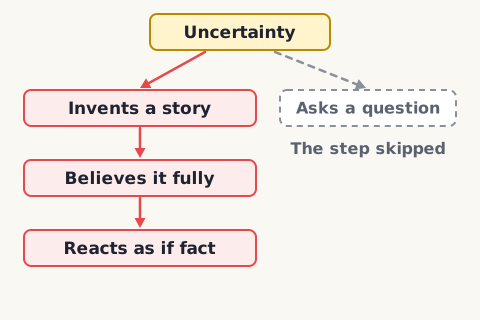
The Need for Answers
The human mind has an innate discomfort with uncertainty and a deep need to explain everything, to feel a sense of security and control. Rather than asking a clarifying question, it fabricates a plausible story, believes that invented story with total certainty, and then reacts emotionally as though the story were an objective fact.
Assumptions Create the Big Drama
Because we inevitably take our own fabricated assumptions personally, imagining a negative motive and reacting as if it were confirmed, assumptions create a massive storm of unnecessary conflict over something that was never actually about us.
Root Cause of Relationship Breakdowns
Many relationship breakdowns, family rifts, and workplace disputes trace back not to irreconcilable differences, but to uncommunicated assumptions.
The Telepathic Assumption Fallacy
The destructive romantic belief that a loving partner should telepathically anticipate your needs and desires without you having to communicate.
Real Love Doesn't Change People
Believing "my love will change them" is an assumption Ruiz warns against: your love will not change anybody — if people change, it is because they want to, never to satisfy someone else's expectations. Real love, he writes, is accepting other people the way they are without trying to change them.
Ask Questions: The Antidote
The definitive cure for making assumptions is simple to state, though it takes courage: ask questions and communicate with radical transparency. Choosing to voice your real needs and expectations, instead of assuming the other person already knows them, replaces resentment with the kind of honest clarity that actually transforms a relationship.
The Inquiry Protocol
When you catch your mind constructing a story about someone else's motives, pause and acknowledge: "I do not have factual evidence for this interpretation." Then ask a direct, kind, clarifying question — "What did you mean by that?" — and state your own authentic desires and boundaries clearly, without manipulation.
Brain Filling Informational Voids
When information is missing, the mind habitually invents fear-based narratives rooted in past conditioning.
The Fourth Agreement
Always Do Your Best: Your best changes from moment to moment across health and sickness. Avoid overexertion and laziness; act out of love for the action itself.
Your Best Is Never Fixed
Your best is never a fixed, static standard — it changes from one moment to the next. Your best when you're rested, energized, and healthy looks completely different from your best when you're sick, exhausted, or grieving, and from your best in the calm of morning versus the middle of a crisis.
Fluidity Prevents Perfectionism
Understanding that "your best" is fluid rather than fixed is what makes self-compassion possible — it's the guard against the twin traps of perfectionism and self-recrimination. When your body is exhausted, doing your best includes honoring the biological need to rest, without turning that rest into another reason for self-judgment.
Doing More Than Your Best
Trying to do more than your best is its own trap — perfectionism and compulsive overexertion. Pushing past your real capacity depletes your vital life force, exhausts your body, burns out your nervous system, and, counterintuitively, ends up prolonging the time it takes to reach your goal.
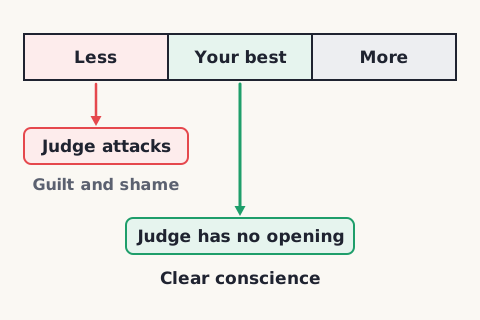
Disarming the Inner Judge
Doing less than your best leaves the door wide open for the Inner Judge to attack, condemning you for laziness and piling on guilt and shame. Give your genuine best instead — neither more nor less — and the Judge has no opening left: even an imperfect outcome lets you sleep with a completely clear conscience.
Sleeping with a Clear Conscience
Even when external outcomes are imperfect, doing your best allows you to rest with a peaceful conscience, free from regret.
Working for Love, Not Reward
Ruiz tells of a man who worked every day purely for the paycheck, dreading Mondays and living only for Friday — and because he acted strictly for the reward, he suffered continuously and performed poorly. Choosing work you genuinely love flips this: doing your best becomes effortless and joyful because you're acting for love of the act itself, not for what it pays.
Immersion in the Present Moment
When you engage in activities you love, doing your best becomes joyful and effortless, fully immersing you in the present moment.
Self-Forgiveness and Patient Repetition
You will break these agreements repeatedly — catch yourself gossiping, taking an insult personally, making an assumption. When that happens, the instruction is not to judge yourself: simply forgive yourself, reaffirm your intent, and do your best in the next moment. Through consistent, patient repetition, the agreements gradually become second-nature habits.
Spiritual Perfectionism
The Four Agreements are explicitly not meant as rigid moral dogmas designed to make you feel guilty every time you stumble. Spiritual Perfectionism is the disguised trap where the Inner Judge borrows spiritual language and standards to condemn you for ordinary, natural human slips instead.
Matched pairs
Each item on the left goes with the one on the right.
- Unexamined Assumptions
- The Big Drama
- Antidote to Assumptions
- Asking Clarifying Questions with Courage
- Best When Energized vs Sick
- Authentic Effort Calibrated to Physical Reality
- Consistent Best Effort
- Complete Disarming of the Inner Judge
- Patient Daily Repetition
- Effortless Second-Nature Mastery
Step by step
Protocol for Dissolving Assumptions through Inquiry
- Notice when your mind begins constructing an imaginary story about another's motives.
- Pause and acknowledge: 'I do not have factual evidence for this interpretation.'
- Ask direct, clarifying questions with kindness: 'What did you mean by that?'
- State your authentic desires and boundaries clearly without manipulation.
Protocol for Self-Forgiveness when Stumbling
- Notice when you break an agreement (e.g. gossiping, making an assumption, taking an insult personally).
- Refuse to judge, punish, or shame yourself for the human slip.
- Forgive yourself immediately and reaffirm your clear intent.
- Do your best in the very next moment without dwelling on the past.
Self-test
Answer each question from memory, then check your work against the answer key.
1. Ruiz teaches that we invent stories in our imagination, believe them fully, then react emotionally as if they were objective what?
- AFacts
- BMemories
- CPredictions
- DOpinions
2. In romantic relationships, assuming a partner will instinctively sense your unspoken needs sets a trap where what is guaranteed?
- AMutual Forgiveness
- BDisappointment
- CClarity
- DGratitude
3. Per Ruiz, why does the mind rush to fill gaps with assumptions?
- AIt is trying to save effort
- BIt wants to win arguments
- CIt craves others' approval
- DAnswers make it feel safe
4. Mindful awareness that catches the brain inventing a story lets you choose direct what, instead of emotional drama?
- AConfrontation
- BMeditation
- CCommunication
- DIsolation
5. Why, according to Ruiz, is it a mistake to assume 'my love will change them'?
- ABecause only a therapist can change someone's habits
- BBecause people change only when they themselves want to
- CBecause temperament is set at birth and cannot be altered
- DBecause love fades once a relationship becomes routine
6. Recognizing that your best is fluid rather than fixed cultivates self-compassion by guarding against perfectionism and what other trap?
- AComplacency
- BChronic Procrastination
- CSelf-recrimination
- DOverconfidence
7. Ruiz's story of the man who worked solely for the Friday paycheck shows that working strictly for a reward creates continuous what?
- AMisery
- BBoredom
- CAnxiety
- DFatigue
8. When your body is exhausted, doing your best includes honoring your biological need for what, without self-judgment?
- ADistraction
- BIsolation
- CDiscipline
- DRest
9. What term describes the idea that your best is never a static metric but varies with energy, illness, and time of day?
- ASpiritual Perfectionism
- BRadical Compulsive Transparency
- CThe Inner Judge
- DDynamic Fluidity of 'Your Best'
10. Doing your best when energized and doing your best when sick both represent what, according to the Fourth Agreement?
- AA lapse the Inner Judge should flag
- BAuthentic effort calibrated to physical reality
- COverexertion needed to prove commitment
- DEffort measured against one fixed standard
Go deeper
- ReadThe Four Agreements by Don Miguel Ruiz · on Amazon ↗
- StudyThe Four Agreements in the FlashFeed app
These are affiliate links: if you buy a book through one, FlashFeed may earn a small commission at no extra cost to you. The commission helps pay for FlashFeed's servers.
As an Amazon Associate we earn from qualifying purchases.
Answer key
- 1. A FactsThe Third Agreement warns that fabricated stories get treated as objective facts, not as the guesses they actually are.
- 2. B DisappointmentSince no partner can read minds, expecting them to guess unspoken needs guarantees disappointment when they fail to.
- 3. D Answers make it feel safeRuiz: we need to explain everything to feel safe, and any answer, even a wrong one, calms that need — so we assume instead of asking.
- 4. C CommunicationCatching the storytelling habit in the act lets you replace drama with direct communication, the antidote to assumptions.
- 5. B Because people change only when they themselves want toRuiz: your love will not change anybody — if people change, it is because they want to. Real love accepts people as they are.
- 6. C Self-recriminationPerfectionism and self-recrimination are the twin traps that understanding your best's fluidity guards against.
- 7. A MiseryBecause he acted only for the reward, the man suffered continuous misery and performed poorly, unlike those who love their work.
- 8. D RestThe fluidity of 'your best' means honoring the need to rest when exhausted is itself doing your best, not a failure to judge.
- 9. D Dynamic Fluidity of 'Your Best'Dynamic Fluidity of 'Your Best' names the principle that your best shifts naturally with your circumstances, not a fixed target.
- 10. B Authentic effort calibrated to physical realityBoth states show authentic effort calibrated to physical reality — your best is never one fixed standard, and it isn't overexertion or something to judge as a lapse.
Sources
- The Four Agreements — Don Miguel Ruiz
- The Four Agreements, Chapter 4: The Third Agreement (Don't Make Assumptions)
- The Four Agreements, Chapter 5: The Fourth Agreement (Always Do Your Best)
Image credits
- The Need for Answers: FlashFeed original diagram · CC-BY-4.0
- Disarming the Inner Judge: FlashFeed original diagram · CC-BY-4.0