
The Four Agreements study guide · Lesson 1 of 5
Toltec Wisdom, Domestication, and the Dream of the Planet
The Toltec Tradition, The Dream of the World, and Domestication · The Inner Judge, The Victim, and the Illusion of Freedom
Unofficial study guide for The Four Agreements: A Practical Guide to Personal Freedom by Don Miguel Ruiz. FlashFeed is not affiliated with the author or publisher.
This is the lesson's study guide from the FlashFeed app, plus its key facts and a self-test.
What you'll be able to do
- Explain the Toltec concept of the Dream of the Planet and how social domestication instills the Inner Judge, Victim, and Book of Law.
- Describe how the Book of Law, the Inner Judge and the Inner Victim form the Parasite, and why the freedom most adults feel is an illusion.
Lesson 1: Toltec Wisdom, Domestication, and the Dream of the Planet
The Toltec Tradition, The Dream of the World, and Domestication
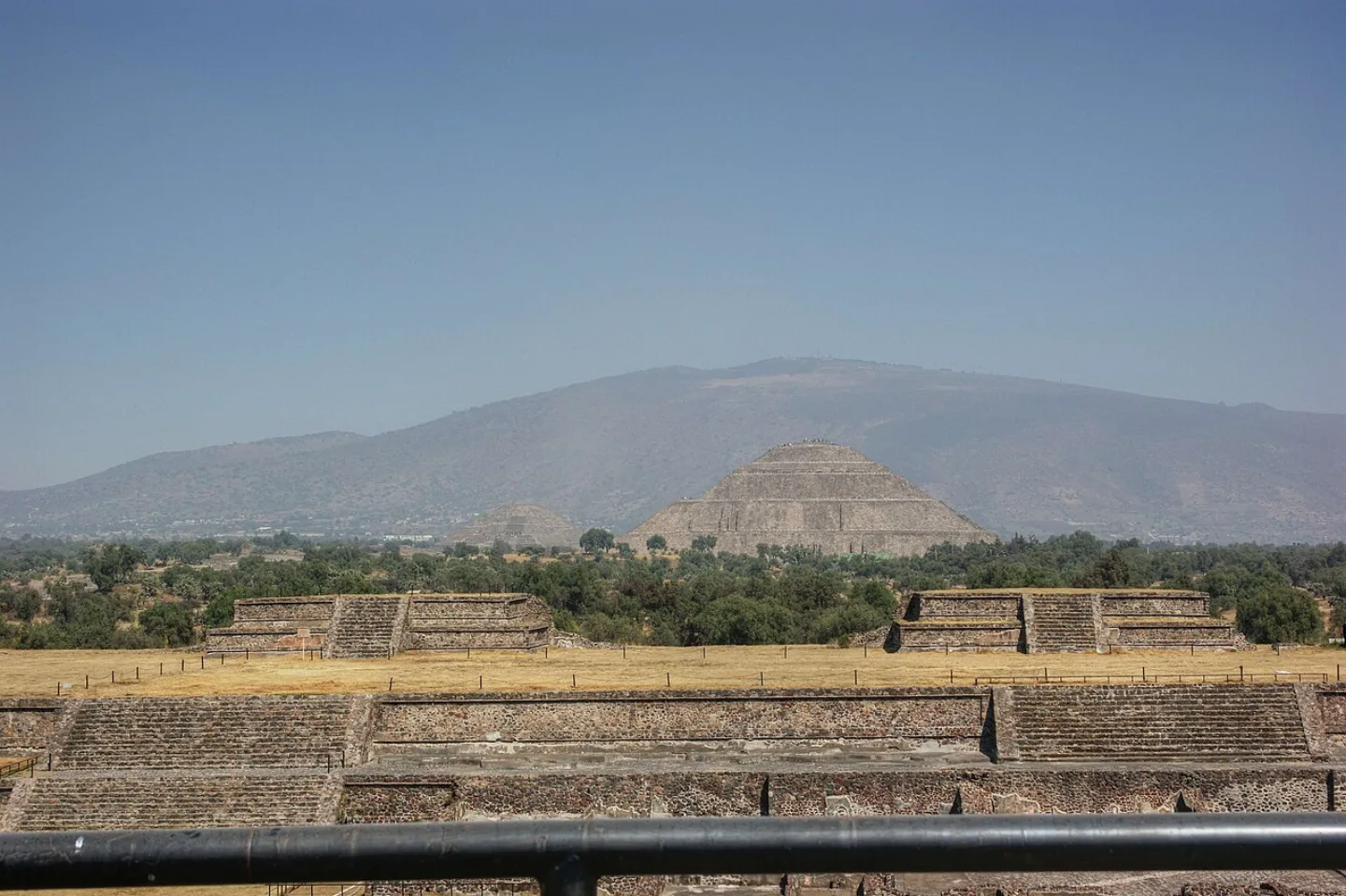
Thousands of years ago across Mesoamerica, the Toltec were revered not as a military empire or single ethnic group, but as a specialized guild of "women and men of knowledge." In the sacred teachings preserved by Don Miguel Ruiz and the lineage of the Eagle Knight Naguals, the Toltecs were scientists, artists, philosophers, healers, and spiritual masters. They gathered at the sacred ceremonial center of Teotihuacan—traditionally translated from Nahuatl as the place where "Man Becomes God"—to explore human perception, dismantle mental illusion, and awaken human consciousness to its divine origin.
In the foundational allegory of the Smoky Mirror, an ancient medicine student in a cave looked up at a starlit sky and realized that all existence is one living entity composed of pure Light. Physical matter functions as a mirror reflecting light, creating the appearance of distinct forms. However, when observing humanity, he noticed a thick fog—a smoke—hanging between these mirrors. This smoke is the conditioned human mind, clouded by fear, memories, judgments, and societal programming. Recognizing that he was a mirror of light whom others could not perceive clearly due to this fog, he named himself the Smoky Mirror (Tezcatlipoca).
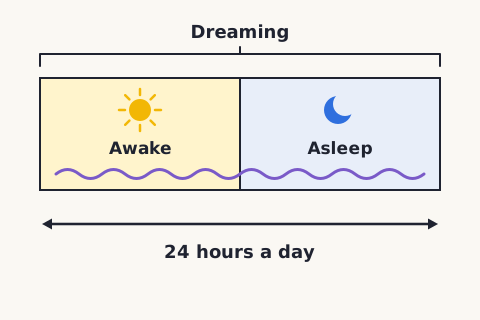
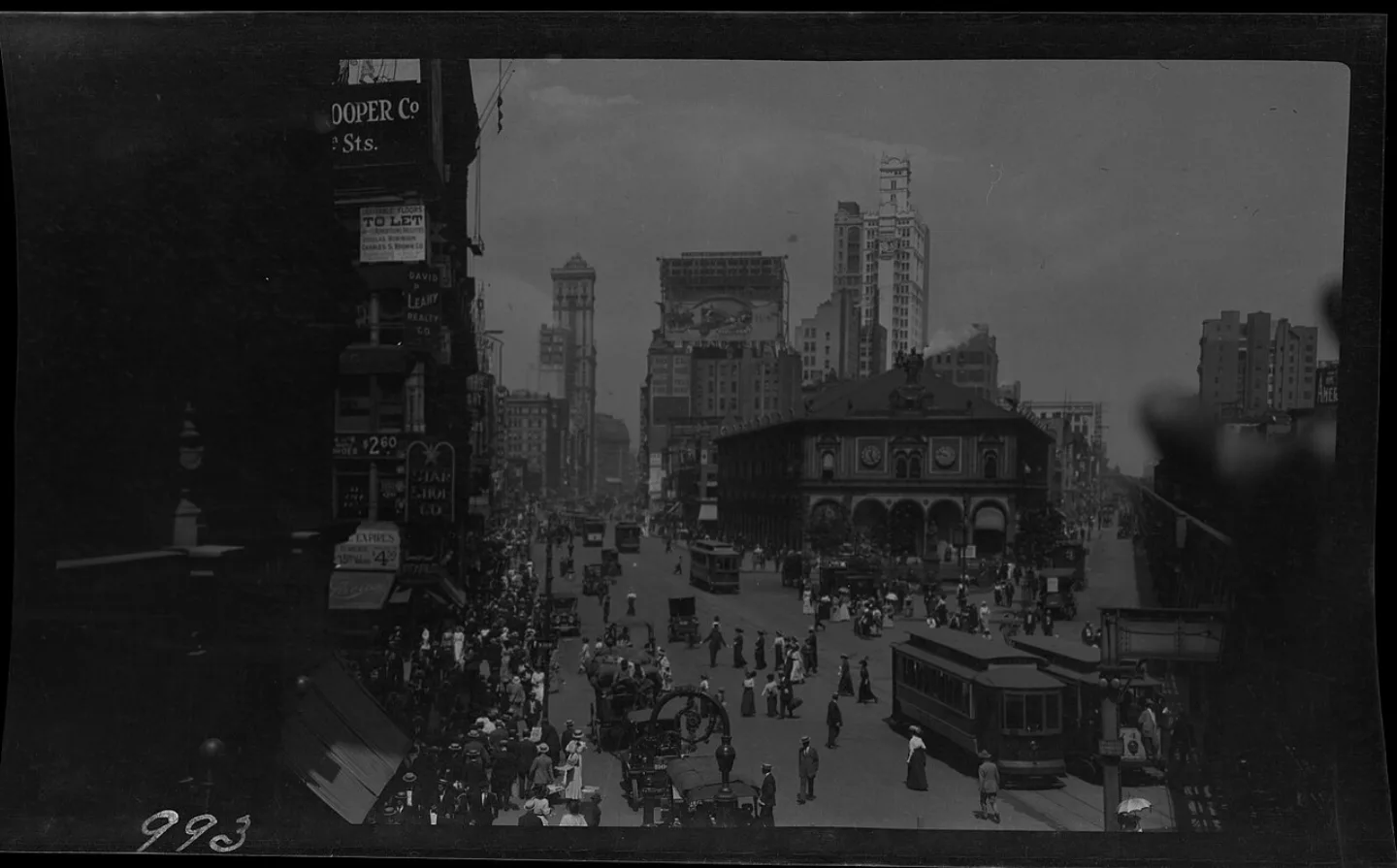
The core insight of Toltec ontology is that perception is entirely a dream. The human brain dreams twenty-four hours a day. When we are awake, a physical framework provides linear stability to our perception; when we sleep, that frame dissolves and the dream transforms fluidly. Long before any individual is born, humanity constructs an immense collective dream known as the Dream of the Planet or the Dream of the World. The Dream of the Planet consists of billions of individual dreams that collectively establish social conventions, legal codes, religious dogmas, cultural customs, languages, and moral rules.
Every human child enters this world without predetermined beliefs and undergoes an inescapable process called Domestication. Just as humans domesticate animals through a structured regimen of rewards and punishments, adults domesticate children. Adults capture the child's attention and transmit unchosen rules of the collective dream. The child is taught what is moral and immoral, acceptable and unacceptable, beautiful and ugly, true and false. We did not choose our native language, our religion, or our moral values; they were installed into our consciousness before we possessed the critical capacity to evaluate them.
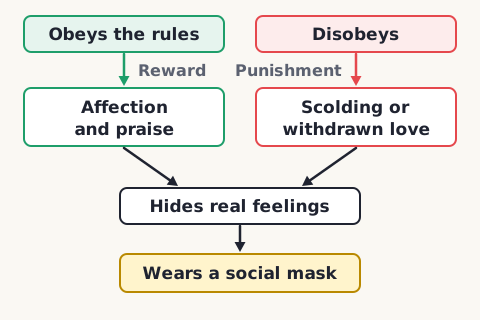
The engine of Domestication is the binary mechanism of punishment and reward, which exploits the child's instinctive dread of rejection and abandonment. When the child obeys societal and parental rules, they receive affection, praise, and rewards; when the child disobeys or expresses authentic impulses that clash with conditioning, they are met with punishment, scolding, or the withdrawal of love. Because the loss of parental love threatens the infant's survival, children learn to suppress their authentic emotional nature and wear artificial social masks designed to please authorities.
Through thousands of childhood repetitions, external conditioning becomes internalized. Adults no longer need to domesticate us because we become our own domesticators. We install an automated control system inside our own minds that continues the punishment and reward cycle independently. We form thousands of unconscious internal Agreements with ourselves, society, and God. However, because the vast majority of these agreements were forged under fear, shame, and coercion, they form an invisible mental prison that robs us of authentic joy, spontaneous vitality, and personal freedom.
The Mechanics of Attention and the Social Mirror
In the Toltec tradition, human attention is understood as the master key of consciousness. Attention is the faculty by which we choose to focus our awareness on specific perceptions, thoughts, and sensory inputs out of an infinite field of information. During the early years of life, adults intentionally hook the attention of the child to implant the rules, beliefs, and values of the collective dream. The child is incapable of resisting because their cognitive architecture has not yet developed critical discernment. Through this persistent capture of attention, the child learns to replicate the exact perceptual framework of their parents and cultural environment.
This conditioning creates what Toltec shamans describe as the "social mirror." We do not experience reality directly; instead, we experience a socially constructed mental simulation. We learn to evaluate our worth, our physical appearance, our intellectual abilities, and our social status entirely through the distorted reflections offered by domesticated society. The consequence is a profound alienation from our authentic spiritual essence. We forget that we are pure light experiencing physical embodiment and instead identify completely with our social roles, titles, and conditioned self-images.
To awaken from this collective trance, the aspiring practitioner must first recognize the artificial nature of their conditioning. The spiritual path begins with the realization that virtually everything we believe about ourselves was installed by external sources. By reclaiming our attention and observing our habitual thought patterns without judgment, we take the first decisive step toward dissolving the smoke of illusion and recovering the authentic freedom of the natural mind.
The Inner Judge, The Victim, and the Illusion of Freedom
Within the domesticated human psyche, Don Miguel Ruiz identifies three interrelated psychological structures that maintain our internal suffering: the Book of Law, the Inner Judge, and the Inner Victim. Together, these three internalized mechanisms enforce the dominion of fear and perpetuate what Toltec masters describe as the living Dream of Hell.
The Book of Law is the unquestioned mental repository of rules, moral decrees, cultural dogmas, and behavioral standards programmed into our subconscious during childhood domestication. Everything written in our personal Book of Law is accepted as unquestioned, absolute truth, even when these beliefs contradict our authentic nature or generate immense emotional torment. Whenever an authentic desire or natural impulse violates the decrees of the Book of Law, an intense wave of guilt, anxiety, and self-recrimination sweeps through the mind. The Book of Law functions as an internal tyrant demanding total submission to arbitrary rules we never consciously chose to adopt.
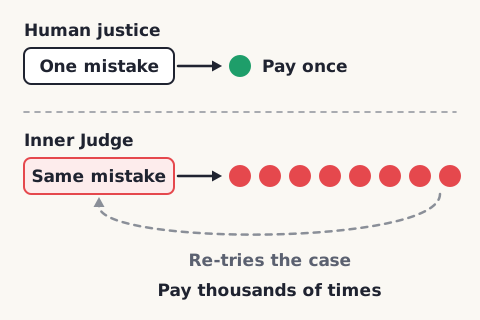
The Inner Judge is that relentless, hyper-critical aspect of our mind whose sole function is to continuously evaluate everything we do, say, think, and feel against the impossible standards of the Book of Law. The Judge monitors our every moment: our appearance, our speech, our career achievements, our intellect, and our worthiness of love. Whenever we fall short of perfection, the Judge finds us guilty, convicts us, and demands punishment. The great tragedy of human psychology is that while human justice dictates paying once for an error, the human Inner Judge forces us to pay thousands of times for the exact same mistake. Every time an embarrassing memory or past failure resurfaces, the Judge re-evaluates the event, finds us guilty again, and inflicts another fresh round of guilt and shame.
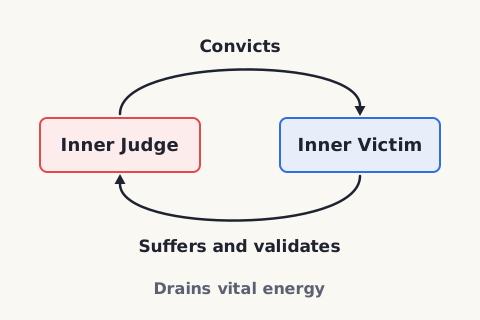
The Inner Victim is the wounded, submissive part of our psyche that accepts the harsh verdict of the Judge and carries the emotional burden of punishment. The Victim perpetually complains: "Poor me, I am not smart enough, attractive enough, wealthy enough, or good enough; why does this always happen to me?" The Victim willingly endures the emotional suffering inflicted by the Judge, validating the core illusion that we are fundamentally flawed, incomplete, and undeserving of happiness. The continuous interplay between the Inner Judge and the Inner Victim creates a closed loop of self-inflicted torment that consumes our vital energy.
This internal chaos is known in the Toltec tradition as the Mitote. Mitote is a Nahuatl word describing a chaotic marketplace or wild party where a thousand people are shouting, arguing, and talking simultaneously at the top of their lungs, and nobody understands anyone else. The domesticated human mind is a massive Mitote: thousands of conflicting voices, contradictory beliefs, unexamined fears, and fragmented identities debate relentlessly within our awareness. Because the Mitote generates a dense mental fog, humans live in chronic delusion, blind to their true divine identity as pure light and unconditional love.
The consequence of the Mitote and the rule of the Judge and Victim is the distortion of human freedom. Most adults believe they are free because they possess political liberties or can choose their career and wardrobe. But this is merely an Illusion of Freedom. In reality, our inner lives remain enslaved to fear-based agreements that compel us to act out of terror of judgment. Real freedom is the capacity to be who we truly are without masks or apologies. To attain true sovereignty, one must declare war against the internal Parasite—the alliance of the Judge, Victim, and Book of Law—and dismantle the false agreements that perpetuate our suffering.
Deconstructing the Parasite and Reclaiming Personal Power
The alliance between the Book of Law, the Inner Judge, and the Inner Victim constitutes what Toltec masters refer to as the Internal Parasite. A biological parasite invades a host organism, consumes its vital nutrients, and releases toxic waste products into the host's system. In precisely the same manner, the psychological parasite invades human consciousness, feeds on our vital life force, and excretes emotional poison in the form of fear, anxiety, guilt, and resentment.
The primary survival mechanism of the parasite is the perpetual generation of emotional drama. Whenever the mind is peaceful and content, the parasite experiences starvation. To sustain its existence, the parasite triggers old grievances, invents imaginary conflicts, magnifies insecurities, and provokes arguments with loved ones. We become addicted to our own suffering because the emotional turmoil validates our conditioned identity. The Judge constantly points out perceived shortcomings, the Victim laments its helplessness, and the Book of Law provides the rigid dogmas that justify the punishment.
Breaking free from this parasitic loop requires understanding that the Judge and Victim are not our authentic self; they are merely autonomous sub-programs operating within our conditioned mind. When you experience a wave of self-criticism or unworthiness, you can observe the phenomenon with mindful detachment, recognizing: "This is merely the voice of the Judge; this is not who I truly am." By withholding emotional reactivity and refusing to feed the parasite with drama, you steadily starve the parasite and reclaim the personal energy necessary to forge a life of joy and spiritual sovereignty.
Key terms
- Toltec
- A Mesoamerican guild of scientists, artists, philosophers, and spiritual practitioners dedicated to exploring and conserving spiritual knowledge.
- Dream of the Planet
- The collective sum of billions of personal dreams establishing societal laws, religions, languages, and moral rules.
- The Book of Law
- The unquestioned mental compendium of cultural rules, dogmas, and moral decrees programmed into the subconscious during domestication.
- The Inner Judge
- The relentless critical faculty of the mind that continuously measures our thoughts, words, and actions against the perfectionist standards of the Book of Law.
- The Inner Victim
- The wounded, submissive aspect of the psyche that accepts the Judge's harsh convictions, carrying guilt and feeling unworthy of happiness.
- The Parasite
- The collective energetic entity formed by the Judge, Victim, and Book of Law that feeds on fear, guilt, and emotional drama.
Key facts
The Toltec and Teotihuacan
The Toltec were not a military empire but a guild of "women and men of knowledge" — scientists, artists, philosophers, healers, and spiritual masters, preserved in the lineage of the Eagle Knight Naguals. They gathered at Teotihuacan, the sacred Mesoamerican site whose Nahuatl name is traditionally translated as the place where "Man Becomes God," to explore human perception and awaken consciousness to its divine origin.
The Smoky Mirror
The allegory of human perception: all existence is pure divine light, physical matter is a mirror, and the human mind is the smoke obscuring clear reflection.
What the Smoke Represents
In the allegory of the Smoky Mirror, the smoke hanging between the mirrors of pure light is not neutral haze — it is specifically the conditioned mind, clouded by fear, memories, judgment, and societal programming. That smoke is what keeps a person from perceiving themselves and others clearly, as mirrors of the same light.
Dreaming as Mind Function
Dreaming is the primary perceptual function of the human brain, operating twenty-four hours a day in both awake and asleep states.
The Dream of the Planet
Long before any individual is born, humanity builds a vast collective dream that Toltec teaching calls the Dream of the Planet. It is the sum of billions of personal dreams, and it is where social conventions, legal codes, religious dogmas, cultural customs, languages, and moral rules all come from — inherited whole, before anyone can question them.
The Domestication Engine
Domestication runs on a simple binary: punishment and reward. When a child obeys the rules of family and culture, they receive affection and praise; when they disobey or act on an authentic impulse that clashes with conditioning, they meet scolding or withdrawn love. Because losing parental love feels like a survival threat, children learn to suppress their real feelings and wear an artificial social mask that keeps the adults around them satisfied.

Attention: Domestication's Master Key
In Toltec teaching, attention is the master key of consciousness — the faculty that lets us focus on some perceptions out of an infinite field of information. During childhood, adults intentionally hook a child's attention to install the rules, beliefs, and values of the collective dream, before the child can critically evaluate any of it.
Self-Domestication and the Mental Prison
Eventually, adults no longer need to domesticate us — we become our own domesticators. We install an internal control system that keeps running the punishment-and-reward cycle on its own, forming thousands of unconscious internal Agreements with ourselves, society, and God. Because most of these agreements were forged under fear, shame, and coercion, they add up to an invisible mental prison that robs us of authentic joy, vitality, and freedom.
Unconscious Internal Agreements
Humans make thousands of agreements with themselves and society that dictate actions, forged under childhood coercion and fear.
The Book of Law
The Book of Law is the unquestioned mental record of rules, dogmas, and moral decrees that childhood domestication programs into the subconscious. Everything written there is treated as absolute truth, even when it contradicts a person's authentic nature — and living by beliefs you never chose but cannot question is a direct source of ongoing emotional suffering.
The Inner Judge
The Inner Judge is the relentless part of the mind that continuously measures everything you do, say, think, and feel against the Book of Law's impossible standards, convicting you whenever you fall short. Human justice makes you pay once for a mistake; the Judge is crueler — every time an old failure resurfaces it re-tries the case, so you pay for the same mistake thousands of times.
The Inner Victim
The Inner Victim is the wounded, submissive part of the psyche that accepts the Judge's harsh verdicts and carries the resulting guilt, endlessly complaining that it isn't smart, attractive, or good enough. Judge and Victim feed each other in a closed loop — the Judge convicts, the Victim suffers and validates the conviction — creating a cycle of self-inflicted torment that drains vital energy.
The Mitote
The chaotic mental fog of a thousand conflicting voices and fragmented identities shouting simultaneously in the mind, obscuring divine awareness.
Real Freedom vs. Its Illusion
Most people believe they are free because they hold political rights or can choose a career and wardrobe — but Toltec teaching calls this the Illusion of Freedom. Real freedom is something else entirely: the capacity to be who you truly are, without masks and without apologizing for it, regardless of what external choices are available to you.

The Internal Parasite
The alliance of the Book of Law, the Inner Judge, and the Inner Victim together form what Toltec masters call the Internal Parasite. Like a biological parasite that invades a host, consumes its nutrients, and releases toxins, this psychological parasite invades consciousness, feeds on vital life force, and excretes emotional poison in the form of fear, anxiety, guilt, and resentment.
Defending the Instrument of Torture
Human beings defend their Book of Law with their lives out of ego identification, even though it is the exact instrument that tortures them.
Declaring War on the Parasite
To fight the internal parasite, Toltec practice offers a concrete sequence: observe the judgmental voice of the Inner Judge without identifying with its decrees, refuse to indulge the Inner Victim's complaints and self-pity, and challenge and rewrite the fear-based rules recorded in the Book of Law. None of this works if you mistake the Judge and Victim for your true self — they are sub-programs running in a conditioned mind, not who you actually are.
The Dream of Hell
When the Book of Law, Inner Judge, and Inner Victim rule the mind, the result is what Toltec masters call the living Dream of Hell — a state governed by fear and steeped in emotional poison. It is not a place you go after death; it is the everyday mental state of anyone still ruled by their own internal tyrant.
Reclaiming Power by Facing Fear
You break the parasite's hold by refusing to feed it: when a wave of self-criticism arises, you can observe it and recognize, "this is the voice of the Judge, not who I truly am." Withholding that emotional reactivity starves the parasite and reclaims the vital energy and personal power needed to build a life of joy and spiritual sovereignty instead.
Matched pairs
Each item on the left goes with the one on the right.
- Domestication Mechanism
- Punishment and Reward Conditioning
- Historical Nagual Response
- Concealing Knowledge into Secret Lineages
- Judge & Victim Interplay
- Closed Loop of Self-Inflicted Torment
- State of Suffering under the Judge
- The Living Dream of Hell
Step by step
Declaring War Against the Internal Parasite
- Observe the judgmental voice of the Inner Judge without identifying with its decrees.
- Refuse to indulge the Inner Victim's complaints and emotional self-pity.
- Challenge and systematically rewrite the fear-based rules in the Book of Law.
Self-test
Answer each question from memory, then check your work against the answer key.
1. According to Don Miguel Ruiz's teachings, what were the Toltec?
- AA royal dynasty of Toltec priests
- BA single ethnic group at Teotihuacan
- CA military empire in Mesoamerica
- DA guild of women and men of knowledge
2. A child is rewarded for obeying family rules and punished for authentic impulses that break them. What is this process called?
- AThe Mitote
- BThe Dream of the Planet
- CDomestication
- DThe Illusion of Freedom
3. In Toltec teaching, what is described as 'the master key of consciousness'?
- AAttention
- BIntuition
- CMemory
- DImagination
4. According to Toltec teaching, what do fear-based childhood agreements ultimately form?
- AAn invisible mental mirror
- BAn invisible mental prison
- CAn invisible mental shield
- DAn invisible mental maze
5. What does the Nahuatl name 'Teotihuacan' traditionally translate to?
- AThe place where man becomes god
- BThe city of eternal fire
- CWhere the sky touches earth
- DThe place of the setting sun
6. What is the Book of Law, in Toltec teaching?
- AThe faculty that judges every thought and act
- BThe chaotic fog of a thousand shouting voices
- CThe part of the psyche that accepts guilt
- DRules and decrees programmed during domestication
7. What is the Inner Judge's function, in Toltec teaching?
- AAccepts guilt and feels unworthy of happiness
- BEvaluates thoughts and acts against the Book of Law
- CRecords moral decrees during childhood
- DGenerates a fog of conflicting inner voices
8. Which internal structure is NOT one of the three that Don Miguel Ruiz says enforce the Dream of Hell?
- AThe Book of Law
- BThe Inner Judge
- CThe Mitote
- DThe Inner Victim
9. A person keeps reliving an old failure, convicting themselves with fresh guilt each time it resurfaces. Which structure is at work?
- AThe Book of Law
- BThe Mitote
- CThe Inner Judge
- DThe Inner Victim
10. In Nahuatl, what does 'Mitote' describe, in Toltec teaching?
- AA chaotic marketplace with everyone shouting
- BA guild of scientists and healers
- CAn allegory of mirrors reflecting light
- DA sacred site for awakening consciousness
Go deeper
- ReadThe Four Agreements by Don Miguel Ruiz · on Amazon ↗
- StudyThe Four Agreements in the FlashFeed app
These are affiliate links: if you buy a book through one, FlashFeed may earn a small commission at no extra cost to you. The commission helps pay for FlashFeed's servers.
As an Amazon Associate we earn from qualifying purchases.
Answer key
- 1. D A guild of women and men of knowledgeThe Toltec were scientists, artists, philosophers, and healers -- not a military empire, ethnic group, or ruling dynasty.
- 2. C DomesticationDomestication is the punishment-and-reward mechanism that installs unchosen rules into a child's mind.
- 3. A AttentionAttention lets us focus on select perceptions out of infinite information, and adults hook it to install cultural rules.
- 4. B An invisible mental prisonThe text says fear-based agreements form 'an invisible mental prison' that robs people of authentic joy and freedom.
- 5. A The place where man becomes godTeotihuacan is traditionally translated as 'the place where Man Becomes God,' the Toltecs' sacred ceremonial center.
- 6. D Rules and decrees programmed during domesticationThe Book of Law is the mental record of rules and moral decrees installed during childhood domestication.
- 7. B Evaluates thoughts and acts against the Book of LawThe Inner Judge continuously measures everything we do against the Book of Law's impossible standards.
- 8. C The MitoteRuiz names three structures -- Book of Law, Inner Judge, and Inner Victim; the Mitote is a related but separate concept.
- 9. C The Inner JudgeThe Inner Judge re-evaluates old failures and inflicts a fresh round of guilt each time they resurface.
- 10. A A chaotic marketplace with everyone shoutingMitote describes a chaotic marketplace or wild party where a thousand voices shout at once, and nobody understands anyone.
Sources
- The Four Agreements — Don Miguel Ruiz
- The Four Agreements, Introduction & Chapter 1: Domestication and the Dream of the Planet
- The Four Agreements, Chapter 1: Domestication and the Dream of the Planet
Image credits
- The Toltec and Teotihuacan: MongeNajera · CC BY-SA 3.0 — commons.wikimedia.org/wiki/File:Teotihuacan_Mexico_1.jpg
- Dreaming as Mind Function: FlashFeed original diagram · CC-BY-4.0
- The Dream of the Planet: Edmund F. Arras · Public domain — commons.wikimedia.org/wiki/File:Herald_Square_-_DPLA_-_670f8b5da9d867c81381d1a66c2f45b3.jpg
- The Domestication Engine: FlashFeed original diagram · CC-BY-4.0
- Attention: Domestication's Master Key: Shixart1985 · CC BY 2.0 — commons.wikimedia.org/wiki/File:Child_attentively_listens_as_an_adult_shares_a_story_from_a_book_in_a_cozy_indoor_setting.jpg
- The Inner Judge: FlashFeed original diagram · CC-BY-4.0
- The Inner Victim: FlashFeed original diagram · CC-BY-4.0
- The Internal Parasite: Centers for Disease Control and Prevention (Openverse) · cc0 1.0 — www.rawpixel.com/image/2288371/free-photo-image-virus-alga-algae


