
The Complete Volkswagen GTI study guide · Lesson 7 of 13
Mk7 Ownership: Problems, DIY & Tuning
Common Problems · DIY and Prevention · Tuning the 2.0T
This is the lesson's study guide from the FlashFeed app, plus its key facts and a self-test.
What you'll be able to do
- Explain the Mk7's electro-mechanical thermostat / water-pump failure and its preventive interval.
- Describe EA888 timing-chain stretch, its cold-start rattle, and when to inspect it.
- Recall the Mk7 prevention checklist: reduced carbon buildup, the IS38 clutch upgrade, water-pump pairing, sunroof drains, and turbo part numbers.
- Explain the IS38 turbo as a drop-in performance upgrade for the Mk7's IS20.
- Describe the 2.0T tuning stages, their power gains, the established Stage 1 tuners, and Stage 2 spark-plug gapping.
Common Problems
The Mk7 GTI is a well-sorted car, but the EA888 Gen 3 has a handful of documented weak points that every owner should know cold. None are exotic; all are cheaper to deal with early than late.
The Early IS20 Turbo Gremlin
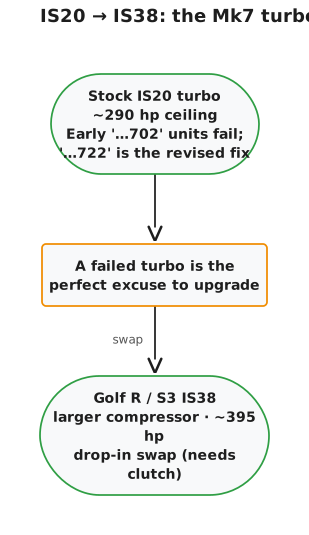
The IHI IS20 turbo fitted to early Mk7 GTIs — mostly 2015–2016 build dates — had an elevated failure rate concentrated in units whose part numbers end in 702, particularly 06K 145 702N. Failures range from gradual boost loss and metallic rattles to catastrophic shaft failure that sends shrapnel through the intercooler and into the intake tract. Volkswagen revised the casting and balancing several times; units ending in 722 are substantially more reliable. Before buying any early Mk7, pull the engine cover and read the number off the turbo body directly.
Every Cloud Has an IS38
An IS20 failure stings, but it arrives with a silver lining the factory never advertised: you are already paying for the labor. The Golf R / Audi S3 IS38 shares the same flanges as the IS20 and drops straight in. The compressor wheel is meaningfully larger, and the result is a genuine performance upgrade rather than a like-for-like replacement. A failure becomes the most cost-efficient turbo swap on the platform.
Water Pump and Thermostat: The #1 Issue
This is the single most common complaint across Mk7 and Mk7.5 ownership forums. The thermostat is electro-mechanical — computer-controlled, not wax-pellet — and mounts directly to the water pump housing. The pump itself is belt-driven from the intermediate shaft, an unusual layout that raises replacement labor costs. The failure mode is gradual: a slow coolant seep, a "malfunction in cooling system" CEL, or a thermostat stuck open that leaves the cabin cold all winter. Replace the water pump and thermostat as a pair preventively at 60,000–80,000 miles; splitting them saves nothing and costs another labor visit shortly after.
The Chain You Should Still Watch
Volkswagen marketed the EA888's timing chain as lifetime-fit, and the Mk7 Gen 3 is better than the Mk6 Gen 2 — but not immune. Chain stretch is real; the telltale is a metallic rattle on cold start that fades once oil pressure climbs. A scan tool reads camshaft-to-crankshaft deviation; deviation outside tolerance means the chain is losing ground. Inspect at 100,000 miles. This is an interference engine — a jumped chain is a rebuild.
Sunroof Drains and Soggy Carpets
Small cracks in the panoramic sunroof drain tray channel rainwater into the cabin instead of through the bodywork drain tubes. It pools in the footwells, soaks the carpet foam, and eventually supports mold. Prevention costs nothing: blow the drain channels clear every six months with compressed air. A cracked tray needs replacement plus a proper interior dry-out — a dehumidifier, not just open windows.
Carbon Buildup, Mostly Solved
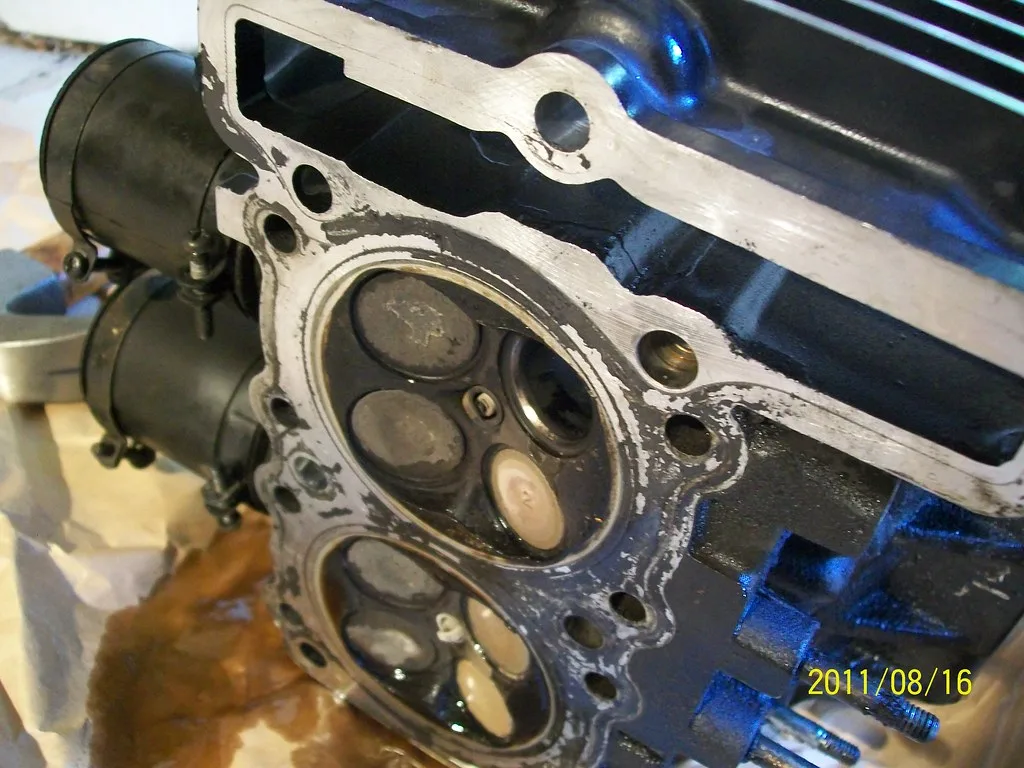
On the Mk6, pure direct injection meant no fuel ever washed over the intake valves, and carbon baked on steadily. The Mk7 uses combined port and direct injection (CPDI) — port injectors spray fuel across the valve faces at lower loads and keep them clean. The problem is not eliminated, but it is significantly reduced. Still worth a walnut-blast inspection at high mileage, but it is no longer the routine maintenance item it was on the previous generation.
DIY and Prevention
The Mk7 GTI is not a fragile car, but it rewards owners who engage with its known failure modes before those modes engage with their wallet. Most of the platform's headline problems are cheaper to prevent than to fix, and none of the prevention tasks require specialist tools or a lift.
Prevent, Don't React
The ownership mindset that keeps Mk7 bills manageable is simple: get ahead of the documented failure points rather than waiting for a warning light. Replace the water pump and thermostat as a pair preventively at 60,000–80,000 miles — they share a housing, labor is the same either way, and the thermostat's electro-mechanical design makes it a time-limited component regardless of how the car feels. Clear the sunroof drain channels every six months with compressed air; a blocked drain tray costs nothing to maintain and hundreds to remediate once carpet foam is saturated. At similar mileage, arrange a walnut blast of the intake valves — combined port and direct injection largely handles this on the Mk7, but high-mileage cars can still accumulate deposits worth addressing. On any used-car purchase, verify the turbo part number by reading it off the unit directly; a 702-suffix IS20 on an early car is a negotiating point or a reason to walk. None of these tasks requires dealership labor, and all of them cost far less than the failures they prevent. Proactive ownership on the Mk7 is not enthusiast perfectionism — it is straightforward value protection.
Tuning the 2.0T
The EA888 Gen 3 is one of the most tuner-friendly four-cylinders Volkswagen has ever sold. The architecture responds well at every level of modification, and the hardware ecosystem that has grown around it is mature, well-documented, and competitively priced.
Stage 1: The Best Money You'll Spend
Stage 1 is a pure ECU flash through the OBD2 port — no hardware changes, no wrenching required. The tune raises boost pressure and adjusts fuelling and ignition timing for the factory components. Vendor claims for the Mk7 GTI run from about 297 to 316 hp, depending on the tune and the fuel: as of 2026, Unitronic lists 297 hp / 346 lb-ft on 91 octane for its Stage 1 and 310 hp / 347 lb-ft on 93 for its Stage 1+, and APR's launch release quoted 316 hp / 381 lb-ft on 98 RON (Research Octane Number) fuel. These are the tuners' own figures, and the gain transforms the car's character without touching a single bolt. Established names in the space include APR, Unitronic, Cobb Accessport, IE, EQT, and Revo. This is the largest single gain per dollar on the entire platform and the logical first step for any owner who wants more.
Stage 2: Let It Breathe
Stage 2 typically pairs an upgraded ECU map with supporting hardware, commonly a 3-inch downpipe, an upgraded intercooler, and a cold-air intake (requirements vary by tuner; Unitronic requires the downpipe and recommends an intake). The downpipe reduces back-pressure on the turbo; the intercooler keeps charge temperatures in check when the engine is working hard; the intake improves volume and consistency. As of 2026, Unitronic claims 337 hp / 370 lb-ft on 93 octane for its Stage 2 software, above any of the Stage 1 claims. The DSG handles Stage 2 comfortably; a stock manual clutch may begin to slip, especially under hard pulls. At this power level, gap the spark plugs tighter — around 0.024 inches — and replace them more frequently than the factory interval.
The IS38 Swap: The Defining Mod
The IS38 — the turbo fitted to the Golf R and Audi S3 — is the most popular single upgrade on the Mk7 GTI. Its compressor wheel is substantially larger than the IS20, and yet it is a drop-in fitment: same flanges, same oil and coolant connections. As of 2026, at the top of a full build, APR Stage 3 IS38 produces approximately 395–397 hp, and Unitronic Stage 2+ delivers approximately 381 hp. At this level the manual clutch must be upgraded — a stock unit will not hold the torque — and the DSG benefits from a TCU tune that raises shift pressure and extends clutch-pack life under the added load. The IS38 swap represents the natural ceiling for most street-driven Mk7 GTIs before the build crosses into diminishing-returns territory.
Key terms
- Electro-mechanical thermostat
- A computer-controlled thermostat that bolts to the Mk7 water pump housing; the pair is the GTI's most common failure point.
- Timing chain stretch
- Wear that lengthens the timing chain over time, throwing off cam-to-crank timing; the telltale is a cold-start rattle.
- IS38
- The larger IHI turbo from the Golf R and Audi S3; a drop-in upgrade for the Mk7 GTI's IS20 using the same flanges.
- Stage 1
- The entry level of ECU tuning, raising boost and adjusting fuelling on otherwise stock hardware. Vendor claims for a Mk7 GTI on this tier run from about 297 to 316 horsepower.
Key concepts
The IS38 Swap
- The most popular single upgrade on the Mk7 GTI, and the natural ceiling for most street-driven builds.
- It fits the larger turbocharger from the Golf R and Audi S3, a drop-in with the same flanges, oil, and coolant connections as the factory unit.
- At the top of a full build it yields roughly 395-397 hp with APR Stage 3, but the manual clutch must be upgraded to hold the torque.
Key facts
The Early IS20 Turbo Gremlin
The IHI IS20 turbo in early Mk7 GTIs (mostly 2015–2016) had a real failure rate — worst on units whose part numbers end in 702, especially 06K 145 702N. Symptoms run from lost boost and metallic noises to shrapnel in the intercooler. VW revised the design repeatedly; units ending in 722 are substantially more reliable.
Every Cloud Has an IS38
Here is the enthusiast silver lining: a dead IS20 is the perfect excuse to fit the Golf R / Audi S3 IS38 turbo instead of another stock unit. You are already paying for the labor — so spend a little more on hardware and walk away with a meaningfully bigger turbo. A failure becomes an upgrade.
Water Pump and Thermostat: The #1 Issue
The single most common Mk7/Mk7.5 complaint. The thermostat is electro-mechanical and bolts straight to the water pump housing, and the pump is belt-driven from the intermediate shaft (an unusual design). Expect a slow coolant leak, a "malfunction in cooling system" CEL, or a thermostat stuck open giving weak winter heat.
The Chain You Should Still Watch
The EA888 uses a timing chain, marketed as "lifetime" but not quite. The Gen 2 (Mk6) was notorious; the Gen 3 in the Mk7 is improved but not immune. Listen for a metallic rattle on cold start in the first few seconds — that signals chain stretch or tensioner wear. A scan tool reads camshaft-to-crankshaft deviation; ignore it and a jumped chain wrecks this interference engine.
Sunroof Drains and Soggy Carpets
Small cracks in the panoramic sunroof drain tray let water into the cabin, where it pools in the footwells and soaks the floor carpet and foam. Left alone it breeds mold. The cheap defense is to blow the drain channels clear every six months; the fix for a cracked tray is replacement plus drying out the interior.
Carbon Buildup, Mostly Solved
Pure direct injection caked the intake valves on the Mk6 because no fuel ever washed over them. The Mk7 uses combined port and direct injection, which sprays fuel across the valves and largely mitigates the problem. It is still worth a look at high mileage, but it is no longer the headline issue it once was.
Prevent, Don't React
The Mk7 rewards owners who get ahead of its known faults. Replace the water pump and thermostat as a pair preventively at 60,000–80,000 miles, clear the sunroof drains every six months, walnut blast the valves around 60,000–80,000 miles, and verify the turbo part number on any used car before you buy. None of these is hard; all of them are cheaper than the failure they head off.
Read The Turbo's Part Number
Before buying an early used Mk7 GTI, check the turbo's part number directly off the unit. A 702-suffix IS20 marks the failure-prone batch — a strong reason to negotiate the price or walk away.
Clear The Drain Channels
The Mk7's panoramic sunroof drain channels should be blown clear with compressed air every six months. Left blocked, they let water pool in the footwells and soak the carpet foam.
Replace Them As A Pair
The Mk7's water pump and thermostat share a single housing, so preventive maintenance calls for replacing both together at 60,000-80,000 miles — the labor cost is the same either way.
Stage 1: The Best Money You'll Spend
A pure software flash through the OBD2 port — no hardware changes. Vendor claims run from about 297 to 316 hp: Unitronic lists 297 hp / 346 lb-ft on 91 octane (310 hp on 93 for Stage 1+), and APR quoted 316 hp / 381 lb-ft on 98 RON. The usual names: APR, Unitronic, Cobb Accessport, IE, EQT, Revo.
Stage 2: Let It Breathe
Typically a 3-inch downpipe and an intake, often with an upgraded intercooler, then a reflash. Unitronic claims 337 hp / 370 lb-ft on 93 octane for its Stage 2 and requires the downpipe. The DSG handles this comfortably; the manual clutch may start to slip. Tuners commonly advise gapping the spark plugs tighter (around 0.024") and changing them more often.
The IS38 Swap: The Defining Mod
The IS38 from the Golf R / Audi S3 is the most popular Mk7 GTI upgrade. Its compressor wheel is meaningfully bigger than the IS20, yet it is a drop-in using the same flanges. On a full build, APR Stage 3 IS38 makes about 395–397 hp and Unitronic Stage 2+ about 381 hp. At this level the manual clutch must be upgraded and the DSG may want a TCU tune.
The Top Of The Build
A full APR Stage 3 build on the IS38 swap tops out around 395 hp — about as far as the Mk7 GTI's platform is pushed on the street.
The Clutch Has To Follow
At IS38 power levels, a stock manual clutch will slip, so manual Mk7 GTIs need an upgraded clutch to hold the torque. The DSG handles it fine, though a TCU tune helps raise shift pressure.
By the numbers
- Recommended preventive water pump and thermostat replacement — lower end of the mileage window
- 60000 miles
- Mileage at which to inspect the timing chain for stretch
- 100000 miles
- Unitronic's claimed Stage 1+ power for the Mk7 GTI on 93 octane
- 310 hp
- Unitronic's claimed Stage 2 power for the Mk7 GTI on 93 octane
- 337 hp
- APR Stage 3 IS38 peak power — lower end of the quoted range
- 395 hp
- Unitronic Stage 2+ IS38 peak power
- 381 hp
Matched pairs
Each item on the left goes with the one on the right.
- Two Mk7 parts to replace preventively together
- The water pump and thermostat as a pair
- How often to clear the Mk7 sunroof drains
- Every six months
Step by step
Replace the Mk7 GTI water pump and thermostat
- Let the engine cool fully and drain the coolant.
- Remove the intake manifold to reach the pump in the center of the engine.
- Disconnect the electro-mechanical thermostat's electrical plug and coolant hoses.
- Unbolt the water pump and thermostat assembly together as a unit.
- Fit the new pump and thermostat as a matched pair with fresh gaskets.
- Reinstall the intake manifold, refill with the correct G13 coolant, and bleed the system.
Moderate difficulty — the pump sits underneath the intake manifold. Always replace pump and thermostat together.
Clear the Mk7 panoramic sunroof drains
- Open the sunroof and locate the drain holes in each corner of the opening.
- Gently feed compressed air or a thin flexible wire into each drain channel.
- Confirm water exits freely at the bottom of the channel near the door sills.
- Repeat every six months as preventive maintenance.
Cheap insurance against soaked footwell carpet and mold.
Clean carbon from the intake valves (walnut blasting)
- Remove the intake manifold to expose the intake ports.
- Rotate each cylinder so its intake valves are fully closed before blasting.
- Seal the port with the blasting adapter and media-blast with crushed walnut shells.
- Vacuum out the loosened carbon and shell residue.
- Reassemble and consider it done around 60,000 to 80,000 miles.
Combined injection slows carbon, so this is preventive rather than urgent on the Mk7.
Follow the recommended Mk7 GTI modification order
- Get a scan tool (OBD11 or VCDS) to diagnose before you modify.
- Flash a Stage 1 tune for the biggest gain per dollar.
- Fit upgraded spark plugs gapped to about 0.024".
- Add an intake system.
- Add an upgraded intercooler.
- Add a catback exhaust for sound and mild power.
- Swap in the IS38 turbo and update the tune.
- Add a 3-inch downpipe (catted for the street).
- Upgrade the clutch (manual) or add a TCU tune (DSG).
- Fit coilovers to match the new pace.
Diagnose first, support the power second. Skipping the clutch on an IS38 build ends in a slipping clutch.
Self-test
Answer each question from memory, then check your work against the answer key.
1. What type of thermostat does the Mk7 GTI use, making it a time-limited component?
- AA vacuum-actuated diaphragm
- BA bimetallic-spring valve, older style
- CWax-pellet, temperature-actuated
- DElectro-mechanical, computer-controlled
2. How is the Mk7 GTI's water pump driven — the unusual layout that raises its replacement labor cost?
- AChain-driven off the crankshaft
- BBy a standalone electric motor
- CBelt-driven from the intermediate shaft
- DDirectly off the camshaft usually
3. At what mileage window should the water pump and thermostat be replaced preventively as a pair?
- A60,000 to 80,000 miles
- B120,000 to 140,000 miles
- C90,000 to 110,000 miles
- D20,000 to 40,000 miles
4. Which of these is NOT a symptom of the Mk7 water-pump/thermostat failure?
- AA slow coolant seep near the water pump housing
- BA sudden loss of turbo boost with metallic rattle
- CA 'malfunction in cooling system' warning
- DA cabin that stays cold all winter
5. Why replace the water pump and thermostat together instead of one at a time?
- AThey share a housing, so the labor is the same either way
- BThe thermostat only works with a brand-new pump impeller
- CVolkswagen voids the entire powertrain warranty otherwise
- DA new pump cannot physically bolt to an old thermostat
6. What is the recommended mileage window to preventively replace the Mk7's thermostat and water pump together?
- A120,000-140,000 miles
- B60,000-80,000 miles
- C30,000-50,000 miles
- D90,000-110,000 miles
7. Why does Mk7 guidance pair the thermostat and water pump on the same preventive schedule?
- AThe thermostat cannot be sold separately from the pump
- BThe dealer requires both under warranty terms
- COnly the pump wears out, but VW bundles both parts
- DThey share a housing, so labor cost is the same either way
8. What is the telltale sign of timing-chain stretch on the EA888?
- AA rattle that appears only at high rpm under load
- BA tick that shows up only once fully warmed up
- CA metallic rattle on cold start that fades as oil pressure climbs
- DA whine that rises with road speed
9. What value does a scan tool read to confirm timing-chain stretch?
- ABoost-pressure deviation
- BOil pressure at idle
- CLong-term fuel trim at cruise
- DCamshaft-to-crankshaft deviation
10. At roughly what mileage should the EA888 timing chain be inspected for stretch?
- A150,000 miles
- B60,000 miles
- C100,000 miles
- D30,000 miles
11. Why is a jumped timing chain on the EA888 so serious?
- AIt is an interference engine, so valves and pistons collide — a rebuild
- BIt always destroys the turbocharger as well
- CIt immediately voids the car's emissions compliance
- DThe chain cannot be replaced without dropping the whole engine
12. How does the Mk7's Gen 3 timing chain compare to the Mk6's Gen 2?
- ACompletely redesigned and now genuinely lifetime-fit
- BImproved and less failure-prone, but still not immune to stretch
- CWorse, because VW switched to a lighter chain
- DIdentical hardware carried over unchanged
13. At what mileage should the EA888's timing chain be inspected for stretch?
- A40,000 miles
- B100,000 miles
- C150,000 miles
- D60,000 miles
14. A scan tool checks for EA888 timing chain stretch by reading deviation between which two components?
- ACamshaft and crankshaft
- BWater pump and thermostat
- CTurbo shaft and compressor wheel
- DDSG input and output shafts
15. Why does the Mk7 GTI's EA888 Gen 3 suffer far less intake-valve carbon buildup than the Mk6 Gen 2 did?
- AIts intake valves have a carbon-resistant coating
- BVW fits an oil catch can from the factory
- CIt abandoned direct injection entirely in favor of port injection
- DIt uses combined port and direct injection (CPDI), so port injectors wash fuel across the valves and keep them clean
16. On the Mk7 prevention checklist, what should you verify by reading it directly off the unit before buying an early used GTI?
- AThe water pump's casting date
- BThe timing chain's camshaft-deviation value
- CThe turbo part number — a 702-suffix IS20 is a reason to negotiate or walk
- DThe DSG mechatronic serial number
17. How often should you clear the Mk7's panoramic sunroof drain channels?
- AEvery six months
- BOnly after the footwells get wet
- CEvery month
- DOnce every two years
18. Which two Mk7 components belong on the checklist to be replaced preventively as a pair?
- AThe turbo and the intercooler
- BThe water pump and the thermostat
- CThe clutch and the flywheel
- DThe timing chain and its tensioner
19. The Mk7 preventive checklist warns the stock clutch must be replaced after which upgrade?
- AA cat-back exhaust
- BA Stage 2 downpipe (~337 hp)
- CA Stage 1 flash (297–316 hp)
- DThe IS38 turbo swap (~400 hp)
20. The Mk7 GTI's IS38 upgrade is the turbo originally fitted to which cars?
- AThe Audi RS3 and TT RS
- BThe Golf GTI and Jetta GLI
- CThe Golf R and Audi S3
- DThe Passat and Tiguan
21. What makes the IS38 a drop-in fit on the Mk7 GTI?
- AIt reuses the original IS20 compressor housing
- BIt requires machining the exhaust flange to fit
- CIt uses the same flanges and oil and coolant connections as the IS20
- DIt ships with adapter plates for the IS20 manifold
22. Beyond fitment, what makes the IS38 a genuine performance upgrade over the IS20?
- AA substantially larger compressor wheel
- BA variable-geometry turbine (VGT)
- CA twin-scroll turbine housing design
- DA ball-bearing center cartridge
23. At the top of a full build, roughly how much power does an APR Stage 3 IS38 make?
- AAbout 300 hp
- BAbout 340 hp
- CAbout 250 hp
- DAbout 395 hp
24. At IS38 power levels, what does a manual-transmission Mk7 require?
- AA full conversion to the DSG gearbox
- BAn upgraded clutch, because the stock unit will not hold the torque
- CNo changes; the stock clutch holds fine
- DOnly a lightweight flywheel
25. Stage 2 on the Mk7 GTI typically pairs an upgraded ECU map with which three supporting hardware changes?
- AA catch can, a lightweight flywheel, and coilovers
- BAn IS38 turbo, upgraded injectors, and a performance clutch
- CA 3-inch downpipe, an upgraded intercooler, and a cold-air intake
- DA larger throttle body, a ported head, and camshafts
26. What exactly is a Stage 1 tune on the Mk7 GTI?
- AAn injector and fuel-pump upgrade
- BA pure ECU flash through the OBD2 port, leaving the hardware stock
- CA downpipe, intercooler, and intake with a reflash
- DAn IS38 turbo swap with a TCU tune
27. Vendor claims put a Mk7 GTI Stage 1 flash at roughly what output?
- AAbout 200 to 220 hp
- BAbout 340 to 360 hp
- CAbout 400 to 420 hp
- DAbout 297 to 316 hp
28. Which of these is an established Stage 1 tuner for the Mk7's EA888?
- AAPR
- BMountune
- CHennessey
- DRoush
29. At Stage 2, how should the spark plugs be gapped?
- AWider, to around 0.044 inches
- BTo around 0.060 inches
- CTighter, to around 0.024 inches
- DTo around 0.032 inches
Go deeper
Answer key
- 1. D Electro-mechanical, computer-controlledThe Mk7 thermostat is electro-mechanical (computer-controlled), not the traditional wax-pellet type. That electronic design makes it a wear-limited part regardless of how the car feels.
- 2. C Belt-driven from the intermediate shaftThe pump is belt-driven from the intermediate shaft — an unusual layout that raises the labor cost. The thermostat bolts to the same pump housing, which is why the pair is replaced together.
- 3. A 60,000 to 80,000 milesReplace the pair preventively at 60,000-80,000 miles. Splitting them saves nothing because they share a housing and the labor is the same either way.
- 4. B A sudden loss of turbo boost with metallic rattleBoost loss with a metallic rattle points to the IS20 turbo, not the cooling system. The thermostat/pump failure shows up as a slow seep, a cooling-system CEL, or a stuck-open thermostat leaving the cabin cold.
- 5. A They share a housing, so the labor is the same either wayThe thermostat mounts to the water pump housing, so both are exposed in the same job. Splitting them saves nothing and just costs another labor visit shortly after.
- 6. B 60,000-80,000 milesMk7 ownership guidance recommends replacing the electro-mechanical thermostat and water pump as a pair at 60,000-80,000 miles.
- 7. D They share a housing, so labor cost is the same either wayThe thermostat bolts to the water pump housing, so replacing them together avoids paying for the same labor visit twice.
- 8. C A metallic rattle on cold start that fades as oil pressure climbsChain stretch announces itself as a metallic rattle in the first seconds of a cold start, fading once oil pressure builds up the tensioner. The other noises point elsewhere.
- 9. D Camshaft-to-crankshaft deviationA scan tool reads camshaft-to-crankshaft deviation; a value outside tolerance means the chain has lost ground and is stretching.
- 10. C 100,000 milesInspect the chain at around 100,000 miles. It was marketed as lifetime-fit, but the Gen 3 is improved rather than immune, so a check at high mileage is warranted.
- 11. A It is an interference engine, so valves and pistons collide — a rebuildThe EA888 is an interference engine: if the chain jumps, the valves and pistons occupy the same space and collide, turning a maintenance item into a full rebuild.
- 12. B Improved and less failure-prone, but still not immune to stretchThe Gen 2 was notorious; the Gen 3 is better but not immune. Chain stretch is still real, so a cold-start rattle and a high-mileage inspection remain worth watching.
- 13. B 100,000 milesMk7 ownership guidance calls for inspecting the timing chain for stretch starting at 100,000 miles.
- 14. A Camshaft and crankshaftChain stretch throws off cam-to-crank timing, so a scan tool reads camshaft-to-crankshaft deviation to detect it.
- 15. D It uses combined port and direct injection (CPDI), so port injectors wash fuel across the valves and keep them cleanThe Mk6's pure direct injection let carbon bake onto the valves. The Mk7's combined port and direct injection (CPDI) sprays fuel across the valve faces at lower loads, greatly reducing (not eliminating) buildup.
- 16. C The turbo part number — a 702-suffix IS20 is a reason to negotiate or walkVerify the turbo part number by reading it off the unit itself. On an early car, a 702-suffix IS20 (the failure-prone batch) is a negotiating point or a reason to walk away.
- 17. A Every six monthsBlow the drain channels clear every six months with compressed air. A blocked drain tray lets water pool in the footwells and soak the carpet foam, costing hundreds to remediate.
- 18. B The water pump and the thermostatThe water pump and thermostat share a housing, so they are replaced together at 60,000-80,000 miles — the labor is the same either way.
- 19. D The IS38 turbo swap (~400 hp)The IS38 swap takes the EA888 to nearly 400 hp, where the stock manual clutch must be upgraded. At Stage 2 (Unitronic claims 337 hp) the stock clutch may only begin to slip.
- 20. C The Golf R and Audi S3The IS38 comes from the Golf R and Audi S3, which share the EA888 platform. It bolts straight onto the GTI in place of the smaller IS20.
- 21. C It uses the same flanges and oil and coolant connections as the IS20The IS38 shares the IS20's flanges and its oil and coolant connections, so it drops straight in — no adapters or machining needed.
- 22. A A substantially larger compressor wheelThe IS38's compressor wheel is meaningfully larger than the IS20's, so it flows more air — a real performance gain rather than a like-for-like replacement.
- 23. D About 395 hpAPR Stage 3 on the IS38 produces roughly 395-397 hp, the top of a full street build. Unitronic Stage 2+ sits a bit lower at about 381 hp.
- 24. B An upgraded clutch, because the stock unit will not hold the torqueAt IS38 torque levels a stock manual clutch will slip, so it must be upgraded. The DSG copes but benefits from a TCU tune to raise shift pressure.
- 25. C A 3-inch downpipe, an upgraded intercooler, and a cold-air intakeStage 2 typically adds a 3-inch downpipe, an upgraded intercooler and a cold-air intake, though requirements vary by tuner (Unitronic requires the downpipe and recommends an intake and cat-back). Unitronic claims 337 hp on 93 octane for Stage 2. The DSG handles it; a stock manual clutch may slip.
- 26. B A pure ECU flash through the OBD2 port, leaving the hardware stockStage 1 is a software-only ECU flash through the OBD2 port — no wrenching. It raises boost and adjusts fuelling and timing for the stock hardware, the biggest gain per dollar on the platform.
- 27. D About 297 to 316 hpUnitronic claims 297 hp on 91 octane and 310 hp on 93 (Stage 1+); APR quoted 316 hp on 98 RON. Unitronic's Stage 2 claim is 337 hp, and IS38 builds approach 400 hp.
- 28. A APRAPR is one of the established Stage 1 tuning houses for the Mk7's EA888, alongside Unitronic, Cobb, IE, EQT, and Revo -- a pure ECU flash with no hardware changes.
- 29. C Tighter, to around 0.024 inchesAt Stage 2 boost the plugs should be gapped tighter — around 0.024 inches — and replaced more often than the factory interval, so the higher boost doesn't blow out the spark.
Sources
- ShopDAP — Mk7 GTI/Golf R Common Problems — www.shopdap.com/blog/post/mk7-gti-golfr-common-problems.html
- NGP Racing — APR ECU Upgrade (IS38) — store.ngpracing.com/products/apr-ecu-upgrade-2-0-tsi-generation-3-is38-turbocharger-vw-mk7-mk7-5-gti-gli-atlas-audi-8v-a3-8s-tt
- UroTuning — Unitronic Mk7 GTI 2.0T performance software — www.urotuning.com/products/unitronic-vw-mk7-gti-2-0t-performance-software
- APR Stage 1 Mk7 GTI 2.0T ECU upgrade release (Ricci Concept repost) — ricci-concept.com/apr-presents-the-apr-stage-1-mk7-gti-2-0t-ecu-upgrade/
Image credits
- The Early IS20 Turbo Gremlin: FlashFeed original diagram · CC-BY-4.0
- Carbon Buildup, Mostly Solved: Gear Loop (Openverse) · by-sa 2.0 — www.flickr.com/photos/38914469@N03/6051427417