
World History: Turning Points of Human Civilization study guide · Lesson 13 of 13
The Digital Revolution, Globalization, and the Anthropocene
The Information Age, Microprocessors, and Global Interconnection · Global Demographic Transitions, Energy Transitions, and the Anthropocene
This is the lesson's study guide from the FlashFeed app, plus its key facts and a self-test.
What you'll be able to do
- Analyze how microprocessors, the World Wide Web, and containerization transformed global communications, supply chains, and computing.
- Describe the Green Revolution, the Demographic Transition Model, the Keeling Curve, the proposed Anthropocene and the Paris Agreement's warming goal.
From the late twentieth century into the twenty-first century, humanity entered an era of exponential technological acceleration, deep economic integration, and unprecedented planetary environmental transformation. The Digital Revolution connected billions through networked computing and the World Wide Web, while modern logistics created real-time global supply chains. Concurrently, human activity expanded to become the dominant geological force on the planet, prompting scientists to propose a new geological epoch: the Anthropocene.
The Information Age, Microprocessors, and Global Interconnection
The transition from mechanical and analog electronic technology to digital computing rested on the invention of the semiconductor transistor in 1947 (the first silicon transistor followed in 1954) and the integrated circuit. In 1971, Intel launched the Intel 4004—the world's first commercial single-chip Microprocessor—which was one product of the exponential growth in chip complexity described by Moore's Law: Gordon Moore's 1965 observation that the number of transistors on a chip was doubling about every year; in 1975 he revised that rate to roughly every two years, the figure most often cited today.
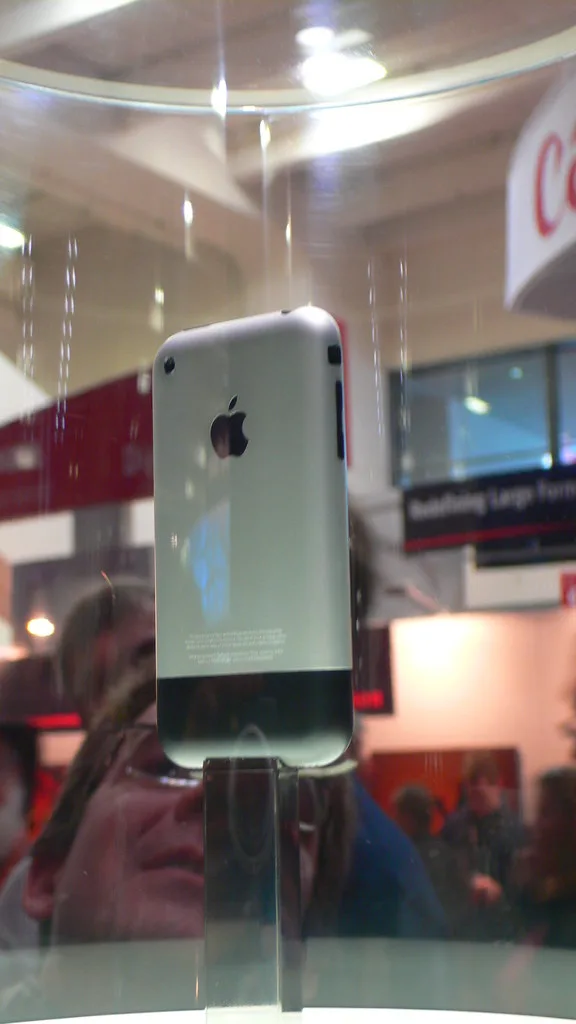
In 1989 at the European Organization for Nuclear Research (CERN) in Geneva, British computer scientist Tim Berners-Lee invented the World Wide Web, integrating hypertext (HTML), uniform resource locators (URLs), and client-server protocols (HTTP) over the underlying internet infrastructure. That infrastructure rested on TCP/IP, a common internetworking protocol that Vint Cerf and Bob Kahn published in 1974 so that different networks could exchange data in small packets; the Advanced Research Projects Agency Network (ARPANET) switched to it on 1 January 1983. On 30 April 1993, CERN released the Web software into the public domain, giving up all rights so that anyone could use, modify and build on it without license fees. By democratizing information access, the Web transformed global commerce, publishing, social interaction, and governance. The mobile smartphone revolution, accelerated by the launch of the Apple iPhone in 2007, transformed mobile computing into a ubiquitous extension of daily human life. A smartphone combines a mobile phone with a web browser, camera, GPS navigation and downloadable apps in one pocket device.
Physical globalization matched digital interconnectivity. In 1956, American entrepreneur Malcom McLean revolutionized global maritime trade by pioneering container shipping with the Intermodal Shipping Container; international standard sizes followed in 1968–1970. By slashing cargo loading costs from $5.86 per ton to 16 cents per ton, containerization enabled frictionless globalized 'just-in-time' manufacturing supply chains. In biotechnology, the international Human Genome Project produced an essentially complete sequence of human DNA in 2003, covering about 92% of the genome, while advances in Artificial Intelligence and deep neural networks transformed human-machine interaction.
Global Demographic Transitions, Energy Transitions, and the Anthropocene
Human population expanded exponentially during the 20th century, surging from 1.6 billion in 1900 to 6 billion in 1999, and passing 8 billion in 2022. This population explosion was sustained by the Green Revolution led by agronomist Norman Borlaug, who developed high-yielding, disease-resistant semi-dwarf wheat; the International Rice Research Institute released a comparable semi-dwarf rice, IR8, in 1966. These crops were paired with synthetic chemical nitrogen fertilizers (the Haber-Bosch process). Borlaug won the 1970 Nobel Peace Prize and is widely credited with saving over a billion people from starvation. Simultaneously, the Demographic Transition Model described how industrializing and urbanizing societies saw death rates fall and then widespread declines in fertility, resulting in rapid demographic aging. About 15% of the world's population lived in cities at the start of the 20th century; by 2018 the United Nations put the urban share at 55%.
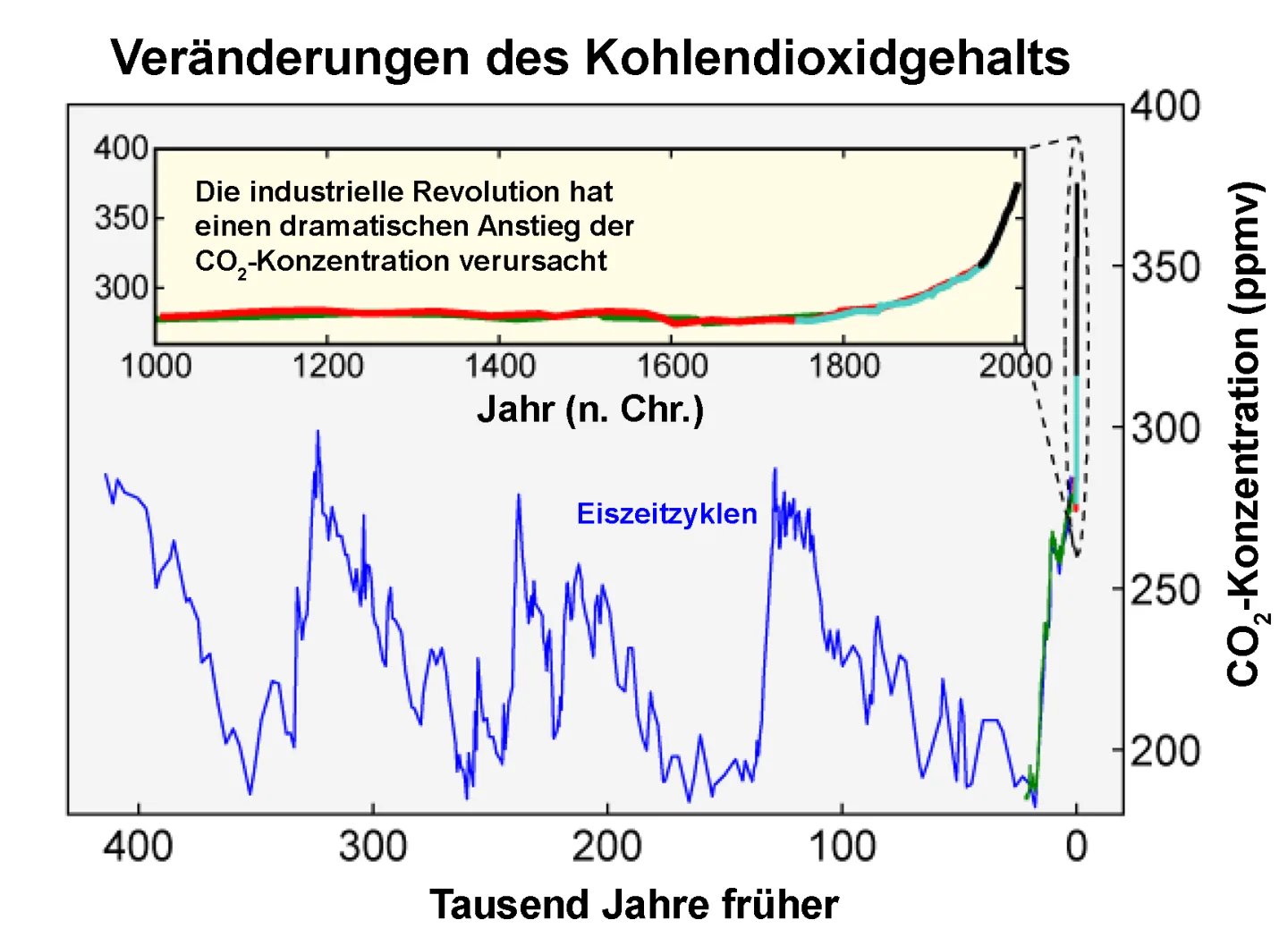
The monumental scale of fossil-fuel industrialization, deforestation, and industrial agriculture fundamentally altered Earth's biological and geochemical systems. At the Mauna Loa Observatory in Hawaii, Charles David Keeling began documenting atmospheric carbon dioxide in 1958; the Keeling Curve demonstrated an unbroken rise in atmospheric CO2 from 315 ppm to over 420 ppm, driving anthropogenic global climate change and oceanic acidification.
In 2000, Nobel laureate Paul Crutzen, with Eugene Stoermer, proposed the term Anthropocene for a new geological epoch in which human activity is the primary driver of global environmental change; Crutzen dated its start to the late 18th century. The Anthropocene Working Group later proposed a mid-20th-century start, marked in the stratigraphic record by radioactive fallout radionuclides, plastic polymers, and carbon isotopes. In March 2024 geologists voted 12 to 4 against adding the Anthropocene to the official geologic time scale; the International Union of Geological Sciences noted that the term would nonetheless remain in wide use.
In December 2015, 196 parties adopted the Paris Climate Agreement, a legally binding international treaty that aims to hold global warming well below 2 °C above pre-industrial levels while pursuing efforts to limit it to 1.5 °C. Each country sets its own emissions targets, called nationally determined contributions. Solar power meanwhile became far cheaper: the International Renewable Energy Agency (IRENA) reported that the average cost of electricity from new utility-scale solar photovoltaic projects fell by 88% between 2010 and 2021.
Key terms
- Moore's Law
- The historical empirical observation that the number of transistors packed onto a microchip doubles roughly every two years, resulting in exponential increases in computational speed and efficiency.
- Anthropocene
- A proposed geological epoch, following the Holocene, defined by the overwhelming, measurable global impact of human activity on Earth's ecosystems and geology; geologists rejected it as a formal epoch in 2024, though the term remains in wide use.
Key concepts
World Wide Web
- Global public information system operating over the internet, invented by Tim Berners-Lee in 1989
- Utilizes Hypertext Markup Language (HTML), Hypertext Transfer Protocol (HTTP), and Uniform Resource Locators (URLs)
- Democratized mass communication, global electronic commerce, and digital knowledge archiving
Microprocessor
- Integrated circuit that incorporates all the core arithmetic, logic, and control functions of a central processing unit (CPU) on a single microchip
- Invented with the Intel 4004 in 1971, following Gordon Moore's law of exponential transistor density scaling
- Drives modern personal computers, digital communications, cloud servers, and embedded automotive devices
Intermodal Containerization
- Standardized reusable steel freight box system designed for seamless transfer between ships, trains, and trucks without unloading contents
- Pioneered by Malcom McLean in 1956, collapsing international freight shipping costs and turnaround times
- Serves as the physical infrastructure enabling global just-in-time manufacturing and international trade
Information Age
- Historical period beginning in the late 20th century characterized by the rapid shift from traditional industry to an economy based on information technology
- Driven by personal computing, the internet, mobile digital telecommunications, and algorithmic automation
- Restructured global financial markets, white-collar labor, media consumption, and political discourse
Anthropocene
- Proposed geological epoch beginning in the mid-20th century marked by dominant human impact on Earth's geology, ecosystems, and climate
- Characterized in the sedimentary record by nuclear fallout radionuclides (plutonium-239), microplastics, synthetic pesticides, and altered carbon isotope ratios
- Follows the Holocene epoch (which began 11,700 years ago with the retreat of the last ice age)
Green Revolution
- Major technological transformation of global agriculture between 1950 and the late 1960s
- Pioneered by Norman Borlaug, utilizing semi-dwarf high-yield cereal crops, synthetic nitrogen fertilizers, irrigation, and pesticides
- Credited with helping avert feared famines, made Mexico self-sufficient in wheat by 1956, and raised world grain output about 160% from 1950 to 1984
Demographic Transition Model
- Phenomenological demographic model describing the historical shift from high birth and death rates to low birth and death rates as countries industrialize
- Consists of four to five stages: pre-industrial equilibrium, mortality drop / population surge, fertility decline, and low-fertility post-industrial equilibrium
- Its final stage, with fertility at or below replacement, implies population stabilization or eventual decline
Keeling Curve
- Continuous high-precision graph of atmospheric carbon dioxide concentration recorded at Mauna Loa Observatory, Hawaii, since 1958
- Demonstrates seasonal photosynthetic oscillations superimposed upon a relentless upward trend from 315 ppm to over 420 ppm
- Serves as the definitive empirical cornerstone of modern climate change science
Key facts
Tim Berners-Lee and the Invention of the World Wide Web
In 1989 at the European Organization for Nuclear Research (CERN), Tim Berners-Lee invented the World Wide Web (Hypertext Markup Language, Hypertext Transfer Protocol, and URLs), creating a decentralized global information space on the internet.
Malcom McLean and the Intermodal Shipping Container
In 1956, Malcom McLean pioneered container shipping with intermodal steel containers, reducing maritime cargo loading costs by over 90% and enabling modern global supply chains.
The Completion of the Human Genome Project
In 2003, the international Human Genome Project finished an essentially complete reference sequence of human DNA's roughly 3 billion base pairs (about 92% of the genome; the remaining gaps were closed later), transforming molecular medicine and biology.
The Launch of the Touchscreen Smartphone Revolution
Introduced in 2007, multi-touch mobile smartphones integrated mobile telecommunications, web browsing, GPS navigation, and app computing into a universal personal device.
The Emergence of Deep Learning Artificial Intelligence
Advances in multi-layer deep neural networks, graphical processing units (GPUs), and vast datasets enabled AI systems to master human language, vision, and protein folding.
The Keeling Curve Atmospheric CO2 Record
Initiated at Mauna Loa Observatory in 1958, the Keeling Curve provided definitive empirical evidence of relentless increases in atmospheric CO2 from 315 ppm to over 420 ppm.
Paul Crutzen and the Anthropocene Proposal
In 2000, Nobel laureate Paul Crutzen proposed that human impacts on Earth's geochemical cycles, biosphere, and climate constitute a new geological epoch: the Anthropocene.
The 2015 Paris Climate Agreement
In December 2015, 196 parties adopted the legally binding Paris Agreement, which aims to hold global warming well below 2°C above pre-industrial levels and to pursue 1.5°C.
The Global Demographic Transition and Urbanization
Over the 20th century many societies moved from high to low birth and death rates, and the urban share of the world's population rose from about 15% around 1900 to 55% by 2018 (UN estimate).
By the numbers
- In what year CE did Tim Berners-Lee write his initial proposal for the World Wide Web at the European Organization for Nuclear Research (CERN)?
- 1989 CE
- In what year CE was the complete sequencing of the Human Genome Project officially announced?
- 2003 CE
- In what year CE was the historic Paris Climate Agreement adopted by 196 nations at COP21?
- 2015 CE
- In what year CE did Charles David Keeling begin his continuous atmospheric CO2 recordings at Mauna Loa?
- 1958 CE
Matched pairs
Each item on the left goes with the one on the right.
- NeXT Computer (Berners-Lee's machine at the European Organization for Nuclear Research)
- A magnesium-cased computer on which the world's first web browser-editor and first web server (CERN httpd) were written in 1990
- Intel 4004 Microprocessor Die
- A miniature integrated circuit containing about 2,300 p-channel metal–oxide–semiconductor (MOS) transistors on a single silicon chip, in a 16-pin dual in-line package
- Mauna Loa Observatory
- A high-altitude volcano laboratory on the Big Island providing continuous monitoring of planetary greenhouse gas accumulations
- Bhadla Solar Park
- A massive utility-scale desert facility generating gigawatts of clean zero-carbon electricity from silicon solar arrays
Self-test
Answer each question from memory, then check your work against the answer key.
1. Why was the World Wide Web software released into the public domain, royalty-free, in 1993?
- ABecause IBM had already patented all computer networking software
- BBecause a European telecom monopoly demanded exclusive distribution rights
- CBecause Berners-Lee's employment contract barred him from selling the code
- DBecause CERN wanted anyone to use and build on it for free
2. What economic bottleneck did the standardized shipping container eliminate in global trade?
- AThe payment of all customs tariffs across every international border
- BThe slow, expensive, and theft-prone manual piece-by-piece breakbulk loading of ships by longshoremen
- CThe lengthy paperwork required for individual bills of lading per crate
- DThe requirement that cargo ships dock only during high tide
3. What observation is formulated by 'Moore's Law' regarding semiconductor microchips?
- AMicrochip manufacturing costs double in price every decade
- BSoftware program code length must double every single year
- CThe number of transistors on a microchip doubles approximately every two years while computing costs decrease
- DMicrochip clock speeds must double in gigahertz every year
4. What was the scientific achievement of the Human Genome Project completed in 2003?
- AProducing a near-complete sequence of human DNA
- BDiscovering that genes are made of DNA
- CProving that the DNA molecule has a double-helix structure
- DGrowing a fully working human organ in a laboratory
5. How did touchscreen smartphones transform digital computing starting in 2007?
- ABy eliminating the need for cellular network towers through direct satellite signals
- BBy making landline telephones the standard tool for business communication
- CBy merging telephony, mobile web access, camera recording, GPS mapping, and apps into an indispensable pocket device
- DBy requiring specialized centers to teach basic phone use
6. What outcome did the container shipping system pioneered by Malcom McLean make possible for global manufacturing?
- AOcean shipping replaced by long-distance rail freight
- BFrictionless just-in-time global manufacturing supply chains
- CA return to loading loose cargo by hand at the docks
- DHigher cargo-handling costs that favored local production
7. What fundamental networking architecture enables diverse computer networks to interconnect as the Internet?
- AThe TCP/IP (Transmission Control Protocol / Internet Protocol) packet-switching protocol suite
- BA centralized circuit-switched exchange routing each connection individually
- CA single dedicated fiber-optic cable connecting every home directly to a central hub
- DA single master vacuum-tube central mainframe located in Washington D.C
8. What landmark computing device did Intel release in 1971?
- AThe Intel 80386 32-bit microprocessor
- BThe Intel 8080 8-bit microprocessor
- CThe Intel 8086 16-bit microprocessor
- DThe Intel 4004 4-bit microprocessor
9. What 1947 invention made single-chip microprocessors like the Intel 4004 possible?
- AThe semiconductor transistor
- BThe punched paper tape reader
- CThe vacuum tube amplifier
- DThe magnetic core memory array
10. Which crop variety is agronomist Norman Borlaug specifically credited with developing for the Green Revolution?
- ADrought-resistant Champa rice from Vietnam
- BEmmer wheat and barley of the Fertile Crescent
- CHigh-yielding, disease-resistant semi-dwarf wheat
- DCalorie-dense potatoes and maize from the Americas
11. What did the Keeling Curve, begun at Mauna Loa Observatory in 1958, demonstrate?
- AAtmospheric CO2 holding flat at about 315 ppm
- BAn unbroken rise in atmospheric CO2 from 315 ppm to over 420 ppm
- CA steady fall in atmospheric CO2 since 1958
- DA rise in atmospheric methane rather than CO2
12. Which marker did the Anthropocene Working Group propose for the start of the Anthropocene, a term Paul Crutzen popularized in 2000?
- ACoal soot from steam engines of the late 18th century
- BLead pollution from Roman-era silver mining
- CCharcoal from forest clearing by Neolithic farmers
- DPlutonium fallout from mid-20th-century bomb tests
13. What pattern does the Demographic Transition Model describe in industrializing societies?
- AFertility falling first, then death rates
- BBirth and death rates both rising together
- CStable birth and death rates despite industry
- DDeath rates falling first, then fertility
14. What is the central goal of the 2015 Paris Climate Agreement?
- ALimit heating only for the United States and Europe, exempting all other nations
- BHold global warming well below 2 °C above pre-industrial levels, aiming for 1.5 °C
- CPause the global shift to renewable energy until 2050
- DHold emissions steady by building new coal-fired power plants
15. What 20th-century population surge did the Green Revolution help sustain?
- AA rise from 1.6 billion in 1900 to 6 billion in 1999
- BA rise from 1.6 billion in 1900 to 8 billion in 1999
- CA rise from 1.6 billion in 1900 to 3 billion in 1999
- DA rise from 1.6 billion in 1900 to 4.5 billion in 1999
16. What did the Haber-Bosch process supply to the Green Revolution?
- AAntibiotics synthesized from industrial coal tar
- BPurified drinking water at industrial scale
- CSynthetic chemical nitrogen fertilizers
- DDesalinated seawater for large-scale farm irrigation
Go deeper
- WatchThe Web Was Given Away In 1971, Intel launched the first commercial microprocessor. A whole processor fit on one chip.
- WatchThe Human Epoch World population passed 8 billion in 2022. In 1900, it was 1.6 billion.
- WatchSixteen Cents a Ton $5.86. That was once the cost to load each ton of cargo onto a ship.
- StudyWorld History: Turning Points of Human Civilization in the FlashFeed app
Answer key
- 1. D Because CERN wanted anyone to use and build on it for freeOn 30 April 1993 the European Organization for Nuclear Research (CERN) gave up all rights to the Web software so anyone could use, modify and build on it without license fees; the free release is credited with the Web's success.
- 2. B The slow, expensive, and theft-prone manual piece-by-piece breakbulk loading of ships by longshoremenBefore containers, loading a cargo ship took days of manual labor costing over $5 per ton; containers automated crane transfers directly between ships and trucks in minutes for pennies per ton.
- 3. C The number of transistors on a microchip doubles approximately every two years while computing costs decreaseGordon Moore observed in 1965 that transistor counts on a chip were doubling about every year; in 1975 he revised that rate to roughly every two years, the figure most often cited today, reflecting steady gains in computing power at falling cost.
- 4. A Producing a near-complete sequence of human DNAThe 13-year international project produced an essentially complete reference sequence of the roughly 3 billion base pairs of human DNA, covering about 92% of the genome; the remaining gaps were closed later by newer efforts.
- 5. C By merging telephony, mobile web access, camera recording, GPS mapping, and apps into an indispensable pocket deviceSmartphones transformed computing from stationary desktop workstations into continuous, portable, location-aware digital access points carried by billions of people.
- 6. B Frictionless just-in-time global manufacturing supply chainsBy cutting the cost of loading cargo from $5.86 to 16 cents per ton, containerization enabled frictionless, globalized just-in-time manufacturing supply chains.
- 7. A The TCP/IP (Transmission Control Protocol / Internet Protocol) packet-switching protocol suiteVint Cerf and Bob Kahn designed TCP/IP, which breaks data into standardized packets routed across disparate physical networks and reassembled reliably at the destination.
- 8. D The Intel 4004 4-bit microprocessorIntel's 1971 Intel 4004 was the world's first commercial single-chip microprocessor.
- 9. A The semiconductor transistorThe 1947 Bell Labs transistor was a germanium point-contact device; silicon transistors followed in 1954. Semiconductor transistors laid the technical foundation for later microprocessors.
- 10. C High-yielding, disease-resistant semi-dwarf wheatNorman Borlaug bred high-yielding, disease-resistant semi-dwarf wheat; the comparable semi-dwarf rice IR8 came from the International Rice Research Institute in 1966.
- 11. B An unbroken rise in atmospheric CO2 from 315 ppm to over 420 ppmCharles David Keeling began documenting atmospheric carbon dioxide at Mauna Loa in 1958; the Keeling Curve demonstrated an unbroken rise from 315 ppm to over 420 ppm.
- 12. D Plutonium fallout from mid-20th-century bomb testsThe Anthropocene Working Group proposed a mid-20th-century start marked by fallout radionuclides (notably plutonium), plastics and carbon-isotope shifts; Crutzen himself had dated the start to the late 18th century. Geologists rejected the formal epoch in 2024.
- 13. D Death rates falling first, then fertilityThe Demographic Transition Model describes how industrializing, urbanizing societies first saw death rates fall and then fertility decline, resulting in rapid demographic aging.
- 14. B Hold global warming well below 2 °C above pre-industrial levels, aiming for 1.5 °CThe 2015 Paris Agreement aims to hold global warming well below 2 °C above pre-industrial levels and to pursue efforts to limit it to 1.5 °C; each country sets its own emissions targets.
- 15. A A rise from 1.6 billion in 1900 to 6 billion in 1999Human population surged from 1.6 billion in 1900 to 6 billion in 1999, a population explosion that the Green Revolution helped sustain.
- 16. C Synthetic chemical nitrogen fertilizersThe Green Revolution paired high-yielding crop varieties with synthetic chemical nitrogen fertilizers produced by the Haber-Bosch process.
Sources
- Moore's law — Wikipedia; Gordon E. Moore, 'Cramming more components onto integrated circuits' (1965); Gordon E. Moore, 'Cramming more components onto integrated circuits' — en.wikipedia.org/wiki/Moore%27s_law
- Internet protocol suite — Wikipedia; Vinton G. Cerf and Robert E. Kahn, 'A Protocol for Packet Network Intercommunication' (1974) — en.wikipedia.org/wiki/Internet_protocol_suite
- CERN, Thirty years of a free and open Web (2023) — home.cern/30-years-free-and-open-web
- Smartphone — Wikipedia; Brian Merchant, The One Device — en.wikipedia.org/wiki/Smartphone
- Green Revolution — Wikipedia; Norman Borlaug, 'The Green Revolution, Peace, and Humanity'; Norman Borlaug, Nobel Lecture — en.wikipedia.org/wiki/Green_Revolution
- Norman Borlaug — Wikipedia; Norman Borlaug, Nobel Lecture — en.wikipedia.org/wiki/Norman_Borlaug
- Urbanization — Wikipedia — en.wikipedia.org/wiki/Urbanization
- UN DESA, 2018 Revision of World Urbanization Prospects; UN DESA, World Urbanization Prospects: The 2018 Revision — www.un.org/development/desa/en/news/population/2018-revision-of-world-urbanization-prospects.html
- UNFCCC, The Paris Agreement; UNFCCC, The Paris Agreement (2015) — unfccc.int/process-and-meetings/the-paris-agreement
- IRENA, Renewable Power Generation Costs in 2021 (executive summary); International Renewable Energy Agency (IRENA), Renewable Power Generation Costs in 2021 — www.irena.org/-/media/Files/IRENA/Agency/Publication/2022/Jul/IRENA_Power_Generation_Costs_2021_Summary.pdf
- Anthropocene — Wikipedia and 3 more references — en.wikipedia.org/wiki/Anthropocene
- Paris Agreement — Wikipedia; UNFCCC, The Paris Agreement — en.wikipedia.org/wiki/Paris_Agreement
- Tim Berners-Lee, Weaving the Web: The Original Design and Ultimate Destiny of the World Wide Web
- Michael S. Malone, The Intel Trinity
- Marc Levinson, The Box: How the Shipping Container Made the World Smaller and the World Economy Bigger
- Francis S. Collins, The Language of Life: DNA and the Revolution in Personalized Medicine
- Brian Merchant, The One Device: The Secret History of the iPhone
- Melanie Mitchell, Artificial Intelligence: A Guide for Thinking Humans
- World Wide Web (Wikipedia) — en.wikipedia.org/wiki/World_Wide_Web
- Michael S. Malone, The Intel Trinity — en.wikipedia.org/wiki/Microprocessor
- Marc Levinson, The Box — en.wikipedia.org/wiki/Intermodal_container
- Manuel Castells, The Information Age: Economy, Society and Culture — en.wikipedia.org/wiki/Information_Age
- Francis S. Collins, The Language of Life — en.wikipedia.org/wiki/Human_Genome_Project
- Malcom McLean — Wikipedia (citing C. E. Ebeling, 'Evolution of a Box') — en.wikipedia.org/wiki/Malcom_McLean
- Tim Berners-Lee (Wikipedia) — en.wikipedia.org/wiki/Tim_Berners-Lee
- HTML (Wikipedia) — en.wikipedia.org/wiki/HTML
- Michael S. Malone, The Intel Trinity — en.wikipedia.org/wiki/Intel
- NeXT Computer (Wikipedia) — en.wikipedia.org/wiki/NeXT_Computer
- Michael S. Malone, The Intel Trinity — en.wikipedia.org/wiki/Intel_4004
- Charles D. Keeling, 'The Concentration and Isotopic Abundances of Carbon Dioxide in the Atmosphere' (1960)
- Paul J. Crutzen and Eugene F. Stoermer, 'The "Anthropocene"' (2000)
- Warren S. Thompson, 'Population' — en.wikipedia.org/wiki/Demographic_transition
- Charles D. Keeling, 'The Concentration and Isotopic Abundances of Carbon Dioxide in the Atmosphere'; Charles D. Keeling, 'The Concentration of Carbon Dioxide in the Atmosphere' — en.wikipedia.org/wiki/Keeling_Curve
- United Nations Department of Economic and Social Affairs, World Population Prospects 2022 — en.wikipedia.org/wiki/World_population
- Vaclav Smil, Enriching the Earth: Fritz Haber, Carl Bosch, and the Transformation of World Food Production — en.wikipedia.org/wiki/Haber_process
- Charles D. Keeling, 'The Concentration of Carbon Dioxide in the Atmosphere' — en.wikipedia.org/wiki/Mauna_Loa_Observatory
- Paul J. Crutzen, 'Geology of Mankind' — en.wikipedia.org/wiki/Paul_J._Crutzen
- IRENA, Renewable Power Generation Costs in 2021 — en.wikipedia.org/wiki/Bhadla_Solar_Park
Image credits
- The Launch of the Touchscreen Smartphone Revolution: nobihaya (Openverse) · by 2.0 — www.flickr.com/photos/36521984920@N01/353217981
- The Keeling Curve Atmospheric CO2 Record: Das Bild wurde für 'Global Warming Art' erstellt ([1]), Übersetzung: David W. (Openverse) · by-sa 3.0 — commons.wikimedia.org/wiki/File:Verlauf_Kohlendioxidgehalt.png
