
Ancient Civilizations: First Cities to Late Antiquity study guide · Lesson 9 of 12
Ancient India: Vedic Foundations, Maurya & Gupta (c. 1500 BCE–550 CE)
Gangetic Deforestation, Janapadas & Mauryan Bureaucracy · The Gupta Golden Age, Mathematics & Monastic Universities
This is the lesson's study guide from the FlashFeed app, plus its key facts and a self-test.
What you'll be able to do
- Analyze Gangetic iron urbanization, the 16 Mahajanapadas, Kautilya's Arthashastra, and Ashokan Dhamma.
- Evaluate Gupta mathematical zero (Shunya), Aryabhata's astronomy, Nalanda university, and metallurgy.
The Second Urbanization, Iron, and the Mahajanapadas
Following the decline of the Indus Valley civilization, Indo-Aryan speaking pastoralist groups migrated into northwest India during the Early Vedic period (c. 1500–1000 BCE), composing sacred oral Sanskrit hymns known as the Rigveda.
Around 1000 BCE, the advent of iron metallurgy (associated with the archaeological Painted Grey Ware culture) catalyzed a historic shift east into the fertile, monsoon-drenched Gangetic Plain. Equipped with heavy iron axes and iron-tipped socketed plowshares, communities cleared the dense subtropical hardwood forests, initiating intensive wet-rice paddy cultivation.
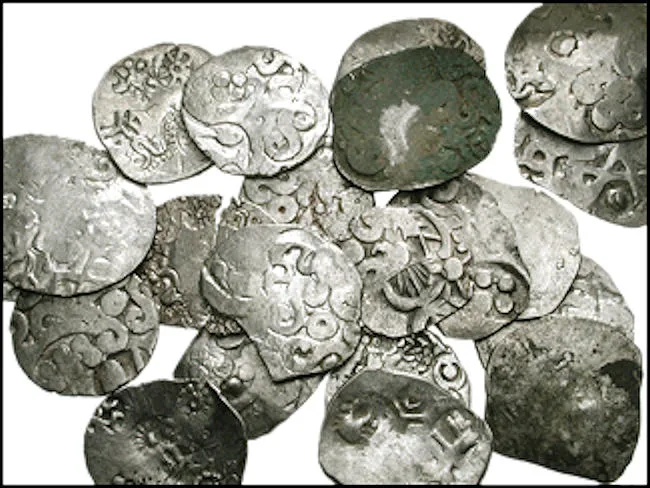
Agricultural surpluses along the Ganges triggered India's Second Urbanization (c. 600 BCE). Tribal territories (Janapadas) consolidated into sixteen major regional states known as the Mahajanapadas (c. 6th century BCE). These states exhibited two distinct political systems:
- Rajyas (Monarchies): Centralized kingdoms such as Magadha and Kosala governed by hereditary kings supported by orthodox Vedic priesthoods (Brahmins).
- Ganasanghas (Oligarchic Republics): Clan-based republics such as the Vajji Confederation (Licchavis) and Shakya clan, governed by elected assemblies of clan elders (Rajas) meeting in civic halls (Santhagara).
This urban milieu of commercial expansion and intellectual ferment gave birth to the Sramana movements—renunciant philosophical traditions rejecting Vedic animal sacrifice and the hereditary four-tier Varna caste system (Brahmins, Kshatriyas, Vaishyas, Shudras). Prominent among these were Buddhism, founded by Siddhartha Gautama (the Buddha, c. 563–483 BCE), and Jainism, codified by Vardhamana Mahavira (c. 599–527 BCE), emphasizing non-violence (Ahimsa), ethical karma, and liberation (Moksha/Nirvana).
Kautilya's Arthashastra and Mauryan Imperial Centralization
By the 4th century BCE, the kingdom of Magadha expanded due to key strategic advantages: rich iron ore deposits in Jharkhand, fertile alluvial rice plains, and wild elephant herds trained for warfare. In 322 BCE, following Alexander of Macedon's withdrawal from the Indus, Chandragupta Maurya overthrew the Nanda dynasty to establish the Mauryan Empire—India's first subcontinental empire.
The theoretical framework of Mauryan governance is preserved in the Arthashastra, a comprehensive Sanskrit treatise on statecraft attributed to Chandragupta's chief advisor and prime minister, Kautilya (also known as Chanakya).
The Arthashastra outlines an administrative realpolitik:
- The Saptanga Theory of State: The state is an organism composed of seven essential elements: King (Swami), Minister (Amatya), Territory (Janapada), Fortified Capital (Durga), Treasury (Kosha), Army (Danda), and Allies (Mitra).
- State Economic Monopolies: The crown maintained strict state ownership over mining, metallurgy, forestry, liquor production, and salt manufacturing.
- Espionage Network: An pervasive intelligence service using undercover spies (merchants, ascetics, courtesans) to monitor provincial governors, gather tax intelligence, and eliminate sedition.
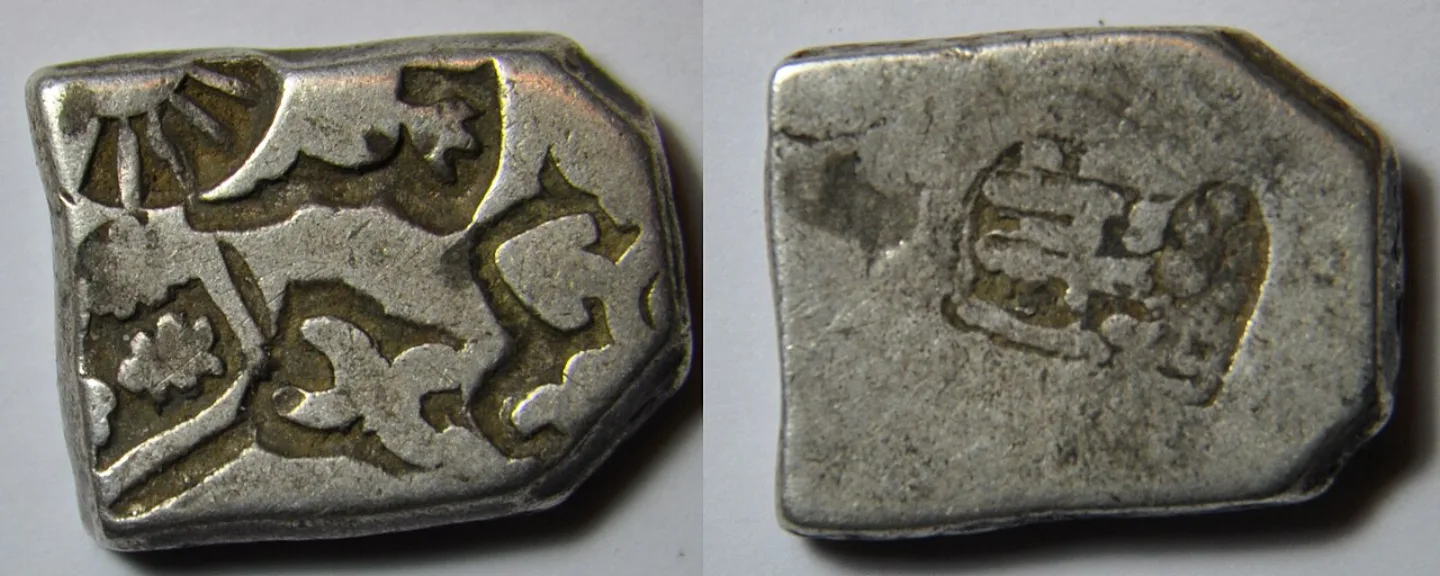
- Land Revenue and Standardized Coinage: The treasury drew a major share of its revenue from taxes on agricultural land, and state transactions were conducted with silver punch-marked coins (Panas) stamped with royal symbols (sun, crescent on hill, wheel).
Ashoka's Edicts, Moral Diplomacy, and Dhamma
The Mauryan Empire reached its zenith under Chandragupta's grandson, Emperor Ashoka (reigned c. 268–232 BCE). In 261 BCE, Ashoka conquered the coastal kingdom of Kalinga (modern Odisha). The resulting military slaughter—costing over 100,000 battlefield deaths and 150,000 deportations—induced profound remorse in the emperor.
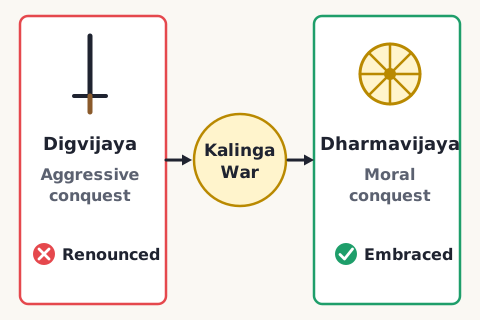
Ashoka renounced aggressive military conquest (Digvijaya) and converted to Buddhism, dedicating his reign to moral conquest through righteous conduct (Dharmavijaya). He promulgated his state policy of Dhamma (civic virtue, tolerance, non-violence, and filial piety) through monumental public inscriptions incised on rock faces and polished 15-meter monolith stone pillars across India, Pakistan, and Afghanistan (Ashoka's Edicts). Inscribed in the local vernacular Prakrit (using Brahmi and Kharosthi scripts), Greek, and Aramaic, the edicts announced the construction of hospitals for humans and animals, the planting of roadside shade trees, and the appointment of moral officers (Dhamma Mahamattas).
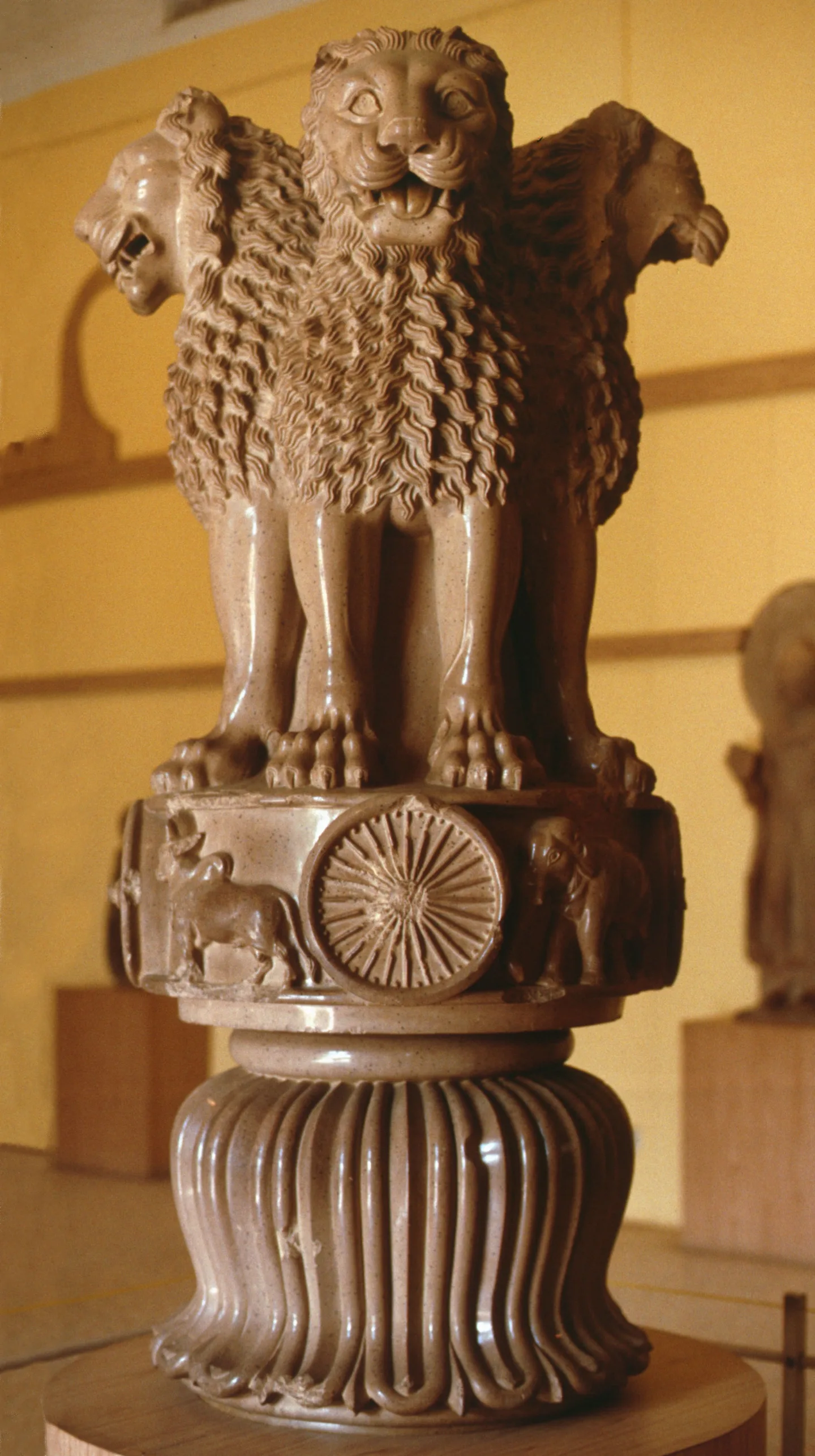
The crown of Ashokan stone artistry is the Lion Capital of Sarnath (c. 250 BCE), carved from single blocks of polished Chunar sandstone. Depicting four Asiatic lions standing back-to-back above an abacus carved with a galloping horse, bull, lion, elephant, and the 24-spoke Dharmachakra (Wheel of Law), the sculpture was adopted in 1950 as the official National Emblem of modern India.
The Decimal Zero and Classical Indian Mathematics
During the Gupta Empire (c. 320–550 CE), founded by Chandragupta I, northern India enjoyed an intellectual and scientific golden age.
The most transformative intellectual breakthrough of the Gupta period was the mathematical formalization of the base-10 decimal place-value system with Zero (Shunya—meaning void or emptiness):
- While Babylonians and Mayans used placeholder symbols, Indian mathematicians treated zero as a fully functional operational number capable of addition, subtraction, multiplication, and algebraic manipulation.
- This system, recorded in the Bakhshali Manuscript (dating from the early centuries CE with distinctive zero dots), was later transmitted through Arab mathematicians (al-Khwarizmi) to Europe as the "Hindu-Arabic numeral system."
In 499 CE, at age 23, astronomer and mathematician Aryabhata composed the Sanskrit treatise Aryabhatiya:
- Proposed that the Earth is a sphere rotating daily on its axis, correctly explaining that the apparent motion of stars is an optical illusion caused by Earth's rotation.
- Calculated the length of the solar year as approximately 365.2587 days (365 days, 6 hours, 12 minutes, 30 seconds).
- Correctly explained solar and lunar eclipses as shadows cast by the Earth and Moon rather than demon attacks.
- Approximated the mathematical constant π to four decimal places (3.1416), recognizing it as an irrational ratio.
Nalanda University and the Gupta Intellectual Renaissance
The Gupta period established the world's premier residential international university: Nalanda Mahavihara (founded 5th century CE in Bihar under imperial patronage). Nalanda accommodated over 10,000 Buddhist monks and international students from China (including famous pilgrims Xuanzang and Yijing), Korea, Japan, Tibet, and Central Asia. Entrance was fiercely competitive: gatekeepers tested applicants on logic, and only two out of ten passed. Students studied Buddhist philosophy, Sanskrit grammar, logic (Nyaya), medicine (Ayurveda), astronomy, and mathematics across vast multi-story libraries.
Gupta metallurgical mastery is embodied in the Iron Pillar of Delhi (c. 400 CE), erected during the reign of Chandragupta II. Standing 7.2 meters tall and weighing over 6 tons, the forged wrought-iron pillar has stood exposed to monsoon weather for over 1,600 years with remarkably little corrosion, protected by an exceptionally high phosphorus content that catalysed a thin passive protective layer (crystalline iron hydrogen phosphate hydrate, with amorphous iron oxyhydroxide, misawite, as the initial protective agent).
Artistic expression reached classical heights in the Gupta age, notably in the rock-cut cave temples of Ajanta (Maharashtra), patronised in their major painted phase by the Vakataka dynasty (Gupta contemporaries), where Buddhist monks painted breathtaking tempera frescoes of the Jataka tales and Bodhisattvas (such as the compassionate Padmapani). In Sanskrit literature, court dramatist Kalidasa composed enduring poetic masterpieces (Shakuntala, Meghaduta), while Gupta mints struck exquisite gold coins (Dinars) depicting the emperor playing the veena lute, embodying an empire that harmonized material wealth with cultural refinement.
Key terms
- Dhamma (Ashokan)
- A civic and moral code promoted by Emperor Ashoka emphasizing non-violence, religious tolerance, and filial respect.
- Shunya
- The Sanskrit mathematical and philosophical term for zero, signifying both emptiness and the operational integer zero.
Key concepts
Mahajanapadas
- Sixteen great territorial realms that emerged in northern India during the 6th century BCE
- Comprised monarchies (*Rajyas*) such as Magadha and Kosala, and oligarchic republics (*Ganasanghas*) like Vajji
- Fostered commercial urbanization, punch-marked coinage, and the emergence of Buddhism and Jainism
The Arthashastra
- Ancient Indian Sanskrit treatise on statecraft, economic policy, espionage, and military strategy
- Attributed to Kautilya (Chanakya), the chief advisor to Chandragupta Maurya c. 300 BCE
- Advocated realpolitik, state monopolies over mining and forestry, and systematic spy networks
Emperor Ashoka
- Third Mauryan Emperor (reigned c. 268–232 BCE) who unified almost the entire Indian subcontinent
- Renounced military conquest after witnessing the slaughter of the Kalinga War in 261 BCE
- Carved moral edicts promoting non-violence, religious tolerance, and animal welfare across Asia
Lion Capital of Sarnath
- Monumental pillar capital carved from polished Chunar sandstone commemorating the Buddha's First Sermon
- Features four addorsed lions standing above a circular abacus with the 24-spoke *Dharmachakra* wheel
- Adopted in 1950 as the official National Emblem of the Republic of India
Shunya (Operational Zero)
- Mathematical concept and numerical glyph formalizing zero as both a place-value holder and computational integer
- Earliest surviving manuscript evidence of zero as a dot symbol, though the manuscript's date is debated (radiocarbon results span the 3rd to 11th centuries CE)
- Transmitted via Islamic scholars (al-Khwarizmi) to Europe to establish modern global arithmetic
Aryabhata
- Fifth-century CE Indian mathematical astronomer who composed the Sanskrit masterwork *Aryabhatiya* in 499 CE
- Formulated that the spherical Earth rotates daily on its axis, calculating the solar year as approximately 365.2587 days (365 days, 6 hours, 12 minutes, 30 seconds)
- Calculated the trigonometric sine table and approximated the value of π to four decimal places (3.1416)
Nalanda Mahavihara
- Ancient residential monastic university founded in Bihar under 5th-century Gupta imperial patronage
- Housed over 10,000 international Buddhist monks, logicians, and medical scholars from across Asia
- Maintained rigorous competitive entrance examinations and a massive multi-story library called *Dharmaganja*
Iron Pillar of Delhi
- 7.2-meter, 6-ton wrought-iron commemorative pillar forged during the reign of Chandragupta II (c. 400 CE)
- Exhibits advanced high-phosphorus forge-welded metallurgy resisting atmospheric corrosion for 1,600 years
- Inscribed in classical Sanskrit Brahmi script honoring King Chandra and the deity Vishnu
Key facts
Iron Technology and Gangetic Agricultural Expansion
From c. 1000 BCE, the adoption of iron axes and iron-tipped plows enabled the clearance of dense hardwood forests in the Gangetic plain, producing wet-rice surpluses that sparked the 'Second Urbanization'.
The Rise of the Sixteen Mahajanapadas
By the 6th century BCE, regional tribal territories consolidated into sixteen major states (Mahajanapadas), comprising both monarchies (Rajyas like Magadha) and oligarchic republics (Ganasanghas like the Licchavis).
Kautilya's Arthashastra and Mauryan Realpolitik
The Arthashastra, attributed to prime minister Kautilya (Chanakya), provided a detailed treatise on imperial statecraft, state monopoly over mines and forests, taxation, espionage networks, and diplomatic realpolitik.
The Mauryan Standing Army and Silver Punch-Marked Coins
Chandragupta Maurya (founded c. 322 BCE) unified northern India with a large standing army — ancient Greek and Roman accounts (Megasthenes, via Pliny) put it at 600,000 infantry and 9,000 war elephants — funded by standard punch-marked silver coins (Panas).
Ashoka's Kalinga War and Conversion to Dhamma
Following the horrific bloodshed of the Kalinga War in 261 BCE (costing over 100,000 lives), Emperor Ashoka renounced aggressive conquest (Digvijaya) and embraced moral conquest through Buddhist principles (Dharmavijaya).
The Sarnath Lion Capital of Ashoka
Carved from polished Chunar sandstone around 250 BCE, the Sarnath Lion Capital features four addorsed Asiatic lions above an abacus with the 24-spoke Dharmachakra wheel, adopted as modern India's state emblem.
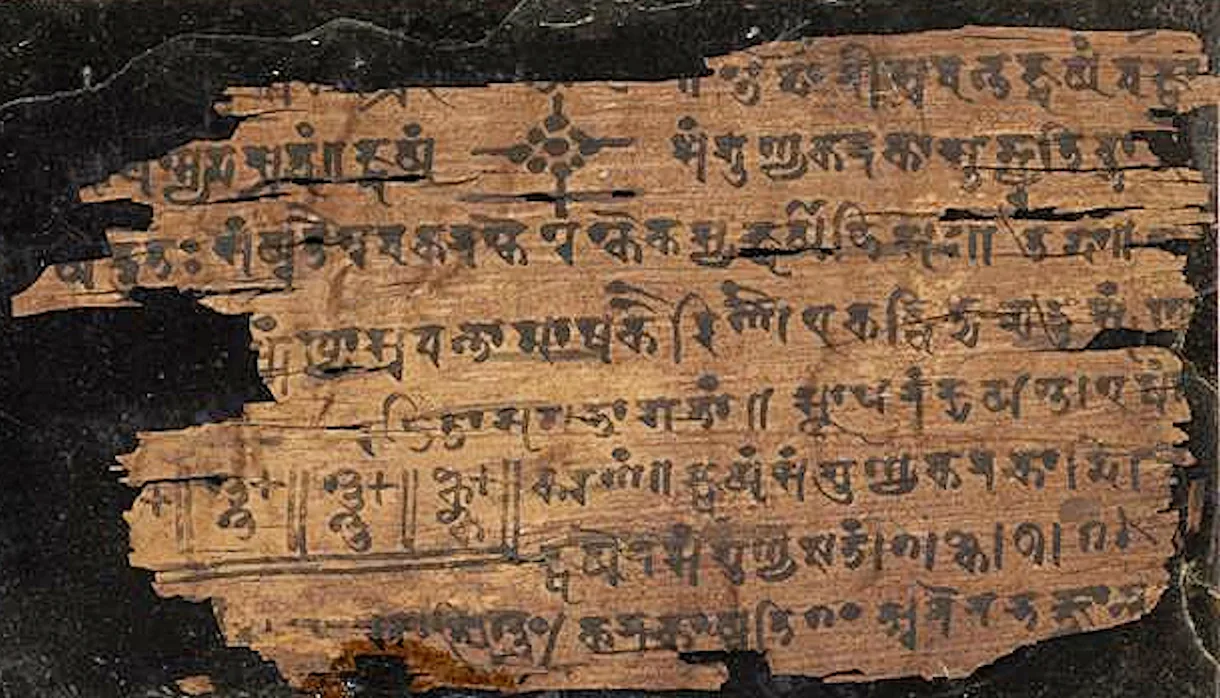
The Invention of Positional Decimal Zero (Shunya)
Indian mathematicians formalized the base-10 decimal place-value system with zero (Shunya) as both a numerical placeholder and an operational number over the first millennium CE, revolutionizing global mathematics; the exact age of the surviving Bakhshali Manuscript remains debated among scholars.
Aryabhata and Earth's Axial Rotation
In 499 CE, Indian astronomer Aryabhata authored the Aryabhatiya, correctly proposing that Earth rotates daily on its axis, calculating the length of the solar year at approximately 365.2587 days (365 days, 6 hours, 12 minutes, 30 seconds), and approximating π as 3.1416.
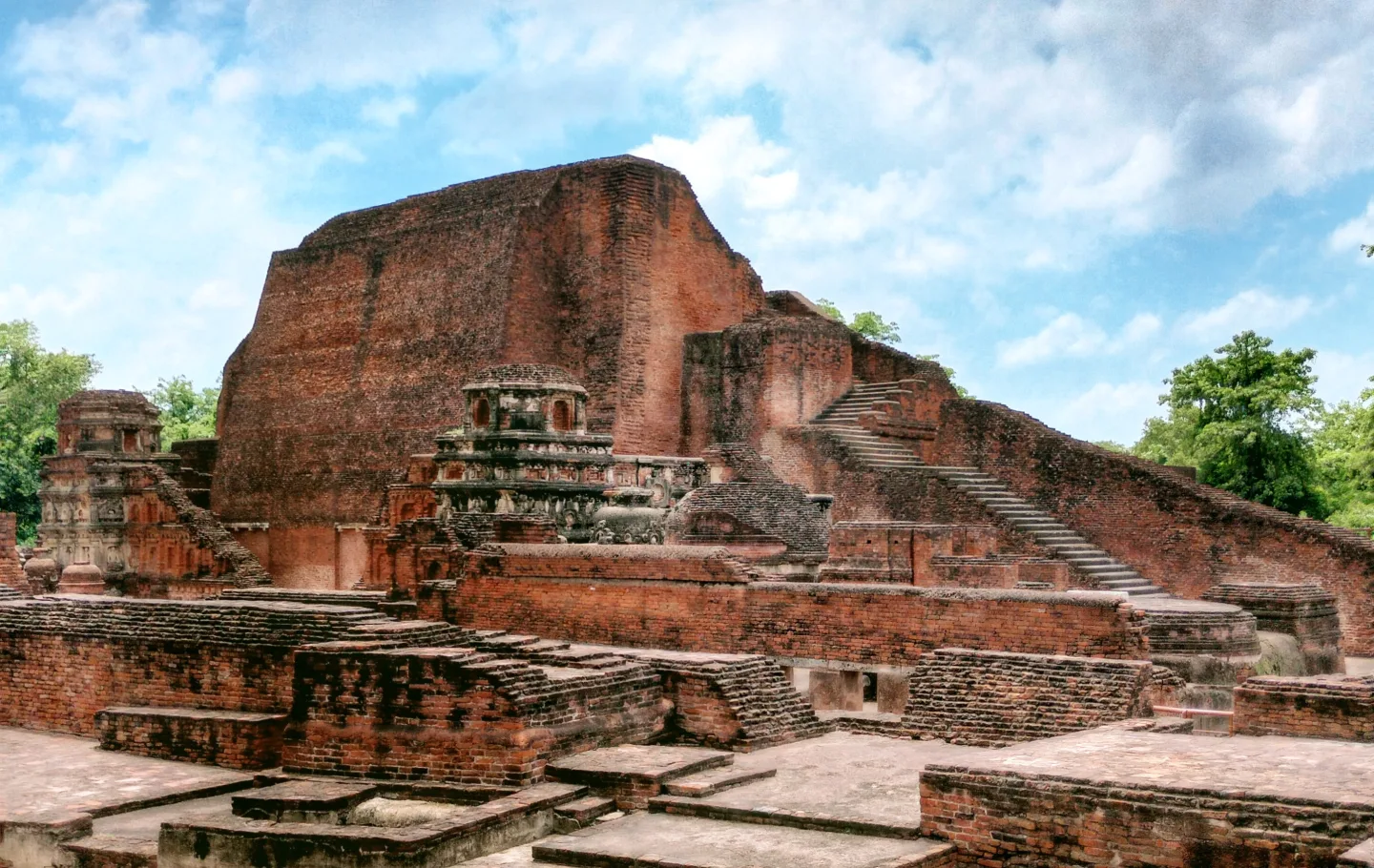
Nalanda Mahavihara: The Residential Monastic University
Founded under Gupta patronage in the 5th century CE, Nalanda Mahavihara housed up to 10,000 monks and international scholars studying Buddhist philosophy, Sanskrit grammar, logic, medicine, and astronomy.
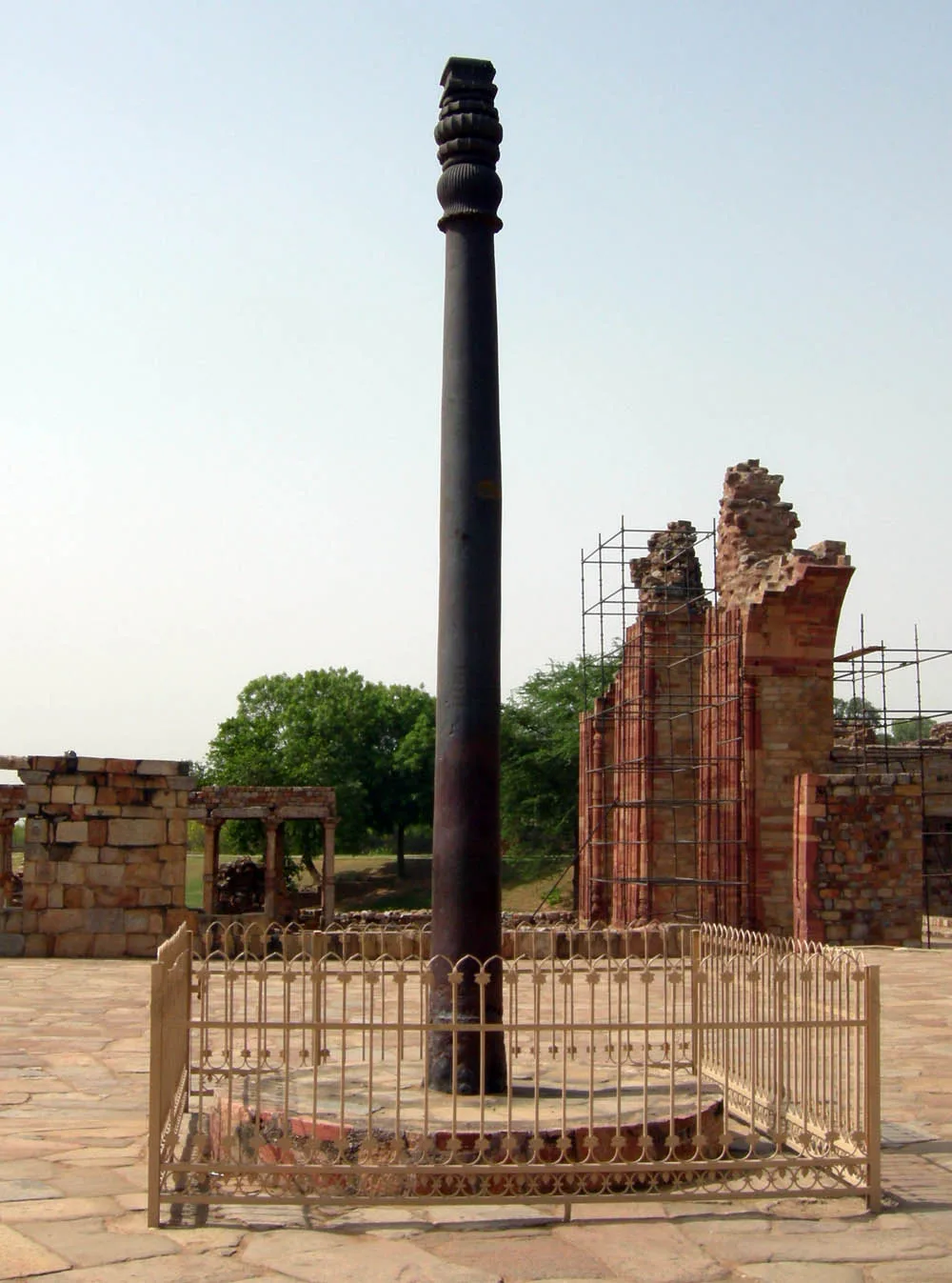
The Iron Pillar of Delhi and Rust-Resistant Metallurgy
Forged during the reign of Chandragupta II (c. 400 CE), the 6-ton, 7.2-meter Iron Pillar of Delhi has resisted corrosion for over 1,600 years due to a protective high-phosphorus iron oxide film (misawite).
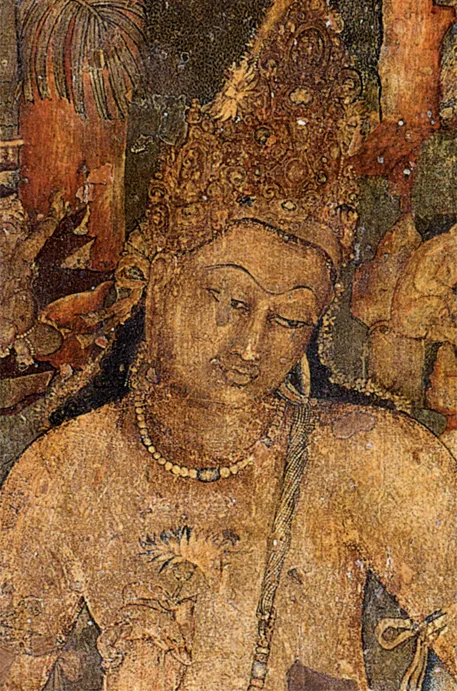
The Ajanta Caves Frescoes and Gupta Classical Art
The rock-cut Buddhist monastery caves at Ajanta (5th century CE) feature masterful tempera murals depicting Jataka tales and Bodhisattvas (such as Padmapani), embodying the classical Gupta aesthetic.
Gupta Gold Dinar Coinage and Royal Iconography
Gupta emperors minted exquisite gold coins (Dinars) depicting the ruler playing the veena lute, hunting tigers, or performing the horse sacrifice (Ashvamedha), reflecting imperial cultural patronage.
By the numbers
- In what year BCE did Emperor Ashoka wage the bloody Kalinga War that prompted his conversion to Buddhism?
- 261 year BCE
- In what year CE did Indian astronomer Aryabhata compose the foundational treatise Aryabhatiya?
- 499 year CE
- What is the approximate total weight in tons of the rust-resistant Iron Pillar of Delhi?
- 6 tons
Matched pairs
Each item on the left goes with the one on the right.
- Digvijaya
- Traditional military conquest and territorial expansion through armed force
- Dharmavijaya
- Moral conquest and diplomatic influence achieved through righteous conduct
- Aryabhatiya (499 CE)
- Treatise on Earth's axial rotation, planetary eclipses, and trigonometry
- Abhijnanashakuntala
- Celebrated Sanskrit drama composed by Kalidasa, traditionally placed in the Gupta-era court
Self-test
Answer each question from memory, then check your work against the answer key.
1. What technological catalyst enabled the 'Second Urbanization' in the Gangetic plain around 600 BCE?
- AThe construction of stone sea dikes along the southern coast of Sri Lanka
- BThe use of iron axes and iron-tipped plows to clear dense subtropical hardwood forests
- CThe introduction of domesticated camel caravans from the Arabian desert
- DThe adoption of piece-mold bronze casting technology imported from Shang China
2. What political distinction separated Ganasanghas (like the Licchavis) from Rajyas (like Magadha)?
- AGanasanghas were theocracies governed strictly by Egyptian-style pharaohs
- BGanasanghas were military colonies administered directly by Spartan hoplites
- CGanasanghas were nomadic tribes that completely rejected writing and coinage
- DGanasanghas were clan-based oligarchic republics governed by assemblies of elders
3. Which resources did the Arthashastra's crown hold under strict state ownership?
- AStrategic natural resources including mines, metallurgy, forestry, and liquor manufacturing
- BState monopoly control over horse trading markets and the training of war elephants
- CDomestic pottery kiln manufacturing and cotton spinning inside family homes
- DState monopoly control over coastal shipping, textile looms, and gemstone workshops
4. What profound ethical shift did Emperor Ashoka enact following the bloody conquest of Kalinga in 261 BCE?
- AHe instead doubled the size of the imperial army to complete the conquest of the Deccan
- BHe divided the empire among his sons so that no single ruler could wage another war
- CHe renounced aggressive military conquest in favor of moral conquest through Dhamma
- DHe ordered the total destruction of all Buddhist monasteries across northern India
5. What symbolic wheel appears on the abacus of the Sarnath Lion Capital of Ashoka?
- AA twenty-four-spoke Dharmachakra wheel representing cosmic and moral law
- BA forty-spoke chariot wheel commemorating the royal conquest of Babylon
- CAn eight-spoke bronze ship steering wheel dedicated to the Greek god Poseidon
- DA sixteen-spoke Aztec solar calendar wheel predicting agricultural eclipses
6. Why was the Indian formalization of Shunya (zero) revolutionary in the history of mathematics?
- AIt prohibited the use of fractional numbers in private commercial market transactions
- BIt treated zero as an operational mathematical integer capable of addition, subtraction, and algebraic calculation
- CIt was used exclusively for measuring high-tide ocean water levels in the Arabian Sea
- DIt replaced all written multiplication tables with mechanical counting abacuses
7. What astronomical hypothesis was correctly proposed by Indian astronomer Aryabhata in his 499 CE treatise?
- AThat planetary orbits are perfect concentric rings made of solid crystalline bronze
- BThat the universe is a flat disc supported on the backs of four cosmic elephants
- CThat the Earth is a sphere rotating daily on its axis, causing the apparent motion of stars
- DThat lunar eclipses are caused by demonic serpents swallowing the solar disc
8. How was entrance admission granted to prospective international scholars applying to Nalanda University?
- ABy paying high annual tuition fees in pure gold Roman solidus coins
- BBy drawing random wooden sortition lots during the annual spring equinox festival
- CBy mandatory hereditary aristocratic nobility verified by the Gupta imperial court
- DBy passing rigorous oral debate examinations conducted by learned university gatekeepers
9. What metallurgical characteristic prevents the 1,600-year-old Iron Pillar of Delhi from rusting?
- AA passive protective film (including misawite) formed on its high-phosphorus wrought iron
- BA protective outer plating of melted gold leaf applied during the Mughal Empire
- CA modern chromium-steel alloy added during a 20th-century restoration effort
- DThe complete absence of moisture or rainfall in the northern Indian climate
10. What spiritual figure is depicted with compassionate naturalism in the famous Cave 1 mural at Ajanta?
- AThe Jain tirthankara Mahavira seated in silent ascetic meditation
- BThe bodhisattva Maitreya, believed destined to become the future Buddha
- CThe historical Buddha Shakyamuni delivering his first sermon at Sarnath's deer park
- DThe Bodhisattva Padmapani holding a blue lotus flower with graceful meditative elegance
Go deeper
Answer key
- 1. B The use of iron axes and iron-tipped plows to clear dense subtropical hardwood forestsIron metallurgy allowed communities to clear the thick subtropical forests of the Gangetic plain, facilitating wet-rice farming and urban centers.
- 2. D Ganasanghas were clan-based oligarchic republics governed by assemblies of eldersGanasanghas were republics or oligarchies where clan leaders (*Rajas*) met in civic assembly halls (*Santhagara*) to deliberate policy.
- 3. A Strategic natural resources including mines, metallurgy, forestry, and liquor manufacturingThe Arthashastra mandated royal state monopolies over high-value strategic resources: mining, metal production, timber forests, salt, and liquor.
- 4. C He renounced aggressive military conquest in favor of moral conquest through DhammaHorrified by the toll of the Kalinga War (Ashoka's own Rock Edict 13 records about 100,000 killed and 150,000 deported), Ashoka embraced Buddhism, renouncing conquest by sword (*Digvijaya*) for conquest by righteousness (*Dharmavijaya*).
- 5. A A twenty-four-spoke Dharmachakra wheel representing cosmic and moral lawThe abacus features the 24-spoke *Dharmachakra* (Wheel of Moral Law), symbolizing the Buddha's First Sermon at Sarnath and Ashoka's righteous statecraft.
- 6. B It treated zero as an operational mathematical integer capable of addition, subtraction, and algebraic calculationUnlike placeholder marks in other cultures, Indian mathematicians treated zero as a functional number with operational algebraic rules.
- 7. C That the Earth is a sphere rotating daily on its axis, causing the apparent motion of starsIn Aryabhatiya, Aryabhata stated that the Earth is spherical and rotates daily on its axis, correctly explaining day and night.
- 8. D By passing rigorous oral debate examinations conducted by learned university gatekeepersChinese pilgrim Xuanzang noted that Nalanda gatekeepers tested applicants with difficult logic questions; only 20–30% passed entrance exams.
- 9. A A passive protective film (including misawite) formed on its high-phosphorus wrought ironThe pillar was forged from high-phosphorus wrought iron, smelted without limestone added to the furnace. The phosphorus catalysed a thin passive protective layer of crystalline iron hydrogen phosphate hydrate, with misawite (an amorphous iron oxyhydroxide) as the initial protective agent.
- 10. D The Bodhisattva Padmapani holding a blue lotus flower with graceful meditative eleganceThe Padmapani ('Holder of the Lotus') Bodhisattva in Ajanta Cave 1 is considered a masterpiece of classical Indian painting.
Sources
- Romila Thapar, The Penguin History of Early India
- National Museum New Delhi: Mauryan and Gupta Collections — www.nationalmuseumindia.gov.in/en/collections/index/7
- Romila Thapar, The Penguin History of Early India — penguin.co.in
- Archaeological Survey of India: Sarnath and Ajanta — asi.nic.in
- Wikipedia: Arthashastra — en.wikipedia.org/wiki/Arthashastra
- Wikipedia: Chandragupta Maurya — en.wikipedia.org/wiki/Chandragupta_Maurya
- Wikipedia: Kalinga War — en.wikipedia.org/wiki/Kalinga_War
- National Museum New Delhi: Mauryan and Gupta Collections — nationalmuseumindia.gov.in
- Bodleian Library, University of Oxford: Bakhshali Manuscript — www.bodleian.ox.ac.uk
- Wikipedia: Iron pillar of Delhi — en.wikipedia.org/wiki/Iron_pillar_of_Delhi
- Wikipedia: Ajanta Caves — en.wikipedia.org/wiki/Ajanta_Caves
Image credits
- The Rise of the Sixteen Mahajanapadas: Wikimedia Commons · Classical Numismatic Group, Inc. http://www.cngcoins.com · CC BY-SA 3.0 — commons.wikimedia.org/wiki/File:Kosala_Karshapana.jpg
- The Mauryan Standing Army and Silver Punch-Marked Coins: Jean-Michel Moullec from Vern sur Seiche (35, Bretagne), France · CC BY 2.0 — commons.wikimedia.org/wiki/File:I42_1karshapana_Maurya_Bindusara_MACW4165_1ar_(8486583162).jpg
- Ashoka's Kalinga War and Conversion to Dhamma: FlashFeed original diagram · CC-BY-4.0
- The Sarnath Lion Capital of Ashoka: Wikimedia Commons · Chrisi1964 · CC BY-SA 4.0 — commons.wikimedia.org/wiki/File:Sarnath_capital.jpg
- The Invention of Positional Decimal Zero (Shunya): Wikimedia Commons · National Geographic · Public domain — commons.wikimedia.org/wiki/File:Bakhshali_manuscript.jpg
- Nalanda Mahavihara: The Residential Monastic University: Wikimedia Commons · Odantapuribs · CC BY-SA 4.0 — commons.wikimedia.org/wiki/File:Temple_No.-_3,_Nalanda_Archaeological_Site.jpg
- The Iron Pillar of Delhi and Rust-Resistant Metallurgy: Wikimedia Commons · Mark A. Wilson · Public domain — commons.wikimedia.org/wiki/File:Iron_Pillar,_Delhi,_May_2008.jpg
- The Ajanta Caves Frescoes and Gupta Classical Art: Unknown author · Public domain — commons.wikimedia.org/wiki/File:Ajanta_Padmapani.jpg


