
History of Arizona study guide · Lesson 5 of 12
Lesson 5: The Wild West Era
Part 1: Mining Booms · Part 2: Tombstone & the O.K. Corral · Part 3: Railroads, Ranching & Population
This is the lesson's study guide from the FlashFeed app, plus its key facts and a self-test.
What you'll be able to do
- Explain Ed Schieffelin's 1877 silver strike and how Tombstone got its name and boomed.
- Describe Arizona's copper boom at Bisbee and Jerome, driven by the electrical revolution.
- Identify the O.K. Corral gunfight participants (Earps, Doc Holliday, Clanton) and its 1881 date.
- Recognize the aftermath of the gunfight — Wyatt Earp's Vendetta Ride and the fires that gutted Tombstone's business district.
- Explain how the 1880 railroad drove population growth and fueled the cattle boom-and-bust.
The Wild West Era
In the 1880s Arizona briefly became the Wild West of every later movie. Silver came out of the ground at Tombstone, copper at Bisbee and Jerome, and a railroad linked it all to the rest of the country. The cattle herd exploded and then collapsed. And in the middle of one boom-town afternoon, three cowboys were shot dead in thirty seconds.
Mining Booms
In 1877, prospector Ed Schieffelin went searching for silver in Apache country. As the story goes, he was warned he'd find nothing but his own tombstone. He found silver, and named the strike Tombstone. By 1881–82 the town's population was estimated at 6,000 to 10,000 people, depending on the source — with saloons, gambling halls, opera houses, four churches, and dozens of brothels.
Copper was the longer story. Bisbee's first copper smelter went up around 1880, and by the time mining ended in 1975 the district — anchored by the Copper Queen mine — had produced over 8 billion pounds of copper. The United Verde Copper Company was incorporated in 1883, and named its camp on Cleopatra Hill Jerome — perched on a 30-degree slope, one of the richest copper towns in the country. Copper boomed because America was wiring itself up: the electrical revolution suddenly made copper a strategic commodity, and Arizona was where it came from.
Tombstone and the O.K. Corral
Wyatt Earp and his brothers Virgil and James arrived in Tombstone in 1879 for the boom; Morgan followed in 1880. They bought mining shares, gambling concessions, water rights. Virgil and Wyatt became lawmen. On October 26, 1881, the Earps and Doc Holliday — a Georgia dentist turned tubercular gunfighter — faced off against the McLaurys and Billy Clanton in a dusty lot near the O.K. Corral. The fight lasted 30 seconds. Three cowboys died. It became the most famous shootout in American history.
The aftermath was nastier than the fight. Virgil was ambushed and crippled; Morgan was shot dead while playing pool. Wyatt's response — the Vendetta Ride of March 1882 — hunted down the men he held responsible, and then he quietly left the territory. Fire also swept the wooden boomtown in June 1881 and again in May 1882, destroying much of its business district; Tombstone rebuilt each time. What ended Tombstone's mines wasn't gunfire or those town fires but water: the shafts had been flooding since the early 1880s, and after the mine pumping plant burned in 1886 and silver prices fell, the flooded mines weren't worth pumping out.
Railroads, Ranching, and Population
Arizona's remoteness ended in 1880 when the Southern Pacific reached Tucson from California, having crossed the Colorado River at Yuma in 1877. It reached El Paso in 1881. Mines could ship ore, ranchers could ship cattle, settlers could arrive in days. The population leapt from 9,658 in 1870 to 40,440 in 1880 — a 319% jump that coincided with the railroad's arrival.
The cattle boom was spectacular and brief. Between 1873 and 1891, Arizona's herd grew from 40,000 to 1.5 million head. Then a drought from 1891 to 1893 killed more than half of those cattle and stripped the grasslands bare. Overgrazing had primed the disaster; the drought finished it. Much of Arizona's range never recovered to pre-boom productivity.
Key concepts
Doc Holliday
- A Georgia dentist whose tuberculosis drove him west, where he remade himself as a gunfighter.
- He stood with the lawmen of Tombstone in the town's most famous fight.
- On October 26, 1881, he faced the McLaurys and Billy Clanton in the 30-second shootout near the O.K. Corral.
Virgil Earp
- One of the brothers who arrived in Tombstone in 1879 for the silver boom, buying up mining shares and gambling concessions.
- He and his brother pinned on badges and became the town's lawmen.
- In the violent aftermath of the O.K. Corral fight, he was ambushed and left crippled.
Morgan Earp
- One of the brothers who joined the family in Tombstone in 1880, drawn by its silver boom.
- He was swept up in the deadly reckoning that followed the town's most famous gunfight.
- He was shot dead while playing a game of pool.
Billy Clanton
- A young cowboy in Tombstone during its silver heyday.
- He lined up alongside the McLaury brothers, opposite the town's lawmen.
- He was one of three cowboys shot dead in the 30-second fight near the O.K. Corral.
Key facts
Jerome, the billion-dollar copper camp
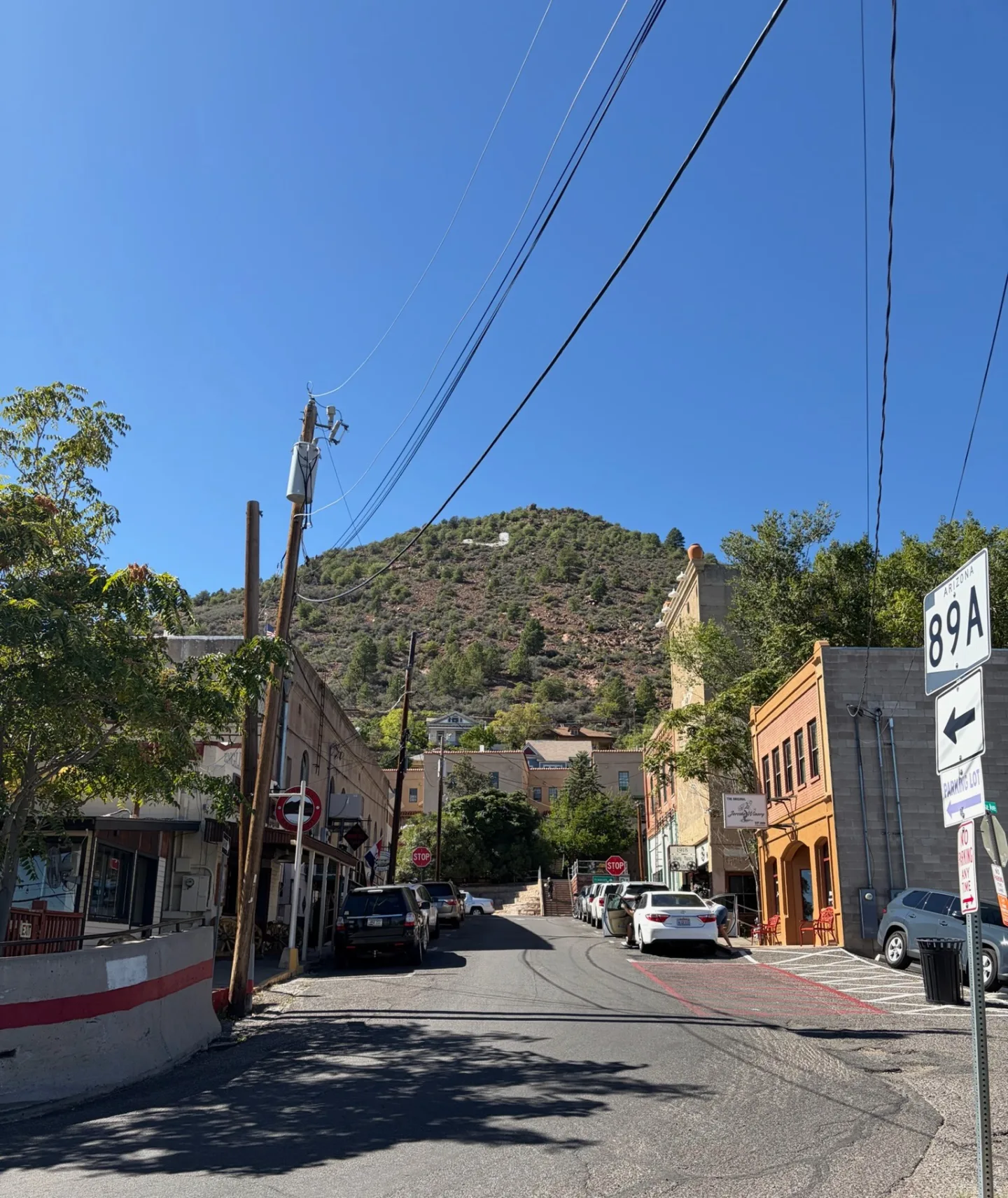
The United Verde Copper Company was incorporated in 1883, and the camp on Cleopatra Hill was named Jerome after Eugene Jerome, a New York financier who backed the company. Perched on a 30° slope, it became one of the richest copper towns in the country before it nearly emptied in the 1950s.
Why copper boomed
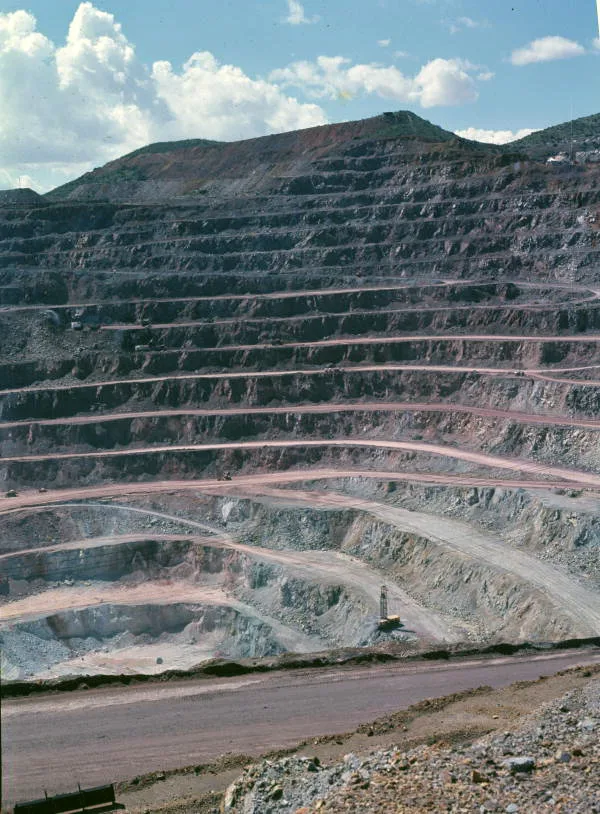
Arizona's copper boom rode the electrical revolution. As America wired up — power lines, telephones, electric motors — copper was suddenly a strategic commodity. The territory's mines and smelters scaled up to meet the demand.
Gunfight at the O.K. Corral
On October 26, 1881, the Earps and Doc Holliday faced off against a faction of cowboys — Billy Clanton and the McLaurys — in a dusty lot near the O.K. Corral. The fight lasted 30 seconds. Three cowboys died. It became the most famous shootout in American history.
The Earp Vendetta Ride
After the O.K. Corral, Virgil Earp was ambushed and crippled. Then Morgan Earp was assassinated while shooting pool. Wyatt responded with the Vendetta Ride of March 1882, hunting down and killing the men he held responsible — and then quietly leaving the territory.
Doc Holliday
Doc Holliday was a Georgia dentist who became a gambler and gunfighter after tuberculosis sent him west. Witty, drunk, deadly, and dying — he was Wyatt Earp's closest friend and stood at his side at the O.K. Corral. He died of TB in 1887 in a Colorado sanatorium.
Tombstone burns, twice
Fire destroyed much of Tombstone's business district in June 1881 and again in May 1882. The wooden boomtown was rebuilt each time. What ended Tombstone's mines was water — they began flooding as shafts went deeper, and after the pumping plant burned in 1886 and silver prices fell, the flooded mines were not worth pumping out.
Tombstone: the town too tough to die
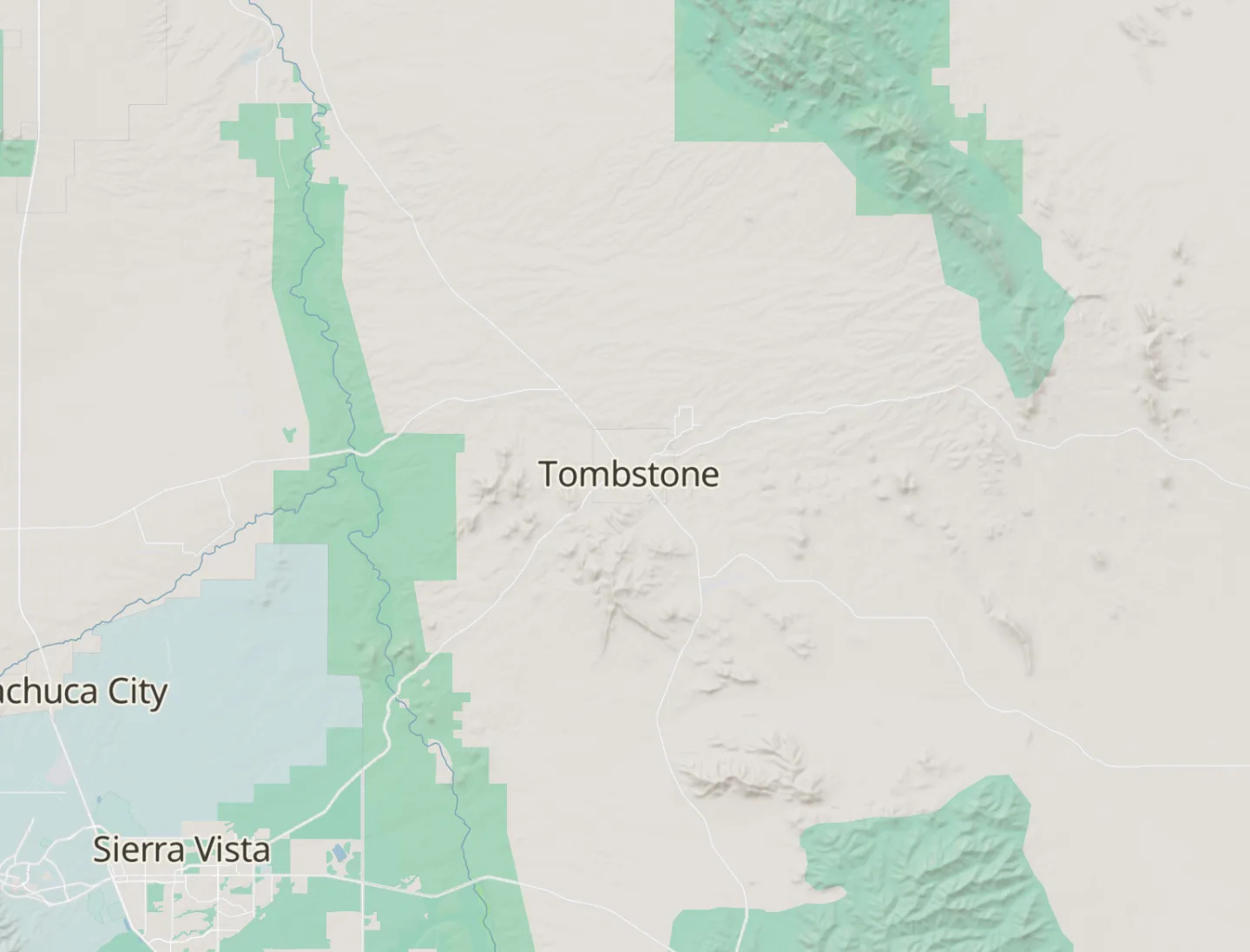
Ed Schieffelin struck silver here in 1877, and by 1881 Tombstone had exploded into one of the Southwest's biggest boomtowns — an estimated 6,000 to 10,000 people. On October 26, 1881, the Earps and Doc Holliday faced the Clantons and McLaurys near the O.K. Corral in the most famous gunfight of the Old West.
The railroads arrive
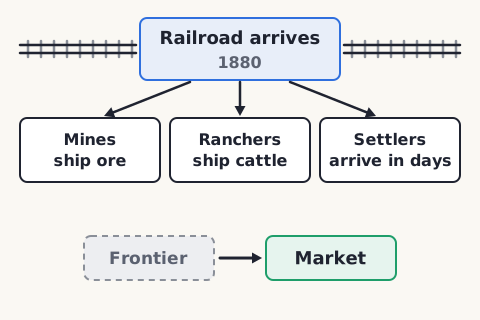
Arizona's remoteness ended in 1880 when the Southern Pacific crossed the territory from California, reaching El Paso the following year. Suddenly mines could ship ore profitably, ranchers could ship cattle, settlers could arrive in days instead of weeks. The desert was no longer the frontier — it was a market.
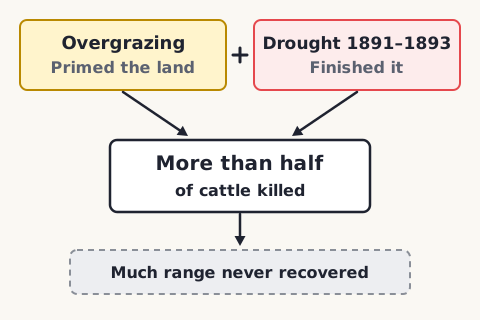
The 1891–1893 die-off
A brutal drought from 1891 to 1893 killed more than half of Arizona's cattle and stripped the grasslands. Overgrazing during the boom had primed the land; the drought finished it. Much of Arizona's range never recovered to pre-boom productivity.
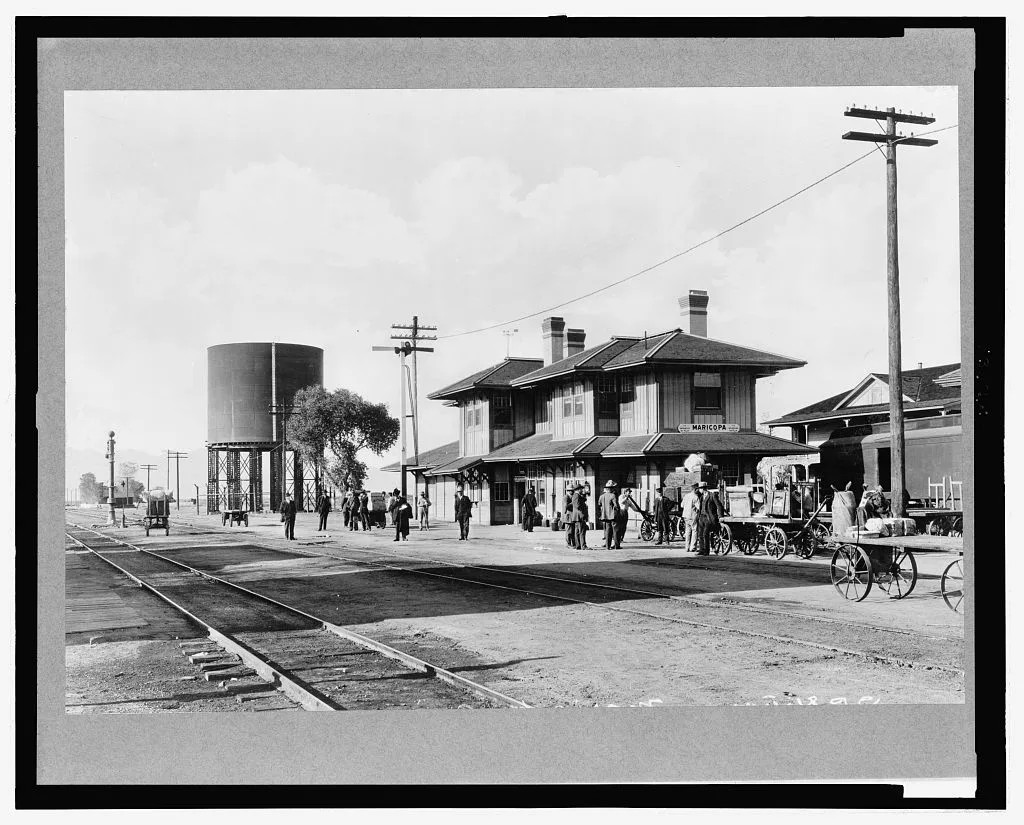
Ore, cattle, and rails
The Southern Pacific Railroad crossed Arizona from California in 1880, reaching El Paso the following year — finally letting mines ship ore and ranchers ship cattle at a profit.
Self-test
Answer each question from memory, then check your work against the answer key.
1. About how large was Tombstone at its peak in 1881?
- AAbout 100,000 people
- BAbout 6,000 to 10,000 people
- CAbout 500 people
- DFewer than 200 people
2. In what year did Ed Schieffelin make his silver strike in southeastern Arizona?
- A1877
- B1891
- C1885
- D1863
3. Why did Schieffelin choose the name he gave his silver strike?
- AThe ore veins were shaped like grave markers
- BHe named it for the grave of a partner killed in the strike
- CHe was warned that was all he'd find in Apache country
- DIt was the name of a New York investing family
4. Which of these was NOT a feature of boom-era Tombstone in 1881?
- ADozens of brothels
- BOpera houses
- CFour churches
- DA copper smelter
5. In **1877**, prospector **___** went searching for silver in the Apache country of southeastern Arizona. As the story goes, he was warned he'd find nothing but his own tombstone. He found silver — and named his strike **Tombstone**.
- AHenry Wickenburg
- BCharles Poston
- CEd Schieffelin
- DJacob Waltz
6. What development made copper a strategic commodity and drove Arizona's copper boom?
- AThe spread of steam-powered mills
- BThe invention of the automobile
- CThe Civil War's demand for munitions
- DThe electrical revolution
7. In what year did the first copper smelter open in Bisbee?
- A1880
- B1891
- C1885
- D1877
8. Which company was incorporated in 1883 and developed the copper camp on Cleopatra Hill?
- ACopper Queen Consolidated
- BUnited Verde Copper Company
- CPhelps Dodge Corporation
- DArizona Copper Company
9. The Bisbee mining district produced over how much copper before operations shut down in 1975?
- A80 billion pounds
- B800 million pounds
- C8 billion pounds
- D8 million pounds
10. A mining camp sits on a 30-degree slope on Cleopatra Hill and was named for a New York investing family. Which town is it?
- AJerome
- BBisbee
- CTombstone
- DWickenburg
11. When did the Gunfight at the O.K. Corral take place?
- AApril 15, 1862
- BOctober 26, 1881
- CFebruary 14, 1912
- DJuly 4, 1876
12. How long did the Gunfight at the O.K. Corral last?
- ANearly an hour
- BAbout 5 minutes
- CRoughly 3 minutes
- D30 seconds
13. Who was the Georgia dentist turned tubercular gambler and gunfighter who stood with the Earps at the O.K. Corral?
- AHenry Wickenburg
- BLewis Williams
- CEd Schieffelin
- DDoc Holliday
14. Which man faced the Earps as part of the cowboy faction rather than fighting alongside them?
- ABilly Clanton
- BDoc Holliday
- CVirgil Earp
- DMorgan Earp
15. In what year did Wyatt Earp and his brothers arrive in Tombstone?
- A1881
- B1879
- C1877
- D1885
16. What was Wyatt Earp's Vendetta Ride?
- AA cattle drive he led out of the territory
- BA prospecting expedition into Apache country
- CA hunt to kill the men he blamed for attacking his brothers
- DA campaign to be elected territorial sheriff
17. What happened to Morgan Earp after the gunfight?
- AHe was elected town marshal of Tombstone
- BHe died of tuberculosis in Colorado
- CHe was assassinated while shooting pool
- DHe rode east and was never heard from again
18. In what year did Wyatt Earp's Vendetta Ride take place?
- A1886
- B1883
- C1881
- D1882
19. What ultimately ended Tombstone's boom?
- AA drought killed off the surrounding cattle herds
- BThe mines flooded and silver prices fell
- CThe railroad bypassed the town entirely
- DThe two fires destroyed the town beyond rebuilding
20. Which Earp brother was ambushed and left crippled after the gunfight?
- AVirgil
- BWyatt
- CWarren
- DJames
21. In what year did the Southern Pacific Railroad reach Tucson, ending the territory's remoteness?
- A1900
- B1854
- C1880
- D1912
22. Arizona's population leapt from **9,658 in ___ to 40,440 in 1880** — a **319% jump** that coincided with the railroad's arrival. Growth stayed strong through statehood in 1912, though it never matched that decade's pace again.
- A1863
- B1870
- C1846
- D1879
23. Between **___ and 1891**, Arizona's cattle herd grew from **40,000 to 1.5 million** head. Texans brought open-range methods to a territory finally pacified after the Apache wars. The land could not support it.
- A1873
- B1866
- C1849
- D1882
24. Which railroad ended Arizona's remoteness by reaching Tucson from California?
- AUnion Pacific
- BSanta Fe Railway
- CCentral Pacific
- DSouthern Pacific
25. What ended Arizona's cattle boom, and how severe was the loss?
- AThe 1880 railroad's freight rates halved the herd
- BAn Apache uprising scattered more than half the herd
- CAn 1891–1893 drought killed more than half the herd
- DAn 1891–1893 drought killed about a tenth of the herd
Go deeper
Answer key
- 1. B About 6,000 to 10,000 people
- 2. A 1877Schieffelin found silver in 1877. 1885 is when Bisbee's rival Copper Queen and Atlanta mines merged into the Copper Queen Consolidated Mining Company — a different mining story.
- 3. C He was warned that was all he'd find in Apache countryAs the story goes, he was told he'd only find his tombstone prospecting Apache country; he turned the taunt into the strike's name. The investing-family naming belongs to Jerome.
- 4. D A copper smelterTombstone was a silver town — the smelter belongs to Bisbee's copper story. Opera houses, four churches, and dozens of brothels are all listed among Tombstone's boom-town features.
- 5. C Ed Schieffelin
- 6. D The electrical revolutionAs America wired up with power lines, telephones, and electric motors, copper demand surged — this electrical revolution drove Arizona's mines to scale up.
- 7. A 1880Bisbee's first copper smelter went up around 1880. 1877 was Schieffelin's silver strike at Tombstone, and 1885 was when the rival Copper Queen and Atlanta mines consolidated into the Copper Queen Consolidated Mining Company — not when smelting began.
- 8. B United Verde Copper CompanyThe United Verde Copper Company was incorporated in 1883. Copper Queen is the name of Bisbee's famous mine, not the Cleopatra Hill company.
- 9. C 8 billion poundsThe Bisbee district's mines, including the Copper Queen, produced over 8 billion pounds of copper before shutting down in 1975.
- 10. A JeromeJerome was perched on a 30-degree slope on Cleopatra Hill and named after a New York investing family. Bisbee was a steep canyon town, but its name and setting differ.
- 11. B October 26, 1881
- 12. D 30 secondsThe fight lasted just 30 seconds and left three cowboys dead — its brevity is part of why it's so famous.
- 13. D Doc HollidayDoc Holliday was a Georgia dentist sent west by tuberculosis and Wyatt Earp's closest friend. Ed Schieffelin was the prospector who founded Tombstone, not a gunfighter.
- 14. A Billy ClantonBilly Clanton and the McLaurys made up the cowboy faction. Virgil, Morgan, and Doc Holliday all stood on Wyatt's side.
- 15. B 1879Virgil, Wyatt, and James arrived in 1879 to profit from the boom (Morgan followed in 1880), two years before the gunfight. 1877 was Schieffelin's strike.
- 16. C A hunt to kill the men he blamed for attacking his brothersWyatt's answer to the attacks on his brothers was to hunt down and kill the men he held responsible, then leave Arizona quietly. He never ran for sheriff or drove cattle.
- 17. C He was assassinated while shooting poolMorgan was shot dead at a pool table. Dying of tuberculosis in Colorado was Doc Holliday's end, in 1887.
- 18. D 1882Wyatt's Vendetta Ride came in March 1882, months after the October 1881 gunfight, as he hunted the men he held responsible for crippling Virgil and killing Morgan. He then quietly left the territory.
- 19. B The mines flooded and silver prices fellWater had seeped into the deepening mines since the early 1880s; after the pumping plant burned in 1886 and silver prices fell, the flooded mines weren't worth pumping out. The town survived both fires by rebuilding; the drought hit ranching, not Tombstone's mines.
- 20. A VirgilVirgil, a lawman alongside Wyatt, was ambushed and crippled. Wyatt came through unhurt and rode the Vendetta in response.
- 21. C 1880
- 22. B 1870
- 23. A 1873
- 24. D Southern PacificThe Southern Pacific reached Tucson from California in 1880 (and El Paso in 1881), letting mines ship ore and ranchers ship cattle profitably.
- 25. C An 1891–1893 drought killed more than half the herdThe 1891–1893 drought killed more than half of Arizona's cattle and stripped the grasslands that overgrazing had already primed for disaster.
Sources
- Tombstone, Arizona — Wikipedia — en.wikipedia.org/wiki/Tombstone,_Arizona
- History of the Southern Pacific Railroad (Wikipedia) — en.wikipedia.org/wiki/History_of_the_Southern_Pacific_Railroad
Image credits
- Jerome, the billion-dollar copper camp: Wikimedia Commons · Seasider53 · CC BY 4.0 — commons.wikimedia.org/wiki/File:Jerome_Avenue,_Jerome,_Arizona.jpg
- Why copper boomed: Joseph Janney Steinmetz · Public domain — commons.wikimedia.org/wiki/File:Anaconda_Copper_Mining_Co.%27s_open_mine_pit_at_Bisbee,_Arizona.jpg
- Tombstone: the town too tough to die: FlashFeed original map · © OpenStreetMap contributors (ODbL) via Protomaps · Elevation: AWS Terrain Tiles — www.openstreetmap.org/copyright
- The railroads arrive: FlashFeed original diagram · CC-BY-4.0
- The 1891–1893 die-off: FlashFeed original diagram · CC-BY-4.0
- Ore, cattle, and rails: Library of Congress · Arizona, Maricopa. Southern Pacific Railroad station · No known restrictions (verify at source) — www.loc.gov/item/2006679484/

