
History of Arizona study guide · Lesson 8 of 12
Lesson 8: The Sunbelt Boom
Part 1: Population Explosion · Part 2: Retirement Communities · Part 3: Politicians on the National Stage
This is the lesson's study guide from the FlashFeed app, plus its key facts and a self-test.
What you'll be able to do
- Explain Arizona's sevenfold population boom (1950-2000), enabled by federal water, cheap land, and air conditioning.
- Identify Arizona's traditional Five C's — Copper, Cattle, Cotton, Citrus, and Climate.
- Describe the retirement-community model — Youngtown (1954), Del Webb's Sun City (1960), and the snowbirds.
- Identify Arizona's national politicians — Goldwater (1964), McCain (2008), and O'Connor (1981).
- Recognize Arizona statesmen Mo Udall and Bruce Babbitt.
The Sunbelt Boom
After 1950 Arizona stopped being a frontier state and started being a Sunbelt one. The population sevenfolded in fifty years. Whole new cities — and a new model of retirement — appeared on what had been desert. And an outsized share of the country's national politicians turned out to come from Phoenix.
Population Explosion
Arizona's population grew from 700,000 in 1950 to over 5 million in 2000 — a sevenfold jump, almost all of it concentrated around Phoenix with Tucson a distant second. Three things made it possible: federal water (Hoover Dam and later the CAP), cheap land, and air conditioning. Phoenix's average July high is about 106°F (1991–2020 normals); without affordable AC starting in the 1950s, none of the boom would have happened.
The old economy gave ground. Phoenix's famous citrus groves — once a signature industry — were almost entirely paved over after 1950, because the land was worth more as suburban housing than as orchards. Cotton declined too. Generations of Arizona schoolchildren had learned the Five C's as the state's economic pillars: Copper, Cattle, Cotton, Citrus, and Climate. The first four built 20th-century Arizona. The fifth — air-conditioned, sunny climate — built the rest.
Retirement Communities
The boom invented a new American institution. Youngtown, founded in 1954 on 320 acres of farmland northwest of Phoenix, was the first planned community in the United States dedicated exclusively to retirees. No children allowed. It set the template.
Six years later, developer Del Webb opened Sun City in 1960 — an "active adult" community with pools, golf courses, and community centers. Opening weekend drew 100,000 visitors. Sun City became the model for retirement living across the Sunbelt, and Arizona's warm winters drew a steady migration of snowbirds from the Northeast and Midwest with pensions, Social Security checks, and savings to spend.
Politicians on the National Stage
For a state with relatively few people, Arizona has produced an outsized share of national figures. Barry Goldwater, son of a Phoenix department-store family, was the 1964 Republican nominee for president. He lost in a landslide to LBJ but reshaped the GOP into the conservative movement that produced Reagan. John McCain, a Navy pilot held prisoner in Vietnam for five and a half years, won Goldwater's old seat in 1986 and was the 2008 Republican nominee.
Sandra Day O'Connor, raised on a remote Arizona cattle ranch, was appointed to the US Supreme Court in 1981 — the first woman ever to sit on the high court. Morris "Mo" Udall represented Arizona's 2nd district from 1961 to 1991 — a liberal Democrat famous for his wit and his strong run for the 1976 Democratic nomination. Bruce Babbitt served as governor from 1978 to 1987, pushed the 1980 Groundwater Management Act, and later became Bill Clinton's Secretary of the Interior.
Key concepts
Morris "Mo" Udall
- A liberal Democrat who represented Arizona's 2nd district in the House from 1961 to 1991.
- He was famous on Capitol Hill for his wit and humor.
- He made a strong run for the 1976 Democratic presidential nomination.
Bruce Babbitt
- He served as governor of Arizona from 1978 to 1987.
- In 1980 he pushed through the state's landmark Groundwater Management Act.
- He later became Bill Clinton's Secretary of the Interior.
Key facts
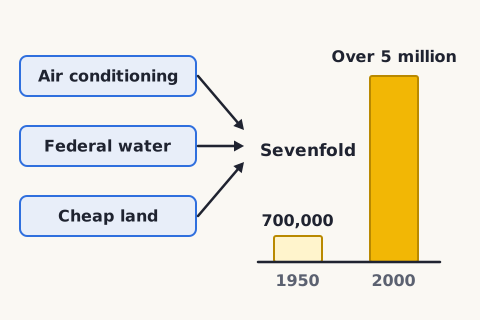
Sevenfold in fifty years
Arizona's population grew from 700,000 in 1950 to over 5 million in 2000 — a sevenfold jump, almost all of it concentrated around Phoenix with Tucson a distant second. Air conditioning, federal water, and cheap land powered the boom.
Citrus groves to subdivisions
Phoenix's famous citrus groves — once one of the state's signature industries — were almost entirely paved over after 1950. The land was worth more as suburban housing than as orchards. Cotton declined too, as water restrictions and global competition squeezed margins.
Air conditioning made it possible
Phoenix's average July high is about 106°F (1991–2020 normals). Without widespread air conditioning — affordable starting in the 1950s — the Sunbelt boom would have been unthinkable. The technology made desert living comfortable enough for retirees, factory workers, and chip fabs alike.
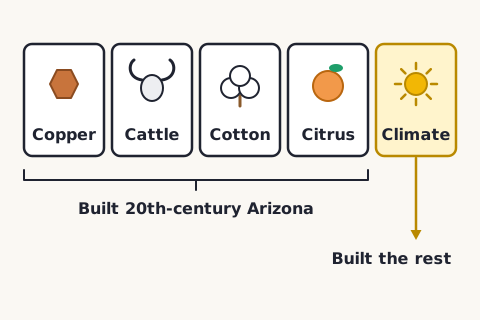
Arizona's Five C's
Generations of Arizona schoolchildren learned the state's economic pillars as the Five C's: Copper, Cattle, Cotton, Citrus, and Climate. The first four built 20th-century Arizona; Climate — air-conditioned and sunny — built the rest.

Arizona's population boom
Arizona had about 700,000 residents in 1950. By 2000, that number had passed 5 million — a sevenfold increase in just fifty years.
The snowbirds
Arizona's warm winters and dry climate drew retirees from the Northeast and Midwest in growing numbers — the 'snowbirds'. They brought pensions, Social Security checks, and savings.
Sun City's opening weekend
When Del Webb's Sun City opened in 1960 with pools and golf courses built for retirees, opening weekend alone drew 100,000 visitors.
Barry Goldwater
Barry Goldwater, son of a Phoenix department-store family, served five terms in the US Senate and was the 1964 Republican nominee for president. He lost in a landslide to LBJ but reshaped the GOP into a conservative movement that produced Reagan.
John McCain
John McCain, a Navy pilot held prisoner in Vietnam for five and a half years, settled in Arizona and won Goldwater's old Senate seat in 1986. He was the 2008 Republican presidential nominee, losing to Barack Obama. He served until his death from brain cancer in 2018.
Sandra Day O'Connor
Sandra Day O'Connor, raised on a remote Arizona cattle ranch and serving as a state appeals judge, was appointed to the US Supreme Court in 1981 by President Reagan — the first woman ever to sit on the high court. She served until 2006.
Bruce Babbitt
Bruce Babbitt served as Arizona governor from 1978 to 1987 — pushing the groundwater law that shaped the state's modern growth. He later ran for the 1988 Democratic presidential nomination and served as US Secretary of the Interior under Bill Clinton.
Self-test
Answer each question from memory, then check your work against the answer key.
1. Arizona's population grew sevenfold between which years?
- A1950 and 2000
- B2000 and 2010
- C1880 and 1900
- D1912 and 1940
2. Arizona's population stood at about 700,000 in 1950. What had it reached by 2000?
- AAbout 2.5 million
- BOver 5 million
- CAbout 1.5 million
- DAbout 12 million
3. Three things made the postwar boom possible. Which was NOT one of them?
- ACheap land
- BAffordable air conditioning
- CFederal water from Hoover Dam and later the CAP
- DA statewide exemption from income tax
4. The case that air conditioning was essential rests on Phoenix's July heat. What is Phoenix's average July high?
- A96°F
- B122°F
- C106°F
- D88°F
5. Which statement best describes where Arizona's 1950–2000 growth landed?
- ASplit about evenly between the state's two largest metro areas
- BAlmost all of it around one metro area, with Tucson a distant second
- CMostly around Tucson, with Phoenix a distant second
- DSpread across rural counties rather than any metro area
6. Which of these is NOT one of Arizona's traditional 'Five C's'?
- AComputers
- BCitrus
- CClimate
- DCopper
7. Which list correctly gives Arizona's traditional Five C's?
- ACopper, Cattle, Corn, Citrus, Climate
- BCopper, Cattle, Cotton, Citrus, Canyons
- CCopper, Chiles, Cotton, Cattle, Climate
- DCopper, Cattle, Cotton, Citrus, Climate
8. Four of the Five C's built 20th-century Arizona. Which one is credited with building everything after 1950?
- ACopper
- BCitrus
- CClimate
- DCattle
9. Which of the Five C's industries was almost entirely paved over around Phoenix after 1950?
- ACotton
- BCopper
- CCattle
- DCitrus
10. One of Arizona's Five C's is missing from this list: Copper, Cattle, Citrus, Climate. Which is it?
- ACorn
- BCotton
- CCactus
- DCanyons
11. Who developed Sun City, Arizona?
- AFred Harvey
- BCarl Hayden
- CDel Webb
- DWyatt Earp
12. In what year was Youngtown — the first US planned community dedicated exclusively to retirees — founded?
- A1954
- B1946
- C1972
- D1960
13. Which statement about Sun City is correct?
- AIt was marketed to young families priced out of Phoenix
- BIt was built by the federal government as a veterans' colony
- CIt opened in 1960, six years after Youngtown, with pools and golf courses
- DIt opened in 1948, the first US community built only for retirees
14. The retirees nicknamed 'snowbirds' migrated to Arizona mainly from which regions?
- AMexico and Central America
- BThe Deep South and Texas
- CThe Pacific Northwest and Alaska
- DThe Northeast and Midwest
15. Founded in 1954 northwest of Phoenix, Youngtown was the first US planned community dedicated exclusively to which group?
- ARetirees
- BCopper miners
- CVeterans
- DCollege students
16. When did Sandra Day O'Connor become the first woman on the US Supreme Court?
- A1964
- B1981
- C1955
- D2005
17. Barry Goldwater, son of a Phoenix department-store family, was the Republican presidential nominee in which year?
- A1972
- B1968
- C1964
- D1960
18. Which Arizonan — a Navy pilot held prisoner in Vietnam for five and a half years — was the 2008 Republican presidential nominee?
- AJohn McCain
- BBruce Babbitt
- CMorris 'Mo' Udall
- DBarry Goldwater
19. Sandra Day O'Connor, raised on a remote Arizona cattle ranch, is remembered for which distinction?
- AFirst woman nominated for president by a major party
- BFirst woman elected to the US Senate from Arizona
- CFirst woman to serve as US Attorney General
- DFirst woman ever to sit on the US Supreme Court
20. Goldwater lost the presidency badly. What lasting effect is he nonetheless credited with?
- AFounding Sun City as an 'active adult' retirement community
- BReshaping the GOP into the conservative movement that produced Reagan
- CWriting Arizona's 1980 Groundwater Management Act
- DServing as Secretary of the Interior under Bill Clinton
21. Which option correctly matches each man to the office he held and his years in it?
- AUdall: US House 1978–1987; Babbitt: governor 1961–1991
- BUdall: US House 1961–1991; Babbitt: governor 1978–1987
- CUdall: US Senate 1961–1991; Babbitt: governor 1988–1998
- DUdall: governor 1961–1991; Babbitt: US House 1978–1987
22. Which of these was NOT part of Mo Udall's career?
- AA strong run for the 1976 Democratic presidential nomination
- BThree decades representing Arizona's 2nd congressional district
- CA term as governor of Arizona
- DA reputation as a liberal Democrat known for his wit
23. Mo Udall, a liberal Democrat famous for his wit, made a strong run for which nomination?
- AThe 1988 Democratic presidential nomination
- BThe 1964 Republican presidential nomination
- CThe 1980 Republican presidential nomination
- DThe 1976 Democratic presidential nomination
24. Which cabinet post did Bruce Babbitt hold under President Bill Clinton?
- ASecretary of the Interior
- BSecretary of Agriculture
- CAttorney General
- DSecretary of Energy
25. Which law did Governor Babbitt push, shaping Arizona's modern growth?
- AThe 1902 Reclamation Act
- BThe 1912 Enabling Act
- CThe 1980 Groundwater Management Act
- DThe 1968 Colorado River Basin Project Act
Go deeper
Answer key
- 1. A 1950 and 2000
- 2. B Over 5 million700,000 to over 5 million is the sevenfold jump. 1.5 or 2.5 million would be far short of sevenfold; 12 million overshoots the state's actual size.
- 3. D A statewide exemption from income taxThe three enablers were federal water, cheap land, and air conditioning. Tax policy is not among them.
- 4. C 106°FPhoenix's average July high is about 106°F (1991–2020 normals); its July daily mean is about 96°F. 122°F is the record extreme (set June 26, 1990), not an average.
- 5. B Almost all of it around one metro area, with Tucson a distant secondGrowth concentrated almost entirely around Phoenix, with Tucson a distant second — not an even split, not Tucson-led, and not rural.
- 6. A ComputersCopper, Cattle, Cotton, Citrus, Climate. Computers came later — and didn't make the alliteration.
- 7. D Copper, Cattle, Cotton, Citrus, ClimateThe pillars taught to generations of Arizona schoolchildren are Copper, Cattle, Cotton, Citrus, and Climate. Corn, canyons, and chiles never made the list.
- 8. C ClimateThe first four C's built 20th-century Arizona; Climate — air-conditioned and sunny — built the rest. Citrus in fact declined after 1950.
- 9. D CitrusPhoenix's citrus groves were paved over because the land was worth more as suburban housing. Cotton declined too, but from water limits and global competition — not by being replaced with subdivisions.
- 10. B CottonThe fifth pillar is Cotton, a mainstay that declined after 1950. Cactus and canyons are Arizona icons but never economic pillars, and corn was never on the list.
- 11. C Del Webb
- 12. A 1954Youngtown was founded in 1954 on 320 acres northwest of Phoenix. 1960 is Sun City's opening, six years later.
- 13. C It opened in 1960, six years after Youngtown, with pools and golf coursesDel Webb's Sun City opened in 1960 as an 'active adult' community — six years after Youngtown, which held the 'first' distinction. Opening weekend drew 100,000 visitors.
- 14. D The Northeast and MidwestArizona's warm winters drew snowbirds from the Northeast and Midwest, bringing pensions, Social Security checks, and savings.
- 15. A RetireesYoungtown (1954) was the first US planned community dedicated exclusively to retirees, and children were not allowed to live there. Veterans, miners, and students were not its target residents.
- 16. B 1981
- 17. C 1964Goldwater was the 1964 Republican nominee and lost in a landslide to LBJ. 1968 and 1972 were Nixon's nominations.
- 18. A John McCainMcCain won Goldwater's old Senate seat in 1986 and was the 2008 nominee, losing to Barack Obama. Goldwater's nomination came far earlier, in 1964.
- 19. D First woman ever to sit on the US Supreme CourtReagan appointed O'Connor to the Supreme Court in 1981, making her the first woman on the high court. She served until 2006.
- 20. B Reshaping the GOP into the conservative movement that produced ReaganDespite the landslide loss to LBJ, Goldwater remade the GOP into the conservative movement that later produced Reagan. Sun City was Del Webb's; the groundwater law and Interior post were Babbitt's.
- 21. B Udall: US House 1961–1991; Babbitt: governor 1978–1987Mo Udall served in the US House (2nd district) 1961–1991; Bruce Babbitt was governor 1978–1987. Udall was never governor or a senator, and Babbitt left office in 1987.
- 22. C A term as governor of ArizonaUdall was a congressman, never governor — that was Babbitt. Udall did serve 1961–1991 in the House, ran strongly in 1976, and was famed for his wit.
- 23. D The 1976 Democratic presidential nominationUdall ran strongly for the 1976 Democratic nomination. The 1988 Democratic run was Bruce Babbitt's, and 1964 was Goldwater's Republican nomination.
- 24. A Secretary of the InteriorAfter his governorship and a 1988 presidential run, Babbitt became Clinton's Secretary of the Interior — a fit for his water and land record.
- 25. C The 1980 Groundwater Management ActBabbitt pushed the 1980 Groundwater Management Act. The 1902 Reclamation Act and 1968 basin act long predate his governorship (1978–1987).
Sources
- Phoenix, Arizona (climate) — Wikipedia — en.wikipedia.org/wiki/Phoenix,_Arizona
Image credits
- Sevenfold in fifty years: FlashFeed original diagram · CC-BY-4.0
- Arizona's Five C's: FlashFeed original diagram · CC-BY-4.0
- Arizona's population boom: Ken Lund (Openverse) · by-sa 2.0 — www.flickr.com/photos/75683070@N00/15435619010
- Bruce Babbitt: David Jiang · CC BY-SA 4.0 — commons.wikimedia.org/wiki/File:Arizona_State_Capitol_Daytime_December_2021.jpg
