
Broken Money: Why Our Financial System Is Failing Us & How We Can Make It Better study guide · Lesson 4 of 7
Lesson 4: Pure Fiat Mechanics and the Cantillon Effect
4.1 Credit Creation and Base Reserves · 4.2 The Cantillon Effect and Financialization
Unofficial study guide for Broken Money: Why Our Financial System is Failing Us and How We Can Make it Better by Lyn Alden. FlashFeed is not affiliated with the author or publisher.
This is the lesson's study guide from the FlashFeed app, plus its key facts and a self-test.
What you'll be able to do
- Explain how commercial banks create money by lending, and how base reserves differ from broad money (M2).
- Explain the Cantillon Effect, how new money enriches early recipients first, and how it drives financialization and inequality.
Monograph Section: Lesson 4 of Broken Money: Why Our Financial System Is Failing Us and How We Can Make It Better by Lyn Alden.
Executive Overview
Deconstructs the accounting mechanics of pure fiat currency, how commercial banks create new deposit money ex nihilo through loan origination rather than lending existing savings, the division between central bank base money (M0) and broad money (M2), Richard Cantillon's insight into asymmetric inflation distribution, the financialization of the real economy, and structural wealth inequality.
Credit Creation and Base Reserves
Conceptual Foundations: Endogenous Money Creation, Ex Nihilo Loan Origination, Base Money (M0) vs Broad Money (M2), Bank of England 2014 Clarification
Core Insight: In the modern financial system, commercial banks create the vast majority of broad money (M2) ex nihilo whenever they originate a new loan, rather than acting as mere pass-through intermediaries of existing customer savings.
When a borrower is approved for a $400,000 mortgage, the bank does not take funds from someone else's savings account; it types the credit into the borrower's account as a newly created deposit liability against the mortgage asset.
Core Insight: The Bank of England published a landmark paper in 2014 officially acknowledging that commercial banks create money through credit origination, correcting decades of standard academic textbook models.
Standard economics textbooks taught that banks first collect deposits and then lend a fraction of them out. The Bank of England clarified that banks lend first, creating deposits in the process, and subsequently search for reserves in interbank markets to meet regulatory settlement needs.
Core Insight: Monetary aggregates are hierarchically structured into base money (M0), narrow money (M1), and broad money (M2), reflecting different degrees of liquidity and credit expansion.
Base money is the ultimate legal settlement medium issued exclusively by the central bank. Broad money consists of private commercial bank credit IOUs created on top of that base, representing the actual purchasing power used by businesses and consumers.
Core Insight: Central bank reserves are closed-loop digital settlement balances held exclusively by licensed commercial banks at the central bank, which cannot circulate directly in the real economy.
A common misconception is that the Fed 'prints money' directly into retail stores. In reality, the Fed creates reserves that stay on commercial bank balance sheets; money enters the real economy only when commercial banks expand their lending or when the government engages in fiscal deficit spending.
Core Insight: Quantitative Easing (QE) is an asset swap where the central bank creates new reserves to purchase government bonds or mortgage-backed securities mainly from non-bank financial companies, which initially raises the deposits those companies hold (and so broad money) while also creating new bank reserves.
QE lowers long-term interest rates by purchasing bonds and, because the sellers are mostly non-banks, initially raises bank deposits; it does not directly put money into consumers' pockets, and its reach into spending depends on how sellers rebalance their portfolios and how much banks lend.
Core Insight: Direct fiscal deficit spending funded by central bank debt monetization directly expands broad money (M2) in the real economy, leading to rapid consumer price inflation.
Unlike QE (which swaps newly created reserves for existing financial assets), direct government stimulus checks, corporate subsidies, and infrastructure grants inject net-new financial assets directly onto consumer balance sheets, generating swift retail inflation as demonstrated during 2020-2022.
Core Insight: When a bank borrower repays an outstanding loan principal, that broad money is extinguished from the economy, shrinking the total money supply.
Money is created through debt issuance and destroyed through debt repayment. During severe economic recessions, if private borrowers pay down debt faster than banks make new loans, the broad money supply contracts, causing deflationary contractions.
Core Insight: In March 2020, the Federal Reserve officially reduced commercial bank reserve requirement ratios to 0%, eliminating mandatory physical reserves and relying entirely on interest on reserve balances (IORB) and capital adequacy ratios.
Banks are no longer legally required to hold a minimum percentage of customer deposits in reserves. Instead, their lending capacity is constrained by capital adequacy ratios (Tier 1 capital) and liquidity coverage rules under Basel III regulations.
Core Insight: The Federal Reserve's primary policy tool transitioned from open market operations targeting the federal funds rate via scarce reserves to an 'ample-reserves' regime controlling the Interest on Reserve Balances (IORB) and Overnight Reverse Repo (ON RRP) facility.
Because QE flooded the banking system with trillions in excess reserves, the Fed can no longer adjust rates by tweaking tiny reserve volumes. Instead, it pays direct interest on reserves, setting an administrative floor under money market rates.
Core Insight: Legal tender laws force domestic citizens and courts to accept state-issued fiat paper currency at face value for all public and private debts, legally suppressing market alternatives.
If an individual attempts to contract in gold or alternative currencies, capital gains tax rules and network effects impose friction (private gold-denominated contracts have been legal in the US since 1977), helping the state's fiat dominate within its borders.
Core Insight: Capital gains taxes on gold and alternative currencies create a deliberate barrier to competition, penalizing citizens who attempt to use hard assets as a medium of exchange.
If a citizen buys a cup of coffee with gold or Bitcoin, tax laws treat the transaction as a taxable sale of property, requiring tracking cost basis and paying capital gains taxes on nominal appreciation, creating overwhelming friction against daily use.
Core Insight: Central banks cannot set both the total quantity of money and the price of money (interest rates) simultaneously; attempting to peg interest rates forces them to accommodate whatever money supply is required to maintain the target rate.
If market demand for borrowing increases, the central bank must inject reserves to prevent interest rates from rising above its target. Conversely, if it attempts to fix the money supply, market interest rates fluctuate wildly based on supply and demand.
Core Insight: Shadow banking comprises non-bank financial intermediaries—such as hedge funds, money market funds, and special purpose vehicles—that perform credit transformation outside regular central bank regulatory oversight.
Shadow banking expanded rapidly to bypass bank capital requirements. During the 2008 crash, runs in the shadow banking repo market triggered systemic contagion that forced the Federal Reserve to bail out non-bank Wall Street broker-dealers.
Core Insight: Under a pure fiat regime, inflation is an implicit, unvoted tax on all holders of cash, savings accounts, and fixed-income assets, quietly transferring purchasing power to the sovereign debtor.
Direct taxation requires visible, controversial political debates and legislation. Monetary inflation allows politicians to finance deficit spending invisibly by diluting the currency, disproportionately harming those on fixed incomes and cash wages.
Core Insight: The ultimate endpoint of an unconstrained fiat regime is the debt trap, where sovereign debt grows faster than tax revenues, forcing the central bank to permanently monetize debt and suppress real yields below inflation.
As of the mid-2020s, sovereign debt has climbed into the range of many advanced economies (100%+ of GDP), and raising interest rates to combat inflation risks pushing government interest expense to consume a large and growing share of the federal budget. The central bank must surrender inflation targets to prevent sovereign insolvency, cementing permanent financial repression.
The Cantillon Effect and Financialization
Conceptual Foundations: The Cantillon Effect, Richard Cantillon (1730s), First Receivers vs Last Receivers, Asset Price Inflation vs CPI
Core Insight: The Cantillon Effect, formulated by Franco-Irish economist Richard Cantillon in the 1730s, proves that newly created money is not distributed evenly, but flows along institutional pipelines, enriching early receivers at the expense of later receivers.
New money enters at specific points—government contractors, primary dealer banks, and corporate borrowers. These first receivers spend the new money before prices have risen. By the time the money trickles down to wage earners and rural consumers, prices of goods have already surged, reducing their real living standards.
Core Insight: First receivers of new money (commercial banks, hedge funds, private equity, and sovereign entities) exploit early access to buy real assets and equities at prevailing pre-inflation prices.
An investment bank that borrows at 1% interest can purchase prime commercial real estate or acquire competing companies. By the time general consumer wages increase years later, asset prices have doubled, locking late receivers out of ownership.
Core Insight: Last receivers of new money—such as wage workers, pensioners, and low-income households—experience higher consumer prices long before their nominal wages or fixed payments adjust.
Because wage contracts and pensions are sticky and renegotiated infrequently, inflation acts as an immediate pay cut for workers, while corporate profit margins and executive asset values soar.
Core Insight: Asset price inflation disproportionately outpaces Consumer Price Index (CPI) inflation under central bank credit expansion because newly created capital concentrates in financial markets rather than consumer basket goods.
Central bank liquidity injections flow into institutional investment portfolios. Because wealthy investors do not buy millions of loaves of bread, the money bids up stocks, bonds, and housing, allowing policymakers to claim 'low inflation' while the cost of wealth accumulation skyrockets.
Core Insight: The financialization of the economy refers to the structural shift where the financial sector expands to dominate corporate profits, GDP, and capital allocation over manufacturing and tangible production.
The financial sector's share of US corporate profits rose from a small minority in the early postwar decades to roughly 30-40% at its early-2000s peak. Companies increasingly generated returns through financial manipulation, debt refinancing, and mergers rather than engineering superior products.
Core Insight: Ultra-low interest rates and credit expansion incentivize corporate executives to engage in massive debt-financed share buybacks rather than long-term capital research and development.
By borrowing billions at 2-3% interest to repurchase their own shares, corporations reduced their share count, driving stock prices higher in the short term. This enriched senior executives whose compensation was tied to stock price metrics while leaving corporations fragile during economic shocks.
Core Insight: The financial website 'WTF Happened in 1971?' documents how productivity and real hourly compensation permanently diverged following the end of the gold standard in August 1971.
From 1945 to 1971, wages grew in tandem with worker productivity. Post-1971, productivity continued to surge due to computers and technology, but the resulting gains accrued almost entirely to capital owners and financial intermediaries, while worker wages stagnated.
Core Insight: Residential real estate transformed from a basic utility for shelter into the primary speculative savings vehicle and store of value for middle-class households.
Because fiat cash in a savings account loses purchasing power steadily to inflation, citizens were forced to treat their primary residences as investment vehicles, pushing the US median home price to roughly 5 times median household income by the early 2020s (and well above 8 times in some coastal metros), compared with about 3-4 times historically.
Core Insight: The Gini coefficient, measuring national wealth and income inequality, has risen in the United States since the early 1970s, and in many (though not all) developed nations, a period that coincides with, but is not proven to be caused by, the move to pure fiat in 1971.
Because the top 10% of US households own roughly 90% of corporate equities and mutual fund shares (Federal Reserve Distributional Financial Accounts) and a large majority of financial assets, every round of central bank monetary expansion disproportionately magnifies their net worth, while the bottom 50% who rely on cash wages fall further behind.
Core Insight: Zombie companies are debt-burdened corporations that generate only enough operating profit to service interest on their debts, kept alive exclusively through perpetual cheap debt refinancing.
In a healthy market economy, unproductive companies go bankrupt, releasing capital and labor to more innovative competitors. Central bank interest rate suppression prevents this creative destruction, locking up over 15-20% of public companies in zombie status.
Core Insight: In a fiat regime, ordinary citizens are forced to become amateur investment speculators simply to protect the purchasing power of their life savings from persistent monetary debasement.
Under a hard money standard, individuals could simply save gold coins in a bank and retain purchasing power across decades. Under fiat, saving in cash guarantees financial impoverishment, forcing society to spend enormous cognitive energy on financial speculation.
Core Insight: The financial sector captures an immense 'tollbooth' on economic life by extracting fees on every electronic credit transaction and debt issuance required by fiat centralization.
Because citizens cannot use physical sovereign cash for digital transactions, banks and payment processors collect substantial fees on electronic payments and credit.
Core Insight: The Cantillon Effect accelerates during national emergencies when government-channeled liquidity bailouts rescue elite financial institutions while main street small businesses are forced into liquidation.
During both the 2008 GFC and the 2020 pandemic lockdowns, trillions in emergency liquidity and credit backstops went first to banks, primary dealers and other large financial institutions (2008) and to large corporations, including airlines (2020), while many small businesses closed permanently despite programs such as PPP.
Core Insight: Constant monetary inflation shortens societal time preference, discouraging long-term capital investment and craftsmanship in favor of short-term consumption and financial trading.
If money holds its value across decades, people plan for the distant future, invest in quality durable goods, and build enduring institutions. Rapidly depreciating money forces people into a 'spend-it-or-lose-it' mentality, eroding societal patience.
Core Insight: The combination of fiat credit expansion and the Cantillon Effect hollows out the middle class, polarizing society into a small financial asset-owning oligarchy and a debt-burdened working class.
As asset prices disconnect from real wages, entry into the asset-owning class becomes unattainable for those without inherited wealth, fueling political polarization, social unrest, and demands for radical political intervention.
Key terms
- Quantitative Easing (QE)
- An asset swap where the central bank creates new reserves to purchase bonds from commercial banks, expanding bank reserves without directly injecting retail M2 money.
- Legal Tender Laws
- Statutory mandates legally compelling courts, citizens, and creditors to accept the state's unbacked fiat paper notes at par for all contractual debts.
- The Cantillon Effect
- The asymmetric economic distortion where newly created money enriches early receivers who spend it first, while devaluing the purchasing power of later receivers.
- Financialization
- The structural economic shift where the financial sector expands to dominate corporate profits, GDP, and capital allocation over physical manufacturing and research.
- Zombie Companies
- Unproductive corporate entities that earn only enough cash to service interest on their debts, surviving solely by rolling over cheap credit in a suppressed-rate regime.
Key facts
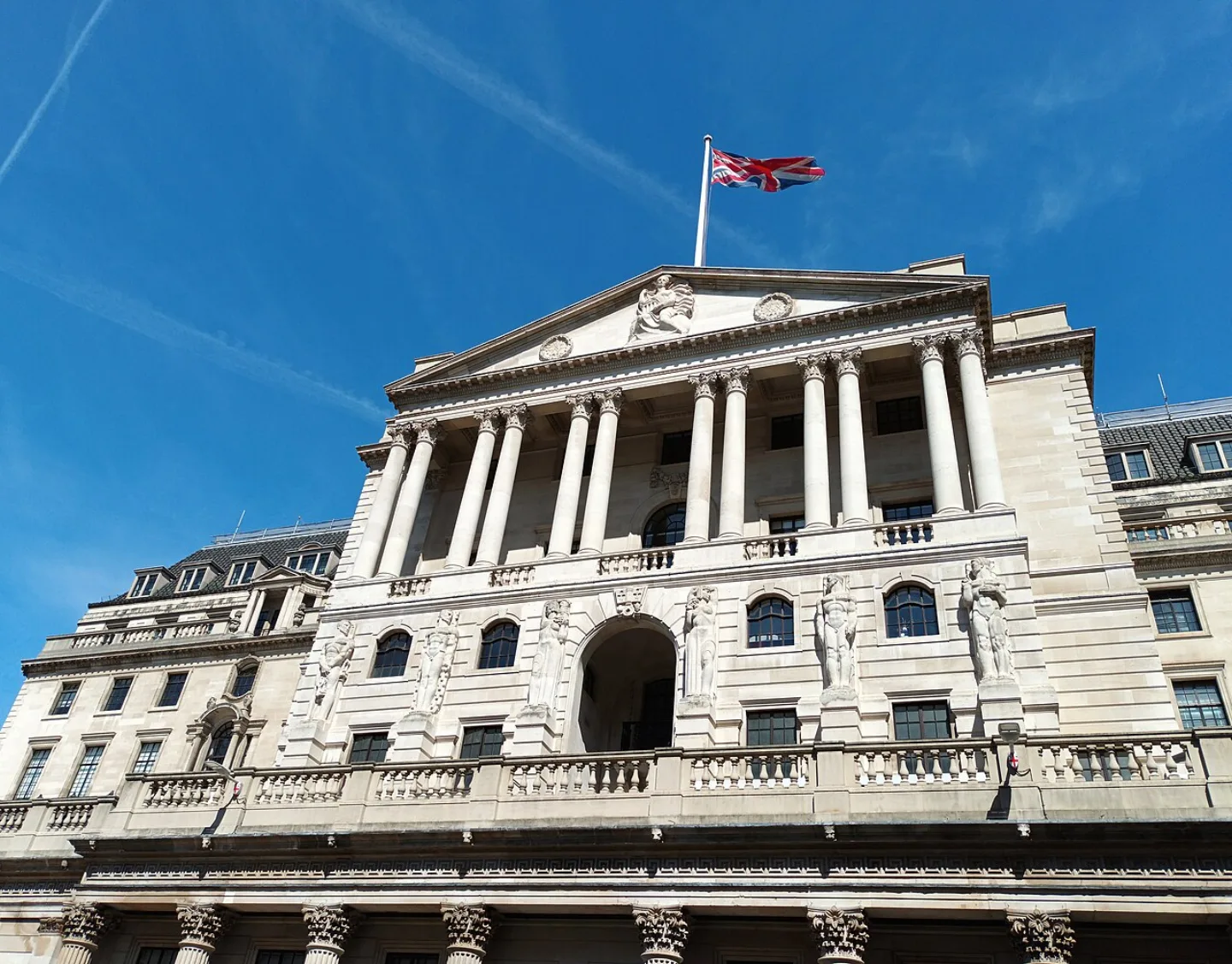
Bank of England 2014 Clarification
Landmark central bank publication confirming that commercial bank lending creates new deposits ex nihilo, officially correcting traditional textbook multiplier models.
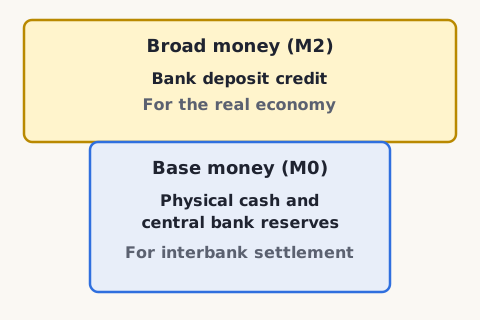
Compare base money (M0) with broad money (M2) in the modern financial hierarchy.
M0 consists of physical cash and central bank reserves used for interbank settlement, whereas M2 consists of commercial bank deposit credit used in the real economy.
Ample-Reserves Regime
Modern central banking framework controlling short-term interest rates via administered rates (IORB and ON RRP) rather than scarce reserve open-market operations.
Shadow Banking System
Non-bank financial intermediaries that perform credit transformation via repo markets and commercial paper without direct access to central bank discount windows.
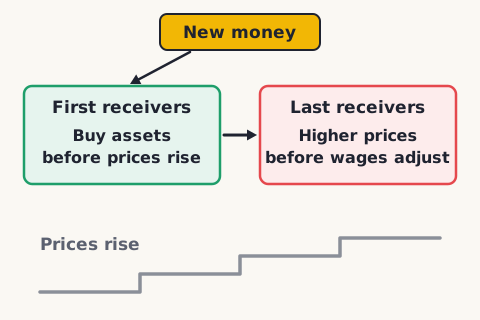
Contrast first receivers versus last receivers of newly created money.
First receivers deploy new credit before prices rise to buy appreciating assets, while last receivers face higher consumer prices long before wages adjust.
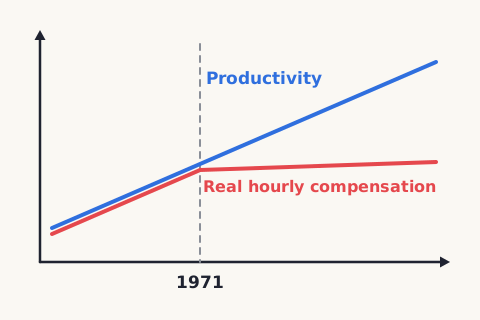
WTF Happened in 1971?
Economic analysis documenting the historic post-1971 decoupling where American worker productivity continued rising while real hourly compensation flatlined.
The Financial Sector Tollbooth
The structural extraction of fees on every electronic payment and debt issuance, enforced by the elimination of physical sovereign bearer cash.
Compare the treatment of Wall Street institutions and main street businesses.
Elite financial institutions receive direct central bank backstops and low-interest loans, while ordinary small businesses face unforgiving bankruptcy during economic shocks.
Matched pairs
Each item on the left goes with the one on the right.
- Loan Principal Repayment
- Extinguishes the deposit liability and permanently destroys broad money.
- Inflation Tax
- Quietly devalues cash savings to transfer real wealth from savers to the sovereign debtor.
- Credit Pyramid Apex
- Derivatives, shadow banking debt, and complex private credit instruments.
- Residential Real Estate
- Transformed from shelter into a speculative savings asset, pricing out younger generations.
Self-test
Answer each question from memory, then check your work against the answer key.
1. When a commercial bank originates a new loan, what does modern (corrected) banking theory say happens?
- ADraws down its central bank reserve account
- BLends out existing depositors' savings
- CSells government bonds to fund the loan
- DCreates a new deposit as a liability
2. Which central bank published a 2014 paper confirming that lending creates new deposits, correcting old textbook models?
- AFederal Reserve
- BBank of England
- CEuropean Central Bank
- DBank for International Settlements
3. Which of these is part of base money (M0) rather than broad money (M2)?
- ACentral bank reserves
- BCommercial bank checking deposits
- CSavings account balances
- DMoney market fund shares
4. Which action directly and immediately expands M2 broad money in consumers' bank accounts?
- AQuantitative Easing bond purchases
- BRaising the interest on reserve balances
- CFiscal deficit spending via stimulus checks
- DCentral bank reserve requirement cuts
5. In March 2020, to what level did the Federal Reserve reduce commercial bank reserve requirement ratios?
- A5%
- B0%
- C8%
- D3%
6. What is the Cantillon Effect?
- AInflation affects all income groups at the same time
- BCentral banks always distribute new money equally
- CConsumer prices always rise faster than asset prices
- DNew money benefits early recipients before prices rise
7. New central bank liquidity flowing into financial markets tends to cause what, relative to official CPI inflation?
- AAsset prices rising much faster than CPI
- BBoth moving at exactly the same pace
- CConsumer prices rising much faster than asset prices
- DWages rising faster than both asset prices and CPI
8. What does 'financialization' describe?
- AManufacturing overtaking finance in GDP share
- BResearch spending outpacing financial services
- CFinance sector dominating profits over manufacturing
- DAgriculture becoming the dominant economic sector
9. What historic economic pattern is documented starting around 1971, per 'WTF Happened in 1971?'
- ABoth productivity and real pay declined together
- BProductivity kept rising while real pay flatlined
- CBoth productivity and real pay rose together steadily
- DProductivity fell while real pay kept rising
10. Persistent monetary inflation is said to shorten societal what, favoring short-term consumption over long-term investment?
- ATime preference
- BInvestment horizon
- CRisk tolerance
- DLiquidity preference
Go deeper
- ReadBroken Money by Lyn Alden · on Amazon ↗
- StudyBroken Money: Why Our Financial System Is Failing Us & How We Can Make It Better in the FlashFeed app
These are affiliate links: if you buy a book through one, FlashFeed may earn a small commission at no extra cost to you. The commission helps pay for FlashFeed's servers.
As an Amazon Associate we earn from qualifying purchases.
Answer key
- 1. D Creates a new deposit as a liabilityBanks lend first, creating a new deposit liability against the loan asset, rather than passing through existing savings.
- 2. B Bank of EnglandThe Bank of England's 2014 paper explicitly corrected the textbook multiplier-model description of banking.
- 3. A Central bank reservesM0 is central-bank-issued base money (cash and reserves); the other options are commercial bank credit that makes up M2.
- 4. C Fiscal deficit spending via stimulus checksFiscal deficit spending deposits new money directly into household accounts; QE and reserve tools only reshape bank balance sheets.
- 5. B 0%The Fed cut reserve requirements to 0%, eliminating mandatory reserves in favor of capital adequacy rules.
- 6. D New money benefits early recipients before prices riseThe Cantillon Effect describes how early recipients of new money spend it before prices rise, while later receivers face higher prices.
- 7. A Asset prices rising much faster than CPILiquidity injections flow mainly into financial markets, so asset price inflation drastically outpaces official CPI.
- 8. C Finance sector dominating profits over manufacturingFinancialization is the structural shift where finance expands to dominate corporate profits, GDP, and capital allocation.
- 9. B Productivity kept rising while real pay flatlinedPost-1971, U.S. worker productivity kept climbing while real hourly compensation stagnated, a widely cited decoupling.
- 10. A Time preferenceShortened time preference means people favor immediate consumption over multi-generational investment as money loses value; liquidity preference and risk tolerance are distinct economic concepts.
Sources
- Broken Money: Why Our Financial System Is Failing Us & How We Can Make It Better — Lyn Alden
Image credits
- Bank of England 2014 Clarification: acediscovery · CC BY 4.0 — en.wikipedia.org/wiki/Bank_of_England
- Compare base money (M0) with broad money (M2) in the modern financial hierarchy.: FlashFeed original diagram · CC-BY-4.0
- Ample-Reserves Regime: Federalreserve · Public domain — commons.wikimedia.org/wiki/File:Eccles_Building_(26088200676).jpg
- Contrast first receivers versus last receivers of newly created money.: FlashFeed original diagram · CC-BY-4.0
- WTF Happened in 1971?: FlashFeed original diagram · CC-BY-4.0
