
Burning Man: From Curiosity to Black Rock City study guide · Lesson 4 of 8
Art, Temples, and Mutant Vehicles
How Playa Art Works · The Temple and Landmark Works · Mutant Vehicles and Mobile Worlds
Unofficial study guide for Enabling Creative Chaos: The Organization Behind the Burning Man Event by Katherine K. Chen. FlashFeed is not affiliated with the author or publisher.
This is the lesson's study guide from the FlashFeed app, plus its key facts and a self-test.
What you'll be able to do
- Explain how playa art is funded, sited and encountered differently from gallery art.
How Playa Art Works
playa art is often large-scale, interactive, collaborative, temporary, and designed in response to the desert. None of those tendencies creates a single required style. Works can use different forms, materials, scales, and modes of participation while still belonging to the artistic life of Black Rock City.
Honoraria partially support selected works, but artists and crews often contribute substantial money, labor, and materials of their own. An Honorarium is therefore a partial grant, not a promise that Burning Man will cover the full cost of an artwork. The difference matters for understanding how ambitious works reach the playa: institutional support can help, while artists and teams still carry much of the production effort.
The art is made for a temporary desert city. Its interactivity and collaboration invite participants into the work, while its temporary character distinguishes it from an object intended to remain permanently on the site.
Scale and interactivity are common, not mandatory formulas. The desert can shape how a work is built and encountered, but no single aesthetic defines the category in practice. Partial grants and crew contributions likewise produce different combinations of institutional support and artist-provided resources.
The Temple and Landmark Works
The recurring Temple tradition began in 2000 with David Best and Jack Haye’s Temple of the Mind. The Temple became a communal setting for memorial ritual, and later designers developed that role through changing architectural forms. In 2018, Arthur Mamou-Mani’s Galaxia used a spiraling timber structure to join digital design with communal remembrance.
Other landmark works show the range of art associated with the event. Marco Cochrane’s Truth is Beauty debuted at Burning Man in 2013. Its monumental female figure asked how women might move if they felt safe. Embrace, a 72-foot wooden sculpture by Matt Schultz and the Pier Group, burned at dawn in 2014.
Burning Man-associated art has also traveled beyond the playa. The Smithsonian’s No Spectators exhibition in 2018–2019 brought such work into a major national museum. These examples span memorial architecture, figurative sculpture, a temporary burn, and a museum exhibition, demonstrating that the art’s cultural life can continue even when an individual playa installation is temporary.
The landmarks also connect different purposes. Temple of the Mind established a recurring memorial form; Truth is Beauty posed a question about women’s safety; Embrace culminated in a dawn burn; and Galaxia joined digital design with communal ritual.
Mutant Vehicles and Mobile Worlds
A Mutant Vehicle is an art vehicle built from scratch or changed so extensively that it becomes more than a normally decorated car. To operate at Black Rock City, it must be invited and pass an on-playa Department of Mutant Vehicles inspection. Artistic transformation and operational permission are both part of the form.
El Pulpo Mecanico, created by Duane Flatmo from recycled scrap, debuted in 2011 and became a widely recognized flame-effect vehicle. Robot Heart began on playa in 2008 as a converted 1972 English double-decker bus. It helped make mobile deep-playa sound gatherings prominent in later Burner culture. Mayan Warrior became an iconic Mexican-led sound and light project widely recognized within Black Rock City's mobile sound-camp culture.
Large sound stages are only one category. Mutant vehicles can also emphasize kinetic sculpture, fire art, public transportation, whimsy, or small-scale craft; a separate Accessibility Vehicle license covers vehicles built for participants with disabilities.
El Pulpo Mecanico represents recycled scrap and flame effects, Robot Heart and Mayan Warrior represent influential mobile sound projects, and many other vehicles center transport, accessibility, kinetic form, fire, humor, or small-scale making.
Key terms
- Honorarium
- A partial grant for selected playa art.
- Mutant Vehicle
- A radically transformed licensed art vehicle.
Key facts
Playa art
Playa art is often large-scale, interactive, collaborative, temporary, and responsive to the desert, but it has no single required aesthetic. Art made for participation.
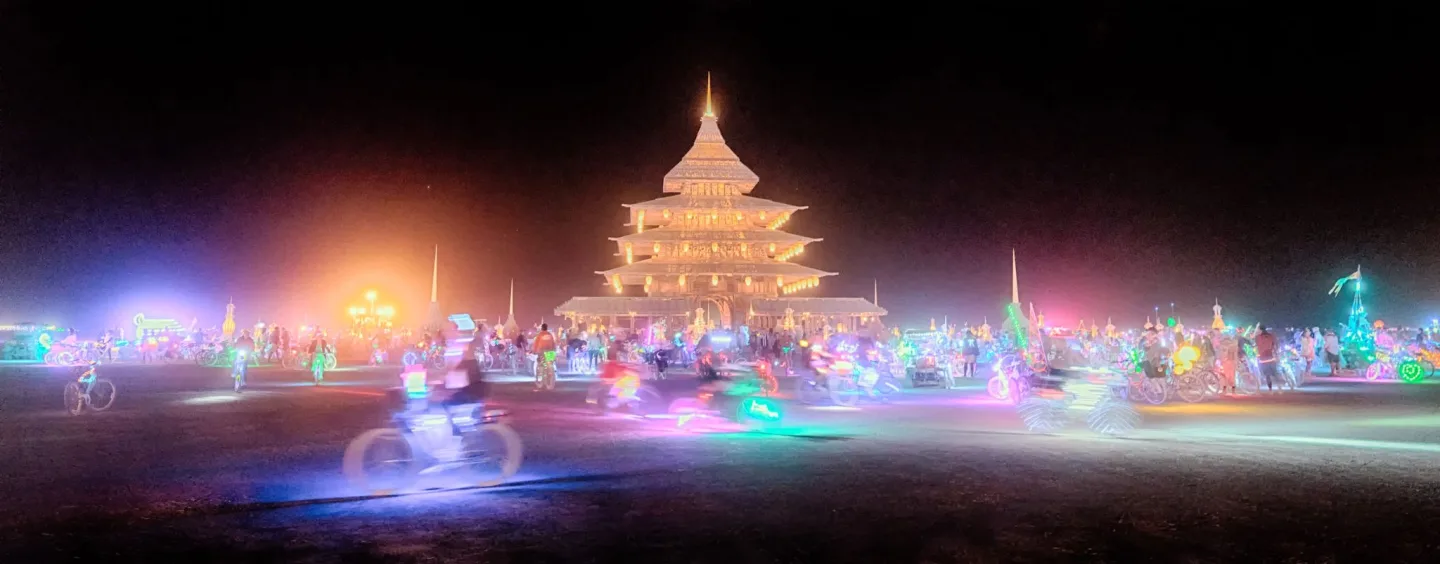
Grants cover only part
Honoraria partially support selected works; many artists and crews still provide substantial money, labor, and materials.
Honorarium
An Honorarium is a partial art grant rather than a promise to cover an artwork’s full cost. A grant, not full funding.
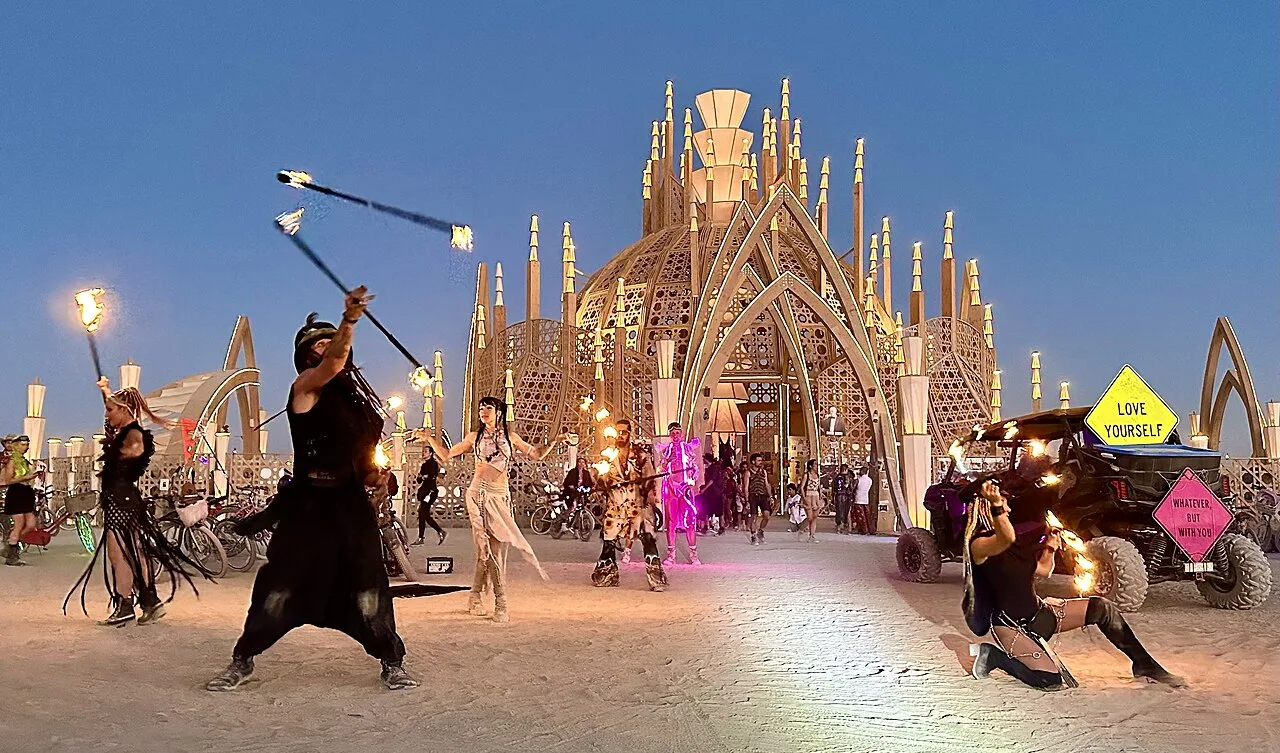
Temple tradition begins
David Best and Jack Haye’s Temple of the Mind began the recurring Black Rock City Temple tradition in 2000.
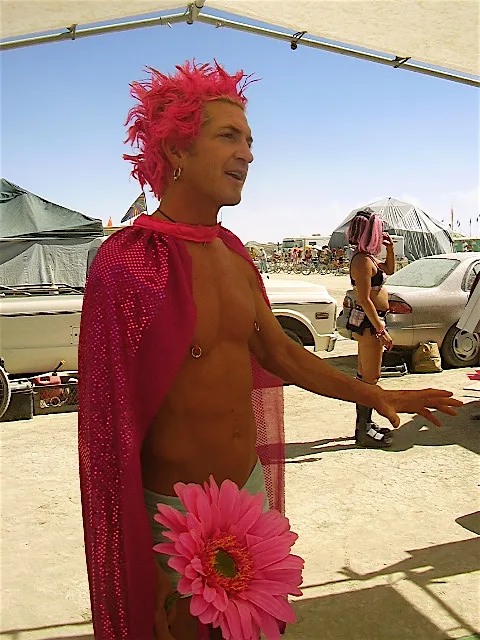
Safety embodied at scale
Marco Cochrane’s Truth is Beauty debuted at Burning Man in 2013 and used a monumental female figure to ask how women might move if safe.
Digital design meets memorial ritual
Arthur Mamou-Mani designed the 2018 Temple, Galaxia, as a spiraling timber structure joining digital design with communal memorial ritual.
Mutant Vehicle
A Mutant Vehicle is an art vehicle built from scratch or transformed so extensively that it is more than a normally decorated car, and it must be invited and pass on-playa DMV inspection to operate. Mutant Vehicles.
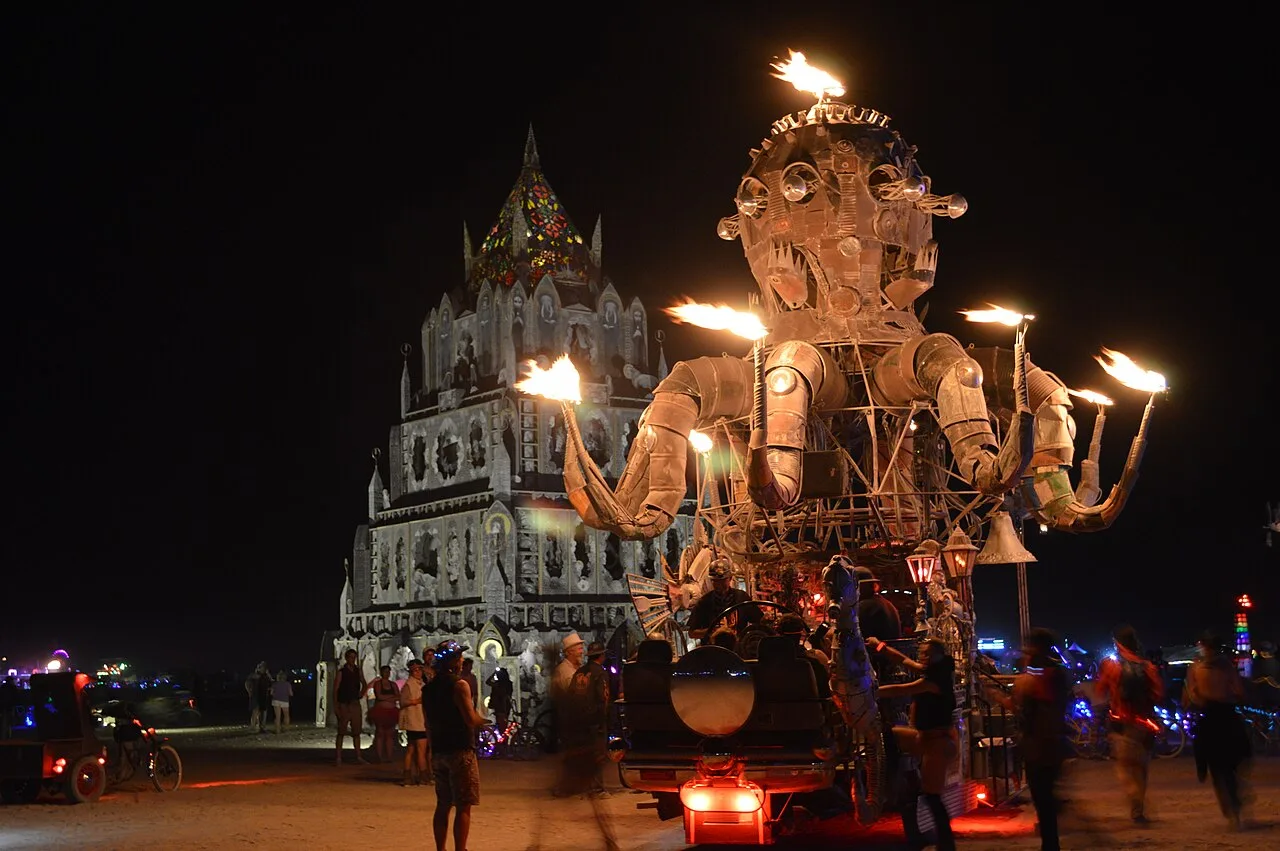
Mutant Vehicles
El Pulpo Mecanico, created by Duane Flatmo from recycled scrap, debuted in 2011 and became a widely recognized flame-effect mutant vehicle.
Mutant Vehicles
Robot Heart began on playa in 2008 as a converted 1972 English double-decker bus and helped make mobile deep-playa sound gatherings a prominent part of later Burner culture.
Matched pairs
Each item on the left goes with the one on the right.
- El Pulpo Mecanico
- Recycled-scrap flame vehicle that debuted in 2011
Self-test
Answer each question from memory, then check your work against the answer key.
1. Which claim about playa art funding is FALSE?
- AHonoraria are partial grants only
- BArtists often add their own labor
- CHonoraria cover full production costs
- DGrants supplement artist resources
2. How does playa art's lifespan compare to a gallery artwork's?
- ADisplayed year-round at a fixed venue
- BKept on a permanent gallery loan circuit
- CStored in a climate-controlled vault indefinitely
- DBuilt for one desert event, then removed
3. Compared to a typical gallery visitor, how does a Black Rock City participant usually experience playa art?
- ABy booking a timed entry ticket
- BBy collaborating with the artwork
- CBy viewing it from behind a rope barrier
- DBy reading a wall placard before viewing
4. What best defines an Honorarium in Burning Man's playa art program?
- AA partial grant that artists must supplement themselves
- BA refundable deposit paid by exhibiting artists
- CA cash prize awarded after the burn
- DA full budget guarantee covering every cost
5. Which trait most distinguishes playa art from a passively viewed gallery piece?
- AA fixed price tag and provenance record
- BA docent-led exhibit tour
- CInteractivity and collaboration
- DClimate-controlled gallery lighting
6. What best describes how Burning Man honoraria fund playa art?
- AA partial grant, supplemented by artists' own resources
- BFull funding covering an artwork's total cost
- CA no-cost loan program
- DA commercial sponsorship deal
7. Besides any honorarium, what do many artists and crews still contribute to their playa art?
- AOnly volunteer hours and no money
- BSubstantial money, labor, and materials of their own
- CNothing further, since honoraria cover everything
- DA share of ticket sales revenue
8. What shapes how playa art is typically built and encountered?
- AA permanent concrete foundation
- BA fixed indoor gallery floor plan
- CA museum's climate-control system
- DIts responsiveness to the desert setting
9. Unlike a gallery piece, how is playa art situated at Black Rock City?
- AIn a permanent outdoor plaza year-round
- BBehind a roped-off velvet display
- CIn a climate-controlled museum wing
- DIn the open desert as a temporary work
10. What distinguishes how participants encounter playa art from how visitors experience typical gallery art?
- APlaya art is roped off and untouchable like gallery work
- BPlaya art is viewed only through audio guides
- CPlaya art invites interactive, collaborative participation
- DPlaya art requires a paid museum admission ticket
Go deeper
- ListenLesson 4 episode
- WatchThe Other Burn Burning Man has a second burn, and it has a different job. It is the Temple.
- WatchMore Than a Painted Car A Burning Man art vehicle can be far more than a painted car. It is called a Mutant Vehicle.
- ReadEnabling Creative Chaos by Katherine K. Chen · on Amazon ↗
- StudyBurning Man: From Curiosity to Black Rock City in the FlashFeed app
These are affiliate links: if you buy a book through one, FlashFeed may earn a small commission at no extra cost to you. The commission helps pay for FlashFeed's servers.
As an Amazon Associate we earn from qualifying purchases.
Answer key
- 1. C Honoraria cover full production costsHonoraria are partial grants, not full funding — artists and crews still cover much of the cost with their own money, labor, and materials.
- 2. D Built for one desert event, then removedPlaya art is built for the temporary desert event and typically removed or burned afterward, unlike a gallery piece kept on permanent long-term display.
- 3. B By collaborating with the artworkPlaya art's interactivity and collaboration invite participants to engage directly with the work, unlike a gallery visitor who views art from a distance.
- 4. A A partial grant that artists must supplement themselvesAn Honorarium is a partial grant; institutional support helps, but artists and crews still supply much of the money, labor, and materials themselves.
- 5. C Interactivity and collaborationInteractivity and collaboration set playa art apart from a passively viewed gallery piece, which is typically just looked at, not touched or built with others.
- 6. A A partial grant, supplemented by artists' own resourcesAn Honorarium is a partial grant, not full funding for a work's total cost.
- 7. B Substantial money, labor, and materials of their ownArtists and crews often contribute significant money, labor, and materials beyond any honorarium.
- 8. D Its responsiveness to the desert settingThe desert can shape how playa art is built and encountered, unlike a fixed indoor setting.
- 9. D In the open desert as a temporary workPlaya art is temporary and sited in the open desert, unlike permanent gallery placement.
- 10. C Playa art invites interactive, collaborative participationPlaya art emphasizes interactivity and collaboration, unlike passive gallery viewing.
Sources
- Smithsonian American Art Museum — Online Gallery for No Spectators: The Art of Burning Man — americanart.si.edu/exhibitions/burning-man/online
- Burning Man Project History — Burning Man Timeline — 2023 — history.burningman.org/timeline/2023/
- Burning Man Project History — Burning Man Timeline — 2014 — history.burningman.org/timeline/2014/
- Burning Man Project History — Burning Man Timeline — 2018 — history.burningman.org/timeline/2018/
- Burning Man Project History — Burning Man Timeline — 2000 — history.burningman.org/timeline/2000/
- Smithsonian American Art Museum — The Renwick’s (David) Best Temple — americanart.si.edu/blog/eye-level/2018/20/57599/renwicks-david-best-temple
- Burning Man Project — Bring Your Mutant Vehicle — burningman.org/black-rock-city/bring-your-mutant-vehicle/
- Burning Man Project — Accessibility Vehicle Operator’s Handbook — burningman.org/black-rock-city/bring-your-mutant-vehicle/accessibility-vehicle-operators-handbook/
- Smithsonian American Art Museum — Duane Flatmo — americanart.si.edu/exhibitions/burning-man/online/duane-flatmo
- Burning Man Project — The Evolution of Robot Heart — burningman.org/podcast/the-evolution-of-robot-heart/
- Burning Man Journal — From Mayan Warrior to the Super Bowl — journal.burningman.org/2024/08/black-rock-city/building-brc/inspiring-sustainability-worldwide/
- Associated Press — Will the Burning Man experiment last 30 more years? — apnews.com/article/burning-man-festival-nevada-future-evolution-environment-7d4a7d27907c39bb053ac9fef5dde662
- Burning Man Project — The 10 Principles of Burning Man — burningman.org/culture/philosophical-center/10-principles/
Image credits
- Grants cover only part: Wikimedia Commons · RawWriter · CC BY-SA 4.0 — commons.wikimedia.org/wiki/File:Temple_du_Burning_Man_2016.jpg
- Temple tradition begins: Wikimedia Commons · Steve Jurvetson · CC BY 2.0 — commons.wikimedia.org/wiki/File:The_Burning_Man_Temple_2024.jpg
- Safety embodied at scale: Wikimedia Commons · dana robinson from los angeles, ca, usa · CC BY-SA 2.0 — commons.wikimedia.org/wiki/File:Burning_man.jpg
- Mutant Vehicles: BLM Nevada · Public domain — commons.wikimedia.org/wiki/File:Totems_of_Confessions_and_El_Pulpo_Mecanico_(21079987615).jpg


