
Burning Man: From Curiosity to Black Rock City study guide · Lesson 3 of 8
Black Rock City in Practice
Layout and Infrastructure · Camps, Volunteering, and Civic Life · Capacity, Tickets, and Access
Unofficial study guide for Enabling Creative Chaos: The Organization Behind the Burning Man Event by Katherine K. Chen. FlashFeed is not affiliated with the author or publisher.
This is the lesson's study guide from the FlashFeed app, plus its key facts and a self-test.
What you'll be able to do
- Describe Black Rock City's clock-face street plan, what it is designed to support, and the mix of institutions that operate it.
- Describe what theme camps and open camping involve, and how volunteer departments work alongside paid staff.
Layout and Infrastructure
Black Rock City’s plan is functional as well as visual. Rod Garrett’s design evolved to support orientation, traffic, services, social interaction, art, and growth. The layout therefore does more than make an attractive shape on a map; it helps a temporary settlement operate at scale.
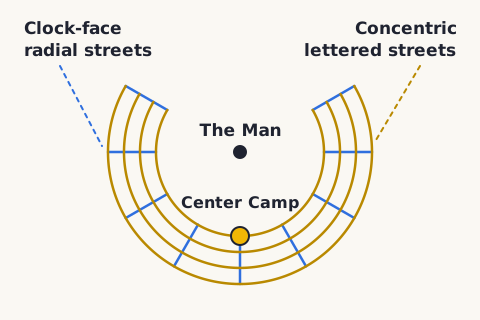
The city uses clock-face radial streets and concentric lettered streets. The Man and Center Camp are major orientation anchors. Together, these features give participants a shared way to describe locations and navigate a city that exists for only a short period.
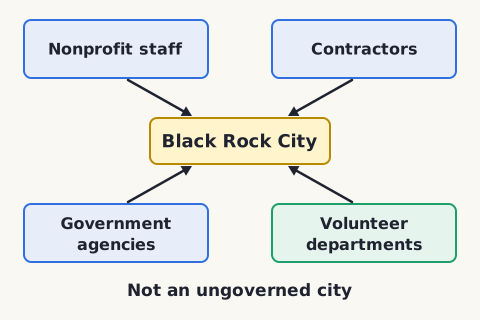
The city is also governed and operated through several kinds of institutions. Its functioning depends on nonprofit staff, contractors, government agencies, and large volunteer departments. Black Rock City is participant-built, but that does not make it an ungoverned city. Formal systems and participant activity work together to provide roads, services, safety, and the social spaces that make the city possible.
Orientation and operation reinforce each other. Radial and lettered streets organize movement, the Man and Center Camp help people locate themselves, and the plan leaves room for social activity, services, and art as the city changes in scale.
Camps, Volunteering, and Civic Life
Theme camps are organized groups that create residential communities and offer public interactivity. Placed camps receive locations through an application process. A camp might give members community and shared infrastructure, but it can also require dues, work shifts, rules, and other obligations. Joining one therefore changes both what a participant receives and what the participant may be expected to contribute.
A placed theme camp is not the only way to live in the city. Open camping allows participants to camp outside placed camps without submitting a placement application or operating a required public program. That option preserves a path for people who do not want the commitments or structure of an organized camp.
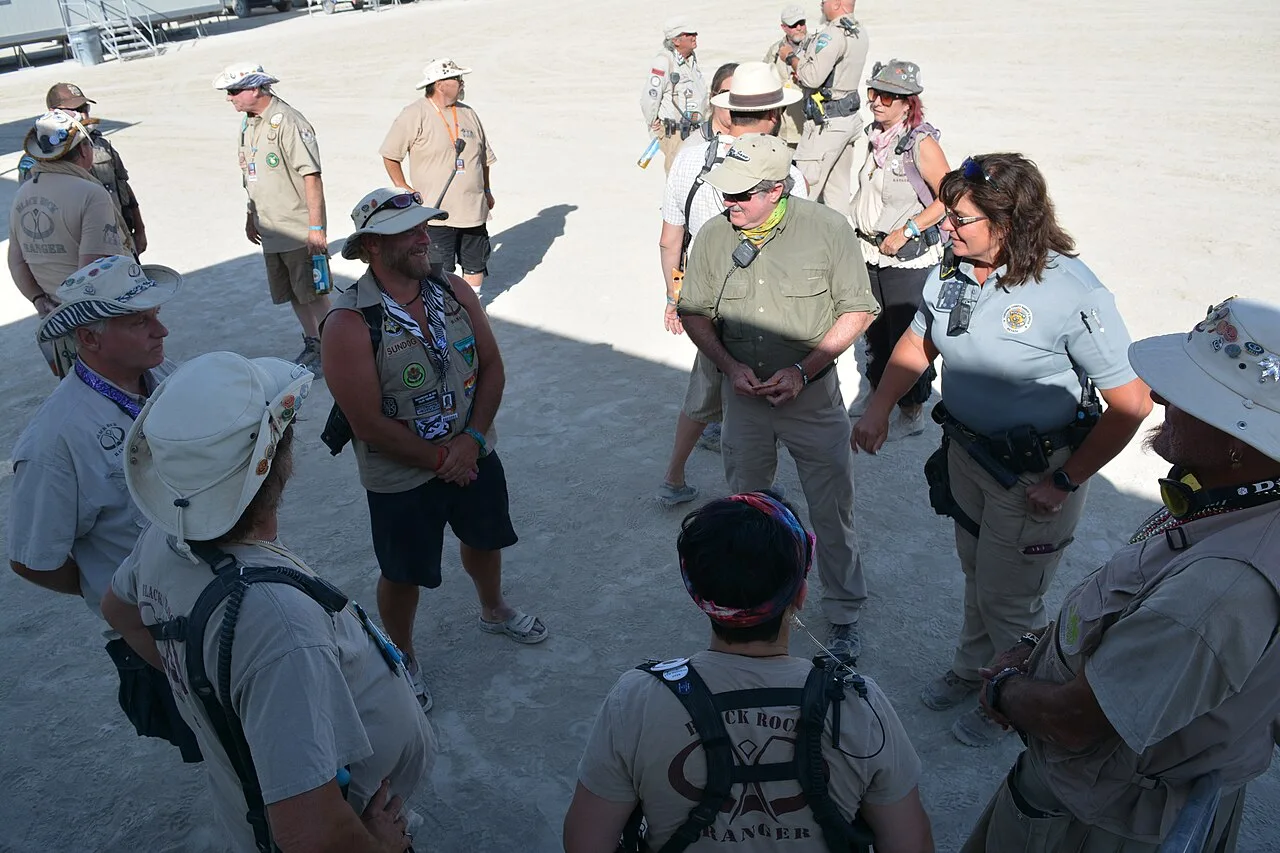
Volunteer departments help operate Black Rock City alongside paid staff, contractors, and public agencies. This mixture reflects the wider production model: participants create much of civic life, but specialized workers and public institutions also carry essential responsibilities. Camps, open camping, and volunteer departments provide different routes into community and contribution rather than a single required experience.
These choices carry different obligations. A placed camp applies for a location and offers public interactivity; its members may share costs and shifts. Open campers do not need a placement application or required program. Volunteers join departments that support city operations alongside other workers and agencies.
Capacity, Tickets, and Access
The organization behind the city changed as the event matured. Burning Man Project completed its transition to nonprofit control in 2014. Black Rock City LLC became its subsidiary, and the annual Black Rock City event became the nonprofit’s largest program.
Ticket access has also changed over time. Tickets sold out for the first time in 2011, but that history should not become a permanent assumption that every sale always sells out. The official final sale still offered tickets in August 2026. Availability is a dated condition, not an evergreen rule.
Price can remain a barrier even when tickets are available. For 2026, the Ticket Aid Program offered a reduced $250 ticket to qualifying applicants with limited income or other eligibility. The combination of ordinary sales and aid programs shows that access involves more than capacity alone: availability, price, timing, and eligibility can all affect who is able to attend.
A first sellout occurred in 2011, tickets remained in an official sale in August 2026, and an aid program offered a lower price to eligible applicants. Any current plan therefore needs current sale information rather than assumptions based on an earlier year.
Key terms
- Theme camps
- Organized groups that create residential communities and public interactivity.
Key facts
City Design
Rod Garrett's city plan evolved to support orientation, traffic, services, social interaction, art, and scalability rather than serving only an aesthetic purpose.
City Design
Black Rock City is organized around clock-face radial streets and concentric lettered streets, with the Man and Center Camp serving as major orientation anchors.
Organization
Black Rock City's functioning depends on a mixture of nonprofit staff, contractors, government agencies, and large volunteer departments; it is not an ungoverned city.
Theme camps
Theme camps are organized participant groups that create residential communities and public interactivity; placed camps receive locations through an application process, while open camping remains available.
Camping
A theme camp can provide community and shared infrastructure, but may also require dues, work shifts, rules, and other obligations.
Open camping is valid
Open camping lets participants camp outside placed camps without a placement application or required camp program.
City mixes labor models
Volunteer departments help operate Black Rock City alongside paid staff, contractors, and public agencies.
Organization
Burning Man Project completed its transition to nonprofit control in 2014, making Black Rock City LLC a subsidiary and the annual event the nonprofit's largest program.
Growth
Tickets sold out for the first time in 2011, but the official final sale still offered 2026 tickets in August; scarcity is not an evergreen rule.
2026 Ticket Aid price
The 2026 Ticket Aid Program offered a reduced $250 ticket to qualifying applicants with limited income or other eligibility. A reduced-price route exists.
By the numbers
- What was the 2026 Ticket Aid base ticket price before applicable taxes and fees?
- 250 USD
Matched pairs
Each item on the left goes with the one on the right.
- Placed camps
- Receive locations through an application process
Self-test
Answer each question from memory, then check your work against the answer key.
1. Which two features serve as Black Rock City's major orientation anchors?
- AThe radial streets and the lettered streets
- BThe Temple and the landmark art installations
- CTheme camps and open camping areas
- DThe Man and Center Camp
2. What street pattern organizes Black Rock City's layout?
- AHexagonal blocks and ring roads
- BGrid streets and numbered avenues
- CClock-face radial and lettered streets
- DSpiral streets and diagonal boulevards
3. Which of these is NOT part of how Black Rock City is governed and operated?
- AA single elected city council
- BContractors
- CVolunteer departments
- DNonprofit staff
4. What did Rod Garrett's city design evolve to support?
- ATicket sales and revenue growth
- BOrientation, traffic, and scalability
- CVehicle speed and parking capacity only
- DAesthetic appeal only
5. Which statement best describes how Black Rock City is run?
- AOnly private contractors, no volunteers
- BParticipant effort plus formal staff and agencies
- CEntirely self-governed with no formal staff
- DRun solely by government agencies
6. How are Black Rock City's streets organized to help participants navigate?
- AA single spiral street winding inward
- BRandomly placed footpaths with no naming
- CClock-face radial streets and concentric lettered streets
- DA numbered grid like a typical downtown
7. What two features serve as the major orientation anchors in Black Rock City's layout?
- AThe Man and Center Camp
- BThe Trash Fence and the Airport
- CThe airport and the ticket office
- DCity Hall and the Temple
8. What is a theme camp?
- ANonprofit and contractor staff providing city services
- BCamping option requiring no application or program
- CVolunteer department operating city services
- DOrganized group creating residential communities
9. How do placed theme camps receive their location in Black Rock City?
- AThrough an application process
- BFirst-come, first-served on arrival
- CBy registering with a government agency
- DBy vehicle license lottery
10. What distinguishes open camping from a placed theme camp?
- ALimited to volunteer staff only
- BRequires paying higher dues
- CRequires a government permit
- DNo placement application or public program required
11. Which is NOT something theme camp membership can require?
- ARules and other obligations
- BDues
- CA government-issued operating license
- DWork shifts
12. How do volunteer departments contribute to civic life in Black Rock City?
- AReplace paid staff and government agencies entirely
- BAssist paid staff and agencies in city operations
- COperate independently without any paid staff
- DProvide only entertainment, not operations support
13. Who do volunteer departments operate Black Rock City alongside?
- AFederal park rangers exclusively
- BTicketing vendors only
- CPaid staff, contractors, and public agencies
- DOnly unpaid campers
14. What does the mix of volunteer departments and paid staff show about the city's civic work?
- AParticipants and specialized workers share responsibility
- BCivic operations are fully outsourced to contractors
- CVolunteers replace all paid staff entirely
- DOnly nonprofit staff run city operations
Go deeper
- ListenLesson 3 episode
- WatchA City on a Clock Black Rock City's streets are laid out like a clock face.
- WatchCamp or Open Camp Nobody at Burning Man has to join a theme camp.
- ReadEnabling Creative Chaos by Katherine K. Chen · on Amazon ↗
- StudyBurning Man: From Curiosity to Black Rock City in the FlashFeed app
These are affiliate links: if you buy a book through one, FlashFeed may earn a small commission at no extra cost to you. The commission helps pay for FlashFeed's servers.
As an Amazon Associate we earn from qualifying purchases.
Answer key
- 1. D The Man and Center CampThe Man and Center Camp are the orientation anchors. Radial/lettered streets organize movement, and staff, agencies, contractors, and volunteers govern operations — neither role is an orientation anchor.
- 2. C Clock-face radial and lettered streetsThe city uses clock-face radial streets crossed with concentric lettered streets, not a grid, spiral, or hexagonal pattern.
- 3. A A single elected city councilThe city runs on nonprofit staff, contractors, government agencies, and volunteer departments, not on an elected city council.
- 4. B Orientation, traffic, and scalabilityThe plan evolved to support orientation, traffic, services, social interaction, art, and scale, not looks alone, speed and parking alone, or ticket revenue.
- 5. B Participant effort plus formal staff and agenciesBlack Rock City is participant-built but still depends on nonprofit staff, contractors, and government agencies working alongside participants.
- 6. C Clock-face radial streets and concentric lettered streetsBRC's layout consists of clock-face radial streets crossed by concentric lettered streets.
- 7. A The Man and Center CampThe Man and Center Camp are the layout's major orientation anchors.
- 8. D Organized group creating residential communitiesTheme camps are organized participant groups building residential communities, unlike open camping (no application/program), volunteer departments, or paid staff and contractors.
- 9. A Through an application processPlaced camps receive locations through an application process, not by agency registration, arrival order, or lottery.
- 10. D No placement application or public program requiredOpen camping lets participants camp without submitting a placement application or running a required public program, unlike placed camps.
- 11. C A government-issued operating licenseDues, work shifts, and rules are possible camp obligations, but a government-issued operating license is not one of them.
- 12. B Assist paid staff and agencies in city operationsVolunteer departments help operate the city alongside paid staff, contractors, and public agencies rather than replacing or excluding them.
- 13. C Paid staff, contractors, and public agenciesVolunteer departments help operate the city alongside paid staff, contractors, and public agencies.
- 14. A Participants and specialized workers share responsibilityThis mixture reflects a model where participants and specialized workers share responsibility.
Sources
- Rod Garrett / Burning Man Journal — Designing Black Rock City — journal.burningman.org/2010/04/black-rock-city/building-brc/designing-black-rock-city/
- U.S. Bureau of Land Management — Burning Man Event Special Recreation Permit Draft Environmental Impact Statement, Volume 1 — eplanning.blm.gov/public_projects/nepa/93518/168727/205347/Burning_Man_Event_SRP-Draft_EIS_Vol1.pdf
- Katherine K. Chen / University of Chicago Press — Enabling Creative Chaos: The Organization Behind the Burning Man Event — press.uchicago.edu/ucp/books/book/chicago/E/bo6797144.html
- Burning Man Project — Black Rock City 2026: Axis Mundi — burningman.org/black-rock-city/black-rock-city-2026/
- Burning Man Project — What to Pack (And What to Leave at Home) — Survival Guide 2026 — survival.burningman.org/leave-no-trace/what-to-pack-and-what-to-leave-at-home/
- Burning Man Project — Decommodification, Gifting, Participation and PAYticipation — burningman.org/black-rock-city/camps/cultural-direction-setting-decommodification/commodification-gifting-decommodification-and-participation/
- Burning Man Project History — Burning Man Timeline — 2014 — history.burningman.org/timeline/2014/
- Burning Man Project History — Burning Man Timeline — 2011 — history.burningman.org/timeline/2011/
- Burning Man Project — Black Rock City 2026 Ticket Sales — burningman.org/black-rock-city/ticketing-information/
- Burning Man Project — Black Rock City Camps (Placement & Open Camping) — burningman.org/black-rock-city/camps/
Image credits
- City Design: FlashFeed original diagram · CC-BY-4.0
- Organization: FlashFeed original diagram · CC-BY-4.0
- City mixes labor models: BLM Nevada · Public domain — commons.wikimedia.org/wiki/File:Black_Rock_Rangers_meeting_(48636860016).jpg
