
Burning Man: From Curiosity to Black Rock City study guide · Lesson 2 of 8
From Beach Burn to Black Rock City
The Baker Beach Beginning · The 1990 Desert Move · Crisis, Rules, and City-Making
Unofficial study guide for Enabling Creative Chaos: The Organization Behind the Burning Man Event by Katherine K. Chen. FlashFeed is not affiliated with the author or publisher.
This is the lesson's study guide from the FlashFeed app, plus its key facts and a self-test.
What you'll be able to do
- Recount the 1986 Baker Beach origin and what forced the move off the beach.
The Baker Beach Beginning
The first Burning Man burn took place in 1986, when Larry Harvey and Jerry James built an improvised wooden figure on Baker Beach in San Francisco and burned it. The first Man was about eight feet tall, much smaller than the structures that would appear in later years.
When the figure burned, a curious crowd gathered around the fire. That gathering is an important part of the origin story: the first burn was not yet a temporary desert city with roads, camps, permits, and public-safety systems. It was a small beach event organized around a handmade wooden figure and a fire that drew people together. Harvey and James supplied the initial structure and burn, while the crowd’s spontaneous response hinted at the participant gathering that the event would later become.
The three details belong together: two builders made an improvised figure, the figure was modest in size, and a curious crowd formed around its burning.
The 1990 Desert Move
The decisive move came in 1990. Authorities allowed the Man to be erected on Baker Beach but did not allow it to be burned there. Organizers associated with the Cacophony Society then helped relocate the burn to the Black Rock Desert as Zone Trip #4.
Changing the location changed the gathering. Reaching the desert required a pilgrimage rather than a casual visit to a city beach. People had to practice survival camping and take greater responsibility for their participation. The open setting also allowed a settlement to form around the Man. These features helped move the gathering toward the participant-built desert community that became Black Rock City.
Attendance estimates from this early period require care. Figures for 1990 vary even within official historical materials, so they are best understood as approximate rather than exact. The durable point is the transformation in place and practice: the burn moved from Baker Beach to the Black Rock Desert, and the demands of travel, survival, and settlement reshaped the event.
The move was both practical and cultural. A restriction on burning at the beach prompted the relocation, Cacophony Society organizers helped create Zone Trip #4, and the desert required people to arrive prepared for travel and survival rather than simply gathering around a city fire.
Crisis, Rules, and City-Making
Growth exposed the limits of informal organization. In 1996, the event reached about 8,000 participants and experienced severe failures involving safety, cleanup, traffic, and organization. The problems made clear that a larger temporary settlement could not operate as though it were still a small beach gathering.
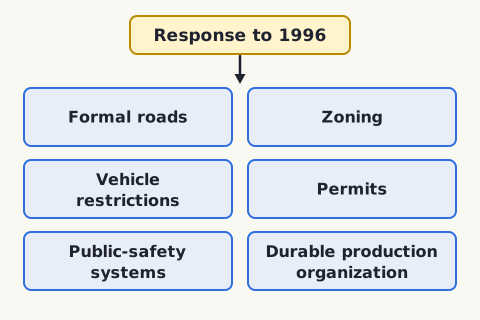
The response helped push Burning Man toward formal roads and zoning, restrictions on vehicle movement, permits, public-safety systems, and a durable production organization. These changes did not simply add bureaucracy. They created structures needed to support a growing city and reduced risks that had become visible in 1996.
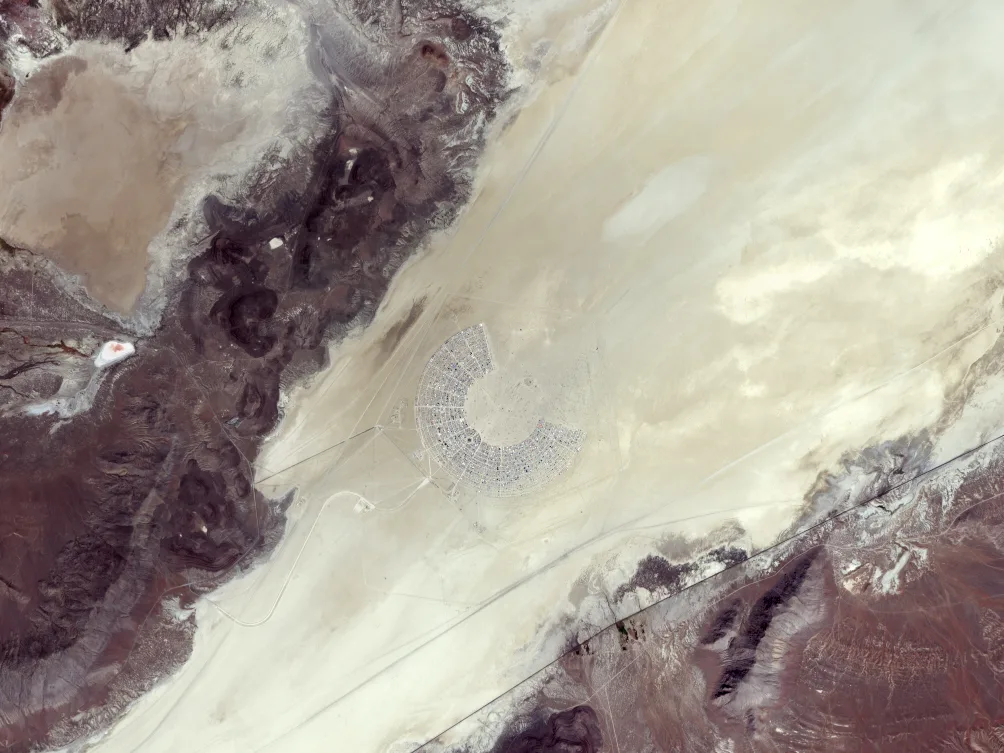
The city’s location and plan also continued to evolve. Black Rock City used Hualapai Flat once in 1997. It returned to the Black Rock playa in 1998 with a scalable semicircular plan centered on the Man. The sequence from beach burn to desert settlement to planned city shows how participation and organization developed together: the gathering became larger and more complex, and its physical design and operating systems changed in response.
The turning point was not a single rule or map. Safety failures, cleanup problems, traffic, and organizational strain combined to drive formal systems. Roads, zoning, vehicle limits, permits, public safety, and a scalable plan addressed different parts of the same challenge: operating a temporary city rather than an informal gathering.
Key facts
Origins
Larry Harvey and Jerry James built and burned the first wooden Man on Baker Beach in San Francisco in 1986.
Crowd made the moment
When the first Man burned on Baker Beach in 1986, a curious crowd gathered around the fire.
First Man height
The first 1986 Man was an improvised wooden figure about eight feet tall, far smaller than later versions. The first Man was modest.
Origins
In 1990 authorities allowed the Man to be erected on Baker Beach but not burned, after which Cacophony Society organizers helped relocate the burn to the Black Rock Desert as Zone Trip #4.
Origins
The 1990 move changed the gathering by requiring a pilgrimage, survival camping, and greater participant involvement, while allowing a settlement to form around the Man.
Historical Method
Early attendance figures, especially for 1990, vary even within official historical materials and should be taught as approximate.
1996 event population
The 1996 event reached about 8,000 participants and exposed severe safety, cleanup, traffic, and organizational failures.
Turning Points
The response to 1996 helped push Burning Man toward formal roads, zoning, vehicle restrictions, permits, public-safety systems, and a durable production organization.
City Design
Black Rock City used a one-time Hualapai Flat site in 1997 and returned to the Black Rock playa in 1998 with a scalable semicircular plan centered on the Man.
By the numbers
- First Man height — how many feet?
- 8 feet
- 1996 event population — how many participants?
- 8000 participants
Self-test
Answer each question from memory, then check your work against the answer key.
1. In what year did Larry Harvey and Jerry James burn the first wooden Man on Baker Beach?
- A1998
- B1996
- C1990
- D1986
2. What specifically forced the burn to leave Baker Beach in 1990?
- ASevere safety and cleanup failures
- BNew vehicle and permit restrictions
- COfficials barred burning it on the beach
- DComplaints about traffic congestion
3. About how tall was the first Man built on Baker Beach in 1986?
- AAbout 8 feet
- BAbout 60 feet
- CAbout 40 feet
- DAbout 25 feet
4. Which was NOT one of the new demands the 1990 desert move placed on participants?
- APracticing survival camping
- BObtaining formal event permits
- CTaking on more personal responsibility
- DMaking a pilgrimage journey
5. What formed spontaneously around the burning figure at the 1986 Baker Beach event?
- AA formally organized camp committee
- BA team of trained safety marshals
- CA curious crowd of onlookers
- DA crew of desert survivalists
6. Who built and burned the first improvised wooden Man on Baker Beach in 1986?
- AJohn Law and Larry Harvey
- BLarry Harvey and Jerry James
- CJerry James and Rod Garrett
- DLarry Harvey and Michael Mikel
7. What gathered around the burning wooden figure at the original 1986 Baker Beach event?
- AA curious crowd
- BA film crew
- CA ticketed audience
- DA city permit inspector
8. What specifically forced the burn to relocate away from Baker Beach in 1990?
- ALocal residents filed noise complaints
- BThe beach flooded during a storm
- CThe beach was sold to developers
- DAuthorities allowed erecting but not burning it there
9. Who helped relocate the 1990 burn to the Black Rock Desert as Zone Trip #4?
- AThe Nevada tourism board
- BCacophony Society organizers
- CU.S. Forest Service rangers
- DThe Bureau of Land Management
Go deeper
- ListenLesson 2 episode
- WatchEight Feet on a Beach In 1986, two men built a wooden figure on a San Francisco beach and set it on fire.
- WatchNo Burning on the Beach In 1990, the Man could stand on Baker Beach, but it could not burn there.
- ReadEnabling Creative Chaos by Katherine K. Chen · on Amazon ↗
- StudyBurning Man: From Curiosity to Black Rock City in the FlashFeed app
These are affiliate links: if you buy a book through one, FlashFeed may earn a small commission at no extra cost to you. The commission helps pay for FlashFeed's servers.
As an Amazon Associate we earn from qualifying purchases.
Answer key
- 1. D 1986The first Baker Beach burn was in 1986. 1990 was the move to the desert, 1996 was the crisis year, and 1998 was the return to the Black Rock playa.
- 2. C Officials barred burning it on the beachAuthorities allowed the Man to be erected on Baker Beach but not burned there, prompting the desert relocation. Safety failures, traffic problems, and permits all arose later, from the 1996 crisis and its aftermath.
- 3. A About 8 feetThe 1986 Man was an improvised wooden figure about eight feet tall, much smaller than the structures built in later years.
- 4. B Obtaining formal event permitsThe desert move required travel, survival camping, and personal responsibility. Formal permits arrived later, as part of the response to the 1996 crisis.
- 5. C A curious crowd of onlookersA curious crowd gathered spontaneously around the fire at Baker Beach in 1986. Safety marshals, survivalist camping, and organized camp committees only emerged later as Black Rock City became a planned settlement.
- 6. B Larry Harvey and Jerry JamesLarry Harvey and Jerry James built and burned the first Man on Baker Beach in 1986.
- 7. A A curious crowdA curious crowd gathered around the fire when the first Man burned in 1986.
- 8. D Authorities allowed erecting but not burning it thereAuthorities permitted erecting the Man on Baker Beach but not burning it, forcing the move.
- 9. B Cacophony Society organizersCacophony Society organizers helped relocate the burn to the desert as Zone Trip #4.
Sources
- Burning Man Project — Timeline — history.burningman.org/timeline/
- Burning Man Project History — Burning Man Timeline — 1990 — history.burningman.org/timeline/1990/
- Katherine K. Chen / University of Chicago Press — Enabling Creative Chaos: The Organization Behind the Burning Man Event — press.uchicago.edu/ucp/books/book/chicago/E/bo6797144.html
- Burning Man Project History — Burning Man Timeline — 1996 — history.burningman.org/timeline/1996/
- Rod Garrett / Burning Man Journal — Designing Black Rock City — journal.burningman.org/2010/04/black-rock-city/building-brc/designing-black-rock-city/
Image credits
- Turning Points: FlashFeed original diagram · CC-BY-4.0
- City Design: European Space Agency · Attribution — commons.wikimedia.org/wiki/File:Earth_from_Space-_Burning_Man_festival_ESA501496.jpg
