
Electronic Music: History, Genres, Scenes, and Sound study guide · Lesson 2 of 5
House and Techno Are People and Places
Chicago House as an Ecosystem · Detroit Techno Builds a Future · What DJs Do Differently
This is the lesson's study guide from the FlashFeed app, plus its key facts and a self-test.
What you'll be able to do
- Describe house, techno, and DJ performance through documented networks, roles, and qualified conventions.
Chicago House as an Ecosystem
Chicago House as an Ecosystem
House music is often introduced with a compact formula: Chicago, the Warehouse, Frankie Knuckles. Those anchors matter, but the compact version can hide the network that made them meaningful. The Warehouse at 206 South Jefferson Street has a documented period of musical significance from 1977 to 1982. Promoter Robert Williams established the venue and recruited Frankie Knuckles, a young DJ shaped by New York club culture, as its resident. Their roles were connected but not interchangeable.
That distinction matters because public histories can turn collaboration into a one-person invention. An introduced congressional resolution credited Knuckles with establishing the Warehouse. Chicago’s later landmark research instead identifies Williams as the promoter who created the venue and Knuckles as its formative resident DJ. The stronger account preserves both contributions. Knuckles shaped long nights through selection, sequencing, edits, rhythmic reinforcement, and attention to dancers; Williams built the institution in which that practice could develop.
The dancers are not background characters. Black and Latinx LGBTQ people were foundational supporters of the Warehouse and used the club as a space for community, self-expression, and release. Calling house a scene means treating those relationships as part of the music: the room and sound system, the dancers’ responses, the DJ’s choices, the records available in shops, engineers’ work, radio circulation, later producers, and competing or allied venues.
This ecosystem view also helps with the disputed story of the genre’s name. The Warehouse is strongly associated with the word “house,” but a neat sentence claiming that one person coined the genre at one instant asks the evidence to do too much. Names often become stable only after dancers, stores, DJs, journalists, and labels begin using them. What can be taught confidently is that the Warehouse and Knuckles are central to Chicago house history, that the club’s queer Black and Latinx social world is foundational, and that many participants carried the sound outward.
Use a network test whenever a history names a “father” or “inventor”: Who ran the space? Who made or edited the recordings? Who engineered the sound? Who danced, promoted, broadcast, sold, and named the music? The result is not less memorable. It is a more accurate map of creative power.
Detroit Techno Builds a Future
Detroit techno needs the same network test. Juan Atkins, Derrick May, and Kevin Saunderson are commonly grouped as the Belleville Three, and each played an important role. Yet the shorthand can become a fence if it makes Rick Davis, Eddie Fowlkes, women DJs, radio figures, labels, clubs, and later collectives disappear. Indiana University’s Archives of African American Music and Culture created its Roots of Techno conference and collection specifically to place the genre within African American culture and history and to preserve testimony from a wider field of Detroit practitioners.
Atkins’s work offers a useful route through the network. He formed Cybotron with Rick Davis, joining electronic sound, futurist language, and dance music before recording under the Model 500 name. Atkins also exchanged ideas with May and Saunderson. The point is not to replace the trio with a new solitary hero. It is to see collaboration, friendship, radio exposure, small labels, local parties, instruments, and imagined futures working together.
Detroit histories often use words such as “futuristic,” “postindustrial,” or “dystopian.” Treat those as interpretations, not automatic descriptions of every track or every creator’s intention. Electronic timbres can suggest machines or science fiction to a listener, but Detroit artists also described possibility, transformation, pleasure, and creative independence. A city’s economic history matters without functioning as a code that mechanically turns factories into a musical style.
International circulation changed the story again. Derrick May helped give techno a broader stylistic and international platform through early European touring. Records and DJs crossed the Atlantic, entered different clubs and media systems, and met new audiences. That movement helped techno become globally recognizable, but it also made it easier for later listeners to mistake a Black Detroit music for a genre that had originated in Europe.
A reliable beginner’s account therefore holds two ideas at once: Detroit techno has a specific African American local history, and techno became a transnational field through circulation and adaptation. Protecting the first point does not require pretending the music stopped changing after it left Michigan.
What DJs Do Differently
Genre is not only audible in a finished track. It can also shape what a DJ is expected to do with several tracks in sequence. A recent study of contemporary house, techno, and drum-and-bass DJs found distinct tendencies. House performers most strongly favored smooth transitions and audience-oriented curation. Techno performers were more associated with multilayered mixing, looping, sampling, and live processing. Drum-and-bass performers were more associated with abrupt transitions, rewinds, and double drops.
These terms describe different ways of organizing attention. A smooth transition gradually transfers rhythmic and tonal weight from one track to another, supporting continuity. Multilayering treats tracks as components that can overlap into a denser, partly new texture. A rewind interrupts the sequence by returning a track to an earlier point, often in response to collective excitement. A double drop coordinates high-impact moments from two tracks so they arrive together.
Do not convert those findings into stereotypes. The research reports conventions in a particular sample, not laws of nature. A house DJ can make a dramatic cut; a techno DJ can play a patient two-track blend; a drum-and-bass set can use long transitions. Individual style, subgenre, venue, audience, technology, and historical moment all matter. Conventions are useful precisely because artists can satisfy, bend, or refuse them.
This gives you a practical listening exercise. When hearing a set, ask three questions. First, how noticeable are the transitions: concealed, gradual, sharp, or theatrical? Second, is the DJ mainly connecting complete tracks or building a layered composite? Third, how does the crowd seem to participate—through sustained flow, anticipation, a requested rewind, or recognition of a coordinated drop? You do not need to see the equipment to hear these choices.
The comparison also prevents a common category error. A genre is not merely a tempo range or drum pattern. It includes repertoires, performance habits, expectations, venues, and communities. Track-level sound and set-level practice overlap, but they are not identical. The next lesson builds a listening map from pulse, groove, bass, timbre, and arrangement, while keeping these social conventions in view.
Sources
- City of Chicago — The Warehouse Landmark Designation Report
- Congress.gov — H.Res.280
- Columbia College Chicago — Chicago House Music Oral History Project
- Dancecult — Disco’s Revenge: House Music’s Nomadic Memory
- Indiana University — Roots of Techno archive
- Detroit Historical Society — Juan Atkins
- Detroit Historical Society — Derrick May
- Dancecult — Genre Conventions in Contemporary DJ Performance
Key terms
- Scene (as used for house music)
- The room and sound system, dancers' responses, the DJ's choices, records in shops, engineers' work, radio circulation, later producers, and rival or allied venues, treated as part of the music itself.
- Belleville Three
- A familiar shorthand for Juan Atkins, Derrick May, and Kevin Saunderson that does not exhaust Detroit techno history.
- Rewind
- Interrupting the sequence by returning a track to an earlier point, often in response to collective excitement.
- Multilayering
- Treating tracks as components that can overlap into a denser, partly new texture.
- Smooth transition
- Gradually transferring rhythmic and tonal weight from one track to another to support continuity.
Key facts
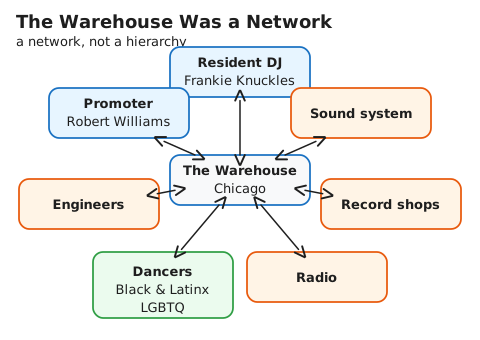
The Warehouse Was a Network
Chicago's landmark report identifies Robert Williams as venue creator and Frankie Knuckles as formative resident DJ. Black and Latinx LGBTQ dancers were foundational, and other institutions complete the history.
A Resolution's One-Name Story
An introduced congressional resolution credited Frankie Knuckles alone with establishing the Warehouse. Chicago's own landmark research instead splits that history between the promoter who created the venue and the DJ who shaped it as resident.
What a Resident DJ Actually Did
Robert Williams recruited Frankie Knuckles, a young DJ shaped by New York club culture, as the Warehouse's resident. Once there, Knuckles shaped long nights through record selection, sequencing, edits, rhythmic reinforcement, and attention to dancers.
A 'Scene' Is Part of the Music
Calling house a scene means treating the room and sound system, dancers' responses, the DJ's choices, records in shops, engineers' work, radio circulation, later producers, and competing or allied venues as part of the music itself, not as background.
No One Instant Coined 'House'
The Warehouse is strongly linked to the word house, but no single dated moment reliably names one coiner of the genre's name. Names typically become stable only after dancers, stores, DJs, journalists, and labels begin using them together.
A Test for 'Father of a Genre' Claims
Whenever a history names one founder or inventor, ask who ran the space, who made or edited the recordings, who engineered the sound, and who danced, promoted, broadcast, sold, and named the music. Answering widens a single-hero story into a documented network.
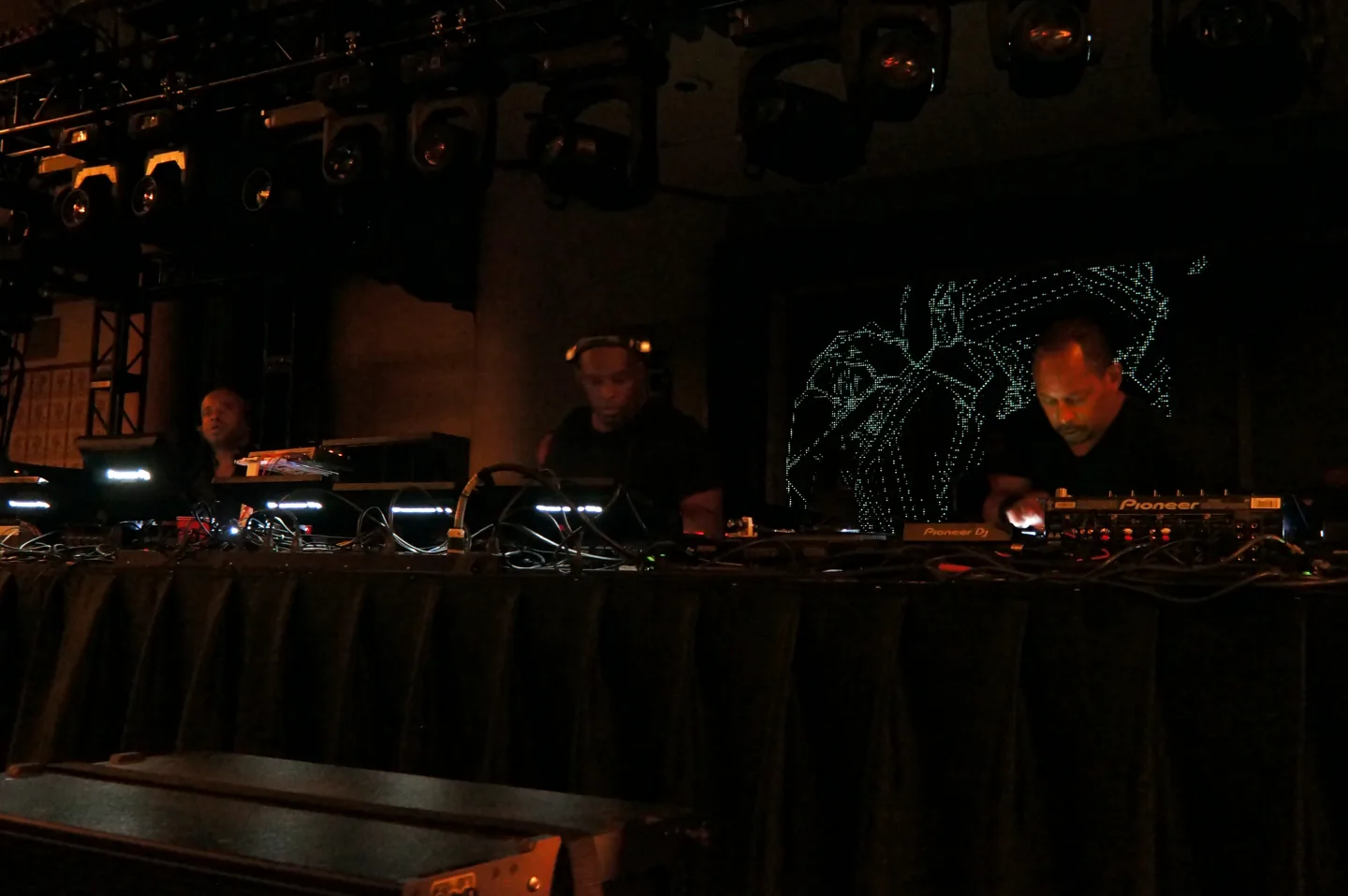
Detroit Techno Exceeds One Trio
Juan Atkins, Derrick May, and Kevin Saunderson are useful anchors, but Rick Davis, Eddie Fowlkes, radio, labels, clubs, and other creators widen the map.
Machines Aren't the Whole Story
Electronic timbres can suggest machines or science fiction to a listener, but Detroit artists also described possibility, transformation, pleasure, and creative independence through the same sounds. The city's economic history matters without mechanically explaining every feature of the music.
May Toured Techno Into Europe
Derrick May helped give techno a broader stylistic and international platform through early European touring. That circulation helped techno become globally recognizable, but it also made it easier for later listeners to mistake a Black Detroit music for one that originated in Europe.
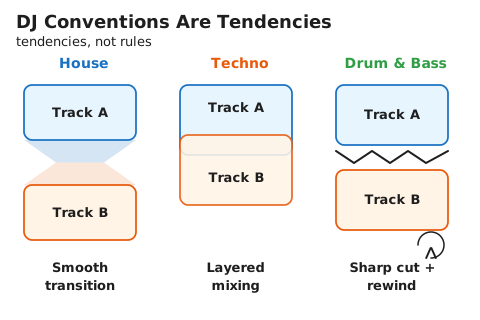
DJ Conventions Are Tendencies
A recent study linked house with smooth curation, techno with layering and processing, and drum and bass with sharper transitions—without turning those patterns into rules.
Three Words for Moving Between Tracks
A smooth transition gradually shifts rhythmic and tonal weight between tracks to keep a set continuous. A rewind interrupts the sequence to return a track to an earlier point, often for collective excitement. Multilayering treats tracks as components that overlap into a denser, partly new texture.

A Genre Is More Than a Tempo
A genre is not merely a tempo range or drum pattern. It also includes repertoires, performance habits, expectations, venues, and communities. Track-level sound and set-level practice overlap, but they are not identical.
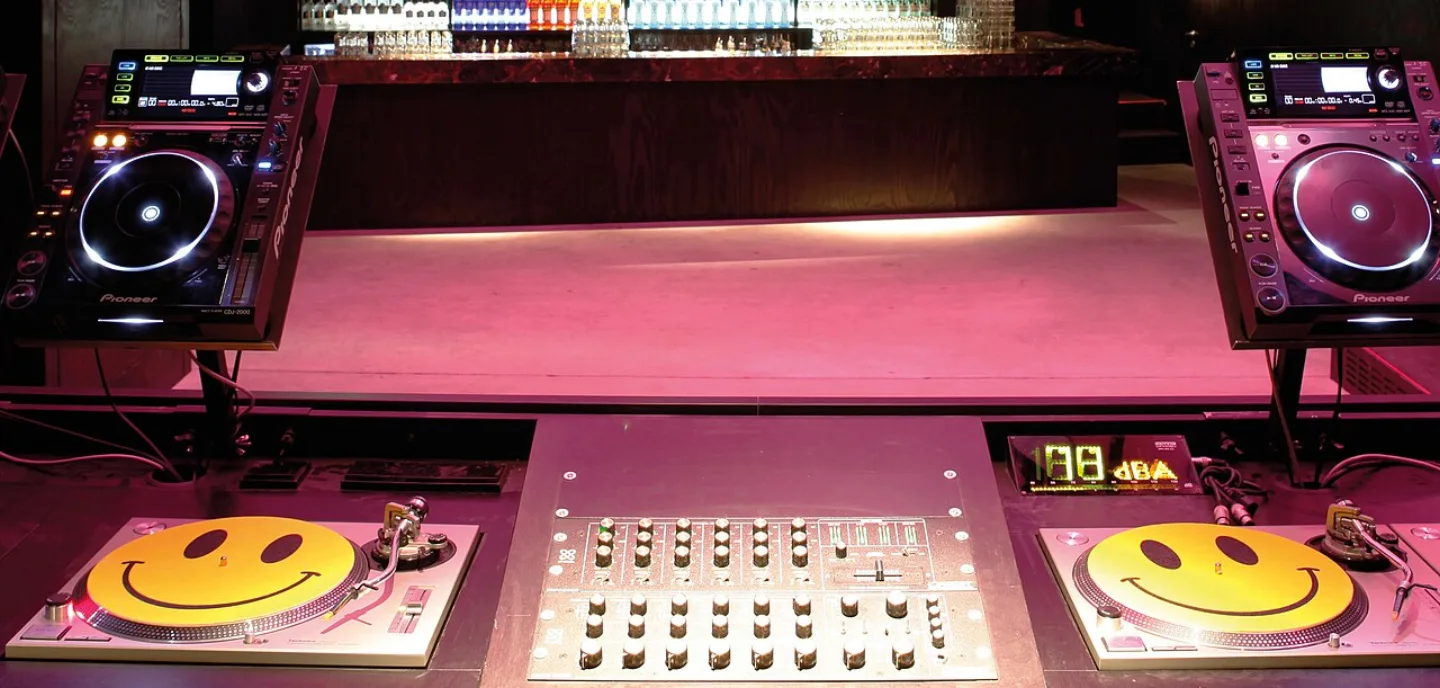
What Can Bend a Convention
Individual style, subgenre, venue, audience, technology, and historical moment can all shape how a DJ handles a genre convention. Conventions stay useful precisely because artists can satisfy, bend, or refuse them.
Matched pairs
Each item on the left goes with the one on the right.
- Robert Williams
- Promoter who created the Warehouse venue
- Cybotron
- Juan Atkins and Rick Davis working together
- Double drop
- Two high-impact moments aligned together
Step by step
Apply a network test to a "father of the genre" claim
- Ask who ran the space.
- Ask who made or edited the recordings.
- Ask who engineered the sound.
- Ask who danced, promoted, broadcast, sold, and named the music.
Answering these questions turns a single-hero story into a documented network of contributors.
Describe a DJ set without seeing the equipment
- Notice whether transitions are concealed, gradual, sharp, or theatrical.
- Hear whether tracks remain separate or overlap into a denser composite.
- Track crowd participation through flow, anticipation, rewind, or drop.
- State the pattern as a tendency and leave room for individual style.
This listening sequence describes performance choices; it does not prove a DJ's genre from one transition.
Self-test
Answer each question from memory, then check your work against the answer key.
1. Which years does Chicago's landmark report give as the Warehouse's period of musical significance?
- AFrom 1984 to 1989
- BFrom 1973 to 1978
- CFrom 1980 to 1985
- DFrom 1977 to 1982
2. Who recruited Frankie Knuckles as the Warehouse's resident DJ?
- AVince Lawrence
- BRobert Williams
- CMarshall Jefferson
- DJesse Saunders
3. Which university's Archives of African American Music and Culture created the Roots of Techno conference and collection?
- AIndiana University
- BWayne State University
- COhio State University
- DUniversity of Michigan
4. Under which name did Juan Atkins record after forming Cybotron with Rick Davis?
- ASection 25
- BFront 242
- CModel 500
- D808 State
5. In a study of genre conventions in DJ performance, which performers were most associated with abrupt transitions, rewinds, and double drops?
- APerformers of house and garage
- BPerformers of dubstep and grime
- CPerformers of drum and bass
- DPerformers of techno and electro
Go deeper
Answer key
- 1. D From 1977 to 1982The Warehouse at 206 South Jefferson Street has a documented period of musical significance from 1977 to 1982. The 1980 to 1985 span misses the first three years of that documented period.
- 2. B Robert WilliamsPromoter Robert Williams established the Warehouse and recruited Frankie Knuckles, a young DJ shaped by New York club culture, as its resident — connected but not interchangeable roles. Jesse Saunders was a later Chicago house producer, not the promoter who built the venue.
- 3. A Indiana UniversityIndiana University's Archives of African American Music and Culture created the Roots of Techno conference and collection to place the genre in African American history and preserve testimony from Detroit practitioners. Wayne State is a Detroit university, not the archive's home.
- 4. C Model 500Atkins formed Cybotron with Rick Davis before recording under the Model 500 name, and he also exchanged ideas with Derrick May and Kevin Saunderson. 808 State is a Manchester group, not an Atkins alias.
- 5. C Performers of drum and bassThe study found drum-and-bass performers were most associated with abrupt transitions, rewinds, and double drops; techno performers were linked with multilayered mixing and live processing, and house performers with smooth transitions and audience-oriented curation.
Sources
- The Warehouse: Landmark Designation Report — www.chicago.gov/content/dam/city/depts/zlup/Historic_Preservation/Publications/The_Warehouse_Report.pdf
- H.Res.280 — Honoring the House music genre and its 'Godfather,' the late Frankie Knuckles; H.Res.280 (114th Congress) — www.congress.gov/114/bills/hres280/BILLS-114hres280ih.xml
- Chicago House Music Oral History Project — digitalcommons.colum.edu/house/index.10.html
- Disco's Revenge: House Music's Nomadic Memory — dj.dancecult.net/index.php/dancecult/article/download/298/284
- Roots of Techno: Black DJs and the Detroit Scene Conference, 1998-2007 — archives.iu.edu/html/VAE6885.html
- Playing by the Rules? Genre Conventions in Contemporary DJ Performance — dj.dancecult.net/index.php/dancecult/article/download/1305/1111/5225
- Detroit Historical Society — Juan Atkins — www.detroithistorical.org/learn/online-research/encyclopedia-of-detroit/atkins-juan
- Detroit Historical Society — Derrick May — www.detroithistorical.org/learn/online-research/encyclopedia-of-detroit/may-derrick
Image credits
- The Warehouse Was a Network: FlashFeed original diagram · CC-BY-4.0
- Detroit Techno Exceeds One Trio: Wikimedia Commons · PeRshGo · CC BY-SA 4.0 — commons.wikimedia.org/wiki/File:The_Belleville_Three_at_The_Detroit_Masonic_Temple_2017_1.png
- DJ Conventions Are Tendencies: FlashFeed original diagram · CC-BY-4.0
- A Genre Is More Than a Tempo: Mark Solarski marksolarski · CC0 — commons.wikimedia.org/wiki/File:Vinyl_%2B_Grado_Headphones_(Unsplash).jpg
- What Can Bend a Convention: Arnold Jaeger Werner · CC BY 2.0 — commons.wikimedia.org/wiki/File:DJ_booth_with_DJ-Mixer,_two_turntables_and_two_CDJ-players_in_former_Bob_Beaman_nightclub_in_Munich.jpg


