
The 5 Love Languages: The Secret to Love That Lasts study guide · Lesson 2 of 7
Lesson 2: Love Language #1 — Words of Affirmation
2.1 Verbal Compliments, Appreciation & Encouragement · 2.2 Kind Words, Humble Requests vs. Demands
Unofficial study guide for The 5 Love Languages: The Secret to Love That Lasts by Gary Chapman. FlashFeed is not affiliated with the author or publisher.
This is the lesson's study guide from the FlashFeed app, plus its key facts and a self-test.
What you'll be able to do
- Apply Words of Affirmation through sincere verbal praise, encouragement, and indirect compliments.
- Distinguish constructive humble requests from destructive coercive demands in spousal communication.
Monograph Section: Lesson 2 of The 5 Love Languages: The Secret to Love That Lasts by Dr. Gary Chapman.
Executive Overview
Examines the transformative power of verbal appreciation and encouragement, explores how encouraging words inspire latent potential, analyzes the vital role of gentle tone and humility in verbal communication, and distinguishes constructive humble requests from destructive coercive demands.
Verbal Compliments, Appreciation & Encouragement
Conceptual Foundations: Words of Affirmation, Verbal Compliments, Mark Twain's Two-Month Diet, Solomon's Proverbs on the Tongue
Core Insight: For individuals whose primary love language is Words of Affirmation, spoken praise, appreciation, and verbal compliments are the most powerful conduits of emotional security.
Spoken recognition of a person's appearance, accomplishments, or character acts as direct emotional nourishment, affirming their worth and making them feel valued.
Core Insight: Chapman's book relates that Mark Twain observed the profound psychological impact of praise by remarking that he could live for two months on a good compliment.
Chapman cites Mark Twain's wit to highlight how enduringly a single heartfelt expression of genuine praise can sustain an individual's emotional morale.
Core Insight: Ancient wisdom literature, such as the Proverbs of Solomon, repeatedly underscores the immense life-giving power of positive, affirming speech.
Language possesses the dual capacity to wound or heal; for an affirmation-oriented spouse, harsh words cut deeply while sincere appreciation restores vitality.
Core Insight: The objective of verbal affirmation is not manipulation or flattery to gain personal advantage, but sincere altruistic appreciation of the spouse.
Affirmation loses its integrity if delivered as a calculated transaction. True affirmation is a gift offered freely to celebrate the partner, not a lever of control.
Core Insight: When people receive sincere verbal appreciation, they are naturally and freely motivated to reciprocate goodwill and meet their partner's desires.
Psychological reciprocity operates best under unconditional warmth; feeling genuinely noticed and praised inspires voluntary mutual generosity without coercion.
Core Insight: To encourage literally means to 'inspire courage,' helping a partner overcome self-doubt and pursue their latent talents.
Encouragement speaks to areas where a partner feels insecure or hesitant, providing the emotional backing they need to step forward and achieve their potential.
Core Insight: Encouraging words require seeing the world through your spouse's perspective to discover what matters deeply to them, rather than imposing your own ambitions.
True encouragement supports the partner's genuine interests—such as writing a book or starting a business—rather than pushing them toward goals convenient to you.
Core Insight: Pressuring a spouse to pursue something they do not desire is not encouragement, but judgment and self-interested nagging.
Encouragement respects spousal autonomy and only reinforces aspirations that the partner themselves has expressed a desire to develop.
Core Insight: Indirect affirmation—such as praising your spouse to friends, relatives, or in front of your children—carries magnified emotional resonance.
Public or third-party compliments signal authentic, unvarnished pride in the partner, reassuring them that your admiration is consistent even when they are not in the room.
Core Insight: Written words of affirmation, such as sticky notes on mirrors or handwritten letters, provide durable physical records of affection.
Unlike spoken remarks which fade into memory, written affirmations can be preserved, revisited in moments of low energy, and treasured for years.
Core Insight: Affirming specific behaviors or traits is far more impactful than offering vague, generic platitudes.
Precision demonstrates attentive observation; noticing exact details proves to the partner that you are actively paying close attention to their daily life.
Core Insight: A partner whose love language is Words of Affirmation feels deeply wounded by harsh criticism, sharp sarcasm, or dismissive silence.
Because words are their primary emotional gateway, verbal attacks inflict profound psychological pain and can rapidly drain their love tank to zero.
Core Insight: Developing a rich vocabulary of affirmation requires intentional practice, such as keeping a dedicated notebook of complimentary phrases.
Building linguistic fluency in a non-native emotional dialect demands conscious effort, vocabulary collection, and deliberate daily rehearsals.
Core Insight: Affirming your spouse in their presence in front of other people publicly honors their standing and fosters mutual marital pride.
Public recognition elevates the partner's social dignity and creates a protective shield of mutual honor around the marriage.
Core Insight: Consistent daily verbal appreciation transforms the emotional climate of a home from defensive tension into collaborative warmth.
When individuals know their daily contributions will be noticed and celebrated, defensiveness melts away and cooperation becomes second nature.
Kind Words, Humble Requests vs. Demands
Conceptual Foundations: Tone of Voice, Kind Words, Emotional Inflection, Gentle Answers
Core Insight: The emotional meaning of a spoken message is often determined more by tone of voice and facial expression than by literal dictionary definitions.
A gentle phrase delivered with cold, sarcastic, or angry inflection communicates hostility rather than affection; tone dictates emotional reality.
Core Insight: When a spouse expresses anger, responding with gentle words and a soft tone de-escalates conflict and fosters open emotional dialogue.
Mirroring hostile energy escalates marital fights, whereas maintaining a calm, compassionate voice validates the partner's distress without defensiveness.
Core Insight: True verbal kindness requires sharing hurt feelings honestly while maintaining respect and avoiding accusatory, venomous language.
Healthy communication focuses on subjective vulnerability ('I feel') rather than character assassination ('You always' / 'You never').
Core Insight: Genuine love does not maintain an exhaustive historical ledger of past spousal mistakes, failures, and grievances.
Constantly weaponizing past errors destroys emotional safety; mature love chooses forgiveness and focuses on present growth.
Core Insight: Forgiveness is not a passive emotional feeling that occurs automatically, but a conscious commitment to release resentment and restore intimacy.
Choosing forgiveness breaks the cycle of bitterness and creates the necessary vacuum for rebuilding trust and emotional connection.
Core Insight: Love makes humble requests, whereas demands, ultimatums, and coercive commands extinguish love and invite rebellion.
A request acknowledges the partner's freedom and value; a demand reduces them to a subordinate, creating resentment and resistance.
Core Insight: A request affirms the spouse's agency and worth by implying that they have something valuable to offer and the freedom to choose.
Asking someone for assistance honors their autonomy; it communicates that their voluntary gift of service or time is deeply prized.
Core Insight: A demand inherently communicates contempt, positioning the speaker as a tyrant and the partner as an object of servitude.
Demanding behavior erodes mutual respect, forcing compliance out of fear or guilt rather than authentic affectionate desire.
Core Insight: Compliance achieved through coercion or nagging never fills an emotional love tank, as true love can only be given freely.
For an action to register as love, the recipient must know it was performed out of voluntary choice rather than weariness from nagging.
Core Insight: Phrasing desires as humble inquiries ('Would it be possible to...?') creates an inviting atmosphere of partnership and collaborative problem-solving.
Invitational phrasing respects the partner's time and energy, fostering a cooperative spirit where both contribute happily.
Core Insight: Words of affirmation are most effective when they target areas of effort that the partner is currently investing in.
Affirming current exertion provides immediate psychological validation during stressful periods, making the partner feel seen.
Core Insight: Apologizing promptly and sincerely when you speak harshly or act selfishly is essential for maintaining verbal credibility in marriage.
Authentic apologies demonstrate humility and a commitment to relational safety, preventing small verbal missteps from festering.
Core Insight: Negative verbal patterns, such as constant complaints and nagging, systematically condition a spouse to withdraw emotionally.
When an individual anticipates criticism upon every interaction, self-preservation compels them to erect emotional walls and disengage.
Core Insight: Complimenting character traits—such as integrity, patience, kindness, and loyalty—affirms the deepest core of a partner's identity.
Praising moral courage and character communicates profound respect, making the partner feel cherished at the level of their fundamental soul.
Core Insight: Mastering the language of Words of Affirmation is a daily discipline that pays massive compounding dividends of emotional intimacy.
A consistent habit of uplifting verbal affirmations acts as an emotional compounding engine, keeping love tanks full and marriages resilient.
Key terms
- Encouragement
- The act of inspiring courage in a partner, helping them overcome self-doubt and develop their latent potential.
- Forgiveness
- A conscious moral commitment to show mercy and release resentment rather than holding past offenses against a partner.
Key facts
The Power of the Tongue
Ancient wisdom emphasizing that spoken words possess the immense psychological power of life and death in relationships.
Reciprocal Goodwill
When people receive sincere verbal appreciation, they are naturally and freely motivated to reciprocate goodwill and meet their partner's desires.
Written Affirmations
Durable physical records of praise and affection—such as handwritten cards or sticky notes—that can be revisited repeatedly.
Public Affirmation
Affirming your spouse in their presence in front of other people publicly honors their standing and fosters mutual marital pride.
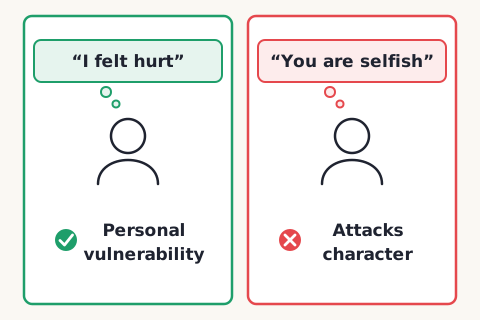
I-Statements in Conflict
Communicating personal vulnerability ('I felt hurt') rather than attacking a partner's character ('You are selfish').
What a Demand Communicates
A demand inherently communicates contempt, positioning the speaker as a tyrant and the partner as an object of servitude.
Invitational Phrasing
Framing desires as collaborative inquiries ('Would it be possible...?') rather than authoritarian mandates.
Compounding Emotional Intimacy
Mastering the language of Words of Affirmation is a daily discipline that pays massive compounding dividends of emotional intimacy.
Matched pairs
Each item on the left goes with the one on the right.
- Nagging and Pressure
- Self-interested attempts to force a spouse toward your own agenda
- Responding with a Gentle Voice
- De-escalates hostility and opens the door for constructive dialogue
- Constant Nagging and Criticism
- Conditions the spouse to shut down and withdraw behind protective walls
Step by step
How to build a rich vocabulary of affirmation if it is not your natural language
- Carry a small notebook or digital journal dedicated to collecting praise phrases.
- Record uplifting words and compliments observed in books, articles, and speeches.
- Select one specific affirming phrase each morning to practice with your spouse.
- Express the compliment directly and observe its positive impact on the relationship.
How to repair verbal credibility after speaking harshly to your spouse
- Acknowledge the harsh tone or hurtful language without rationalizing your anger.
- State an explicit, heartfelt apology: 'I was wrong to speak to you that way.'
- Ask for forgiveness and reaffirm your genuine commitment to speaking with kindness.
- Listen patiently to your partner's response without becoming defensive.
Self-test
Answer each question from memory, then check your work against the answer key.
1. How long did Mark Twain say he could live on one good compliment?
- AOne week
- BOne year
- CSix months
- DTwo months
2. What does the word 'encourage' literally mean, according to Chapman?
- ATo inspire courage
- BTo offer correction
- CTo teach a new skill
- DTo demand improvement
3. Praising your spouse to their parents when your spouse isn't in the room is an example of which practice?
- AWritten affirmation
- BIndirect affirmation
- CPublic affirmation
- DSpecific affirmation
4. Chapman says pressuring a spouse toward a goal they haven't expressed a desire for is actually a form of what?
- AConstructive feedback
- BEncouragement and support
- CJudgment and nagging
- DTough love
5. What should be the true motive behind genuine verbal affirmation, per Chapman?
- ASincere and altruistic appreciation
- BManipulation to gain personal advantage
- CA tactic to avoid conflict
- DA conditional reward for compliance
6. What effect does responding with a gentle voice have during a conflict, per Chapman?
- ACalms the moment but breeds resentment
- BSignals weakness and invites more conflict
- CDe-escalates hostility and opens dialogue
- DEscalates hostility and ends discussion
7. According to Chapman, compliance won through nagging or emotional coercion is really an act of what, not love?
- AShared commitment
- BGenuine devotion
- CMutual respect
- DFear or guilt
8. Saying 'I felt hurt' instead of 'You are selfish' is an example of which communication technique?
- ANagging
- BI-statements
- CInvitational phrasing
- DScore-keeping
9. What does Chapman call framing a desire as 'Would it be possible...?' instead of a command?
- AInvitational phrasing
- BNagging
- COngoing score-keeping tally
- DI-statements
10. Which of these is NOT a constructive communication habit?
- AI-statements
- BConstant nagging and criticism
- CResponding with a gentle voice
- DInvitational phrasing
Go deeper
- ReadThe 5 Love Languages by Gary Chapman · on Amazon ↗
- StudyThe 5 Love Languages: The Secret to Love That Lasts in the FlashFeed app
These are affiliate links: if you buy a book through one, FlashFeed may earn a small commission at no extra cost to you. The commission helps pay for FlashFeed's servers.
As an Amazon Associate we earn from qualifying purchases.
Answer key
- 1. D Two monthsChapman quotes a line attributed to Twain, that a single sincere compliment could sustain him for two months, illustrating praise's lasting emotional power.
- 2. A To inspire courageChapman notes 'encourage' literally means to inspire courage, helping a partner overcome self-doubt and pursue their potential.
- 3. B Indirect affirmationChapman calls praise relayed to friends or relatives indirect affirmation; it carries magnified emotional resonance for the spouse.
- 4. C Judgment and naggingTrue encouragement supports the partner's own aspirations; pushing your own agenda instead is judgment and self-interested nagging.
- 5. A Sincere and altruistic appreciationChapman insists affirmation must be sincere and altruistic; using it as flattery or leverage undermines its integrity.
- 6. C De-escalates hostility and opens dialogueA gentle voice de-escalates hostility and opens the door for constructive dialogue, unlike a harsh tone that inflames conflict.
- 7. D Fear or guiltChapman explains that compliance forced through nagging or coercion reflects fear or guilt in the spouse, not authentic loving cooperation.
- 8. B I-statementsI-statements express personal vulnerability instead of attacking the partner's character, defusing conflict rather than escalating it.
- 9. A Invitational phrasingInvitational phrasing frames desires as collaborative requests rather than authoritarian demands, inviting cooperation instead of resistance.
- 10. B Constant nagging and criticismConstant nagging and criticism conditions a spouse to withdraw; it is the destructive habit the lesson contrasts with constructive ones.
Sources
- The 5 Love Languages: The Secret to Love That Lasts — Gary Chapman
- The 5 Love Languages - Chapter 4
Image credits
- I-Statements in Conflict: FlashFeed original diagram · CC-BY-4.0