
How to Talk to Anyone: 92 Little Tricks for Big Success study guide · Lesson 5 of 6
The Science of Praise & High-Impact Remote Connection
Strategic Praise vs. Fawning Flattery · Vocal Acoustics & Telephone Charisma
Unofficial study guide for How to Talk to Anyone: 92 Little Tricks for Big Success in Relationships by Leil Lowndes. FlashFeed is not affiliated with the author or publisher.
This is the lesson's study guide from the FlashFeed app, plus its key facts and a self-test.
What you'll be able to do
- Distinguish Grapevine Glory and Carrier Pigeon Kudos from shallow flattery to deliver high-impact compliments.
- Modulate vocal acoustics with Talking Gestures, project "Oh Wow, It's You!" warmth, and use Name Shower to establish connection over remote voice channels.
FlashFeed Study Guide | How to Talk to Anyone Knowledge Pack (Lesson 5)
Strategic Praise vs. Fawning Flattery
Praise is one of the most powerful catalysts in human interaction, yet direct flattery frequently arouses suspicion. Strategic praise bypasses skepticism through indirect channels, implied validation, and bespoke private commendations.
Grapevine Glory, Carrier Pigeon Kudos & Overheard Eulogies
Direct compliments often cause recipients to wonder about hidden motives. Grapevine Glory solves this by praising someone behind their back to a mutual friend or colleague. When the compliment naturally travels through the grapevine, it carries far greater credibility because it arrives free of any suspicion of sycophancy.
Conversely, become a Carrier Pigeon: whenever you hear someone speak warmly of an acquaintance, fly straight to them and deliver the praise ('You should have heard how glowingly Susan spoke of your leadership!'). This creates positive emotional transference, associating you with goodwill. With Accidental Adulation, slip a specific compliment into the secondary, parenthetical part of a sentence rather than stating it as your main point — e.g., 'Because you're so sharp, you'd have caught that clause, but I signed it anyway.'
Implied Magnificence & The Killer Compliment
Weave admiration seamlessly into dialogue using Implied Magnificence—embedding recognition of their status as an undisputed premise of your question ('As an accomplished negotiator, how would you structure this agreement?').
Reserve The Killer Compliment for rare, high-impact moments. Delivered strictly in private, a Killer Compliment names one highly specific, personal quality you've noticed — physical or characterological — rather than a vague, generic remark.
Little Strokes, The Knee-Jerk "Wow!" & Boomeranging
Maintain daily relationship vitality through Little Strokes—frequent, brief micro-compliments for everyday diligence and routine courtesy. The instant someone finishes a feat, react with The Knee-Jerk "Wow!": an immediate, enthusiastic reaction reads as genuine in a way a considered, delayed one never does. When receiving praise, use Boomeranging to accept graciously and redirect appreciation back to the giver.
Vocal Acoustics & Telephone Charisma
Voice-only communication strips away visual cues, placing the entire burden of connection upon vocal formants, pacing, and temporal courtesy.
The Tombstone Game: Aspirational Legacy
To forge profound rapport, deploy The Tombstone Game: ask the important people in your life directly what core achievement, virtue, or legacy they would most want inscribed on their tombstone, then align your praise with that aspirational self-concept.
Somatosensory Vocal Modulation & "Oh Wow, It's You!"
Your physical body dictates your vocal acoustics. Talking Gestures turns your nods and smiles into sounds the caller can actually hear — an audible "mm-hmm" for a nod, a warm exclamation for a smile — since a silent gesture never reaches them. "Oh Wow, It's You!" means answering the phone warmly, crisply, and professionally, then, the instant you hear who's calling, letting a huge, genuine smile flood your voice — a smile performed before you even answer doesn't have the same effect.
Name Shower & Temporal Consent
Because phone calls eliminate visual gaze, deploy Name Shower: speak the caller's name markedly more often than in person. Hearing their name acts as an auditory tether that prevents their attention from wandering to digital distractions.
Never plunge straight into a pitch. Practice What Color Is Your Time? by asking: 'Do you have four or five minutes, or are you in the middle of something?' Securing explicit temporal consent eliminates the latent resentment caused by unsolicited interruptions.
Dynamic Voicemail & Your Ten-Second Audition
Maintain a Constantly Changing Outgoing Message updated daily with date and availability to project dynamic efficiency. Make the message you leave on someone's voicemail itself an audition with Your Ten-Second Audition, since the first seconds decide whether you get a callback.
Core Takeaways & Practical Action Checklist
- Deliver praise through the grapevine so it reaches its target free of any suspicion of self-interest.
- Deliver Carrier Pigeon Kudos immediately whenever you hear someone commended.
- Reserve Killer Compliments for a specific, personal quality — physical or otherwise — delivered strictly in private.
- Turn your nods and smiles into sounds the caller can hear, and let your smile show in your voice the instant you recognize who's calling.
- Always ask 'What color is your time?' before diving into telephone business.
Real-World Case Study: The Art of Influence Across Distance and Praise
An executive is tasked with repairing a strained relationship with a key regional partner while negotiating a critical contract renewal over the telephone. Direct flattery has failed in the past, breeding suspicion of ulterior motives.
The executive executes a masterclass in strategic praise and telephone charisma. Before dialing, she speaks to the partner's regional vice president, praising the partner's visionary integrity and technical leadership (Grapevine Glory). Within twenty-four hours, the vice president enthusiastically relays this praise to the partner (Carrier Pigeon Kudos), free of any suspicion of self-interest.
When placing the call, the executive turns every nod and murmur of agreement into a sound the partner can actually hear — an audible 'mm-hmm,' a warm laugh — rather than a silent gesture wasted on the phone (Talking Gestures), then lets real warmth flood her voice the instant she hears the partner's voice ("Oh Wow, It's You!"). She opens with crisp clarity and immediately asks, 'What color is your time today? Do you have ten minutes, or are you in the middle of a fire?' (What Color Is Your Time?). Securing focused consent, she uses the partner's first name regularly as an auditory anchor (Name Shower).
Weeks earlier, over dinner, she had asked what he would most want inscribed on his tombstone (The Tombstone Game); when the partner now mentions completing an arduous hospital charity project, the executive ties her private Killer Compliment to that very answer, commending his moral endurance and civic legacy. The contract is signed with record speed.
Praise & Audio Communication Matrix
| Scenario | Ineffective Habit | Elite FlashFeed Technique |
|---|---|---|
| Compliment Channel | Direct face-to-face flattery | Indirect Grapevine Glory through third parties |
| Phone Greeting | Plunging straight into sales pitch | Asking 'What color is your time?' for consent |
| Audio Engagement | Monotonous voice while multitasking | Talking Gestures and Name Shower |
| Partner Good News | Mild, delayed acknowledgment | Immediate, enthusiastic Knee-Jerk "Wow!" celebration |
| Receiving Praise | Awkward dismissal ('Oh, it was nothing') | Gracious Boomeranging back to the giver |
Actionable Behavioral Drills & Muscle Memory Exercises
- The Grapevine Glory Experiment: Today, speak genuine, high-level praise about a colleague to a mutual friend with no expectation of acknowledgment. Notice how it compounds relationship trust over the coming weeks.
- Carrier Pigeon Delivery: The next time you hear someone speak warmly of an acquaintance, make an immediate point to contact that acquaintance and deliver the third-party compliment word-for-word.
- The Phone Smile Protocol: Place a small cosmetic mirror next to your workstation monitor. Ensure you are smiling physically in the mirror every time you initiate an audio call.
Key terms
- Little Strokes
- Frequent, brief micro-compliments given for everyday diligence and routine courtesy.
- Boomeranging
- Accepting a compliment graciously, then redirecting the appreciation back to the giver.
Key facts
Grapevine Glory
Grapevine Glory means praising someone behind their back to a mutual friend or colleague, so the compliment eventually reaches them through a third party. Because there's nothing to gain by saying it, the praise carries no suspicion of an ulterior motive — it's believed in a way a face-to-face compliment never is.
Carrier Pigeon Kudos
Carrier Pigeon Kudos means relaying kind words the moment you hear someone speak warmly of a third party — "you should have heard how glowingly Susan spoke of your leadership!" Delivering that secondhand compliment costs you nothing, and the warmth of it attaches to whoever delivers the message, so the messenger collects part of the credit too.
Implied Magnificence
Implied Magnificence embeds admiration as an undisputed premise inside a question rather than stating it directly — "as an accomplished negotiator, how would you structure this agreement?" assumes the accomplishment rather than asserting it. Because skepticism inspects claims, not presuppositions, folding the praise into the premise lets it bypass the defenses a direct compliment raises.
The Killer Compliment
The Killer Compliment is reserved for rare, high-impact moments: delivered strictly in private, it names one highly specific, personal quality you've noticed in someone — physical or characterological — rather than a vague, generic remark. "What exquisite eyes you have" or "You have a wonderful air of honesty" land; "I like your tie" doesn't.
Little Strokes
Little Strokes are frequent, brief micro-compliments for everyday diligence and routine courtesy, rather than praise saved only for exceptional achievements. Small, regular acknowledgment halts the slow erosion that sets in when reliable, ordinary effort goes unnoticed.
The Knee-Jerk "Wow!"
The Knee-Jerk "Wow!" means reacting instantly and enthusiastically the moment someone finishes a feat, rather than with a considered, delayed response. The immediacy is what makes it read as genuine — a reaction that waits reads as calculated by comparison.
Boomeranging
Boomeranging means accepting a compliment graciously and then redirecting appreciation back to the person who gave it, rather than deflecting it awkwardly. Taking the compliment and sending it back keeps the exchange even instead of one-sided.
The Tombstone Game
The Tombstone Game asks the important people in your life directly what they'd like inscribed on their tombstone — their core achievement, virtue, or legacy — then, weeks later when the moment is right, feeds those words back to them as a compliment. Praise aimed at who someone hopes to be reaches further, and lasts longer, than praise aimed only at what they've already done.
"Oh Wow, It's You!"
"Oh Wow, It's You!" means answering the phone warmly, crisply, and professionally — then, the instant you hear who's calling, letting a huge, genuine smile flood your voice. A smile performed before you even pick up doesn't have the same effect.
Name Shower
Name Shower means speaking a caller's name markedly more often than you would face-to-face, since phone calls eliminate eye contact as an attention anchor. Their name is what pulls wandering attention back from whatever else is competing for it on the other end of the line.
What Color Is Your Time?
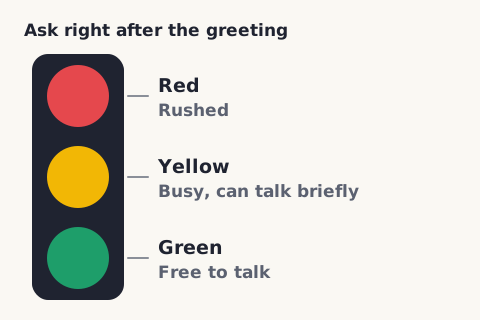
What Color Is Your Time? means asking, right after the greeting, whether the other person's time is 'red' (rushed), 'yellow' (busy but can talk briefly), or 'green' (free to talk) — instead of plunging straight into a pitch. Securing that explicit consent about timing costs one sentence and eliminates the latent resentment of an unsolicited interruption.
Constantly Changing Outgoing Message
A Constantly Changing Outgoing Message, updated daily with the date and your availability, signals that you're on top of things and kills a round of pointless phone tag. This replaces the ordinary habit of a generic greeting left unchanged for months.
Your Ten-Second Audition
Your Ten-Second Audition treats the message you leave on someone's voicemail as an audition — the first ten seconds decide whether you get a callback, so it has to be confident, clear, and worth calling back for.
Matched pairs
Each item on the left goes with the one on the right.
- The Knee-Jerk "Wow!"
- Reacting instantly, the moment someone finishes a feat, with enthusiastic praise.
- Your Ten-Second Audition
- Treating a voicemail message you leave for someone as an audition for a callback.
- "Oh Wow, It's You!"
- Letting real warmth into your voice once you know who's calling, rather than performing a smile beforehand.
Self-test
Answer each question from memory, then check your work against the answer key.
1. Praising someone behind their back to a mutual friend, so the compliment eventually reaches them through a third party, is called:
- ALittle Strokes
- BGrapevine Glory
- CImplied Magnificence
- DCarrier Pigeon Kudos
2. Hearing a colleague speak warmly about someone, then immediately relaying that praise to them yourself, is called:
- AGrapevine Glory
- BThe Killer Compliment
- CCarrier Pigeon Kudos
- DBoomeranging
3. Which technique is delivered strictly in private, directly to the person, rather than routed through any third party?
- AGrapevine Glory
- BCarrier Pigeon Kudos
- CWhat Color Is Your Time?
- DThe Killer Compliment
4. Saying 'As a skilled negotiator, how would you structure this deal?' to embed praise as an assumed premise is:
- AImplied Magnificence
- BGrapevine Glory
- CThe Tombstone Game
- DThe Killer Compliment
5. What does Lowndes's Grapevine Glory involve?
- AMention it to a mutual friend
- BPrivately name a core virtue
- CRelay an overheard compliment
- DTalk about them in earshot
6. Directly asking someone what they'd want inscribed on their tombstone, then letting that answer guide your praise, is:
- AName Shower
- BThe Killer Compliment
- CThe Tombstone Game
- DWhat Color Is Your Time?
7. Letting a huge, genuine smile flood your voice the instant you recognize who's calling is:
- AYour Ten-Second Audition
- B"Oh Wow, It's You!"
- CName Shower
- DThe Tombstone Game
8. Asking 'Do you have four or five minutes, or are you in the middle of something?' right after the greeting is:
- A"Oh Wow, It's You!"
- BName Shower
- CYour Ten-Second Audition
- DWhat Color Is Your Time?
9. Updating your voicemail greeting daily with the date and your availability, to project dynamic efficiency, is:
- A"Oh Wow, It's You!"
- BYour Ten-Second Audition
- CConstantly Changing Outgoing Message
- DThe Killer Compliment
10. According to 'Talking Gestures,' what should you do during an audio-only call?
- AKeep your body still to focus on word choice
- BTurn silent gestures into sound
- CWrite silent notes while the caller talks
- DLower the phone's volume to reduce noise
11. Why does 'Name Shower' call for saying a caller's name more often on the phone than in person?
- AIt signals urgency to end the call quickly
- BIt fills conversational pauses caused by lag
- CIt personalizes your outgoing voicemail greeting
- DIt substitutes for eye contact as an attention anchor
Go deeper
- ReadHow to Talk to Anyone by Leil Lowndes · on Amazon ↗
- StudyHow to Talk to Anyone: 92 Little Tricks for Big Success in the FlashFeed app
These are affiliate links: if you buy a book through one, FlashFeed may earn a small commission at no extra cost to you. The commission helps pay for FlashFeed's servers.
As an Amazon Associate we earn from qualifying purchases.
Answer key
- 1. B Grapevine GloryGrapevine Glory reaches the target through a third party, so it carries no suspicion of ulterior motive and is believed far more readily.
- 2. C Carrier Pigeon KudosCarrier Pigeon Kudos delivers secondhand praise you overheard; the warmth of the message attaches to you as the messenger.
- 3. D The Killer ComplimentThe Killer Compliment is given privately, directly to the person, praising deep character. Grapevine Glory and Carrier Pigeon Kudos route praise through a third party instead; What Color Is Your Time? is a phone-timing consent question, not a private compliment at all.
- 4. A Implied MagnificenceImplied Magnificence folds admiration into a question's premise, so skepticism — which inspects claims, not assumptions — never engages.
- 5. A Mention it to a mutual friendGrapevine Glory means praising someone to a mutual friend so the compliment travels to them indirectly, free of any suspicion of flattery.
- 6. C The Tombstone GameThe Tombstone Game asks directly what someone would want inscribed on their tombstone, then aligns praise with that aspirational self-concept.
- 7. B "Oh Wow, It's You!"Letting real warmth flood your voice once you recognize who's calling reads as far more genuine than a smile performed before you even answer. Lowndes calls this "Oh Wow, It's You!"
- 8. D What Color Is Your Time?What Color Is Your Time? secures explicit consent about timing before diving into business, avoiding the resentment of an unwanted interruption.
- 9. C Constantly Changing Outgoing MessageA Constantly Changing Outgoing Message signals you're on top of things and heads off a round of pointless phone tag.
- 10. B Turn silent gestures into soundTalking Gestures calls for turning silent gestures like nods and smiles into audible sounds — since the caller can't see them, a vocalized cue is the only way they land.
- 11. D It substitutes for eye contact as an attention anchorPhone calls eliminate eye contact, so the caller's name becomes the auditory tether that pulls wandering attention back.
Sources
- How to Talk to Anyone: 92 Little Tricks for Big Success — Leil Lowndes
- How to Talk to Anyone — Part Six: How to Differentiate the Power of Praise from the Folly of Flattery
- How to Talk to Anyone — Part Seven: How to Direct Dial Their Hearts
Image credits
- What Color Is Your Time?: FlashFeed original diagram · CC-BY-4.0