
The Infinity Machine (book) study guide · Lesson 8 of 12
AlphaFold — Fermat for biology
A promise after Seoul · CASP14 and the 200 million
Unofficial study guide for The Infinity Machine: Demis Hassabis, DeepMind, and the Quest for Superintelligence by Sebastian Mallaby. FlashFeed is not affiliated with the author or publisher.
This is the lesson's study guide from the FlashFeed app, plus its key facts and a self-test.
What you'll be able to do
- Define protein folding and recognise Anfinsen's conjecture that a protein's sequence alone determines its folded shape
- Define AlphaFold as the DeepMind system that predicts 3D protein structure from amino-acid sequence, and identify John Jumper as AlphaFold 2's lead
- Explain AlphaFold 1's leap — predicting the continuous distance between amino-acid pairs (a 'distogram') rather than binary contact
- Define the GDT accuracy metric and the biennial CASP contest that scores protein-structure predictions
- Recall AlphaFold 2's landmark results — 92 GDT at CASP14 (2020), the direct-folding pivot, and ~200 million proteins released by July 2022.
A promise after Seoul
The seeds of AlphaFold were planted on a South Korean sidewalk in 2016. What followed was a decade-long attempt to crack the central unsolved problem of structural biology: reading a protein's amino-acid sequence and predicting the exact three-dimensional shape it folds into.
A promise on a Seoul sidewalk
After AlphaGo defeated Lee Sedol in March 2016, Hassabis walked back to the hotel with David Silver and declared they could solve protein folding. Silver was sceptical; Hassabis had been circling the problem since reading the literature as an undergraduate. Within months he had assembled a hackathon team to begin. The moment captures something essential about DeepMind's operating logic: a moonshot target named in the aftermath of one victory, before the next campaign had formally started.
Anfinsen's conjecture
In his 1972 Nobel Prize lecture, Christian Anfinsen conjectured that a protein's sequence alone determined its folded shape — that no additional cellular machinery was required to encode it. Biologists accepted the principle for half a century but could not extract a shape from a sequence computationally. Protein folding is the process by which a chain of amino acids twists itself into a specific three-dimensional shape that determines the protein's function. AlphaFold was the algorithmic vindication of Anfinsen's conjecture, arriving roughly fifty years after he stated it.
Jumper arrives, October 2017
Andrew Senior recruited John Jumper in October 2017. Jumper, then 32, brought an unusually broad background: mathematics, physics, chemistry, biology, and machine learning, including three years at D. E. Shaw Research modelling proteins with Newtonian physics. He contributed the biological intuition the team had lacked. Jumper would go on to lead AlphaFold 2 and eventually share the 2024 Nobel Prize in Chemistry with Hassabis for the work.
CASP: the biennial test
Since 1994, Professor John Moult had run CASP — the Critical Assessment of Structure Prediction — every two years. Labs received amino-acid sequences for proteins whose true shapes were known only to the experimentalists, then competed to predict them. The headline accuracy metric is GDT (Global Distance Test), a score measuring how closely predicted atom positions match the experimentally verified ones. CASP gave AlphaFold an external, objective scoreboard at a moment when internal benchmarks could have become circular.
From contact map to distogram
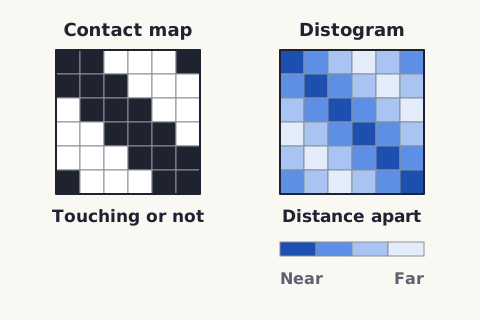
Rival labs trained networks to predict whether two amino acids were in contact — a binary yes or no. AlphaFold's convolutional network instead predicted the distance between amino-acid pairs on a continuous scale, producing what researchers called a distogram. As one team member described it: like going from black and white to full-colour television. The shift gave the model far richer geometric information to work with and became AlphaFold 1's defining architectural choice.
CASP14 and the 200 million
AlphaFold 1 proved the concept; AlphaFold 2 rewrote the contest's history. This part follows the team through a gutsy architectural pivot, a landmark score of 92 GDT at CASP, and the release of a database that folded roughly 200 million proteins by July 2022.
AlphaFold wins CASP13, December 2018
At CASP13 in Cancún in December 2018, AlphaFold bested all 97 other entrants — most dramatically in the "free modelling" category where no evolutionary template existed. DeepMind won 25 of 43 hard cases; the nearest rival won three. The result announced the system's existence publicly and set the expectation the team then had to surpass. CASP is the biennial Critical Assessment of Structure Prediction contest, where protein-folding methods compete on unsolved structures judged by independent experimentalists.
The direct-folding pivot
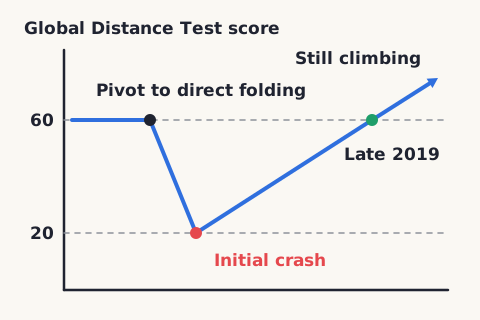
After CASP13, Hassabis told the team the job was not finished. The next version would predict the exact 3D coordinates of every atom directly, rather than assembling them via a post-hoc energy-minimisation search. The GDT score initially crashed from 60 to 20. The team kept going. By late 2019 the score had clawed back to 60 and continued rising — a textbook example of accepting short-term regression to unlock a structurally superior approach.
Enter the transformer
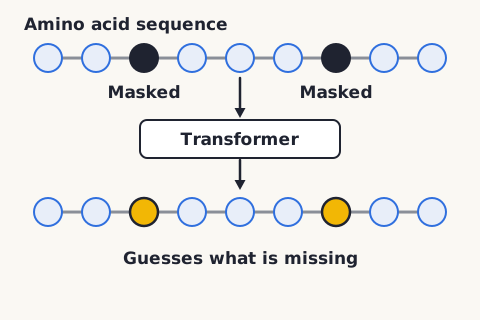
In 2019, Jumper's team rebuilt AlphaFold's neural network around a transformer architecture — specifically a "tetraformer" combining four variants. They masked amino acids in the UniProt database and trained the model to predict the missing residues, the same self-supervised trick BERT had used on language. The result: evolutionary co-variation patterns in multiple-sequence alignments turned out to encode the geometry of the folded protein.
CASP14, November 2020
When Professor Moult tallied CASP14 in November 2020, AlphaFold 2 had scored 92 GDT — more than 50 percent above any previous contest best. The accuracy reached a threshold where the gold-standard experimental measurement could not detect a meaningful difference from the prediction. "A seismic and unprecedented shift," one observer wrote. Hassabis and Jumper shared the 2024 Nobel Prize in Chemistry for this work.
200 million proteins
After CASP14, DeepMind partnered with the European Bioinformatics Institute to release the AlphaFold Structure Database. Within months it covered all ~20,000 human proteins; by July 2022 it held approximately 200 million entries — nearly every protein known to science. Over 3 million researchers had accessed it by 2025, enabling drug discovery, disease research, and basic biology at a scale that wet-lab crystallography alone could never have matched.
"Cheese tomorrow"
Late in the book, Hassabis is asked about large language models and is blunt: "Everyone talks about the benefits of language models, but mostly it's just cheese tomorrow. The clearest benefit from AI so far is AlphaFold." He frames the next decade as a race to compress a century of medical discovery into years, with the technology deliberately aimed at diseases of the developing world — the problems that profit motive alone would not have solved.
Key terms
- Protein folding
- The process by which a chain of amino acids twists itself into a specific three-dimensional shape that determines a protein's function. Predicting the final shape from the sequence alone — biology's Fermat's Last Theorem — was the challenge AlphaFold solved.
- GDT (Global Distance Test)
- CASP's headline accuracy score. It measures the percentage of a predicted protein's main-chain atoms that lie within a tolerated distance of the ground-truth crystallography structure. Roughly 90 GDT is the threshold at which a prediction is as good as an experimental measurement.
- AlphaFold
- AlphaFold is the DeepMind system that predicts a protein's three-dimensional structure from its amino-acid sequence. AlphaFold cracked a fifty-year grand challenge in biology and helped win Hassabis a share of the 2024 Nobel Prize in Chemistry.
- CASP
- CASP is the biennial Critical Assessment of Structure Prediction contest, where protein-folding methods compete on unsolved structures. AlphaFold's runaway victory at CASP in 2020 stunned the field of biology.
Key concepts
Anfinsen's conjecture
- An idea from a 1972 Nobel lecture about what determines a protein's final shape.
- It held that a chain's amino-acid sequence alone dictates the folded form, needing no extra cellular machinery.
- Biologists accepted it for half a century but couldn't compute it, until AlphaFold vindicated it roughly fifty years later.
distogram
- AlphaFold 1's defining output, replacing a simple yes/no prediction about pairs of amino acids.
- Instead of asking whether two residues touch, it predicted the continuous distance between them.
- A team member likened the richer geometric picture to going from black-and-white to full-colour television.
CASP
- A biennial contest, running since 1994, that pits protein-folding methods against one another.
- Run by Professor John Moult, it hands labs amino-acid sequences whose true shapes only the experimentalists know.
- It gave AlphaFold an external scoreboard, from a 2018 Cancun edition to a landmark 2020 edition where the score hit 92 GDT.
GDT (Global Distance Test)
- The headline accuracy score used to judge protein-structure predictions.
- It measures how closely predicted atom positions match the experimentally verified ones.
- During a risky architectural pivot it crashed from 60 to 20; by CASP14 it reached 92, over 50% above any prior best.
Key facts
A promise on a Seoul sidewalk
After AlphaGo defeated Lee Sedol in March 2016, Hassabis walked back to the hotel with David Silver. "I'm telling you," he said, "we can solve protein folding." Silver was sceptical. Hassabis had been waiting to tackle the problem since reading the literature as an undergraduate. Within months he had scrambled a hackathon team to try.
Anfinsen's conjecture
In his 1972 Nobel Prize lecture, Christian Anfinsen conjectured that a protein's sequence alone determined its folded shape — that the information needed was all encoded in the amino acids. For the next half-century, biologists believed him in principle but could not extract the shape from the sequence in practice. AlphaFold was the algorithmic vindication of Anfinsen.
CASP: the biennial test
Every two years since 1994, Professor John Moult had organised CASP — the Critical Assessment of Structure Prediction. Competing labs received amino acid sequences for proteins whose true shapes were known only to the experimentalists. Predictions were scored by Global Distance Test (GDT). For AlphaFold, CASP was the externally verifiable scoreboard.
From contact map to distogram
Where rival labs trained networks to predict whether two amino acids touched, AlphaFold trained its convolutional network to predict the distance between them on a continuous scale. "Like going from black and white to a full-colour TV," researcher Marek Barwinski said. The shift to distograms was AlphaFold 1's signature insight.
AlphaFold wins CASP13, December 2018
In Cancun in early December 2018, AlphaFold bested the other 97 CASP entrants — particularly in the "free modelling" category where no evolutionary template was known. DeepMind won 25 of 43 hard cases; its nearest rival won three. "What just happened?" became the question of the conference.
The direct-folding pivot
After CASP13, Hassabis told the team they were not done. The next iteration would predict the exact 3D coordinates of every atom directly, instead of relying on a post-hoc search. The GDT score initially crashed from 60 to 20. The team kept going. By late 2019 the new approach was back at 60 and climbing.
Enter the transformer
In 2019 Jumper's team rebuilt AlphaFold's neural network as a transformer — specifically a "tetraformer" combining four variants of the architecture. They masked amino acids in the UniProt database and trained the model to guess what was missing, the same trick BERT had used on language. Evolutionary patterns turned out to encode the geometry of proteins.
"Cheese tomorrow"
Asked late in the book about language models, Hassabis was dismissive: "Everyone talks about the benefits of language models, but mostly it's just cheese tomorrow. The clearest benefit from AI so far is AlphaFold." He wants to spend the next decade compressing a century of medical discovery — and pointing the technology at diseases of the developing world.
By the numbers
- AlphaFold 2's GDT score at CASP14
- 92 GDT
- Approximate number of proteins folded by AlphaFold by July 2022 (millions)
- 200 million
Matched pairs
Each item on the left goes with the one on the right.
- Lead scientist on AlphaFold 2
- John Jumper
Self-test
Answer each question from memory, then check your work against the answer key.
1. Protein folding is the process by which a chain of amino acids does what?
- ASplits into shorter peptides that the cell recycles for energy
- BBinds to a crystallography plate so its atoms can be imaged
- CTwists itself into a specific three-dimensional shape that determines the protein's function
- DCopies itself onto a matching strand of messenger RNA
2. What did Christian Anfinsen conjecture about proteins?
- AThat most proteins can fold into several equally stable shapes
- BThat a protein's sequence alone determines its folded shape
- CThat a protein's shape can only be determined by crystallography
- DThat extra cellular machinery is required to encode the folded shape
3. Where and when did Anfinsen state his conjecture?
- AIn a 1994 keynote at the first CASP contest
- BIn his 2004 memoir on structural biology
- CIn a 1962 Nobel lecture on the double helix
- DIn his 1972 Nobel Prize lecture
4. Which statement about Anfinsen's conjecture is NOT true?
- ABiologists rejected the principle and worked to disprove it for fifty years
- BIt concerned the information encoded in the amino acids
- CBiologists accepted the principle but could not compute a shape from a sequence
- DAlphaFold was the algorithmic vindication of the conjecture
5. Roughly how long after Anfinsen stated his conjecture did AlphaFold vindicate it algorithmically?
- AAbout twenty-five years
- BAbout fifty years
- CAbout a century
- DAbout ten years
6. AlphaFold is the DeepMind system that predicts what, from what input?
- AA protein's three-dimensional structure, from its amino-acid sequence
- BA protein's amino-acid sequence, from a crystallography image
- CA gene's mutation rate, from its evolutionary history
- DA drug molecule's binding affinity, from a protein's known shape
7. Who was the lead scientist on AlphaFold 2?
- AAndrew Senior
- BJohn Moult
- CDavid Silver
- DJohn Jumper
8. A lab has the amino-acid chain of a newly discovered protein but no experimental structure. What would running AlphaFold on it give them?
- AThe gene sequence that coded for the chain
- BA ranked list of drugs that bind the protein
- CA predicted three-dimensional structure for that chain
- DA crystallography image of the protein's atoms
9. Which prize did John Jumper share with Demis Hassabis for the AlphaFold work?
- AThe 2020 Turing Award
- BThe 2024 Nobel Prize in Chemistry
- CThe 2024 Nobel Prize in Physiology or Medicine
- DThe 2022 Breakthrough Prize in Mathematics
10. Which of these is NOT an accurate description of AlphaFold or its team?
- AAlphaFold predicts 3D structure from an amino-acid sequence
- BJumper was recruited in October 2017 by Andrew Senior, the project's first lead
- CJumper brought biological intuition the team had lacked
- DJumper was recruited in October 2017 by John Moult, who then led AlphaFold 2
11. AlphaFold 1 broke from rival labs by having its network predict what about pairs of amino acids?
- AA binary yes-or-no of whether the two were in contact
- BThe exact 3D coordinates of each atom directly
- CThe continuous distance between them, producing a "distogram"
- DWhich amino acid would mutate next over evolution
12. A "distogram" records what information about pairs of amino acids?
- AThe distance between them on a continuous scale
- BTheir order along the amino-acid chain
- CWhether they touch, as a yes-or-no flag
- DThe bond angle between their side chains
13. What did rival labs train their networks to predict about two amino acids?
- AThe evolutionary age of each residue
- BA binary label for contact between them
- CThe exact 3D coordinates of every atom
- DThe continuous distance separating them
14. A team member compared the shift from contact maps to distograms to which change?
- AGoing from sheet music to a live orchestra
- BGoing from a paper map to satellite navigation
- CGoing from a telescope to a microscope
- DGoing from black-and-white to full-colour television
15. Which statement about AlphaFold 1's distogram leap is NOT true?
- AIt was produced by a transformer network built in 2019
- BIt gave the model far richer geometric information
- CIt was AlphaFold 1's defining architectural choice
- DIt was produced by a convolutional network
16. What does the GDT score measure?
- AHow many labs entered a given CASP contest
- BHow fast a model produces a structure prediction
- CHow closely a prediction's atom positions match the experimentally verified structure
- DHow many amino acids a predicted protein contains
17. What does the acronym CASP stand for?
- AComparative Assay of Structural Proteins
- BCritical Assessment of Structure Prediction
- CConsortium for Applied Structural Physics
- DComputational Analysis of Sequence Properties
18. How often has CASP run, and since when?
- AEvery two years since 1972
- BEvery four years since 2004
- CEvery year since 1994
- DEvery two years since 1994
19. Roughly what GDT value marks the threshold at which a prediction is as good as an experimental measurement?
- AAbout 50
- BAbout 60
- CAbout 90
- DAbout 20
20. Which statement about CASP is NOT true?
- ACompeting labs are given the true shapes in advance so they can calibrate
- BPredictions are scored by Global Distance Test
- CCompeting labs receive only amino-acid sequences
- DThe true shapes are known only to the experimentalists
21. When DeepMind pivoted AlphaFold 2 to predict every atom's 3D coordinates directly, what happened to its GDT score at first?
- AIt rose smoothly with no setback
- BIt jumped straight from 60 to 92
- CIt crashed from about 60 to about 20 before clawing back
- DIt held steady near 60 for two years
22. What GDT score did AlphaFold 2 achieve at CASP14?
- A43
- B20
- C60
- D92
23. How did AlphaFold 2's CASP14 result compare with the contest's previous best?
- AAbout 10 percent higher than the previous best
- BMore than 50 percent higher than any previous best
- CRoughly tied with the previous best
- DDouble the previous best, but only in free modelling
24. Approximately how many proteins did the AlphaFold Structure Database hold by July 2022?
- A200 million
- B20,000
- C97
- D3 million
25. Which statement about AlphaFold 2's landmark results is NOT true?
- AMoult tallied the winning CASP scores in November 2018
- BThe database held roughly 200 million proteins by July 2022
- CAlphaFold 2 scored about 92 GDT at CASP14
- DThe direct-folding pivot first sank GDT from about 60 to about 20
Go deeper
- ReadThe Infinity Machine by Sebastian Mallaby · on Amazon ↗
- StudyThe Infinity Machine (book) in the FlashFeed app
These are affiliate links: if you buy a book through one, FlashFeed may earn a small commission at no extra cost to you. The commission helps pay for FlashFeed's servers.
As an Amazon Associate we earn from qualifying purchases.
Answer key
- 1. C Twists itself into a specific three-dimensional shape that determines the protein's functionProtein folding is a chain of amino acids twisting into a specific 3D shape, and that shape determines the protein's function. Crystallography is how the shape is measured experimentally, not what folding is.
- 2. B That a protein's sequence alone determines its folded shapeAnfinsen's conjecture: the information needed for the folded shape is all in the amino-acid sequence — no additional cellular machinery required. That is the opposite of saying extra cellular machinery must encode the shape.
- 3. D In his 1972 Nobel Prize lectureAnfinsen stated the conjecture in his 1972 Nobel Prize lecture. CASP began in 1994 under John Moult — a different milestone entirely.
- 4. A Biologists rejected the principle and worked to disprove it for fifty yearsBiologists accepted Anfinsen's principle for half a century — they simply could not extract the shape from the sequence in practice. They did not reject it.
- 5. B About fifty yearsAnfinsen conjectured in 1972 and AlphaFold delivered around 2020 — roughly fifty years, matching the "fifty-year grand challenge" framing used throughout the account.
- 6. A A protein's three-dimensional structure, from its amino-acid sequenceAlphaFold takes an amino-acid sequence and predicts the 3D structure. The reverse direction — sequence from an image — is not what it does.
- 7. D John JumperJohn Jumper led AlphaFold 2. Andrew Senior was the project's first lead and the person who recruited Jumper; Moult ran CASP; Silver led AlphaGo work.
- 8. C A predicted three-dimensional structure for that chainAlphaFold's job is sequence in, predicted 3D structure out. It does not produce experimental images, work backwards to genes, or screen drugs — those are downstream or different tools.
- 9. B The 2024 Nobel Prize in ChemistryJumper and Hassabis shared the 2024 Nobel Prize in Chemistry for AlphaFold. It was Chemistry, not Physiology or Medicine.
- 10. D Jumper was recruited in October 2017 by John Moult, who then led AlphaFold 2Andrew Senior — not John Moult — recruited Jumper in October 2017. Moult was the professor who ran the independent CASP contest.
- 11. C The continuous distance between them, producing a "distogram"Rivals predicted a binary contact map (in contact or not). AlphaFold instead predicted the distance between amino-acid pairs on a continuous scale — a distogram — described as going from black-and-white to full-colour TV. It was AlphaFold 1's defining architectural choice.
- 12. A The distance between them on a continuous scaleA distogram records the continuous distance between amino-acid pairs. The binary touch/no-touch flag is the older contact map that rival labs predicted.
- 13. B A binary label for contact between themRivals predicted a binary contact map. Predicting continuous distance was AlphaFold's departure; predicting exact 3D coordinates directly came later, with AlphaFold 2's pivot.
- 14. D Going from black-and-white to full-colour televisionResearcher Marek Barwinski described it as "like going from black and white to a full-colour TV" — the distogram carried far richer geometric information than a binary contact map.
- 15. A It was produced by a transformer network built in 2019AlphaFold 1's distogram came from a convolutional network. The transformer (the "tetraformer") arrived in 2019 with AlphaFold 2 — a later, separate rebuild.
- 16. C How closely a prediction's atom positions match the experimentally verified structureGDT measures the percentage of a predicted protein's main-chain atoms lying within a tolerated distance of the ground-truth structure — an accuracy score, not a speed or size measure.
- 17. B Critical Assessment of Structure PredictionCASP is the Critical Assessment of Structure Prediction — the contest where protein-folding methods compete on structures known only to the experimentalists.
- 18. D Every two years since 1994Professor John Moult has run CASP every two years since 1994 — it is biennial. 1972 is the year of Anfinsen's Nobel lecture, a different milestone.
- 19. C About 90Roughly 90 GDT is the threshold where a prediction is as accurate as experiment. 60 and 20 were mid-pivot AlphaFold 2 scores, not the experimental-quality bar.
- 20. A Competing labs are given the true shapes in advance so they can calibrateLabs receive only the sequences; the true shapes are withheld and known only to the experimentalists. That blinding is what made CASP an external, objective scoreboard.
- 21. C It crashed from about 60 to about 20 before clawing backThe direct-folding pivot initially tanked the GDT score from ~60 to ~20. The team pressed on; by late 2019 it had recovered to 60 and kept climbing — a textbook case of accepting short-term regression to unlock a better approach.
- 22. D 92AlphaFold 2 scored roughly 92 GDT (92.4) at CASP14 in November 2020. 60 and 20 were scores during the direct-folding pivot; 43 was the count of hard cases at CASP13.
- 23. B More than 50 percent higher than any previous bestAlphaFold 2's 92 GDT was more than 50 percent above any previous best in CASP's history — accurate enough that experimentalists' gold-standard test could not detect a meaningful difference.
- 24. A 200 millionBy July 2022 the database held roughly 200 million entries. 20,000 is the human proteome it covered within months; 3 million is the number of researchers who had used it by 2025.
- 25. A Moult tallied the winning CASP scores in November 2018Moult tallied CASP14 in November 2020, not 2018. December 2018 was CASP13 in Cancún — the earlier AlphaFold 1 win, a different contest.
Image credits
- From contact map to distogram: FlashFeed original diagram · CC-BY-4.0
- The direct-folding pivot: FlashFeed original diagram · CC-BY-4.0
- Enter the transformer: FlashFeed original diagram · CC-BY-4.0