
Investing 201 study guide · Lesson 12 of 17
Essential Investing Vocabulary
Market basics · Advanced terms · Indexes and benchmarks
This is the lesson's study guide from the FlashFeed app, plus its key facts and a self-test.
What you'll be able to do
- Distinguish bull markets, bear markets, and corrections by depth of decline.
- Define core market terms: volatility/VIX, blue chip, dividend yield, and IPO.
- Explain advanced concepts: alpha, beta, float, and short selling.
- Explain hedging, options, buybacks, and basis points.
- Distinguish the major indexes (S&P 500, Dow, Nasdaq, Russell 2000) and their weighting.
Fluency in the language of markets is its own form of literacy. Once these terms come without hesitation, you can read a financial headline, an analyst note, or an earnings recap and know exactly what's being said. This lesson drills the vocabulary every serious investor carries in their head.
Market basics
Start with the words that describe market mood and structure. A bull market is a stretch of rising prices and optimism, typically defined as a 20%+ rise from a recent low; a bear market is the opposite — a 20%+ decline from a recent high, marked by pessimism. A milder correction is a 10–20% drop from a peak, normal and historically frequent. Volatility measures price fluctuation, and the VIX — the Chicago Board Options Exchange (CBOE) Volatility Index, the market's "fear gauge" — tracks expected S&P 500 swings over the next 30 days and spikes during stress.
Company size is described by market cap (stock price × shares outstanding), sorted into tiers (common cutoffs; providers draw the lines slightly differently): mega-cap at 200B+, large-cap 10–200B, mid-cap 2–10B, small-cap 300M–2B, and micro-cap below $300M. A blue chip is a large, established, financially sound company with a long track record. An IPO (Initial Public Offering) is a private company's first sale of stock to the public. And dividend yield — annual dividend per share divided by price — tells you the income return on a stock.
Advanced terms
Deeper analysis brings a second tier of vocabulary. Alpha is return above a benchmark — your edge, the value added beyond simply matching the market. Beta measures sensitivity to market moves; a beta of 1.5 means a stock tends to swing 50% more than the market, both up and down. Float is the number of shares actually available for public trading, total shares minus insider and restricted holdings.
Several terms describe positioning and mechanics. Short selling is borrowing shares to sell them, hoping to buy back cheaper — profitable when prices fall but carrying theoretically unlimited downside. A hedge is an offsetting position that reduces risk, like buying put options as portfolio insurance. Options are contracts giving the right, not the obligation, to buy (call) or sell (put) at a set price by a set date. A buyback is a company repurchasing its own stock, shrinking the share count and lifting earnings per share (EPS). And basis points (bps) are a precision unit: 100 basis points equal 1%, the standard way to discuss interest-rate and margin changes.
Indexes and benchmarks
Finally, the yardsticks. The S&P 500 is a market-cap-weighted index of 500 leading large U.S. public companies, chosen by an index committee — the most widely used benchmark. The Dow Jones Industrial Average is a price-weighted index of just 30 large companies; it's one of the oldest major broad U.S. stock benchmarks but, because of its price weighting, less representative of the broad market. The Nasdaq Composite includes all stocks on the Nasdaq and is heavily tech-weighted, while the Nasdaq 100 holds the 100 largest non-financial Nasdaq companies and is the basis for the QQQ ETF. The Russell 2000 tracks 2,000 small-cap companies, the standard small-cap benchmark.
One subtlety ties the indexes together: weighting changes the message. Because the S&P 500 is market-cap weighted, its giants dominate its movements — which is exactly why the Magnificent Seven exert such outsized influence. Because the Dow is price-weighted, a high-priced stock sways it more than a far larger company with a lower share price, a quirk that makes the Dow a charming but imperfect gauge of the real economy.
Key terms
- Bull market
- A market environment of rising prices and investor optimism, typically defined as a 20%+ rise from a recent low.
- Bear market
- A market decline of 20% or more from a recent high, marked by pessimism and selling.
- Correction
- A decline of 10–20% from a recent peak — normal, historically frequent, and usually short-lived.
- Volatility / VIX
- Volatility is the statistical measure of price fluctuation. The VIX (Chicago Board Options Exchange (CBOE) Volatility Index), the market's 'fear gauge,' measures expected S&P 500 volatility over the next 30 days and spikes during stress.
- Blue chip
- A large, well-established, financially sound company with a long track record of reliable performance.
- IPO
- Initial Public Offering — a private company's first sale of stock to the public, the moment it begins trading on an exchange.
- Alpha
- Returns above a benchmark — for example, beating the S&P 500. Alpha is your edge, the value added beyond simply matching the market.
- Beta
- A stock's sensitivity to market moves. A beta of 1.5 means it tends to move 50% more than the market, both up and down.
- Float
- The number of shares available for public trading — total shares minus insider holdings and restricted stock.
- Short selling
- Borrowing shares to sell them, hoping to buy them back cheaper later. It profits from falling prices but carries theoretically unlimited downside risk.
- Hedge
- Taking an offsetting position to reduce risk — for example, buying put options as insurance on a stock portfolio.
- Options
- Contracts giving the right, but not the obligation, to buy (call) or sell (put) a stock at a set price by a set date.
- Buyback
- A share repurchase — a company uses cash to buy its own stock, reducing the share count and increasing earnings per share.
- S&P 500
- A market-cap-weighted index of the 500 largest U.S. public companies — the most widely used benchmark for the U.S. stock market.
- Dow Jones Industrial Average
- A price-weighted index of 30 large U.S. companies, one of the oldest major broad U.S. stock benchmarks but less representative of the broad market than the S&P 500.
- Russell 2000
- An index of 2,000 small-cap U.S. companies — the standard benchmark for small-cap performance.
Key concepts
S&P 500
- The single most widely used benchmark for the U.S. stock market.
- It's market-cap-weighted, so its giants dominate its moves — exactly why the Magnificent Seven wield such outsized influence over it.
- It holds the largest U.S. public companies and is the index people usually mean when they say 'the market.'
Dow Jones Industrial Average
- One of the oldest major broad U.S. stock benchmarks.
- It's price-weighted, so a high-priced stock sways it more than a far larger company with a lower share price.
- It tracks just 30 large companies — a charming but imperfect gauge of the broad economy.
Nasdaq Composite
- This benchmark sweeps in every stock listed on one heavily tech-weighted U.S. exchange, financial and non-financial alike.
- It's the all-inclusive, broad measure of that entire exchange — not the trimmed list of its 100 biggest names.
Nasdaq 100
- This benchmark holds only the largest non-financial companies listed on one heavily tech-weighted U.S. exchange.
- It's the index that the popular QQQ ETF is built to track.
Russell 2000
- Among the major indexes, this is the yardstick investors reach for to measure small companies.
- It's THE standard small-cap benchmark, tracking a couple thousand of the smallest U.S. firms.
Key facts
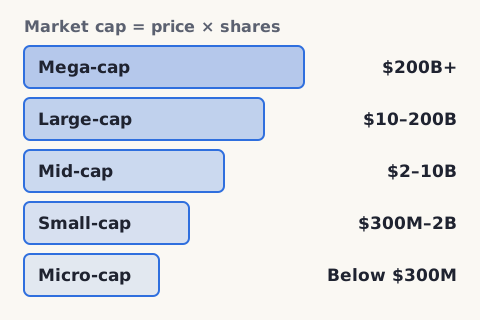
Market-cap tiers
Market cap is stock price times shares outstanding. The common tiers (providers draw the lines slightly differently): mega-cap is 200B+, large-cap 10–200B, mid-cap 2–10B, small-cap 300M–2B, and micro-cap below $300M. Size shapes a stock's risk, liquidity, and growth runway.
Defining A Blue Chip
A 'blue chip' stock is a large, well-established, financially sound company with a long track record — the opposite of a young or unproven business.

Calculating Dividend Yield
A stock's dividend yield is calculated by dividing its annual dividend per share by the stock price, giving investors a measure of income return.
What An Initial Public Offering (IPO) Represents
An IPO, or Initial Public Offering, is a private company's first sale of stock to the public, the moment it begins trading on a stock exchange.
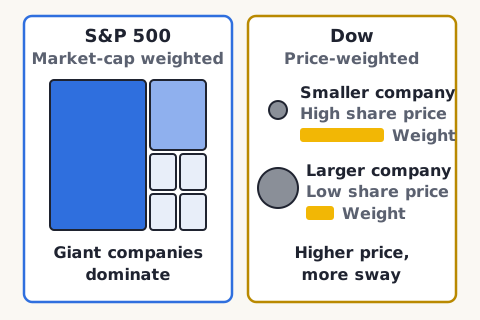
Weighting matters
How an index is weighted changes what it tells you. The S&P 500 is market-cap weighted, so giant companies dominate it. The Dow is price-weighted, so a high-priced stock sways it more than a larger company with a lower share price — a quirk that makes the Dow less representative.
Benchmark For The Small Guys
The Russell 2000 tracks 2,000 small-cap U.S. companies and serves as the standard benchmark for small-cap stock performance.
Matched pairs
Each item on the left goes with the one on the right.
- Dividend yield
- Annual dividend per share divided by the stock price
- Basis points (bps)
- 100 basis points = 1%; used for interest rates and margins
- Nasdaq Composite
- All stocks on the Nasdaq exchange — heavily tech-weighted
- Nasdaq 100
- The 100 largest non-financial Nasdaq companies; basis for QQQ
Self-test
Answer each question from memory, then check your work against the answer key.
1. What separates a market correction from a bear market?
- AThey begin at the same 20% threshold and differ only in duration
- BA correction is a 5–10% drop; a bear market is any drop over 10%
- CA correction is a 10–20% drop; a bear market is a 20%+ drop
- DA correction is a 20%+ drop; a bear market is a 10–20% drop
2. A stock index climbs 25% from its recent low, and investor optimism is running high. Which market condition does this describe?
- ARecession
- BBull market
- CBear market
- DCorrection
3. A bear market begins at what size of decline from a recent high?
- A20% or more
- B10% or more
- C5% or more
- D15% or more
4. Which statement about a market correction is NOT accurate?
- AIt is a 10–20% drop from a recent peak
- BIt is usually short-lived
- CIt is historically frequent and normal
- DIt is steeper than a bear market
5. The S&P 500 falls 15% from its recent high. How is this decline classified?
- AA correction
- BA bull market
- CA bear market
- DA recovery
6. What does the VIX, the market's 'fear gauge,' measure?
- AThe total market cap of U.S. stocks
- BExpected S&P 500 volatility over the next 30 days
- CThe average dividend yield of the S&P 500
- DThe number of initial public offerings (IPOs) each year
7. Which best describes a 'blue chip' stock?
- AA heavily shorted, speculative stock
- BA company that just completed its initial public offering
- CA stock with a market cap below $300M
- DA large, well-established, financially sound company with a long track record
8. How is a stock's dividend yield calculated?
- AAnnual dividend per share times shares outstanding
- BStock price divided by annual dividend per share
- CAnnual dividend per share divided by the stock price
- DStock price times shares outstanding
9. What does an IPO (Initial Public Offering) represent?
- AA private company's first sale of stock to the public
- BA company's first dividend payment
- CA stock's addition to the S&P 500
- DA company repurchasing its own shares
10. Which statement about volatility and the VIX is NOT correct?
- AVolatility is a statistical measure of price fluctuation
- BThe VIX measures a fund's return above its benchmark
- CThe VIX is the CBOE Volatility Index
- DThe VIX spikes during market stress
11. In investing, what does 'alpha' refer to?
- AA stock's sensitivity to market moves
- BThe shares available for public trading
- CAn offsetting position that reduces risk
- DReturn above a benchmark
12. A stock has a beta of 1.5. When the overall market rises 10%, how much does the stock tend to move?
- AAbout 10% up
- BAbout 5% up
- CAbout 15% up
- DAbout 1.5% up
13. How is a stock's float best defined?
- AStock price times shares outstanding
- BTotal shares minus insider holdings and restricted stock
- CThe total number of shares a company has issued
- DThe shares held only by company insiders
14. Which statement about short selling is correct?
- AIts maximum possible loss is capped at what you originally invested, as with a normal stock purchase.
- BIt has no risk as long as the market is calm
- CIt profits from falling prices but carries theoretically unlimited downside
- DIt profits from rising prices with strictly limited downside
15. Which pairing of an advanced term with its meaning is INCORRECT?
- ABeta: a stock's sensitivity to market moves
- BAlpha: return above a benchmark
- CFloat: shares available for public trading
- DShort selling: buying shares hoping the price rises
16. If a central bank raises interest rates by 75 basis points, how large is that increase?
- A0.75 percentage points
- B0.075 percentage points
- C7.5 percentage points
- D75 percentage points
17. What is a hedge?
- AA bet designed to amplify portfolio risk
- BBorrowing shares to sell them short
- CAn offsetting position taken to reduce risk
- DA company repurchasing its own stock
18. What does an option contract give its holder?
- AThe right, but not the obligation, to buy or sell at a set price by a set date
- BA guaranteed dividend payment
- CThe obligation to buy the stock at expiration
- DImmediate ownership of company shares
19. What effect does a stock buyback have on earnings per share (EPS)?
- AIt lowers EPS by issuing more shares
- BIt raises EPS by shrinking the share count
- CIt has no effect on EPS
- DIt doubles the company's dividend
20. In options terminology, what is a 'call'?
- AAn obligation to sell shares at expiration
- BThe right to sell a stock at a set price
- CA repurchase of a company's own stock
- DThe right to buy a stock at a set price
21. In the price-weighted Dow Jones Industrial Average, which stock moves the index the most?
- AThe one with the most shares outstanding
- BThe one with the highest dividend yield
- CThe one with the highest share price
- DThe one with the largest total market cap
22. How is the S&P 500 weighted, and how many companies does it track?
- AEqual-weighted, 100 tech companies
- BMarket-cap weighted, the 500 largest U.S. public companies
- CMarket-cap weighted, 2,000 small-caps
- DPrice-weighted, 30 large companies
23. The Russell 2000 is the standard benchmark for which segment of the market?
- ALarge-cap technology companies
- BHigh-dividend blue chips
- CThe 30 largest industrials
- DSmall-cap companies
24. How many companies make up the Dow Jones Industrial Average, and how is it weighted?
- A30 companies, price-weighted
- B100 companies, tech-weighted
- C2,000 companies, market-cap weighted
- D500 companies, market-cap weighted
25. Which statement about the Nasdaq indexes is NOT correct?
- AThe Nasdaq Composite is a price-weighted index of 30 companies
- BThe Nasdaq 100 is the basis for the QQQ ETF
- CThe Nasdaq 100 holds the 100 largest non-financial Nasdaq firms
- DThe Nasdaq Composite includes all stocks on the Nasdaq
Go deeper
- WatchBull, Bear or Correction A rise of 20% or more from a recent low typically marks a bull market.
- WatchA Beta of 1.5 Alpha is the return you earn above a benchmark. It is your edge.
- WatchWeighting Changes the Message The S&P 500 tracks the 500 largest U.S. companies. Bigger companies count for more.
- StudyInvesting 201 in the FlashFeed app
Answer key
- 1. C A correction is a 10–20% drop; a bear market is a 20%+ dropA correction is a 10–20% decline from a recent peak — normal and frequent. A bear market is steeper: a 20%+ decline from a recent high, marked by pessimism.
- 2. B Bull marketA bull market is rising prices and optimism, typically a 20%+ rise from a recent low. A 25% gain clears that threshold; a bear market and correction are declines.
- 3. A 20% or moreA bear market is a decline of 20% or more from a recent high. A 10–20% drop is only a correction, which is milder and more frequent.
- 4. D It is steeper than a bear marketA correction (10–20% drop) is milder than a bear market (20%+ drop), not steeper. The other statements match the definition of a correction.
- 5. A A correctionA 15% decline falls in the 10–20% range, which defines a correction. A bear market requires a drop of 20% or more from the high.
- 6. B Expected S&P 500 volatility over the next 30 daysThe VIX (Chicago Board Options Exchange (CBOE) Volatility Index) tracks expected S&P 500 volatility over the next 30 days and spikes during stress. The other options describe unrelated market figures.
- 7. D A large, well-established, financially sound company with a long track recordA blue chip is a large, established, financially sound company with a long track record. A sub-$300M cap is micro-cap, and a fresh IPO lacks the long track record.
- 8. C Annual dividend per share divided by the stock priceDividend yield = annual dividend per share ÷ price, giving the income return. Price × shares outstanding is market cap, an unrelated figure.
- 9. A A private company's first sale of stock to the publicAn IPO is a private company's first sale of stock to the public, when it begins trading on an exchange. Repurchasing shares is a buyback, a different action.
- 10. B The VIX measures a fund's return above its benchmarkReturn above a benchmark is alpha, not the VIX. The VIX is the CBOE Volatility Index tracking expected S&P 500 swings, and it spikes under stress.
- 11. D Return above a benchmarkAlpha is return above a benchmark — the value added beyond matching the market. Sensitivity to the market is beta; shares available to trade is float.
- 12. C About 15% upA beta of 1.5 means the stock tends to move 50% more than the market. A 10% market rise implies roughly a 15% move in the stock.
- 13. B Total shares minus insider holdings and restricted stockFloat is the shares actually available for public trading: total shares minus insider and restricted holdings. Price × shares outstanding is market cap.
- 14. C It profits from falling prices but carries theoretically unlimited downsideShort selling borrows shares to sell, hoping to rebuy cheaper, so it profits when prices fall — but losses are theoretically unlimited as a price can keep rising.
- 15. D Short selling: buying shares hoping the price risesShort selling is borrowing and selling shares hoping the price falls, not buying hoping it rises. The other three pairings are accurate.
- 16. A 0.75 percentage points100 basis points equal 1%, so 75 basis points = 0.75 percentage points. Basis points are the standard precision unit for discussing interest-rate and margin changes.
- 17. C An offsetting position taken to reduce riskA hedge is an offsetting position that reduces risk, like buying put options as portfolio insurance. Short selling and buybacks are different mechanics.
- 18. A The right, but not the obligation, to buy or sell at a set price by a set dateOptions give the right, not the obligation, to buy (call) or sell (put) at a set price by a set date. They do not confer share ownership or guaranteed income.
- 19. B It raises EPS by shrinking the share countA buyback repurchases the company's own stock, reducing the share count so earnings are spread over fewer shares — lifting EPS.
- 20. D The right to buy a stock at a set priceA call is the right to buy at a set price by a set date; a put is the right to sell. A buyback is a company repurchasing its stock, not an option.
- 21. C The one with the highest share priceThe Dow is price-weighted, so a high share price — not company size — gives a stock the most sway. A smaller firm with a pricey share can move the Dow more than a far larger company with a low share price.
- 22. B Market-cap weighted, the 500 largest U.S. public companiesThe S&P 500 is a market-cap-weighted index of the 500 largest U.S. companies. Price-weighted with 30 names is the Dow; 2,000 small-caps is the Russell 2000.
- 23. D Small-cap companiesThe Russell 2000 tracks 2,000 small-cap U.S. companies and is the standard small-cap benchmark. The 30 largest industrials describes the Dow.
- 24. A 30 companies, price-weightedThe Dow is a price-weighted index of just 30 large companies and one of the oldest major broad U.S. stock benchmarks. Market-cap weighting of 500 companies describes the S&P 500.
- 25. A The Nasdaq Composite is a price-weighted index of 30 companiesA price-weighted index of 30 companies is the Dow, not the Nasdaq Composite, which includes all Nasdaq stocks and is heavily tech-weighted.
Image credits
- Market-cap tiers: FlashFeed original diagram · CC-BY-4.0
- Calculating Dividend Yield: Wikimedia Commons · PapesseOracleGaia · CC BY-SA 4.0 — commons.wikimedia.org/wiki/File:AngelikaRaimbow.jpg
- Weighting matters: FlashFeed original diagram · CC-BY-4.0
