
The Last Economy (book) study guide · Lesson 2 of 15
The Intelligence Inversion
The four inversions · The mathematics of obsolescence
Unofficial study guide for The Last Economy: A Guide to the Age of Intelligent Economics by Emad Mostaque. FlashFeed is not affiliated with the author or publisher.
This is the lesson's study guide from the FlashFeed app, plus its key facts and a self-test.
What you'll be able to do
- Sequence the four sources of economic value in order: Land, Labor, Capital, Intelligence.
- Recall the landmark dates and figures marking the early inversions (Luddite uprising, Bell Labs transistor, Ford's River Rouge).
- Explain how capital dematerialized, using Venice, Kodak, Instagram, and WhatsApp as evidence.
- Define the Intelligence Inversion and explain how intelligence became reproducible capital, marked by ChatGPT's launch.
- Explain the Metabolic Rift as why the fourth inversion leaves no landing place for human labor.
The four inversions
Mostaque's central claim is that economic value has not evolved gradually — it has overturned in sudden, civilization-reshaping lurches, each making the previous generation's winning asset near-worthless.
The Luddites were right
In 1811, skilled artisans gathered near Nottingham and smashed weaving frames. History remembers them as anti-progress reactionaries; Mostaque reads them as accurate prophets with the wrong timeline. They understood the machines were not just displacing tasks but ending an entire way of being — the craftsman whose identity, income, and dignity fused in a single act of making. It took two centuries for the pattern to fully unfold, but the logic was correct from the start.
Four inversions of value
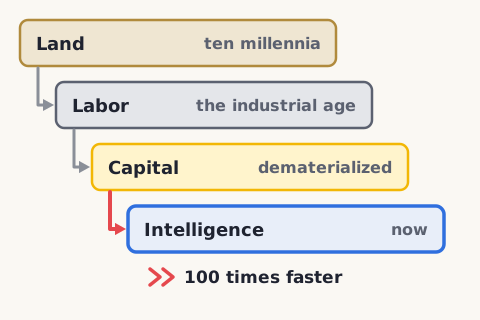
Mostaque identifies four moments when the foundational source of economic value overturned: Land (ten millennia of agricultural dominance), Labor (the industrial age), Capital (the dematerialized network economy), and now Intelligence. Each inversion did not destroy wealth — it relocated it. Civilizations that failed to recognize the shift in time became the archaeological layer beneath the next one. The fourth inversion is unfolding roughly a hundred times faster than any of its predecessors.
Land to Labor
For ten thousand years, value meant land. The first crack came from Venice — a city-state with no farmland that grew wealthy by controlling the flow of goods. Around 1750, James Watt's separate condenser supercharged the steam engine. In Manchester, life expectancy in working-class districts fell to seventeen, yet the mills out-produced a hundred villages. What you owned mattered less; what you could organize and move mattered more. The first inversion was complete.
Labor to Capital
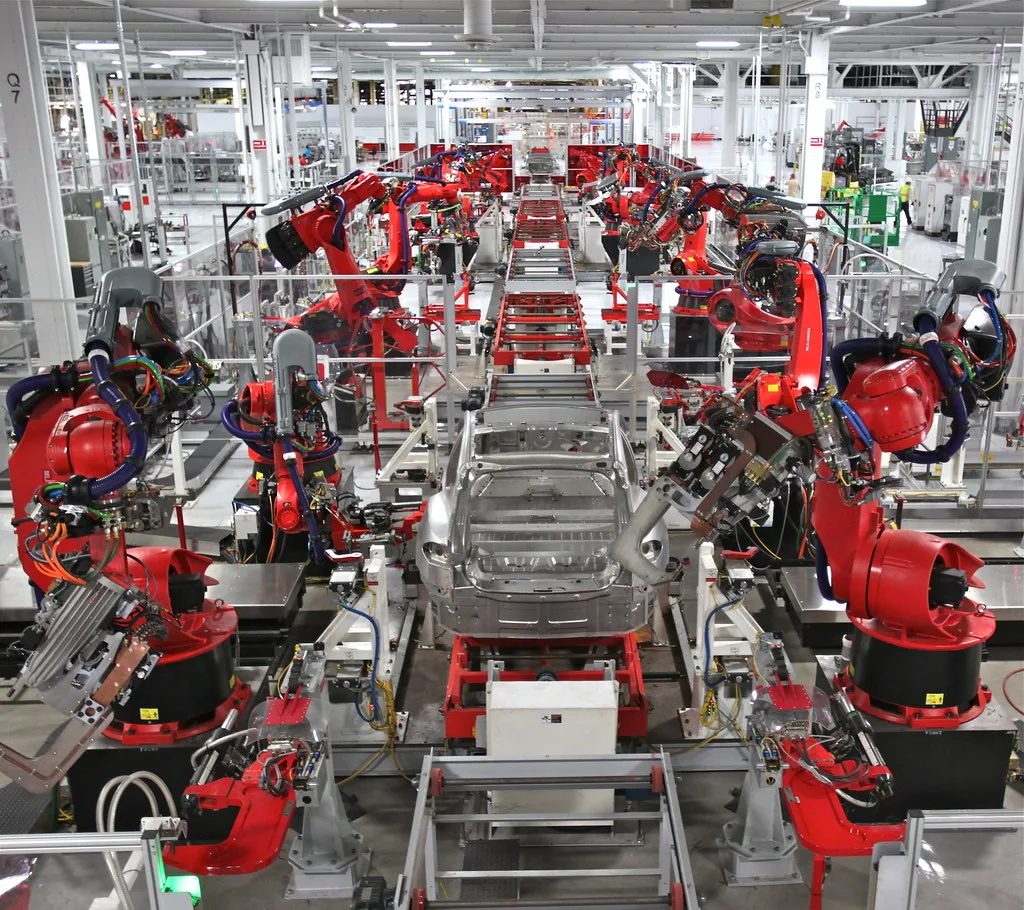
Bell Labs invented the transistor in 1947; by 1970 a computer could run an entire production line. Ford's River Rouge plant employed 100,000 workers in 1930; by 1990 it made more cars with 6,000. Value flowed not to those who worked hardest but to those who owned the means of production — increasingly algorithms rather than physical factories. The dispossessed 94,000 workers found no equivalent refuge because the new factories did not need bodies.
Capital becomes ephemeral
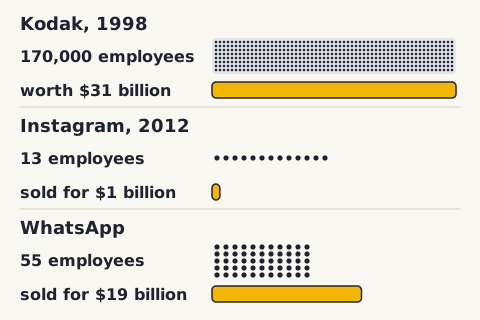
Around 2000, capital itself dematerialized. In 1998 Kodak employed 170,000 people and was worth 31 billion. In 2012, Facebook bought Instagram — thirteen employees, no factories, no inventory — for 1 billion. WhatsApp sold for $19 billion with fifty-five employees. The physical plant, the labor force, the warehouse — all had become irrelevant. Value had become the invisible structure of the network: the pattern of connections, not the weight of things.
The mathematics of obsolescence
The previous four inversions each left humans somewhere to retreat. Mostaque's unsettling argument is that the fourth may not — and the reason is structural, not political.
The Intelligence Event
On November 30, 2022, OpenAI released ChatGPT: a million users in five days, 100 million in two months. For all of prior history, intelligence was a form of labor — scarce, locked in human skulls, and therefore economically valuable precisely because it could not be copied. The fourth inversion changes that: intelligence has become a form of capital, reproducible at near-zero marginal cost and improving recursively without rest or wages. When the price of high-quality cognition approaches zero, the scarcity premium that has underpinned the professional class for a century begins to collapse.
The shrinking refuge
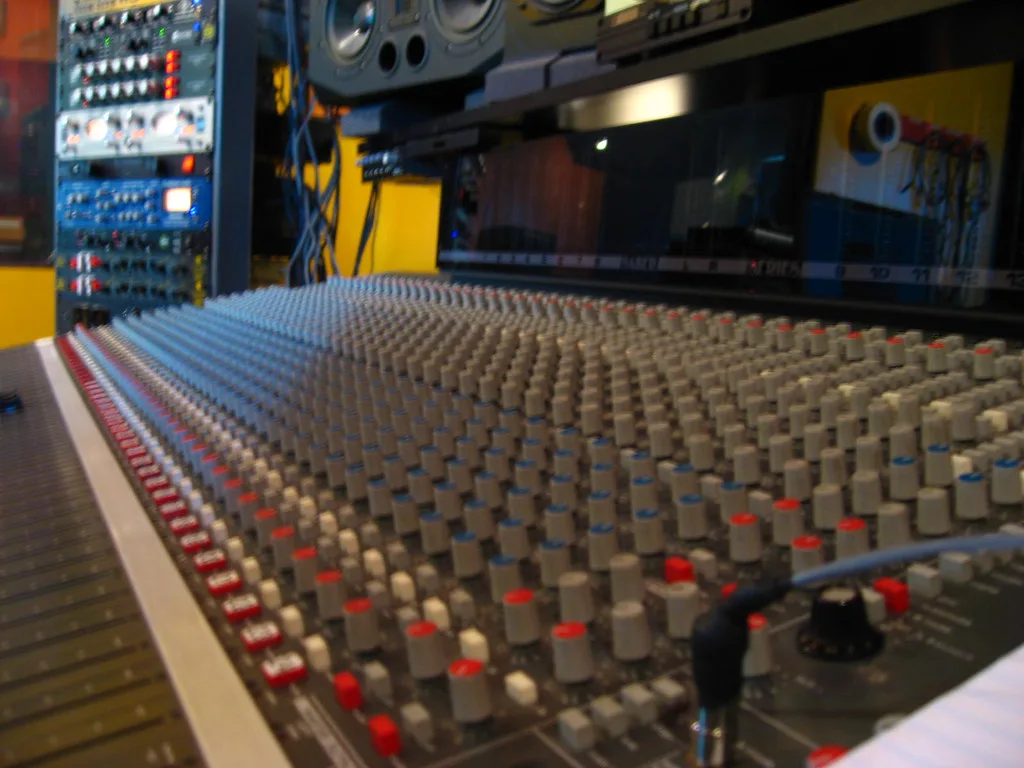
The conventional answer to "what will humans do?" is creatives and caretakers — fields that seem to demand human warmth, judgment, or originality. But the refuges keep contracting. An AI-generated song topped streaming charts. AI therapists in blind studies have reported higher patient satisfaction than human practitioners. The next offered refuge — AI trainers and supervisors — is transitional at best, since AI systems are already training other AI systems. Each fallback position that once seemed permanent turns out to be another staging area. Mostaque's phrase: "For the first time in economic history, we face an inversion with no obvious landing place."
Nowhere left to pivot
Every prior inversion preserved a retreat. When land mattered less, humans became laborers. When physical labor mattered less, humans became knowledge workers. Mostaque calls this the Metabolic Rift — the fundamental physical difference between human labor, a metabolic engine requiring food, shelter, and rest, and AI or robotic labor, a non-metabolic engine requiring only electricity. Human labor carries a biological overhead that AI does not, which means that for a growing majority of cognitive tasks the economic value of a human is not merely lower than an AI's — it is negative once that overhead is priced in. When knowledge work itself is displaced, the historical pattern of retreat breaks. "We are the last humans to remember when human thought had economic value. The first to discover what comes after."
Key terms
- The Intelligence Inversion
- The current, unprecedented moment where intelligence becomes a scalable, non-biological, uncapped commodity (AI) — breaking the assumptions of scarcity-based economics and triggering a civilizational phase transition. It is the fourth and final inversion of the source of economic value.
- The Metabolic Rift
- The fundamental physical difference between human labor — a metabolic engine that requires food, shelter, and rest — and AI/robotic labor, a non-metabolic engine that requires only electricity. This is why the fourth inversion is final: there is nowhere left to pivot when you are out-competed by a form of labor that does not need to eat, sleep, or live.
Key concepts
- A photo-sharing startup Mostaque uses to show how capital dematerialized — no factories, no inventory, no warehouse.
- When it was acquired in 2012, it had just thirteen employees.
- Facebook paid $1 billion for this thirteen-person company with no physical plant at all.
- A messaging service Mostaque cites as proof that value had become the invisible structure of the network, not the weight of things.
- It changed hands with a workforce of just fifty-five people.
- This fifty-five-employee company sold for $19 billion.
Kodak
- A once-giant firm Mostaque contrasts with tiny network-era startups to mark the moment capital itself dematerialized.
- In 1998 it employed roughly 170,000 people and was worth about $31 billion.
- This film-and-imaging giant's 170,000 payroll and $31 billion worth are the 'before' picture beside the thirteen-person startup that dwarfed it.
Bell Labs
- The research lab Mostaque credits with the breakthrough that opened the shift from Labor to Capital.
- In 1947 it invented the transistor.
- Its 1947 transistor meant that by 1970 a single computer could run an entire production line.
Key facts
Four inversions of value
Mostaque argues the foundational source of economic value has inverted four times: Land (ten millennia of agricultural dominance), Labor (the industrial age), Capital (the ephemeral, dematerialized economy), and now Intelligence. Each time, civilizations that clung to the old rules became archaeological layers. The fourth inversion is happening a hundred times faster than any before — and offers no retreat.
Land to Labor
For ten thousand years, value meant land. The first crack appeared in Venice — rich without farmland by controlling the flow of goods. Then around 1750 James Watt's separate condenser supercharged the steam engine. In Manchester, life expectancy in working-class neighborhoods dropped to seventeen, but the mills out-produced a hundred villages. Value shifted from what you owned to what you could organize.
Labor to Capital
Bell Labs invented the transistor in 1947; by 1970 a computer could run a production line. Ford's River Rouge plant employed 100,000 workers in 1930; by 1990 it made more cars with 6,000. The missing 94,000 found no jobs. Value flowed not to those who worked hardest but to those who owned the means of production — increasingly algorithms, not factories.
Capital becomes ephemeral
Around 2000, capital itself dematerialized. In 1998 Kodak employed 170,000 people and was worth 31 billion. In 2012 Facebook bought Instagram — thirteen employees, no factories, no inventory — for 1 billion. WhatsApp sold for $19 billion with fifty-five employees. Value had become the invisible structure of the network itself.
The Intelligence Event
On November 30, 2022, OpenAI released ChatGPT: a million users in five days, a hundred million in two months. For all of history, intelligence was a form of labor, scarce and locked in human skulls. Now it has become a form of capital — copied infinitely, improving recursively. When the marginal cost of high-quality cognition approaches zero, scarcity-based economics begins to buckle.
The shrinking refuge
The standard answer to 'what will humans do?' is 'creatives and caretakers.' But the refuges keep shrinking: an AI-generated song topped the streaming charts, and AI therapists report higher patient satisfaction than humans in blind studies. The next answer — 'AI trainers and supervisors' — is transitional at best, since AI systems are already training other AI systems. 'For the first time in economic history, we face an inversion with no obvious landing place.'
Nowhere left to pivot
Every previous inversion left humans somewhere to retreat: when land mattered less, humans became laborers; when labor mattered less, knowledge workers. When knowledge work matters less than AI, humans become what? Mostaque's honest answer: we do not know. 'We are the last humans to remember when human thought had economic value. The first to discover what comes after.'
The Metabolic Rift
Mostaque's Metabolic Rift names the physical gap between human labor and AI labor: human work is metabolic, needing food, rest, and shelter, while AI and robotic labor is non-metabolic, running on electricity alone.
From Labor to Capital
For most of history, intelligence was labor — scarce, valuable, and locked in human skulls. Mostaque says the fourth inversion turns it into capital instead: reproducible at near-zero marginal cost and able to improve itself recursively.
By the numbers
- Ford's River Rouge workforce in 1930 (people)
- 100000 workers
- Year skilled artisans smashed weaving frames near Nottingham
- 1811 year
- Year Bell Labs invented the transistor
- 1947 year
- Year of the Luddite uprising near Nottingham
- 1811 year
- ChatGPT users within two months of its November 2022 launch (millions)
- 100 million users
Matched pairs
Each item on the left goes with the one on the right.
- Mostaque's four sources of economic value, in order
- Land, then Labor, then Capital, then Intelligence
- Instagram's headcount when Facebook bought it for $1 billion
- Thirteen employees, with no factories or inventory
Self-test
Answer each question from memory, then check your work against the answer key.
1. In what order does Mostaque sequence the four foundational sources of economic value?
- ACapital, Land, Labor, Intelligence
- BLand, Capital, Labor, Intelligence
- CLabor, Land, Capital, Intelligence
- DLand, Labor, Capital, Intelligence
2. Which source of value is the fourth and current inversion in Mostaque's scheme?
- ALand
- BLabor
- CIntelligence
- DCapital
3. Which of these is NOT one of Mostaque's four sources of economic value?
- AEnergy
- BCapital
- CLabor
- DLand
4. Which source of value dominated for roughly ten millennia of agricultural civilization?
- ACapital
- BLand
- CLabor
- DIntelligence
5. Between Land and Capital, which source of value held the middle position?
- ALabor
- BTrade
- CIntelligence
- DEnergy
6. In what year did skilled artisans gather near Nottingham and smash weaving frames?
- A1789
- B1847
- C1811
- D1750
7. What did Bell Labs invent in 1947, seeding the shift from Labor to Capital?
- AThe steam engine
- BThe microprocessor
- CThe integrated circuit
- DThe transistor
8. How many workers did Ford's River Rouge plant employ in 1930?
- A170,000
- B100,000
- C6,000
- D94,000
9. By 1990, River Rouge produced more cars than in 1930 using how many workers?
- A6,000
- B13,000
- C100,000
- D55,000
10. Which date-or-figure pairing is INCORRECT?
- ABell Labs transistor — 1947
- BRiver Rouge 1930 workforce — 100,000
- CLuddite frame-smashing — 1811
- DLuddite uprising — 1947
11. Mostaque says the first inversion (Land to Labor) was foreshadowed by which city-state, which grew wealthy without farmland by controlling the flow of goods?
- AAmsterdam
- BVenice
- CGenoa
- DFlorence
12. How many people did Kodak employ in 1998, when it was worth $31 billion?
- A100,000
- B55,000
- C170,000
- D13,000
13. When Facebook bought Instagram for $1 billion in 2012, how many employees did Instagram have?
- ASeventeen
- BFifty-five
- CThirteen
- DSix thousand
14. For how much did WhatsApp sell, with just fifty-five employees?
- A$19 billion
- B$100 billion
- C$31 billion
- D$1 billion
15. How did Venice grow wealthy despite having no farmland, foreshadowing dematerialized value?
- ABy owning vast plantations
- BBy controlling the flow of goods
- CBy mining precious metals
- DBy manufacturing textiles
16. For all of prior history intelligence was scarce and valuable as a form of labor. Mostaque says the fourth inversion changes this by turning intelligence into a form of what?
- ALand — a fixed, ownable resource
- BRaw materials to be extracted
- CA public good funded by the state
- DCapital — reproducible at near-zero marginal cost
17. What event on November 30, 2022 marks the start of the Intelligence Inversion?
- AOpenAI released ChatGPT
- BFacebook bought Instagram
- CBell Labs invented the transistor
- DKodak declared bankruptcy
18. How many users did ChatGPT reach within two months of its November 2022 launch?
- A170 million
- B13 million
- C1 million
- D100 million
19. Why does the Intelligence Inversion collapse the professional class's scarcity premium?
- AHuman intelligence stops improving entirely
- BLand regains its status as the top asset
- CHigh-quality cognition becomes reproducible at near-zero marginal cost
- DGovernments nationalize all intelligent systems
20. Before the fourth inversion, intelligence was economically valuable because it was a form of what?
- ALand — fixed and ownable
- BLabor — scarce and locked in human skulls
- CEnergy — cheap and abundant
- DCapital — infinitely reproducible
21. What does Mostaque's 'Metabolic Rift' describe?
- AThe gap between rich and poor nations
- BThe delay between an invention and its adoption
- CThe difference between land value and capital value
- DThe physical gap between human metabolic labor and non-metabolic AI labor
22. According to the Metabolic Rift, human labor is a metabolic engine that requires what?
- AFood, shelter, and rest
- BLand and raw materials
- COnly maintenance and repair
- DOnly electricity
23. Unlike human labor, AI or robotic labor is a non-metabolic engine that requires only what?
- AFood and rest
- BSunlight and water
- CElectricity
- DWages and benefits
24. Why does the Metabolic Rift make the fourth inversion offer no landing place for human labor?
- AGovernments refuse to retrain displaced workers
- BHuman biological overhead can make a worker's value negative once priced in
- CLand becomes scarce again for everyone
- DAI cannot yet perform creative tasks
25. Which is NOT part of the biological overhead that gives human labor its metabolic cost?
- AShelter
- BRest
- CFood
- DElectricity
Go deeper
- ReadThe Last Economy by Emad Mostaque · on Amazon ↗
- StudyThe Last Economy (book) in the FlashFeed app
These are affiliate links: if you buy a book through one, FlashFeed may earn a small commission at no extra cost to you. The commission helps pay for FlashFeed's servers.
As an Amazon Associate we earn from qualifying purchases.
Answer key
- 1. D Land, Labor, Capital, IntelligenceValue inverted through Land (ten millennia of agriculture), Labor (the industrial age), Capital (the dematerialized network economy), and now Intelligence.
- 2. C IntelligenceIntelligence is the fourth inversion, unfolding roughly a hundred times faster than its predecessors. Capital was the third; Land and Labor were the first two.
- 3. A EnergyThe four sources are Land, Labor, Capital, and Intelligence. Energy is not one of them, though it distinguishes AI's non-metabolic labor.
- 4. B LandFor ten thousand years value meant Land. Labor rose with the industrial age, Capital with the network economy, and Intelligence now.
- 5. A LaborThe order is Land, then Labor (the industrial age), then Capital, then Intelligence. Labor sits between Land and Capital.
- 6. C 1811The Luddite uprising near Nottingham was in 1811. Around 1750 Watt's condenser supercharged the steam engine, but the frame-smashing came later.
- 7. D The transistorBell Labs invented the transistor in 1947; by 1970 a computer could run a whole production line. The microprocessor and integrated circuit came later.
- 8. B 100,000River Rouge employed 100,000 workers in 1930. By 1990 it made more cars with just 6,000 — a loss of 94,000 jobs. 170,000 was Kodak's 1998 headcount.
- 9. A 6,000By 1990 the plant made more cars with just 6,000 workers, down from 100,000 in 1930. The dispossessed 94,000 found no equivalent refuge.
- 10. D Luddite uprising — 1947The Luddite uprising was 1811, not 1947. 1947 is the year Bell Labs invented the transistor. The other pairings are correct.
- 11. B VeniceVenice, a city-state with no farmland, grew rich by controlling the flow of goods — the first crack in ten millennia of land-based value, before Watt's steam engine completed the shift from what you own to what you can organize.
- 12. C 170,000Kodak employed 170,000 people in 1998 at a $31 billion valuation — the old material economy. Instagram had thirteen employees; WhatsApp fifty-five.
- 13. C ThirteenInstagram had thirteen employees, no factories, and no inventory. WhatsApp had fifty-five when it sold for $19 billion — value as network pattern, not physical plant.
- 14. A $19 billionWhatsApp sold for $19 billion with fifty-five employees. Instagram went for $1 billion; Kodak was worth $31 billion in 1998 with 170,000 people.
- 15. B By controlling the flow of goodsVenice, with no farmland, grew rich by controlling the flow of goods — showing value shifting from what you own to what you can organize and move.
- 16. D Capital — reproducible at near-zero marginal costOnce locked in human skulls, intelligence was labor — scarce and uncopyable. AI makes it capital: reproducible at near-zero marginal cost and improving recursively. As the price of cognition nears zero, the professional class's scarcity premium collapses.
- 17. A OpenAI released ChatGPTOpenAI released ChatGPT on November 30, 2022 — a million users in five days, 100 million in two months — marking intelligence's turn into reproducible capital.
- 18. D 100 millionChatGPT hit a million users in five days and 100 million in two months — the fastest adoption in history, signaling intelligence becoming near-free capital.
- 19. C High-quality cognition becomes reproducible at near-zero marginal costWhen intelligence becomes capital — copied at near-zero marginal cost and improving recursively — cognition's price approaches zero, and the century-old scarcity premium underpinning professionals collapses.
- 20. B Labor — scarce and locked in human skullsFor all prior history intelligence was labor: scarce, locked in human skulls, valuable precisely because it could not be copied. The fourth inversion turns it into reproducible capital.
- 21. D The physical gap between human metabolic labor and non-metabolic AI laborThe Metabolic Rift is the physical difference between human labor — a metabolic engine needing food, shelter, rest — and AI/robotic labor, a non-metabolic engine needing only electricity.
- 22. A Food, shelter, and restHuman labor requires food, shelter, and rest — a biological overhead. AI/robotic labor, being non-metabolic, requires only electricity, which is why the value gap can turn negative.
- 23. C ElectricityAI/robotic labor needs only electricity — no food, shelter, rest, or wages. That absence of biological overhead is why a human's economic value can go negative for many cognitive tasks.
- 24. B Human biological overhead can make a worker's value negative once priced inBecause human labor carries a biological overhead AI lacks, for a growing majority of cognitive tasks a human's value is not just lower but negative once that overhead is priced in — so the historical pattern of retreat breaks.
- 25. D ElectricityFood, shelter, and rest are the metabolic needs of human labor. Electricity is what non-metabolic AI labor requires — the opposite side of the rift.
Image credits
- Four inversions of value: FlashFeed original diagram · CC-BY-4.0
- Labor to Capital: jurvetson (Openverse) · by 2.0 — www.flickr.com/photos/44124348109@N01/7408451314
- Capital becomes ephemeral: FlashFeed original diagram · CC-BY-4.0
- The shrinking refuge: Jason Lander (Openverse) · by 2.0 — www.flickr.com/photos/8566600@N07/533720739