
The Last Economy (book) study guide · Lesson 9 of 15
The Three Flows & Network Prison
The Three Flows · The Network Prison
Unofficial study guide for The Last Economy: A Guide to the Age of Intelligent Economics by Emad Mostaque. FlashFeed is not affiliated with the author or publisher.
This is the lesson's study guide from the FlashFeed app, plus its key facts and a self-test.
What you'll be able to do
- Distinguish Gradient, Circular, and Harmonic Flow, derived from the Hodge Decomposition of any flow into three components.
- Identify the three topologies of power (Hub and Spoke, Small World, Distributed Mesh) and which is the extraction engine.
- Explain Piketty's r > g and its physical reading as exponential circular flow outrunning linear gradient flow.
The Three Flows
Economics has spent centuries arguing over which river is the real one. Mostaque's answer: all three are real, they describe different physics, and every economy runs all three at once.
The blind scholars and the elephant
Six scholars each feel a different part of an elephant and declare a different animal. Mostaque uses this image to indict economic history: Smith, Marx, and Hayek each grasped a genuine piece of reality, then mistook it for the whole. The resulting debates — capitalism versus communism, markets versus planning — were disputes between three partial truths, not truth and error. Mostaque's Three Flows framework contains rather than discards those traditions. The underlying mathematics is the Hodge Decomposition theorem, which proves that any flow on any surface breaks uniquely into exactly three components. This is the universal grammar of all economic activity, not a metaphor.
Gradient Flow: the gospel of Adam Smith
A Gradient Flow moves from high potential to low, eliminating the difference as it goes — the physics of scarcity and rivalry. Sell a loaf of bread and you have one less; the buyer gains one. Adam Smith's invisible hand is, in Mostaque's reading, a beautiful literary name for the negative gradient operator: prices signal imbalance, exchange resolves it, equilibrium follows. This is not wrong — it is incomplete. A pure gradient economy trends toward stillness: every imbalance corrected, every flow exhausted. Growth requires something else.
Circular Flow: the ghost of Karl Marx
A Circular Flow is self-reinforcing and accumulative — the physics of abundance and non-rivalry. Share an idea and the recipient gains everything while you lose nothing; use a network and its value to every member increases. Marx's formula for capital, M–C–M', is a technically precise description of a circular flow: money generates commodities that generate more money. His error was attributing circularity solely to labor exploitation, when all non-rival goods — knowledge, software, reputation — follow the same mathematics. The circular economy does not tend toward equilibrium; it tends toward runaway concentration, which is why platforms that catch a circular flow can grow without apparent ceiling.
Harmonic Flow: the wisdom of Friedrich Hayek
A Harmonic Flow neither depletes its source nor spins in a self-amplifying loop. It is the persistent channel determined by the shape of the space itself — the riverbed that guides the river regardless of how much water flows. This is the economics of structure, trust, and institutions: the unwritten conventions, shared languages, and legal frameworks that let strangers coordinate without negotiating from scratch. Hayek called this spontaneous order. Mostaque credits him with seeing it clearly while faulting him for concluding that such structures cannot and should not be consciously redesigned — a political choice dressed as physics.
The three flows of a single day
The framework is not abstract. Buy a coffee: Gradient Flow — a complete, zero-sum exchange in Smith's River. Watch a tutorial and pass the skill to a colleague: Circular Flow — knowledge replicated, both parties richer, Marx's Whirlpool. Speak English with the barista: Harmonic Flow — using an invisible persistent infrastructure that neither party owns or depletes, Hayek's Riverbed. A flourishing life, Mostaque argues, requires conscious balance of all three, not unconscious default to whichever the surrounding economy happens to reward.
Coercion as a pathological flow
Mostaque adds a fourth, explicitly pathological category: coercion. Theft and forced labor are not a fourth flow type but a Gradient Flow reversed by force — an entropy pump. A voluntary exchange is positive-sum and increases total MIND (Money, Intelligence, Network, Diversity) in the system. A coercive one enriches one node while destroying the source node's other capitals — its freedom, its community, its potential. The net change is negative. When platform architecture makes participation nominally voluntary but structurally inescapable, the line between exchange and extraction blurs.
The Network Prison
The meritocracy story holds that effort and talent determine outcomes. Mostaque's counter is structural: your position in a network matters more than what you do from that position, and most people are in the wrong network before they take their first step.
Topology is destiny
In 2003, a programmer in Mumbai with better code than Zuckerberg still had worse prospects — not because of talent, but because Zuckerberg's Harvard position placed Peter Thiel two connections away. This is topology: the study of which nodes connect to which. Mostaque's claim is not about fairness but about structure. In a world where capital and attention concentrate through network effects, position in the graph precedes performance within it. The web's shape determines the range of outcomes available to each node before the game begins.
The mathematics of inequality
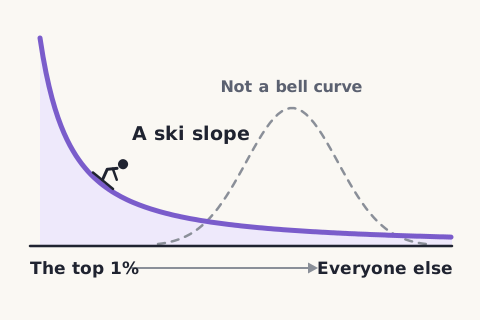
Real networks grow through preferential attachment: new nodes connect to nodes that already have many connections. The consequence is a power law distribution — the rich get richer not as a moral failing but as an algebraic inevitability. About 1% of users generate ~90% of content; ~0.1% of startups capture 41% of funding; the top 1% holds half of all equity. Success follows a ski slope, not a bell curve. Policy premised on a bell-curve world does not reach the topology that regenerates inequality as fast as intervention smooths it.
The physics of r > g
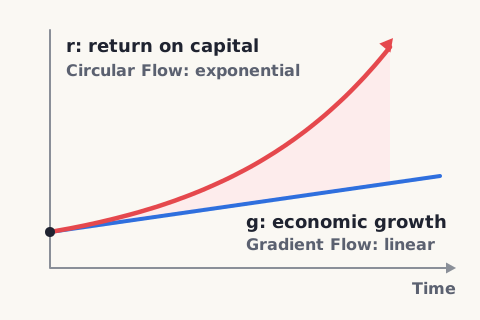
Thomas Piketty showed that the return on capital (r) consistently exceeds economic growth (g). Mostaque offers a physical explanation: g is the linear growth of the Gradient Flow economy — rivalrous goods, human labor, slow-compounding productivity. r is the exponential growth of the Circular Flow economy — non-rival capital, platforms, and intelligence compounding without natural ceiling. AI amplification accelerates r while collapsing the labor value that drives g. The gap is not a policy failure; it is a consequence of two different flow physics running in the same economy.
Three topologies of power
Mostaque names three network structures, each with a characteristic economic personality. Hub and Spoke — the Extraction Engine: all value flows through a central node (Amazon Marketplace, app stores), creating what he calls digital sharecropping. Efficient at extraction; brittle at the center; zero resilience if the hub fails. Small World — the Innovation Engine: tightly connected clusters with occasional long bridges between them (Silicon Valley), where ideas percolate within clusters and combine across bridges. This is the topology that produces disproportionate innovation. Distributed Mesh — the Resilience Engine: every node connects to several neighbors, no center (Bitcoin, village economies), poor at concentrating capital but excellent at surviving shocks. Understanding which topology you are in — or can build — is a strategic question, not a philosophical one.
The Great Exclusion
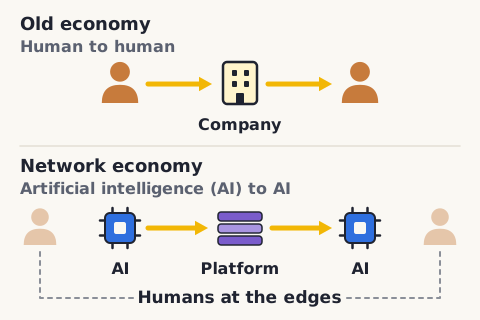
The darkest implication of the network analysis is structural exclusion. In the old economy, value moved human-to-human through companies; even peripheral workers participated as necessary nodes. In the network economy, value increasingly moves AI-to-AI through platforms — entire transaction chains executed machine-to-machine, humans neither present nor required. Workers are not losing a competition; they are being pushed to the topological edge of networks that no longer route value through them. Mostaque calls this the Great Exclusion: not economic irrelevance through underperformance, but topological irrelevance through architectural change.
The topology of thought
The three network structures mirror how intelligence itself is organized. A traditional corporation — rigid hierarchy, orders cascading down — is a Hub-and-Spoke network: efficient at execution, brittle at innovation. A modern Transformer is a Small World network: its attention mechanism allows any token to bridge to any other, generating combinatorial reach. The human brain is a Distributed Mesh — less efficient than a chip but orders of magnitude more resilient. Mostaque treats these not as analogies but as the same mathematics appearing at different scales.
Key terms
- The Three Flows of Value
- The universal grammar of all economic activity, derived from the Hodge Decomposition theorem — which proves any flow on any surface breaks uniquely into exactly three components. Gradient Flow (competitive, zero-sum exchange of scarce goods), Circular Flow (accumulative, positive-sum dynamics of non-rival goods), and Harmonic Flow (the persistent structural channels of trust and institutions).
Key concepts
Gradient Flow
- The first of Mostaque's three economic currents — the physics of scarcity and rivalry, running from high potential to low.
- Sell a loaf of bread and you have one less while the buyer gains one: a complete, zero-sum exchange.
- Mostaque reads Adam Smith's invisible hand as a literary name for this force; a pure version trends toward stillness.
Circular Flow
- The second of Mostaque's three currents — the physics of abundance and non-rivalry, self-reinforcing and accumulative.
- Share an idea and the recipient gains everything while you lose nothing; a network grows more valuable to every member.
- Marx's formula M–C–M' describes it; it tends toward runaway concentration, letting platforms grow without ceiling.
Harmonic Flow
- The third of Mostaque's three currents — it neither depletes its source nor spins in a self-amplifying loop.
- It is the persistent channel set by the shape of the space itself — the riverbed that guides the river however much water runs.
- This is the economics of structure, trust, and institutions; Friedrich Hayek called it spontaneous order.
Hub and Spoke
- The first of Mostaque's three network topologies — he calls it the Extraction Engine.
- All value passes through a single central node — think Amazon Marketplace or app stores — creating digital sharecropping.
- Efficient at extraction but brittle at the center, with zero resilience if that node fails; a rigid corporate hierarchy is its living form.
Small World
- The second of Mostaque's three network topologies — he calls it the Innovation Engine.
- It is built from tightly connected clusters joined by occasional long bridges, so ideas percolate within and combine across them.
- Silicon Valley is its exemplar; a Transformer's attention mechanism, letting any token bridge to any other, is the same structure.
Distributed Mesh
- The third of Mostaque's three network topologies — he calls it the Resilience Engine.
- Every node connects to several neighbors with no center at all — think Bitcoin or village economies.
- Poor at concentrating capital but excellent at surviving shocks; the human brain is its biological version.
Key facts
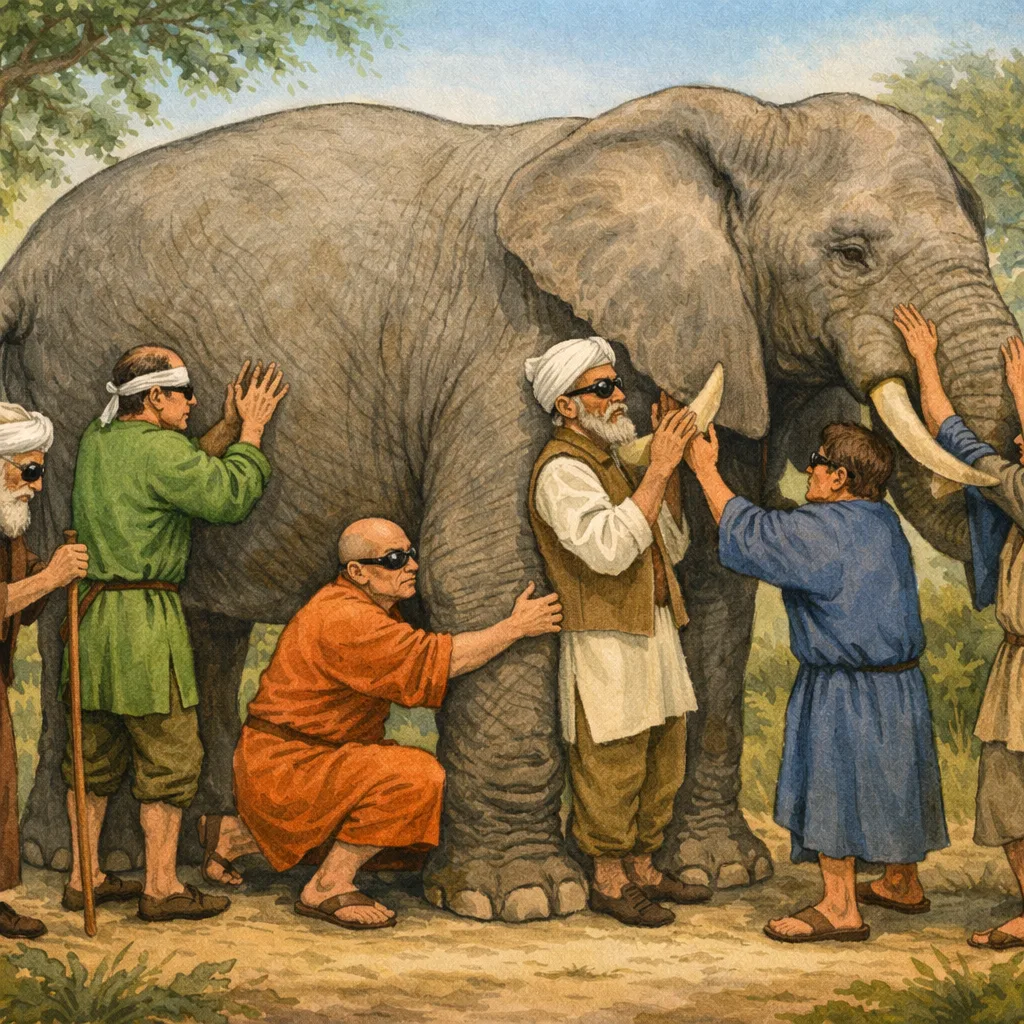
The blind scholars and the elephant
Six blind scholars touch an elephant; each is perfectly right about their part and catastrophically wrong about the whole. Mostaque casts the history of economics this way: Adam Smith felt the steady pulse of competitive exchange; Karl Marx grasped the accumulative spiral of capital; Friedrich Hayek touched the invisible structures of tradition and trust. 'Centuries of blood spilled over a false dichotomy. Today, we turn on the lights.'
Gradient Flow: the gospel of Adam Smith
Gradient flows follow potential differences and eliminate them — the economics of scarcity and rivalry. When a baker sells a loaf, they have one less and the buyer one more. Adam Smith was the prophet of this flow: his 'invisible hand' is a beautiful metaphor for what a physicist calls the negative gradient operator. The limitation: Smith was not wrong, just incomplete. In a pure gradient system, all flows eventually cease — every economy a stagnant pond.
Circular Flow: the ghost of Karl Marx
Circular flows create self-reinforcing, accumulative loops — the economics of abundance and non-rivalry. When an idea is shared, the recipient gains everything and the originator loses nothing; the more it is used, the more valuable it becomes. Marx was the haunted poet of this flow: his formula for capital, M-C-M', is a perfect description of a circular flow. His error was attributing it solely to the exploitation of labor, when all non-rival goods follow it.
Harmonic Flow: the wisdom of Friedrich Hayek
Harmonic flows neither deplete sources nor spin in loops; they are the persistent channels determined by the shape of economic space itself — the riverbeds that guide the river. This is the economics of structure, trust, and institutions. Hayek's 'spontaneous order' is the emergence of these flows: the unwritten rules and shared trust that let a complex society coordinate. His limitation: believing these structures could not and should not be consciously designed.
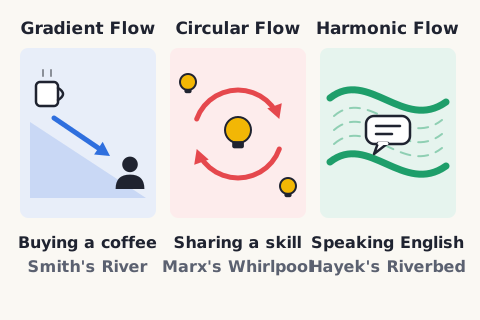
The three flows of a single day
The framework runs your own life. Buying a coffee is Gradient Flow — a complete, zero-sum exchange (Smith's River). Learning a skill from a video and sharing it is Circular Flow — knowledge replicated, both parties richer (Marx's Whirlpool). Speaking English with the barista is Harmonic Flow — using an invisible, persistent infrastructure not depleted by use (Hayek's Riverbed). 'A flourishing life requires a masterful and conscious balance of all three.'
Coercion as a pathological flow
Mostaque adds a fourth, pathological category: coercion. Theft or slavery is not a separate flow but a pathological Gradient Flow that acts as an entropy pump. A normal transaction is positive-sum and increases global MIND. A coercive one enriches one agent in the short term while actively destroying the source node's other capitals — its freedom (Diversity), its community (Network), its potential (Intelligence). The net change in global MIND is negative.
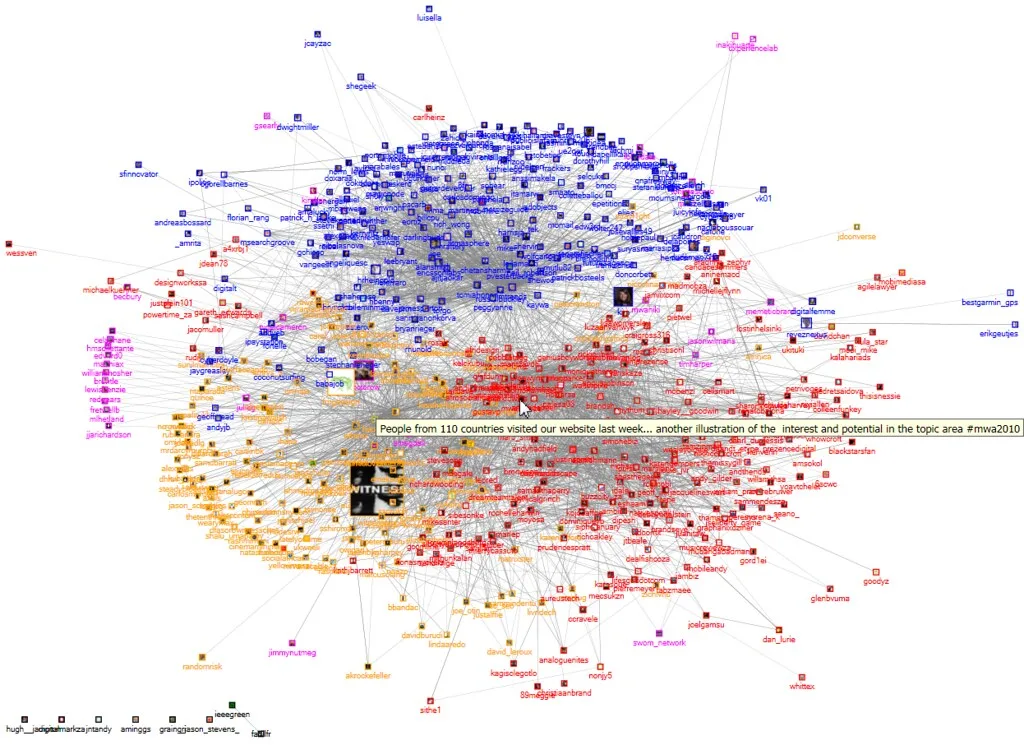
Topology is destiny
We are raised on the myth of the level playing field where talent is rewarded. Mostaque's counter: 'You are not a player on a level field. You are a node in a web, and the structure of that web matters more than anything you do within it.' This is not cynicism but topology. In 2003, Mark Zuckerberg's code may have been beatable, but his Harvard position put Peter Thiel two connections away. A superior programmer in Mumbai had a worse position. 'In the age of intelligence, topology is destiny.'
The mathematics of inequality
Real networks follow power laws via 'preferential attachment' — new nodes connect to nodes that already have many connections. The rich get richer not through moral failing but mathematical inevitability. About 1% of users generate ~90% of content; ~0.1% of startups receive 41% of funding; the top 1% holds 50% of all stocks. 'Success is not a bell curve, but a ski slope.' To ask for equality here is to ask water to flow uphill.
The physics of r > g
Mostaque gives a physical explanation for Thomas Piketty's famous inequality, r > g: the return on capital exceeds economic growth. In his reading, g is the linear growth of the Gradient Flow economy (rivalrous goods, human labor); r is the exponential, self-amplifying growth of the Circular Flow economy (non-rival capital, networks, intelligence). 'AI amplification is pouring rocket fuel on r while collapsing the value of the labor that drives g.'
Three topologies of power
Mostaque names three network structures. Hub and Spoke — the Extraction Engine: all value flows through a center (Amazon Marketplace, 'digital sharecropping'). Small World — the Innovation Engine: tightly connected clusters with occasional long bridges (Silicon Valley), where ideas percolate and combine. Distributed Mesh — the Resilience Engine: every node connects to several neighbors, no center (Bitcoin, communities), terrible at concentrating capital but excellent at surviving shocks.
The Great Exclusion
The darkest truth of network topology: we are not just being outcompeted, we are being structurally excluded. In the old economy, value flowed human-to-human through companies. In the network economy, value flows AI-to-AI through platforms; entire transactions happen machine-to-machine. 'We are not just becoming economically irrelevant. We are becoming topologically irrelevant' — pushed to the edges of networks that no longer need us.
The topology of thought
These structures mirror how intelligence itself is organized. A traditional corporation, with its rigid hierarchy, is a Hub-and-Spoke network — efficient at execution but brittle and unintelligent. A modern AI like a Transformer is a Small World network: its attention mechanism lets any node bridge to any other, the topology of innovation. The human brain is a Distributed Mesh — less efficient than a chip but infinitely more resilient: the topology of consciousness.
Matched pairs
Each item on the left goes with the one on the right.
- Economist who identified r > g
- Thomas Piketty
Self-test
Answer each question from memory, then check your work against the answer key.
1. In Mostaque's 'three flows of a single day,' speaking English with the barista is an example of Harmonic Flow. What makes it harmonic?
- AIt reverses a voluntary exchange through force
- BIt is a complete, zero-sum exchange that leaves you with less
- CIt replicates knowledge so that both parties end up richer
- DIt uses a persistent shared infrastructure that neither party owns or depletes
2. The Three Flows framework rests on which mathematical theorem, which proves any flow on any surface breaks uniquely into exactly three components?
- AThe central limit theorem
- BThe Hodge Decomposition theorem
- CThe Nash equilibrium theorem
- DThe Coase theorem
3. Selling a loaf of bread so you have one less and the buyer one more exemplifies which flow, which Mostaque ties to Adam Smith's invisible hand?
- AGradient Flow
- BHarmonic Flow
- CCircular Flow
- DCoercive Flow
4. Marx's formula M–C–M', in which money generates commodities that generate more money, is a precise description of which flow?
- AHarmonic Flow
- BGradient Flow
- CCircular Flow
- DPathological Flow
5. Which statement about the Three Flows framework is NOT correct?
- ACircular Flow is self-reinforcing and tends toward runaway concentration
- BHarmonic Flow is the persistent channel set by the shape of the space
- CCoercion is a genuine fourth flow type distinct from the other three
- DGradient Flow eliminates potential differences and trends toward stillness
6. What makes a Circular Flow different from a Gradient Flow, per Mostaque?
- AA persistent channel shaped by institutions
- BFlows high to low, eliminating the difference
- CReverses a voluntary exchange through force
- DSelf-reinforcing and accumulative, not depleting
7. Which economist's formula for capital, M-C-M', does Mostaque cite as a precise description of Circular Flow?
- AKarl Marx
- BAdam Smith
- CThomas Piketty
- DFriedrich Hayek
8. Mostaque names three topologies of power. Which one is the 'Extraction Engine,' where all value flows through a central node — as with Amazon Marketplace or app stores — producing what he calls 'digital sharecropping'?
- ADistributed Mesh
- BHub and Spoke
- CSmall World
9. Which topology, made of tightly connected clusters with occasional long bridges between them (as in Silicon Valley), is Mostaque's 'Innovation Engine'?
- ASmall World
- BPreferential Mesh
- CHub and Spoke
- DDistributed Mesh
10. Bitcoin and village economies, where every node connects to several neighbors with no center, illustrate which topology, the 'Resilience Engine'?
- AHierarchical tree
- BDistributed Mesh
- CHub and Spoke
- DSmall World
11. In Mostaque's 'topology of thought,' a modern Transformer, whose attention mechanism lets any token bridge to any other, is which kind of network?
- AHub and Spoke
- BHierarchical tree
- CDistributed Mesh
- DSmall World
12. In Mostaque's 'topology of thought,' which pairing of a structure to its network topology is INCORRECT?
- AModern Transformer to Small World
- BTraditional corporation to Hub and Spoke
- CBitcoin to Hub and Spoke
- DHuman brain to Distributed Mesh
13. Which network topology does Mostaque call the 'Innovation Engine'?
- ADistributed Mesh
- BHub and Spoke
- CSmall World
- DPreferential Attachment
14. What structural feature defines a Small World topology, per Mostaque?
- AEvery node connecting to several neighbors with no center
- BAll value flowing through one central node
- CA persistent channel shaped by the space itself
- DTightly connected clusters with occasional long bridges
15. Which topology does Mostaque call the 'Resilience Engine'?
- ADistributed Mesh
- BSmall World
- CPreferential Attachment
- DHub and Spoke
16. What is true of a Distributed Mesh topology, according to Mostaque?
- AIt concentrates capital efficiently at a single hub
- BConnects to several neighbors, no center, resists shocks
- CIt is brittle at the center but efficient at extraction
- DIt relies on long bridges linking tightly-knit clusters
17. Which economist identified the inequality r > g, that the return on capital consistently exceeds economic growth?
- AThomas Piketty
- BKarl Marx
- CFriedrich Hayek
- DAdam Smith
18. In Piketty's inequality r > g, what do r and g stand for?
- Ar is revenue; g is government spending
- Br is the inflation rate; g is the gold price
- Cr is risk; g is GDP per capita
- Dr is return on capital; g is economic growth
19. In Mostaque's physical reading of r > g, which flow economy does each term map to?
- Ar is the Gradient Flow economy; g is the Circular Flow economy
- Br is the Circular Flow economy; g is the Gradient Flow economy
- Cr is the Harmonic Flow economy; g is the Gradient Flow economy
- Dr is the Circular Flow economy; g is the Harmonic Flow economy
20. Mostaque argues the persistent gap between r and g is best understood as what?
- AA policy failure that better taxation would have closed
- BA statistical artifact of how growth is measured
- CA consequence of two different flow physics running in the same economy
- DA moral failing on the part of capital owners
21. According to Mostaque, how does AI amplification affect the r > g gap?
- AIt collapses r while boosting g
- BIt raises g faster than r, closing the gap
- CIt leaves both r and g unchanged
- DIt accelerates r while collapsing the labor value that drives g
Go deeper
- ReadThe Last Economy by Emad Mostaque · on Amazon ↗
- StudyThe Last Economy (book) in the FlashFeed app
These are affiliate links: if you buy a book through one, FlashFeed may earn a small commission at no extra cost to you. The commission helps pay for FlashFeed's servers.
As an Amazon Associate we earn from qualifying purchases.
Answer key
- 1. D It uses a persistent shared infrastructure that neither party owns or depletesHarmonic Flow is Hayek's Riverbed — the persistent structural channel (language, institutions, trust) that guides activity without being consumed. A shared language is used by both parties without either owning or depleting it.
- 2. B The Hodge Decomposition theoremMostaque grounds the Three Flows in the Hodge Decomposition theorem, which proves any flow on any surface splits uniquely into three parts. He calls this the universal grammar of economic activity, not a metaphor.
- 3. A Gradient FlowGradient Flow moves from high potential to low, a zero-sum exchange of scarce, rivalrous goods. Smith's invisible hand is Mostaque's literary name for the negative gradient operator. Circular and Harmonic flows are non-rival.
- 4. C Circular FlowCircular Flow is self-reinforcing and accumulative; M-C-M' is its exact description. Marx's error was blaming it solely on labor exploitation when all non-rival goods follow the same math. Gradient Flow is zero-sum, not accumulative.
- 5. C Coercion is a genuine fourth flow type distinct from the other threeCoercion is not a fourth flow but a pathological Gradient Flow reversed by force, an entropy pump. The other three statements accurately describe Gradient, Circular, and Harmonic Flow.
- 6. D Self-reinforcing and accumulative, not depletingCircular Flow is self-reinforcing and accumulative — sharing an idea makes both parties richer — unlike the depleting Gradient Flow.
- 7. A Karl MarxMarx's M-C-M' formula for capital is, in Mostaque's reading, a technically precise description of a Circular Flow.
- 8. B Hub and SpokeHub and Spoke routes all value through a central node — efficient at extraction, brittle at the center. Mostaque calls the result 'digital sharecropping.' Small World is the Innovation Engine and Distributed Mesh is the Resilience Engine.
- 9. A Small WorldSmall World networks let ideas percolate within clusters and combine across bridges, producing disproportionate innovation. Hub and Spoke is the Extraction Engine; Distributed Mesh is the Resilience Engine.
- 10. B Distributed MeshDistributed Mesh has no center; it is poor at concentrating capital but excellent at surviving shocks. Hub and Spoke centralizes value; Small World clusters with bridges. Bitcoin is Mostaque's mesh example.
- 11. D Small WorldA Transformer's attention gives combinatorial reach between tokens, making it a Small World network. A rigid corporation is Hub and Spoke; the human brain is a Distributed Mesh.
- 12. C Bitcoin to Hub and SpokeBitcoin is a Distributed Mesh (the Resilience Engine), not Hub and Spoke. The other three pairings are exactly how Mostaque maps structures of execution, resilience, and combinatorial reach.
- 13. C Small WorldSmall World networks — tightly connected clusters joined by occasional long bridges — are the Innovation Engine; Hub and Spoke extracts, Distributed Mesh resists shocks.
- 14. D Tightly connected clusters with occasional long bridgesSmall World networks are tightly connected clusters joined by occasional long bridges — the structure that lets ideas percolate and combine into disproportionate innovation.
- 15. A Distributed MeshDistributed Mesh has no center — every node connects to several neighbors — making it poor at concentrating capital but excellent at surviving shocks.
- 16. B Connects to several neighbors, no center, resists shocksDistributed Mesh (Bitcoin, village economies) has no center; every node connects to several neighbors, making it excellent at surviving shocks though poor at concentrating capital.
- 17. A Thomas PikettyThomas Piketty showed r > g. Mostaque then supplies a physical reading of it. Hayek, Marx, and Smith map to the three flows but did not formulate r > g.
- 18. D r is return on capital; g is economic growthr is the return on capital and g is economic growth; r > g means capital's return outpaces the overall economy. The other pairings invent meanings the text never uses.
- 19. B r is the Circular Flow economy; g is the Gradient Flow economyr is the exponential Circular Flow economy (non-rival capital, platforms, intelligence compounding without ceiling); g is the linear Gradient Flow economy (rivalrous goods, human labor). Harmonic Flow plays no part in the mapping.
- 20. C A consequence of two different flow physics running in the same economyMostaque insists the gap is not a policy failure but a consequence of two different flow physics — exponential circular growth and linear gradient growth — running in the same economy.
- 21. D It accelerates r while collapsing the labor value that drives gAI accelerates r (exponential circular flow) while collapsing the labor value behind g (linear gradient flow), widening the gap. Mostaque calls this a consequence of two flow physics, not a policy failure.
Image credits
- The blind scholars and the elephant: AI-generated (gpt-image-1.5)
- The three flows of a single day: FlashFeed original diagram · CC-BY-4.0
- Coercion as a pathological flow: AI-generated (gpt-image-1.5)
- Topology is destiny: Marc_Smith (Openverse) · by 2.0 — www.flickr.com/photos/49503165485@N01/5056603811
- The mathematics of inequality: FlashFeed original diagram · CC-BY-4.0
- The physics of r > g: FlashFeed original diagram · CC-BY-4.0
- The Great Exclusion: FlashFeed original diagram · CC-BY-4.0