
Major Wars: Strategy, Technology, and Mechanics of Conflict study guide · Lesson 5 of 13
The Gunpowder Revolution, Pike-and-Shot, & Vauban Fortifications
Pike-and-Shot Formations & the Gunpowder Revolution · Vauban's Siege Science & Early Modern Grand Strategy
This is the lesson's study guide from the FlashFeed app, plus its key facts and a self-test.
What you'll be able to do
- Explain pike-and-shot: the tercio and its mangas, Maurice's countermarch, Nobunaga's palisade volleys at Nagashino, and Gustavus's swords-drawn cavalry charge.
- Explain Vauban's three siege parallels and zigzag saps, his Pré Carré fortress line, and the socket bayonet, and how the siege of Candia became a mine war.
Lesson 5: The Gunpowder Revolution, Pike-and-Shot, & Vauban Fortifications
The Trace Italienne Star Fortress Geometry
The introduction of mobile siege cannons in the late 15th century rendered tall, thin medieval vertical stone walls obsolete. In response, Italian military architects developed the trace italienne (star fortress). Star fortresses featured low, thick earthen ramparts faced with brick to absorb kinetic cannon impact, fronted by wide dry ditches and angled bastions. The geometric layout of diamond-shaped bastions created interlocking fields of flanking artillery and musket fire that covered every foot of the ditch, eliminating all dead ground where attacking sappers could take shelter.
The Spanish Tercio Square Formation
During the Italian Wars, Gonzalo Fernández de Córdoba (El Gran Capitán) developed the Spanish Tercio, a 1,500-to-3,000-man mixed-arms formation that dominated European battlefields for over a century. The core consisted of a massive central square of armored pikemen wielding 16-to-18-foot pikes, flanked at the four corners by mobile "sleeves" (mangas) of arquebusiers and musketeers. When cavalry charged, the missile troops retreated under the protective canopy of the pike hedgehog; when infantry stalled, the firearms emerged to deliver devastating close-range volleys.
Arquebus Firepower at the Battle of Pavia
At the Battle of Pavia in 1525, Imperial-Spanish forces defeated the French royal army and captured King Francis I. The decisive factor was the tactical deployment of Spanish and German Imperial arquebusiers (estimates of their numbers vary by source, from roughly 1,500 up to about 3,000) taking cover in sunken drainage ditches and wooded groves. Utilizing the armor-piercing power of lead bullets fired at close range, the entrenched arquebusiers systematically shot down the unmaneuverable French heavy armored gendarme cavalry as they charged across rough ground.
Maurice of Nassau and the Countermarch Volley
During the Eighty Years' War, Dutch commander Maurice of Nassau revolutionized gunpowder infantry tactics through classical Roman-inspired drill. To solve the problem of slow musket reloading times, Maurice instituted the countermarch: infantry deployed ten ranks deep; after the front rank discharged its matchlocks, it turned and marched between the files to the rear to reload, while the second rank stepped forward. Maurice also reduced battalion sizes from massive clumsy tercios to agile 500-man units.
Gustavus Adolphus and Combined Arms at Breitenfeld
King Gustavus Adolphus of Sweden transformed military doctrine during the Thirty Years' War, earning the title "Father of Modern Warfare." At the Battle of Breitenfeld (1631), Gustavus defeated Count Tilly's Catholic Imperial tercios using an agile combined-arms system: thin linear infantry lines delivering thunderous rolling volleys (salvee), light mobile 3-pounder regimental copper/iron artillery, and aggressive shock cavalry charging with swords drawn rather than firing pistols from the saddle (caracole).
Oda Nobunaga's Rotating Volleys at Nagashino
In feudal Japan, the Battle of Nagashino (1575) demonstrated the revolutionary potential of massed firearms. Warlord Oda Nobunaga defeated the renowned Takeda clan's elite heavy samurai cavalry by constructing wooden palisades along the Rengo River and deploying massed matchlock (teppo) gunners along the line — tradition holds 3,000 guns firing in three rotating ranks, though the primary source (Shinchō Kōki) records roughly 1,000 guns and modern historians dispute whether the rotating-volley technique was used at all. As the Takeda horsemen charged across the muddy riverbed, gunfire shattered their charges before they could reach the stockades.
Vauban's System of Three Parallel Siege Trenches
French military engineer Sébastien Le Prestre de Vauban codified siege warfare into an exact mathematical science. Vauban rejected bloody frontal assaults in favor of his system of three parallels:
- First Parallel: Dug out of direct musket range parallel to the fortress face to establish artillery batteries.
- Second Parallel: Advanced via zigzag approach trenches (saps) to bring intermediate batteries closer.
- Third Parallel: Dug at the foot of the fortress glacis, from which breaching batteries battered the bastion walls while sappers dug underground mines.
The French Pré Carré Double Fortress Frontier
Appointed Marshal of France under Louis XIV, Vauban reorganized the vulnerable northeastern frontier into the Pré Carré ("dueling field"). Rather than maintaining dozens of scattered medieval castles, Vauban constructed a synchronized double line of state-of-the-art star citadels (such as Lille, Neuf-Brisach, and Dunkirk). These fortresses controlled canal intersections and road networks, preventing hostile foreign armies from invading France without undergoing months of costly sieges.
Prolonged Gunpowder Siege Warfare at Candia
The Siege of Candia (1648–1669) in Venetian Crete is often described as the longest recorded siege in history, having lasted 21 years between the Ottoman Empire and the Republic of Venice. The conflict highlighted the attritional brutality of early modern subterranean warfare: Ottoman sappers and Venetian engineers dug extensive networks of competing underground counter-mine galleries (accounts document over 70 Ottoman mines exploded), detonating massive gunpowder mines beneath bastion foundations.
The Great Cavalry Charge at the Battle of Vienna 1683
At the Battle of Vienna on September 12, 1683, allied European forces led by Polish King John III Sobieski broke the two-month Ottoman siege commanded by Grand Vizier Kara Mustafa. After imperial infantry cleared the foothills of the Vienna Woods, Sobieski led what is widely described as history's largest recorded cavalry charge: roughly 18,000 horsemen, spearheaded by 3,000 elite Winged Hussars armed with 18-foot hollow lances, descending the Kahlenberg heights to shatter the Ottoman camp and end Ottoman expansion into Central Europe.
The Socket Bayonet and Flintlock Musket Transition
By the late 17th century, two technological breakthroughs eliminated the need for dedicated pikemen:
- Flintlock Musket: Replaced the cumbersome burning match with a flint striking steel (frizzen), vastly increasing fire reliability and safety around gunpowder magazines.
- Socket Bayonet: Promoted into French army service under Vauban (its actual inventor is uncertain — some accounts credit Scottish general Hugh Mackay), it fitted a steel blade around the muzzle with a hollow ring, allowing infantry to fire and reload with the blade attached. The entire battleline became fully armed with both missile and close-quarters shock capabilities.
Key terms
- Trace Italienne
- A low-profile star fortress design featuring thick earthen ramparts and angular bastions that provide interlocking defensive gunfire.
- Countermarch
- An infantry drill where successive ranks discharge firearms and march to the rear of the file to reload while trailing ranks advance.
- Parallel Trench
- A continuous trench line excavated in front of a besieged fortress to protect attacking artillery batteries and assault troops.
- Socket Bayonet
- A blade fitted with an offset hollow collar that attaches to the exterior of a gun barrel without obstructing the muzzle.
Key concepts
Angled Bastion
- Diamond-shaped projecting work extending outward from the main curtain wall of a star fortress
- Designed so cannon mounted on its flanks could sweep the ditch in front of adjacent walls
- Eliminated all dead ground where attacking sappers could take shelter from defensive gunfire
Spanish Tercio
- Regimental formation of up to 3,000 men combining armored pikemen and missile troops
- Featured a massive central pike square protected at its four corners by sleeves of arquebusiers
- Dominated European battlefields for over a century until defeated at Rocroi in 1643
Infantry Countermarch
- Tactical drill where front ranks fire their weapons and cycle to the rear of the file to reload
- Maintained unbroken continuous volley fire against advancing enemy cavalry or infantry
- Developed by Maurice of Nassau and William Louis of Nassau based on Roman military treatises
Gustavus Adolphus
- King of Sweden who revolutionized military doctrine during the Thirty Years' War
- Pioneered lightweight mobile regimental artillery, linear infantry salvos, and aggressive cavalry charges
- Killed in action while leading cavalry in fog at the Battle of Lützen in 1632
Sébastien Le Prestre de Vauban
- Marshal of France and chief military engineer under King Louis XIV
- Supervised more than forty sieges over his career, with a near-unbroken record of success (the 1702 siege of Hulst being the rare exception)
- Systematized siege warfare with the three-parallel-trench system and ricochet gunfire, and championed French army adoption of the socket bayonet
Zigzag Approach Sap
- Trench dug in sharp alternating angles toward a besieged fortress wall
- Prevented defending artillery from firing directly down the length of the trench (enfilade)
- Connected parallel trench lines to safely move troops and heavy cannons closer to the glacis
Polish Winged Hussars
- Elite heavy shock cavalry of the Polish-Lithuanian Commonwealth wearing feathered back wings
- Armed with 18-foot hollow wood lances longer than infantry pikes to break enemy squares
- Spearheaded the massive 18,000-horse relief charge at the Battle of Vienna in 1683
Socket Bayonet
- Steel dagger fitted with a hollow cylindrical collar that locks around a musket muzzle
- Allowed soldiers to fire, reload, and thrust in close-quarters melee with the blade attached
- Rendered dedicated defensive pikemen completely obsolete across 18th-century European armies
Key facts
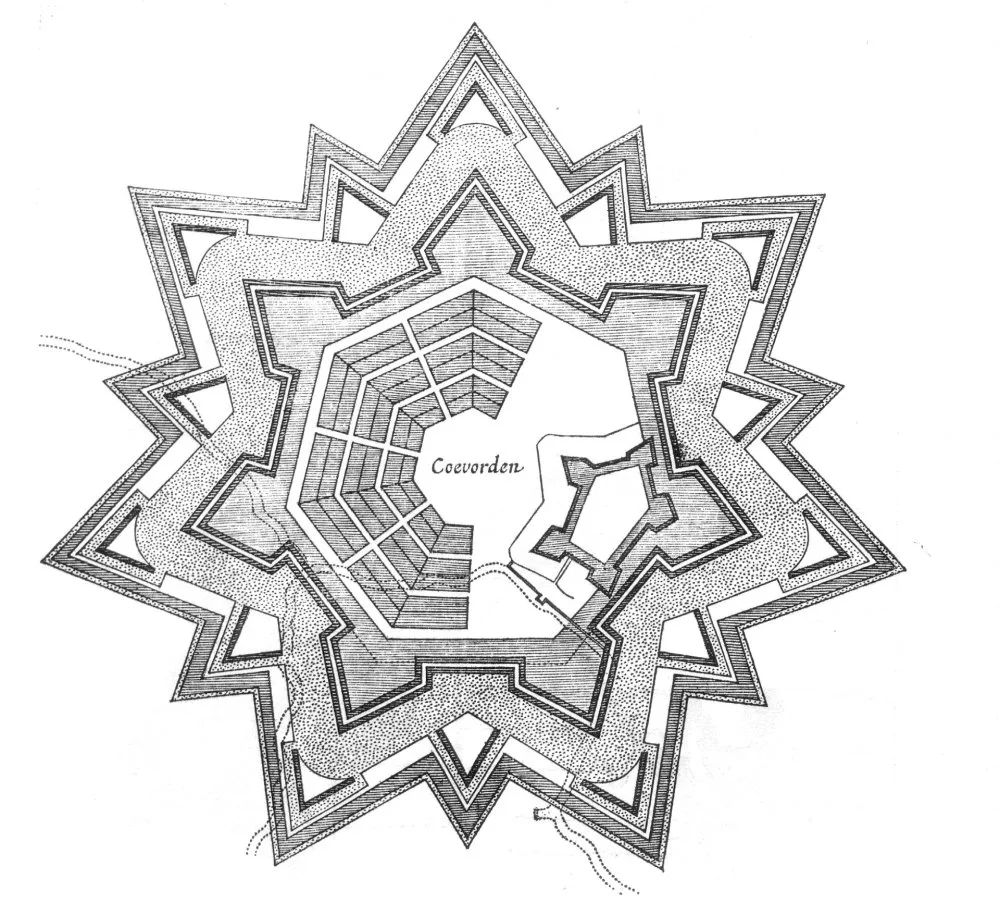
Geometry of the Trace Italienne
The trace italienne star fortress used low, thick earthen ramparts and angled bastions to eliminate blind spots and absorb cannon impacts.
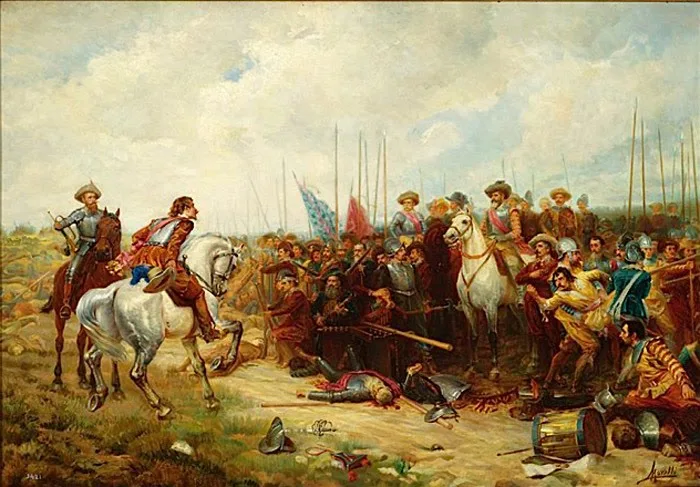
The Spanish Tercio Pike-and-Shot System
The Spanish Tercio combined a central square of pikemen with corner sleeves of arquebusiers to dominate European warfare for over a century.
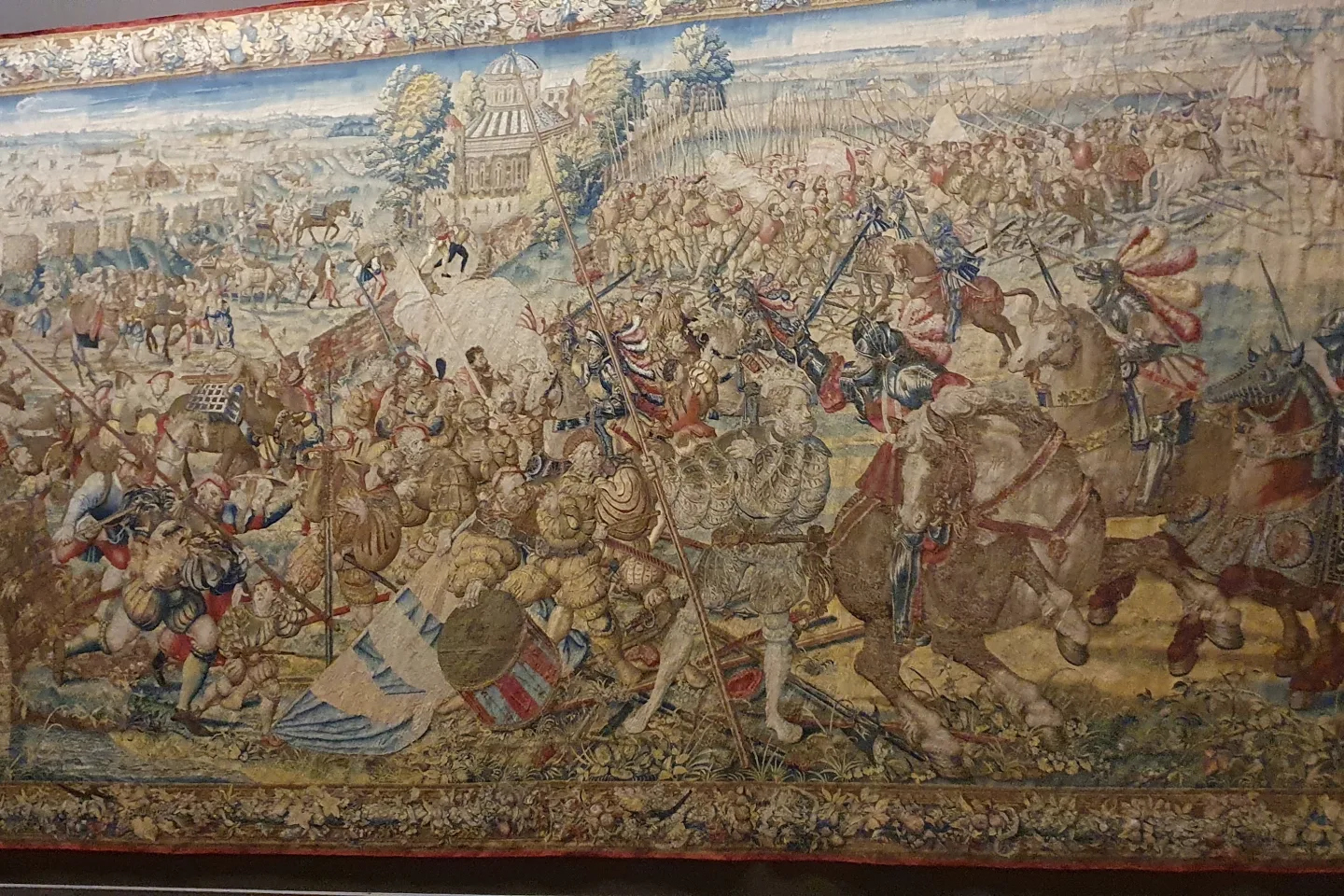
Arquebus Firepower at Pavia
At Pavia in 1525, Imperial-Spanish arquebusiers firing from sunken terrain wiped out French armored heavy gendarme cavalry.
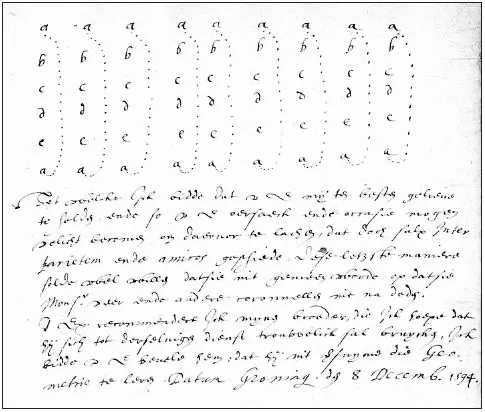
Maurice of Nassau's Countermarch Volley Drill
Maurice of Nassau revolutionized infantry tactics by introducing the ten-rank countermarch drill to maintain continuous rolling musket fire.
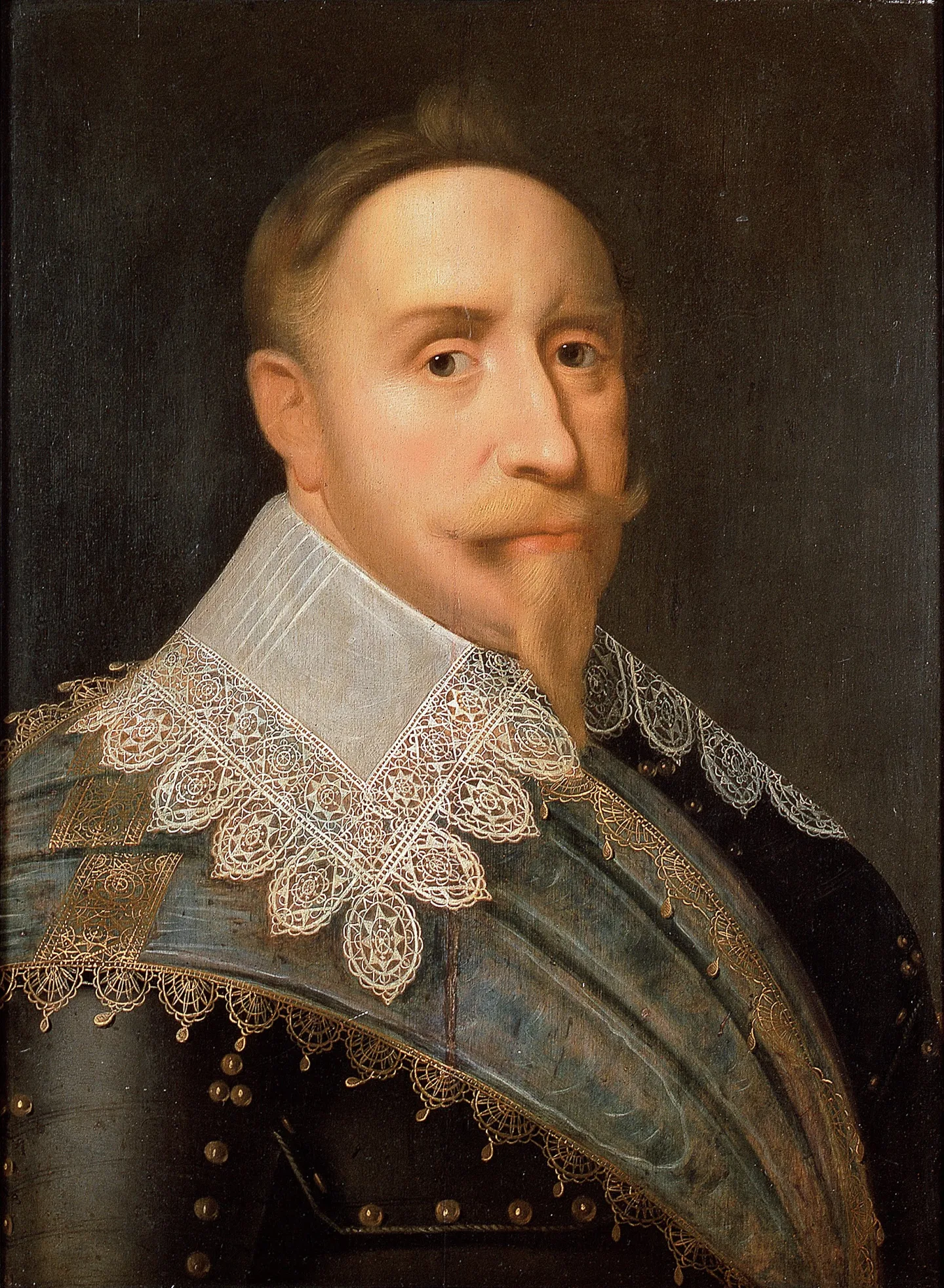
Gustavus Adolphus at Breitenfeld
At Breitenfeld in 1631, Gustavus Adolphus defeated Imperial tercios using linear musket salvos, mobile light artillery, and aggressive shock cavalry.
Oda Nobunaga's Volleys at Nagashino
At Nagashino in 1575, Oda Nobunaga used palisades and massed matchlock gunners — traditionally numbered at 3,000 firing in rotating ranks, though modern historians dispute this specific figure and technique — to help defeat the elite Takeda samurai cavalry.
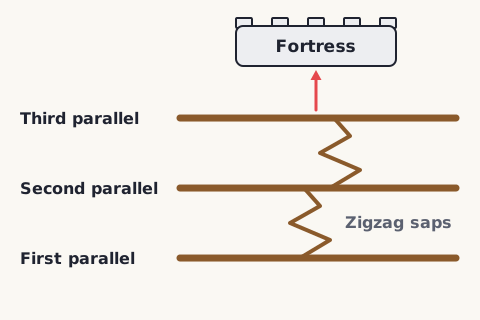
Vauban's Three Parallel Siege Trenches
Vauban standardized siege engineering into three progressive parallel trenches connected by zigzag saps to breach fortresses with minimal casualties.
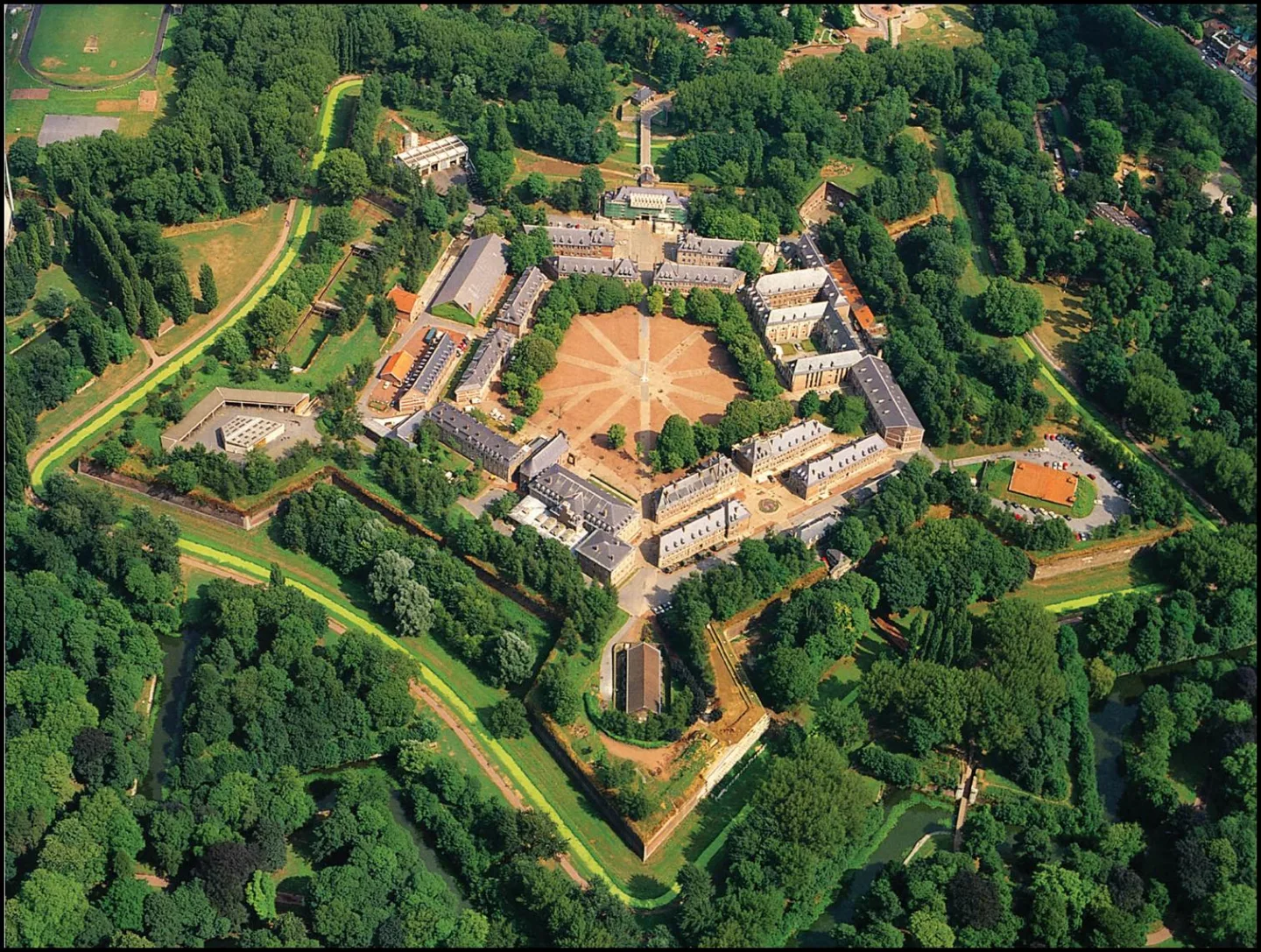
The French Pré Carré Fortress Frontier
Vauban engineered the Pré Carré double border line of synchronized star citadels to seal France's northeastern frontier against foreign invasion.
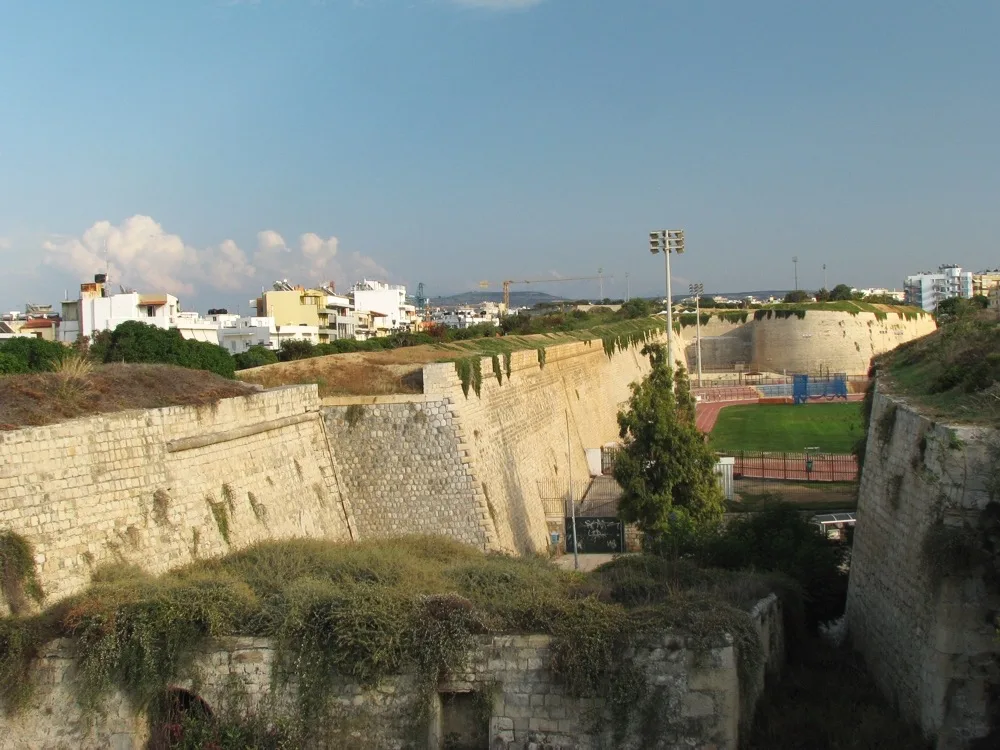
Subterranean Mining Siege at Candia
The 21-year Siege of Candia (1648–1669) in Crete is often cited as history's longest siege, defined by extensive underground gunpowder mining warfare.
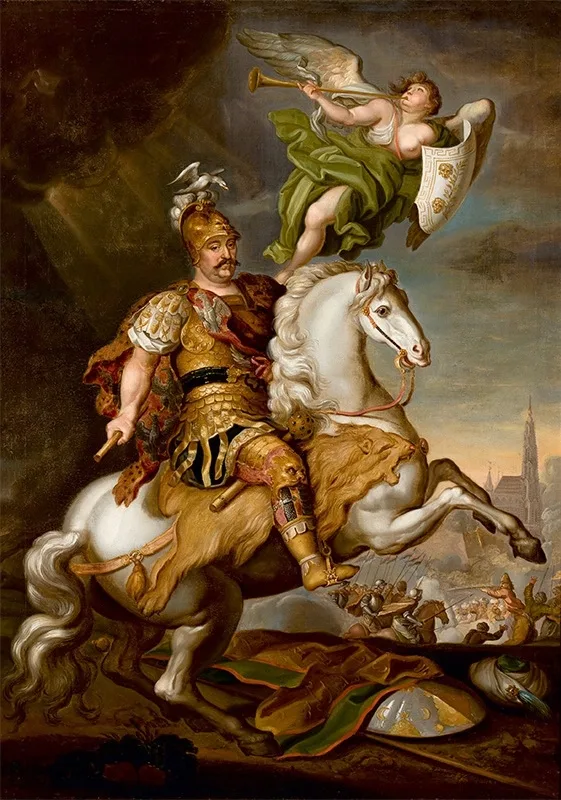
The Winged Hussar Charge at Vienna 1683
At Vienna in 1683, King John III Sobieski led what is widely described as history's largest recorded cavalry charge of roughly 18,000 horsemen to break the Ottoman siege.
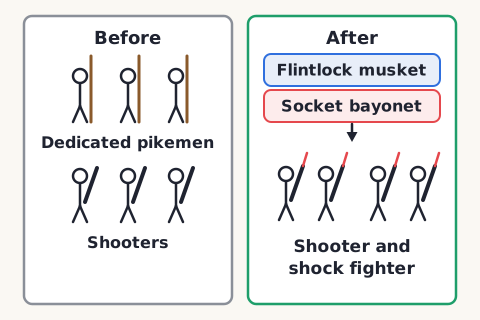
The Socket Bayonet and Flintlock Musket
The introduction of the socket bayonet and flintlock musket eliminated dedicated pikemen, turning every infantryman into a shooter and shock fighter.
By the numbers
- In what year AD did Spanish arquebusiers defeat the French royal army at the Battle of Pavia?
- 1525
- In what year AD did Gustavus Adolphus defeat the Catholic League at the Battle of Breitenfeld?
- 1631
- In what year AD did Oda Nobunaga deploy rotating matchlock volleys at the Battle of Nagashino?
- 1575
- In what year AD did King John III Sobieski lead the great cavalry charge at the Battle of Vienna?
- 1683
Matched pairs
Each item on the left goes with the one on the right.
- Central Pike Square
- Dense hedgehog of 18-foot pikes providing an impenetrable barrier against cavalry
- Ten-Rank Countermarch
- Front ranks fire and cycle through internal file alleys to the rear to reload
- First Parallel Trench
- Dug out of musket range parallel to fortress bastions to establish initial heavy artillery
- Locking Socket Bayonet
- Hollow cylindrical collar locking over the barrel exterior via a zigzag slot and stud
Self-test
Answer each question from memory, then check your work against the answer key.
1. How did Maurice of Nassau's tactical countermarch drill alter the physical mechanics of European infantry combat?
- AIt trained pikemen to interlock their pikes overhead into a solid roof against musket fire
- BIt required the front rank to kneel completely before firing so rear ranks could see past them
- CRotated infantry ranks to deliver continuous rolling musket volleys at close range
- DIt mandated that soldiers link arms in pairs to prevent individuals from breaking rank under fire
2. Which tactic allowed Oda Nobunaga's forces to break the Takeda cavalry charge at the Battle of Nagashino (1575)?
- AMassed lancer charge down from the heights
- BRotating matchlock volleys from behind wooden palisades
- CCountermarch drill cycling ranks to the rear to reload
- DEntrenched arquebusiers firing from sunken drainage ditches
3. What cavalry tactic did Gustavus Adolphus adopt at Breitenfeld in place of the caracole?
- AFiring pistols from the saddle while wheeling away
- BCharging with lances leveled at full gallop
- CDismounting to fight as pike-armed infantry
- DCharging with swords drawn after one pistol volley
4. Why was the flintlock musket vastly safer and more reliable than the earlier matchlock musket?
- AIt eliminated the smoldering open slow match, which was a constant fire hazard around stored gunpowder and became unreliable in wet weather
- BIt was cast from a single piece of tempered bronze that never jammed or fouled with carbon buildup
- CIt fired a heavier lead ball capable of punching through most infantry armor
- DIt used a corked powder flask soldiers carried strapped across the chest
5. In the Spanish Tercio, what was the term for the mobile arquebusier units stationed at the formation's four corners?
- APhalanxes
- BMangas
- CCohorts
- DManiples
6. What grand strategic principle underpinned Vauban's Pré Carré fortress line on France's northeastern frontier?
- AA single wall stretching from the coast to the Alps
- BRelying on mobile field armies instead of fixed forts
- CConcentrating all defense spending on one capital citadel
- DA double line of citadels guarding roads and waterways
7. Why did the 21-year Siege of Candia become a horrific war of subterranean attrition?
- AOttoman and Venetian sappers dug extensive networks of competing underground mine and counter-mine galleries beneath the bastions
- BVenetian defenders retreated into deep cellars and cisterns beneath the city to escape the constant bombardment
- COttoman engineers dug a single long tunnel beneath the harbor to smuggle assault troops into the city
- DVenetian engineers coated the bastion faces with wet clay to muffle the sound of enemy digging
8. Where was Vauban's 'Third Parallel' trench constructed during a formal siege?
- ADirectly inside the enemy town marketplace reached via underground tunnels
- BAcross the nearest river to divert drinking water supplies away from the citadel
- CAt the foot of the fortress glacis, within point-blank musket and grenade range of the ramparts
- DThree miles away from the fortress to protect the headquarters baggage camp with Third detachments
9. What was the function of Vauban's First Parallel trench in a siege?
- AAdvance via zigzag saps to bring batteries closer
- BDig at the glacis foot for breaching batteries and mines
- CDetonate underground mines beneath bastion foundations
- DEstablish artillery batteries out of direct musket range
10. Which military figure championed the socket bayonet's adoption into French army service, letting infantry fire and reload with the blade still attached?
- AGustav II Adolf, King of Sweden
- BSebastien Le Prestre de Vauban
- CMaurice of Nassau
- DJohn Churchill, Duke of Marlborough
11. What core principle guided Vauban's system of siege trenches against fortresses?
- AA naval-only blockade meant to starve out the garrison
- BA single massed mine under the main gate
- CThree parallels advancing instead of frontal assault
- DRepeated massed infantry assaults
12. What was the purpose of the zigzag saps in Vauban's second parallel?
- AAdvancing batteries out of a straight musket line
- BSheltering cavalry for a breaching charge
- CDraining floodwater from the first parallel
- DSignaling artillery ranges to the third line
Go deeper
Answer key
- 1. C Rotated infantry ranks to deliver continuous rolling musket volleys at close rangeMaurice broke weapon handling into standardized drills published in illustrated manuals, enabling disciplined, continuous volley firing.
- 2. B Rotating matchlock volleys from behind wooden palisadesNobunaga built palisades along the Rengo River and massed matchlock gunners there; tradition holds they numbered 3,000 firing in rotating ranks, though modern historians dispute this specific figure and technique, citing the primary Shinchō Kōki's account of roughly 1,000 guns.
- 3. D Charging with swords drawn after one pistol volleyGustavus banned the caracole's repeated pistol volleys, ordering Swedish cavalry to fire once at close range then charge home with swords drawn.
- 4. A It eliminated the smoldering open slow match, which was a constant fire hazard around stored gunpowder and became unreliable in wet weatherThe matchlock required a constantly burning open wick (slow match), a major hazard around powder and useless in rain; the flintlock struck flint against steel.
- 5. B MangasThe mangas ('sleeves') were arquebusier and musketeer units at the Tercio's corners, distinct from Roman maniples, cohorts, or Greek phalanxes.
- 6. D A double line of citadels guarding roads and waterwaysThe Pré Carré was a double line of star citadels (Lille, Neuf-Brisach, Dunkirk) controlling roads and waterways, forcing invaders into months of costly sieges.
- 7. A Ottoman and Venetian sappers dug extensive networks of competing underground mine and counter-mine galleries beneath the bastionsOver 21 years, Ottoman sappers and Venetian engineers dug extensive networks of competing mine and counter-mine galleries (accounts document over 70 Ottoman mines exploded), detonating gunpowder charges beneath Candia's bastion foundations.
- 8. C At the foot of the fortress glacis, within point-blank musket and grenade range of the rampartsThe Third Parallel was excavated right at the edge of the glacis, providing a trench platform for breaching batteries and assault troops.
- 9. D Establish artillery batteries out of direct musket rangeThe First Parallel was dug beyond musket range parallel to the fortress to set up initial batteries; saps, breaching, and mining came in later stages.
- 10. B Sebastien Le Prestre de VaubanVauban championed the socket bayonet's adoption into French army service, retaining firing capability with the blade attached and ending the need for dedicated pikemen; the bayonet's actual invention is usually credited to Scottish general Hugh Mackay after the 1689 Battle of Killiecrankie.
- 11. C Three parallels advancing instead of frontal assaultVauban rejected costly frontal assaults, advancing entrenchments in three parallels to bring batteries progressively closer to the walls.
- 12. A Advancing batteries out of a straight musket lineSaps zigzagged forward so defenders on the wall never had a straight shot down the trench, letting batteries advance safely.
Sources
- Parker, The Military Revolution
- Parker, The Army of Flanders
- Oman, A History of the Art of War
- Roberts, Gustavus Adolphus
- Turnbull, Nagashino 1575
- Vauban, Attacks on Fortified Places
- Ostwald, Vauban Under Siege
- Setton, Venice and the Turks
- Millar, Vienna 1683
- Parker, The Military Revolution; Parker, The Army of Flanders — www.cambridge.org
- Roberts, Gustavus Adolphus — www.jstor.org
- Ostwald, Vauban Under Siege — www.brill.com
- Vauban, Attacks on Fortified Places; Oman, A History of the Art of War — www.oxfordreference.com
- Millar, Vienna 1683; Turnbull, Nagashino 1575 — www.ospreypublishing.com
- Parker, The Military Revolution — archive.org/details/militaryrevoluti0000park
- Setton, Venice, Austria, and the Turks in the Seventeenth Century — en.wikipedia.org/wiki/Siege_of_Candia
- Roberts, Gustavus Adolphus — en.wikipedia.org/wiki/Caracole
Image credits
- Geometry of the Trace Italienne: Markus Schweiss · Public domain — en.wikipedia.org/wiki/List_of_bastion_forts
- The Spanish Tercio Pike-and-Shot System: Víctor Morelli Sánchez-Gil · Public domain — commons.wikimedia.org/wiki/File:Painting_-_The_Battle_of_Rocroi_by_Morelli_y_Sanchez_Gil_(1912).jpg
- Arquebus Firepower at Pavia: Yair Haklai (Openverse) · by-sa 4.0 — commons.wikimedia.org/wiki/File:Battle_of_Pavia_tapestries-5.jpg
- Maurice of Nassau's Countermarch Volley Drill: Yprpyqp (Openverse) · by-sa 4.0 — commons.wikimedia.org/wiki/File:1594_Dutch_musketry_volley_technique.jpg
- Gustavus Adolphus at Breitenfeld: Wikimedia Commons · Presumably Jacob Hoefnagel · Public domain — commons.wikimedia.org/wiki/File:Attributed_to_Jacob_Hoefnagel_-_Gustavus_Adolphus,_King_of_Sweden_1611-1632_-_Google_Art_Project.jpg
- Vauban's Three Parallel Siege Trenches: FlashFeed original diagram · CC-BY-4.0
- The French Pré Carré Fortress Frontier: Wikimedia Commons · Piocrr · CC BY-SA 3.0 — commons.wikimedia.org/wiki/File:Citadelle_vue_du_ciel.jpg
- Subterranean Mining Siege at Candia: Robin & Bazylek from Krak�w, Poland (Openverse) · by 2.0 — commons.wikimedia.org/wiki/File:Walls_of_Heraklion2-bazylek.jpg
- The Winged Hussar Charge at Vienna 1683: Wikimedia Commons · Jerzy Siemiginowski-Eleuter · Public domain — commons.wikimedia.org/wiki/File:Siemiginowski_Sobieski_at_the_Battle_of_Vienna.jpg
- The Socket Bayonet and Flintlock Musket: FlashFeed original diagram · CC-BY-4.0


